
Modelling Mechanical Properties of Topical Films Containing Ganoderma applanatum using the Design of Experiments
DOI:
https://doi.org/10.48048/tis.2023.6485Keywords:
Preparation, Mechanical properties, Ganoderma applanatum, Topical filmsAbstract
With the guidance of Design-Expert® software version 11, the mechanical properties of topical films containing Ganoderma applanatum (G. applanatum) extracts were investigated. While ethyl cellulose (EC), G. applanatum extracts, and triethyl citrate (TEC) were independent factors, ultimate tensile strength (UTS), elongation at break, and folding endurance were dependent variables. The best relationships between UTS, elongation at break, and folding endurance could be predicted more accurately using quadratic, 2FI, and linear models, respectively. The ratio of EC, G. applanatum extracts, and TEC was predicted by the Design of Experiments (DoE) to be 2.6: 2.8: 2.8. The model’s suitability for predicting outcomes inside the design space without necessitating extra trials was established by proving that the ratio’s value of prediction was more than 4. The experimental values of UTS, elongation at break, and folding endurance were 82.15±7.42 MPa, 87.40±15.56 %, and 79±6 folds, respectively. The percent errors of prediction were 12.27, 15.49, and 11.82 %, respectively. The Design-Expert® software’s DoE effectively demonstrated a low percent error of the prediction of less than 20 %. This was suitable and acceptable for developing film formulation in drug delivery systems.
HIGHLIGHTS
- The formulations of topical films containing applanatum extract were optimized, and they were improved
- EC and TEC were used as polymer matrix and plasticizer, respectively
- The best relationships between UTS, elongation at break, and folding endurance could be predicted more accurately using quadratic, 2FI, and linear models, respectively
- UTS, elongation at break, and folding endurance experimental values were 82.15±7.42 MPa, 87.40±15.56 %, and 79±6 folds
- Less than 20 % was effectively proven which was enough and acceptable
GRAPHICAL ABSTRACT 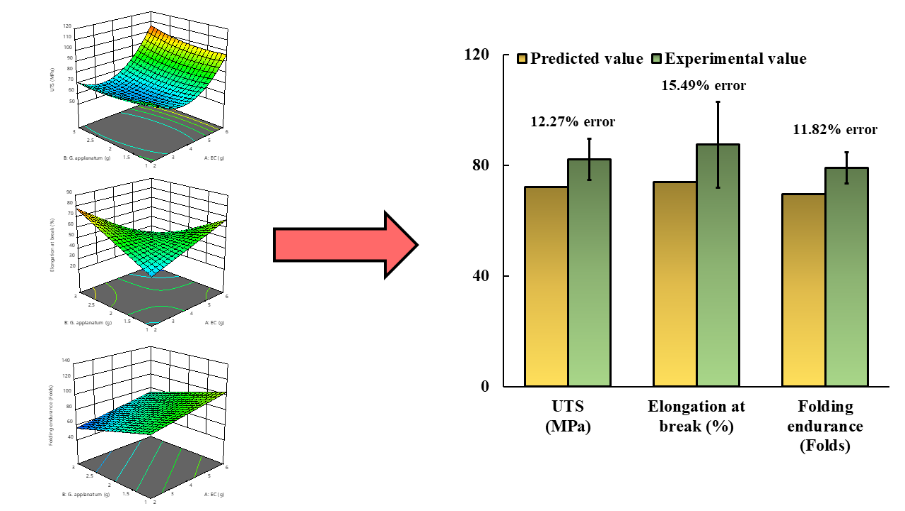
Downloads
References
M Kozarski, A Klaus, M Nikšić, MM Vrvić, N Todorović, D Jakovljević and LJLD Van Griensven. Antioxidative activities and chemical characterization of polysaccharide extracts from the widely used mushrooms Ganoderma applanatum, Ganoderma lucidum, Lentinus edodes and Trametes versicolor. J. Food Compos. Anal. 2012; 26, 144-153.
S Jogaiah, M Kurjogi, M Abdelrahman, N Hanumanthappa and L-SP Tran. Ganoderma applanatum-mediated green synthesis of silver nanoparticles: Structural characterization, and in vitro and in vivo biomedical and agrochemical properties. Arab. J. Chem. 2019; 12, 1108-20.
YT Jeong, BK Yang, SC Jeong, SM Kim and CH Song. Ganoderma applanatum: A promising mushroom for antitumor and immunomodulating activity. Phytother. Res. 2008; 22, 614-9.
X Sun, C Zhao, W Pan, J Wang and W Wang. Carboxylate groups play a major role in antitumor activity of Ganoderma applanatum polysaccharide. Carbohydr. Polym. 2015; 123, 283-7.
WA Elkhateeb, GM Zaghlol, IM El-Garawani, EF Ahmed, ME Rateb and AE Abdel Moneim. Ganoderma applanatum secondary metabolites induced apoptosis through different pathways: In vivo and in vitro anticancer studies. Biomed. Pharmacother. 2018; 101, 264-77.
O Tsivileva, A Pankratov, V Misin, A Zavyalov, V Volkov, O Tsymbal, N Yurasov and VE Nikitina. Antioxidant properties of the artist's conk medicinal mushroom, Ganoderma applanatum (Agaricomycetes), upon cultivation with para-substituted phenolic compounds and tea leaf extracts. Int. J. Med. Mushrooms 2018; 20, 549-60.
W Elkhateeb, G Daba, A El-Dein, D Sheir, W Fayad, M Shaheen, E Elmahdy and T-C Wen. Insights into the in-vitro hypocholesterolemic, antioxidant, antirotavirus, and anticolon cancer activities of the methanolic extracts of a Japanese lichen, Candelariella vitellina, and a Japanese mushroom, Ganoderma applanatum. Egypt. Pharmaceut. J. 2020; 19, 67-73.
S Mohammadifar, S Fallahi Gharaghoz, MR Asef Shayan and A Vaziri. Comparison between antioxidant activity and bioactive compounds of Ganoderma applanatum (Pers.) Pat. and Ganoderma lucidum (Curt.) P. Karst from Iran. Iran. J. Plant Physiol. 2020; 11, 3417-24.
LM Cheung, PCK Cheung and VEC Ooi. Antioxidant activity and total phenolics of edible mushroom extracts. Food Chem. 2003; 81, 249-55.
DA Williamson, GP Carter and BP Howden. Current and Emerging Topical Antibacterials and Antiseptics: Agents, Action, and Resistance Patterns. Clin. Microbiol. Rev. 2017; 30, 827-60.
TJ Coderre. Topical drug therapeutics for neuropathic pain. Expert. Opin. Pharmacother. 2018; 19, 1211-20.
SC Yeoh and CF Goh. Topical delivery of salicylates. Drug Deliv. and Transl. Res. 2022; 12, 981-1001.
RK Thapa, KG Grønlien and HH Tønnesen. Protein-based systems for topical antibacterial therapy. Front. Med. Tech. 2021; 3, 1-14.
SN Politis, P Colombo, G Colombo and DM Rekkas. Design of experiments (DoE) in pharmaceutical development. Drug Dev. Ind. Pharm. 2017; 43, 889-901.
IM Fukuda, CFF Pinto, CdS Moreira, AM Saviano and FR Lourenço. Design of experiments (DoE) applied to pharmaceutical and analytical quality by design (QbD). Braz. J. Pharm. Sci. 2018; 54, 1-16.
S Dandapat, M Kumar, R Ranjan and MP Sinha. Ganoderma applanatum extract mediated synthesis of silver nanoparticles. Braz. J. Pharm. Sci. 2022; 58, e19173.
Y Sampaopan and J Suksaeree. Formulation development and pharmaceutical evaluation of Lysiphyllum strychnifolium topical patches for their anti-inflammatory potential. AAPS PharmSciTech 2022; 23, 116.
Y Sampaopan and J Suksaeree. Effect of Eudragit® NE 40D on the properties of pectin film-based polymer blends. J. Polym. Environ. 2021; 29, 2881-7.
C Monton, Y Sampaopan, W Pichayakorn, K Panrat and J Suksaeree. Herbal transdermal patches made from optimized polyvinyl alcohol blended film: Herbal extraction process, film properties, and in vitro study. J. Drug Deliv. Sci. Tech. 2022; 69, 103170.
W Pichayakorn, C Monton, Y Sampaopan, K Panrat and J Suksaeree. Fabrication and characterization of buccal film loaded self-emulsifying drug delivery system containing Lysiphyllum strychnifolium stem extracts. AAPS PharmSciTech 2022; 23, 194.
R Gottipati and S Mishra. Process optimization of adsorption of Cr(VI) on activated carbons prepared from plant precursors by a two-level full factorial design. Chem. Eng. J. 2010; 160, 99-107.
J Suksaeree. Mechanical properties of herbal patches from chitosan-based polymer blends for medical applications. Mater. Sci. Forum 2018; 917, 52-6.
L Huo, Y Wei, H Zhang, Y Wang, B Deng, Y Wang and L Jin. Preparation and properties of triethyl citrate plasticized chitosan-based membranes for efficient release of curcumin. J. Appl. Polym. Sci. 2022; 139, 51908.
SANA Zuber, A Rusli and H Ismail. Effectiveness of triacetin and triethyl citrate as plasticizer in polyvinyl alcohol. Mater. Today: Proc. 2019; 17, 560-7.
S Costa, M Barroso, A Castañera and M Dias. Design of experiments, a powerful tool for method development in forensic toxicology: application to the optimization of urinary morphine 3-glucuronide acid hydrolysis. Anal. Bioanal. Chem. 2010; 396, 2533-42.

Downloads
Published
How to Cite
Issue
Section
License
Copyright (c) 2023 Walailak University

This work is licensed under a Creative Commons Attribution-NonCommercial-NoDerivatives 4.0 International License.





