
Application of Microwave-Assisted Drying to Shorten Granules Drying Process for the Preparation of Thunbergia laurifolia Lindl. Leaf Tablets
DOI:
https://doi.org/10.48048/tis.2023.4993Keywords:
actorial design, Moisture content, Optimization, Rosmarinic acid, Wet granulationAbstract
Thunbergia laurifolia Lindl. is a medicinal plant that belongs to the family of Acanthaceae. It possesses several biological and pharmacological activities. According to the Thai National List of Essential Medicines, T. laurifolia leaves are used for the treatment of fever. This work sought to optimize microwave-assisted drying of Thunbergia laurifolia Lindl. leaf granules to shorten the granule drying process by the 32 full factorial design. Power was varied from 300, 450 and 600 W for 5, 10 and 15 min, to minimize moisture content and maximize rosmarinic acid content. Results showed that the optimal microwave-assisted drying condition within the design space and control space was the power of 450 W for 13 min. This condition gave the moisture content of 4.77 ± 0.24 % and rosmarinic acid content of 0.0566 ± 0.0075 %. The HPLC method was validated; it showed good linearity, specificity, precision, and accuracy. Furthermore, the system suitability was achieved. The T. laurifolia leaf granules obtained from the optimal microwave-assisted drying condition were further used to prepare T. laurifolia leaf tablets by the wet granulation method. Three batches of 650 mg tablets containing 250 mg of T. laurifolia leaf powder were prepared using different compression forces: 500, 1,000 and 1,500 psi. The suitable compression force was 1,500 psi; the tablet formulation had suitable hardness (9.88 ± 0.52 kP), low friability (0.20 %), and a short disintegration time (23.17 ± 0.76 s). Rosmarinic acid marker was dissolved from the tablets for approximately 75 % within 4 h when 0.5 % sodium lauryl sulfate aqueous solution was used as dissolution medium. In conclusion, microwave-assisted drying could be applied in preparing T. laurifolia leaf tablets by shortening the granules drying time.
HIGHLIGHTS
- The 32 full factorial design was applied to optimize microwave-assisted drying of Thunbergia laurifolia leaf granules
- The optimal microwave-assisted drying condition providing the low moisture content with high rosmarinic acid content was the power of 450 W for 13 min
- The tablets prepared from laurifolia leaf granules had suitable hardness, low friability, short disintegration time, and a high percentage of rosmarinic acid marker dissolved
GRAPHICAL ABSTRACT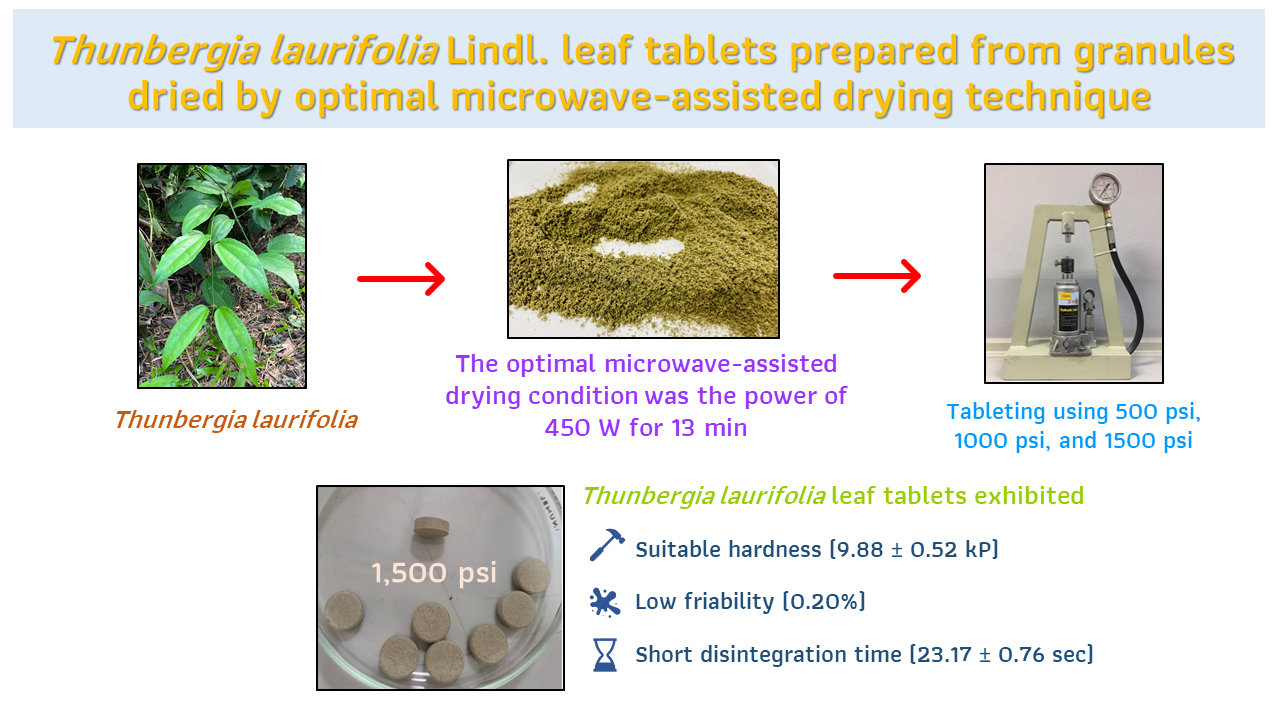
Downloads
References
EWC Chan, SY Eng, YP Tan and ZC Wong. Phytochemistry and pharmacological properties of Thunbergia laurifolia: A review. Pharmacognosy J. 2011; 3, 1-6.
M Junsi and S Siripongvutikorn. Thunbergia laurifolia, a traditional herbal tea of Thailand: Botanical, chemical composition, biological properties and processing influence. Int. Food Res. J. 2016; 23, 923-7.
P Suwanchaikasem, C Chaichantipyuth and S Sukrong. Antioxidant-guided isolation of rosmarinic acid, a major constituent from Thunbergia laurifolia, and its use as a bioactive marker for standardization. Chiang Mai J. Sci. 2014; 41, 117-27.
Ministry of Public Health of Thailand, Thailand National List of Essential Medicines, Available at: http://ndi.fda.moph.go.th/ndi_news_detail/index/220, accessed January 2022.
P Hongsing, C Palanuvej and N Ruangrungsi. In vitro biological activities of Thunbergia laurifolia stem and leaf with reference to rosmarinic acid. Songklanakarin J. Sci. Technol. 2020; 42, 615-20.
KG Pitt. Tablet formulation. In: GD Tovey (Ed.). Pharmaceutical formulation: The science and technology of dosage forms. Royal Society of Chemistry, Cambridge, 2018, p. 78-104.
SN Chee, AL Johansen, L Gu, J Karlsen and PWS Heng. Microwave drying of granules containing a moisture-sensitive drug: A promising alternative to fluid bed and hot air oven drying. Chem. Pharmaceut. Bull. 2005; 53, 770-5.
N Kutlu. Optimization of ohmic heating-assisted osmotic dehydration as a pretreatment for microwave drying of quince. Food Sci. Technol. Int. 2021; 28, 60-71.
ZH Loh, CV Liew, CC Lee and PWS Heng. Microwave-assisted drying of pharmaceutical granules and its impact on drug stability. Int. J. Pharmaceut. 2008; 359, 53-62.
H Sandip, B Babasaheb, K Preeti and S Akshay. Effect of microwave drying in improving granule characteristics of tablets. Int. J. Res. Pharmaceut. Chem. 2012; 2, 22-6.
A Patra, S Abdullah and RC Pradhan. Microwave-assisted extraction of bioactive compounds from cashew apple (Anacardium occidenatale L.) bagasse: Modeling and optimization of the process using response surface methodology. J. Food Meas. Characterization 2021; 15, 4781-793.
S Sano, Y Iwao, S Kimura, S Noguchi and S Itai. Impact of active ingredients on the swelling properties of orally disintegrating tablets prepared by microwave treatment. Int. J. Pharmaceut. 2014; 468, 234-42.
KV Kande, DJ Kotak, MS Degani, D Kirsanov, A Legin and PV Devarajan. Microwave-assisted development of orally disintegrating tablets by direct compression. AAPS PharmSciTech 2017; 18, 2055-66.
S Tian, C Hao, G Xu, J Yang and R Sun. Optimization conditions for extracting polysaccharide from Angelica sinensis and its antioxidant activities. J. Food Drug Anal. 2017; 25, 766-75.
S Yang, L Jin, X Ren, J Lu and Q Meng. Optimization of fermentation process of Cordyceps militaris and antitumor activities of polysaccharides in vitro. J. Food Drug Anal. 2014; 22, 468-76.
C Monton, P Kittiratpattana, S Nakyai, T Sutapakul, A Navabhatra, T Wunnakup, N Chankana and J Suksaeree. Microwave-assisted extraction of Clausena anisata leaves and Vernonia cinerea whole plants to maximize nitrate content: Optimization approach, antioxidant activity, and cytotoxicity. Adv. Tradit. Med. 2021; 22, 697-711.
P Jaisamut, S Wanna, A Thanakoon, S Saejew, N Saowapark, W Suchato, P Chumvong, T Kosawiwat, P Momaklua and S Chusri. Evaluation of microwave-assisted extraction method for preparation and assessment of Thai herbal medicine oral tablets with enriched phytochemical compounds. AAPS PharmSciTech 2021; 22, 167.
ML Soran, M Stan, Ü Niinemets and L Copolovici. Influence of microwave frequency electromagnetic radiation on terpene emission and content in aromatic plants. J. Plant Physiol. 2014; 171, 1436-43.
ICH Expert Working Group, ICH Harmonised Tripartite Guideline - Validation of analytical procedures: Text and methodology Q2(R1), Available at: https://database.ich.org/sites/default/ files/Q2%28R1%29%20Guideline.pdf, accessed January 2022.
Center for Drug Evaluation and Research, Reviewer guidance - Validation of chromatographic methods, Available at: https://www.fda.gov/media/75643/download, accessed January 2022.
L Wiset, N Poomsa-ad and W Onsaard. Drying characteristics and quality evaluation in microwave-assisted hot air drying of cherry tomato. Eng. Appl. Sci. Res. 2021; 48, 724-31.
K Kathirvel, K Ramachandra Naik, Y Gariepy, V Orsat and GSV Raghavan. Microwave drying - a promising alternative for the herb processing industry. In: Proceedings of the written for presentation at the CSBE/SCGAB 2006 Annual Conference Edmonton Alberta, Canada. 2006.
C Monton, C Luprasong and L Charoenchai. Acceleration of turmeric drying using convection and microwave-assisted drying technique: An optimization approach. J. Food Process. Preservat. 2019; 43, e14096.
B Mahieddine, B Amina, S M Faouzi, B Sana and D Wided. Effects of microwave heating on the antioxidant activities of tomato (Solanum lycopersicum). Ann. Agr. Sci. 2018; 63, 135-9.
C Monton, C Luprasong and L Charoenchai. Convection combined microwave drying affect quality of volatile oil compositions and quantity of curcuminoids of turmeric raw material. Rev. Bras. Farmacognosia 2019; 29, 434-40.
RS Fletcher, T Slimmon, CY McAuley and LS Kott. Heat stress reduces the accumulation of rosmarinic acid and the total antioxidant capacity in spearmint (Mentha spicata L). J. Sci. Food Agr. 2005; 85, 2429-36.
GA Akowuah and I Zhari. Effect of extraction temperature on stability of major polyphenols and antioxidant activity of Orthosiphon stamineus leaf. J. Herbs Spices Med. Plants 2010; 16, 160-6.
S Abdullah, AR Shaari, IH Rukunudin and MS Ahmad. Effect of drying temperature on rosmarinic acid and sinensetin concentration in Orthosiphon stamineus herbal leaves. IOP Conf. Ser. Mater. Sci. Eng. 2018; 318, 012074.
P Rattanadecho and N Makul. Microwave-assisted drying: A review of the state-of-the-art. Drying Technol. 2016; 34, 1-38.
F Osei-Yeboah and CC Sun. Validation and applications of an expedited tablet friability method. Int. J. Pharmaceut. 2015; 484, 146-55.
D Markl and JA Zeitler. A review of disintegration mechanisms and measurement techniques. Pharmaceut. Res. 2017; 34, 890-917.

Downloads
Published
How to Cite
Issue
Section
License
Copyright (c) 2022 Walailak University

This work is licensed under a Creative Commons Attribution-NonCommercial-NoDerivatives 4.0 International License.





