
Callistemon viminalis Leaf Extract Mediated Biosynthesis of Ag, rGO-Ag-ZnO Nanomaterials for Catalytic PEM Fuel Cell Application
DOI:
https://doi.org/10.48048/tis.2022.493Keywords:
Callistemon viminalis leaf, Metal Nanoparticles, Hydrogen conversion, Power Density, Green EnergyAbstract
Cost-effective manufacture of hydrogen proton exchange membrane fuel cells (PEM-fuel cells) is of much interest to concerned researchers. Platinum metal has already shown good performance in the PEM fuel cell, yet its high cost means that it is not affordable to all nations. This paper identifies ways to reduce the cost by replacing platinum-based PEM fuel cells with synthesised eco-friendly silver (Ag) nanoparticles and reducing graphene oxide coated silver composited zinc oxide (rGO/Ag-ZnO) nanomaterials. Ag nanoparticles and reduced graphene oxide coated silver composited zinc oxide nanomaterials were synthesised using Callistemon viminalis leaf extract. PEM fuel cell modification was achieved using newly biosynthesised nanomaterials, while power density was compared with commercial platinum metal-based PEM fuel cells. The present study shows that modified PEM fuel cells can replace commercial platinum-based PEM fuel cells for cost-effective hydrogen proton exchange membrane fuel cells.
HIGHLIGHTS
- Reduced graphene oxide coated Ag-ZnO nanomaterials formed by Callistemon viminalis, low-cost PEM fuel cell which uses rGO-Ag-ZnO nanoparticle.
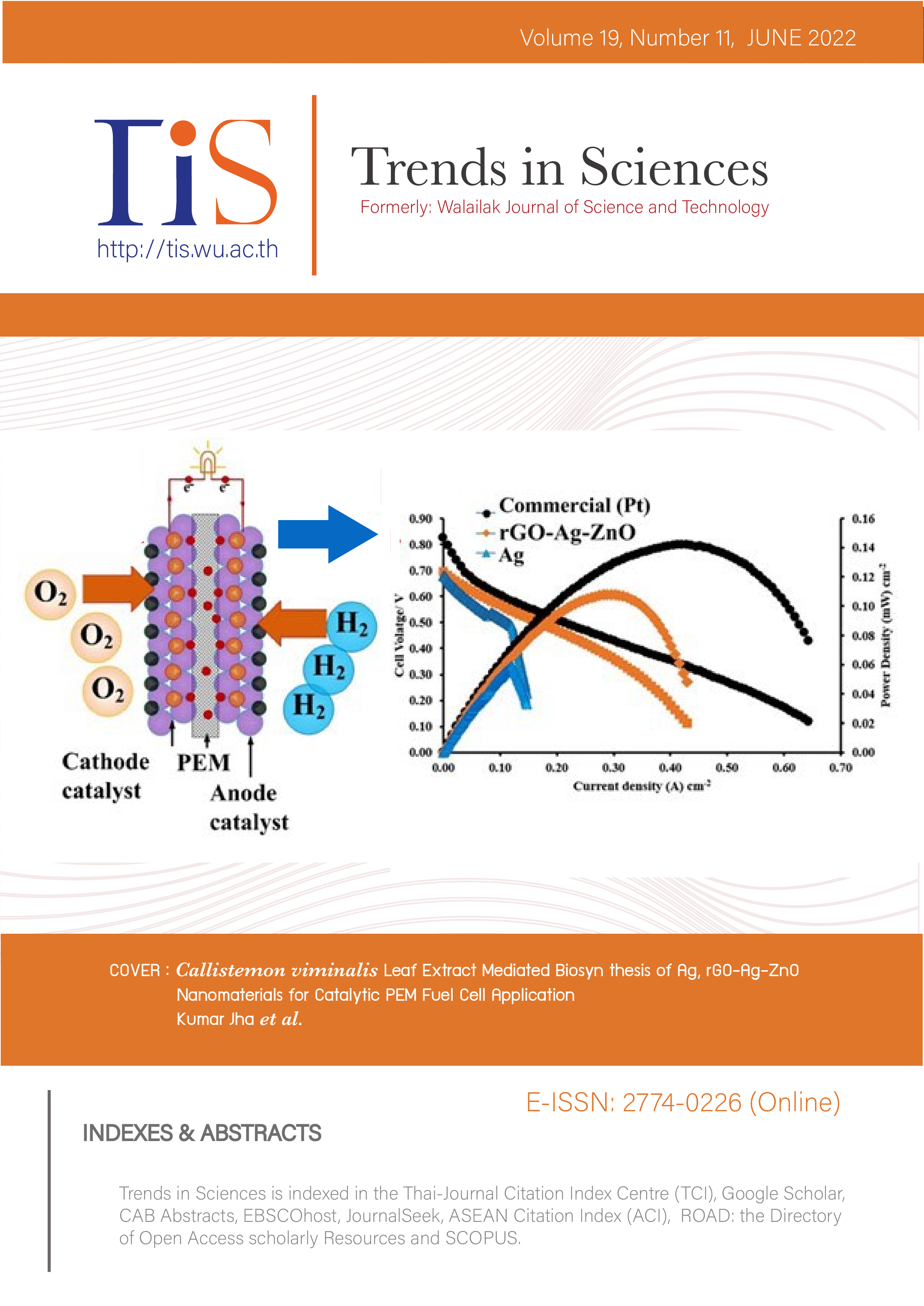
GRAPHICAL ABSTRACT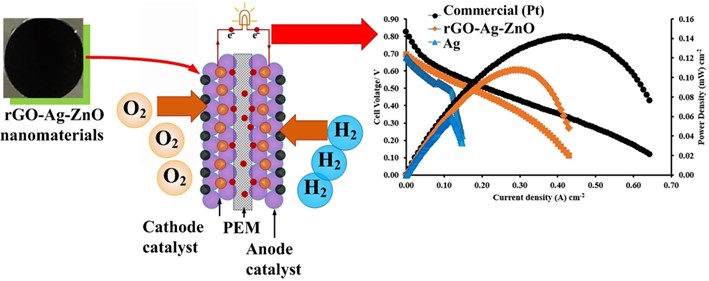
Downloads
References
NS Chaudhari, AP Bhirud, RS Sonawane, LK Nikam, SS Warule, VH Rane and BB Kale. Ecofriendly hydrogen production from abundant hydrogen sulfide using solar light-driven hierarchical nanostructured ZnIn2S4 photocatalyst. Green Chem. 2011; 13, 2500-6.
K Christmann, K Friedrich and N Zamel. Activation mechanisms in the catalyst coated membrane of PEM fuel cells. Prog. Energ. Combust. Sci. 2021; 85, 100924.
R Hanke-Rauschenbach, B Bensmann and P Millet. Hydrogen production using high-pressure electrolyzers. In: V Subramani, A Basile and TN Veziroğlu (Eds.). Compendium of hydrogen energy. Woodhead Publishing, Oxford, 2015, p. 179-224.
J Joy, J Mathew and SC George. Nanomaterials for photoelectrochemical water splitting: Review. Int. J. Hydrog. Energ. 2018; 43, 4804-17.
K Jyoti, M Baunthiyal and A Singh. Characterization of silver nanoparticles synthesized using Urtica dioica Linn. leaves and their synergistic effects with antibiotics. J. Radiat. Res. Appl. Sci. 2016; 9, 217-27.
N Kilinc-Ata. Trends in the market growth for Proton Exchange Membrane Fuel Cell (PEMFC): A review of the literature and market dynamics. Eur. J. Econ. Finance Adm. Sci. 2007; 8, 69-92.
X Liu, X Li, X Liu, S He, J Jin and H Meng. Green preparation of Ag-ZnO-rGO nanoparticles for efficient adsorption and photodegradation activity. Colloids Surf. A: Physicochem. Eng. Asp. 2020; 584, 124011.
K Maeda and K Domen. Photocatalytic water splitting: Recent progress and future challenges. J. Phys. Chem. Lett. 2010; 1, 2655-61.
F Marques. Grand challenges in fuel cells: Materials issues at all length scales. Front. Energ. Res. 2013; 1, 5.
S Menon, H Agarwal, SR Kumar and SV Kumar. Green synthesis of silver nanoparticles using medicinal plant Acalypha indica leaf extracts and its application as an antioxidant and antimicrobial agent against foodborne pathogens. Int. J. Appl. Pharm. 2017; 9, 42-50.
YK Mohanta, SK Panda, AK Bastia and TK Mohanta. Biosynthesis of silver nanoparticles from Protium serratum and investigation of their potential impacts on food safety and control. Front. Microbiol. 2017; 8, 626.
PS Narayan, NL Teradal, S Jaldappagari and AK Satpati. Eco-friendly reduced graphene oxide for the determination of mycophenolate mofetil in pharmaceutical formulations. J. Pharm. Anal. 2018; 8, 131-7.
P Nikolaidis and A Poullikkas. A comparative overview of hydrogen production processes. Renew. Sust. Energ. Rev. 2017; 67, 597-611.
H Saleem, M Haneef and HY Abbasi. Synthesis route of reduced graphene oxide via thermal reduction of chemically exfoliated graphene oxide. Mater. Chem. Phys. 2017; 204, 1-7.
C Sealy. The problem with platinum. Mater. Today 2008; 11, 65-8.
A Shafaghat. Synthesis and characterization of silver nanoparticles by phytosynthesis method and their biological activity. Synth. React. Inorg. Metal-Org. Nano-Met. Chem. 2014; 45, 381-7.
N Singh, R Nyuur and B Richmond. Renewable energy development as a driver of economic growth: Evidence from multivariate panel data analysis. Sustainability 2019; 11, 2418.
T Taner. Alternative energy of the future: A technical note of PEM fuel cell water management. J. Fundam. Renew. Energ. Appl. 2015; 5, 163.
S Wi, H Woo, S Lee, J Kang, J Kim, S An, C Kim, S Nam, C Kim and B Park. Reduced graphene oxide/carbon double-coated 3-D porous ZnO aggregates as high-performance Li-ion anode materials. Nanoscale Res. Lett. 2015; 10, 204.
L Xin, Z Zhang, Z Wang, J Qi and W Li. Carbon supported Ag nanoparticles as high performance cathode catalyst for H2/O2 anion exchange membrane fuel cell. Front. Chem. 2013; 1, 16.
XH Yau, FW Low, CS Khe, CW Lai, SK Tiong and N Amin. An investigation of the stirring duration effect on synthesized graphene oxide for dye-sensitized solar cells. PloS One 2020; 15, e0228322.
QW Zhang, LG Lin and WC Ye. Techniques for extraction and isolation of natural products: A comprehensive review. Chin. Med. 2018; 13, 20.
PR Kumar, PL Suryawanshi, SP Gumfekar, BA Bhanvase and S Sonawane. Sonochemical synthesis of Pt-Co/C electrocatalyst for PEM fuel cell applications. Surf. Interfaces 2018; 12, 116-23.
AJ Hung, CC Yu, YH Chen and LY Sung. Cost analysis of proton exchange membrane fuel cell systems. AIChE J. 2008; 54, 1798-810.
Downloads
Published
How to Cite
Issue
Section
License
Copyright (c) 2022 Walailak University

This work is licensed under a Creative Commons Attribution-NonCommercial-NoDerivatives 4.0 International License.





