
Green Synthesis of Few-Layer Graphene for Supercapacitor Applications via Mechanical Exfoliation using A High-Speed Kitchen Blender
DOI:
https://doi.org/10.48048/tis.2026.10895Keywords:
Green synthesis, Single step, Mechanical exfoliation, Supercapacitor, Few-layer graphene, Shear exfoliation, Pluronic F-127 surfactantAbstract
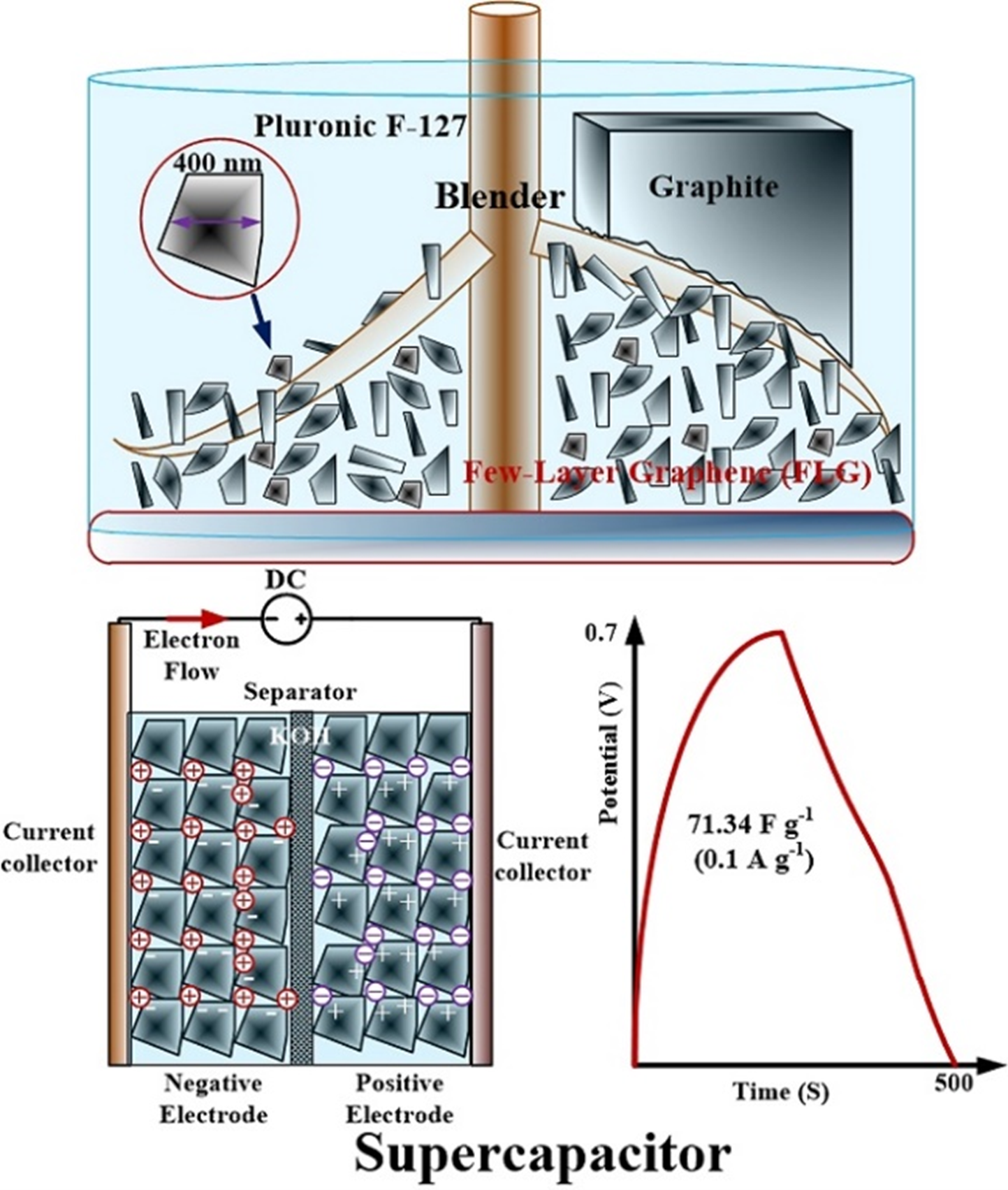
Supercapacitors (SCs) have the potential to be reliable energy storage devices. They offer high-power, a long life cycle, and excellent reliability, making them ideal for consumer electronics. Numerous studies have focused on developing carbon-based materials with a high specific surface area and electronic and ionic conductivity that leads to the provision of high specific capacitance. Few-layer graphene (FLG) has garnered significant attention due to its exceptional electrical, mechanical, and thermal properties. This study introduces a simple, scalable, and eco-friendly approach to synthesizing FLG through mechanical exfoliation using a high-speed kitchen blender. The process employs graphite and Pluronic F-127 surfactant in an aqueous solution, ensuring reduced environmental impact. Structural analysis via Raman and FTIR spectroscopies and XRD confirmed successful exfoliation with minimal defects, and retention of the graphitic framework. TEM images demonstrate approximately 400 nm diameter, uniformly shaped, well-ordered nanosheets. Electrochemical characterization highlights the suitability of FLG electrodes for supercapacitors, while cyclic voltammetry (CV) displays excellent reversibility, and EIS demonstrates a low charge transfer resistance (~0.15 Ω). The fabricated FLG-based supercapacitor achieved specific capacitances up to 71.34 F g−1 under a low current density, confirming high energy storage efficiency. The combination of simplicity, scalability, and cost-effectiveness makes this method promising for large-scale production, fostering advances in sustainable energy storage technologies.
HIGHLIGHTS
- The yield of FLG obtained through mechanical exfoliation, which results in flakes with a lateral dimension lower than 1.6 μm, was 85 wt% at its maximum.
- The EIS results showed low Rs (0.45 Ω) and Rct (0.07 Ω), confirming efficient ion transport and dominantly capacitive behavior of the FLG electrode.
- The FLG electrode demonstrated good capacitive behavior and rate capability with a specific capacitance of 34 F g−1 at 0.1 A g−1.
GRAPHICAL ABSTRACT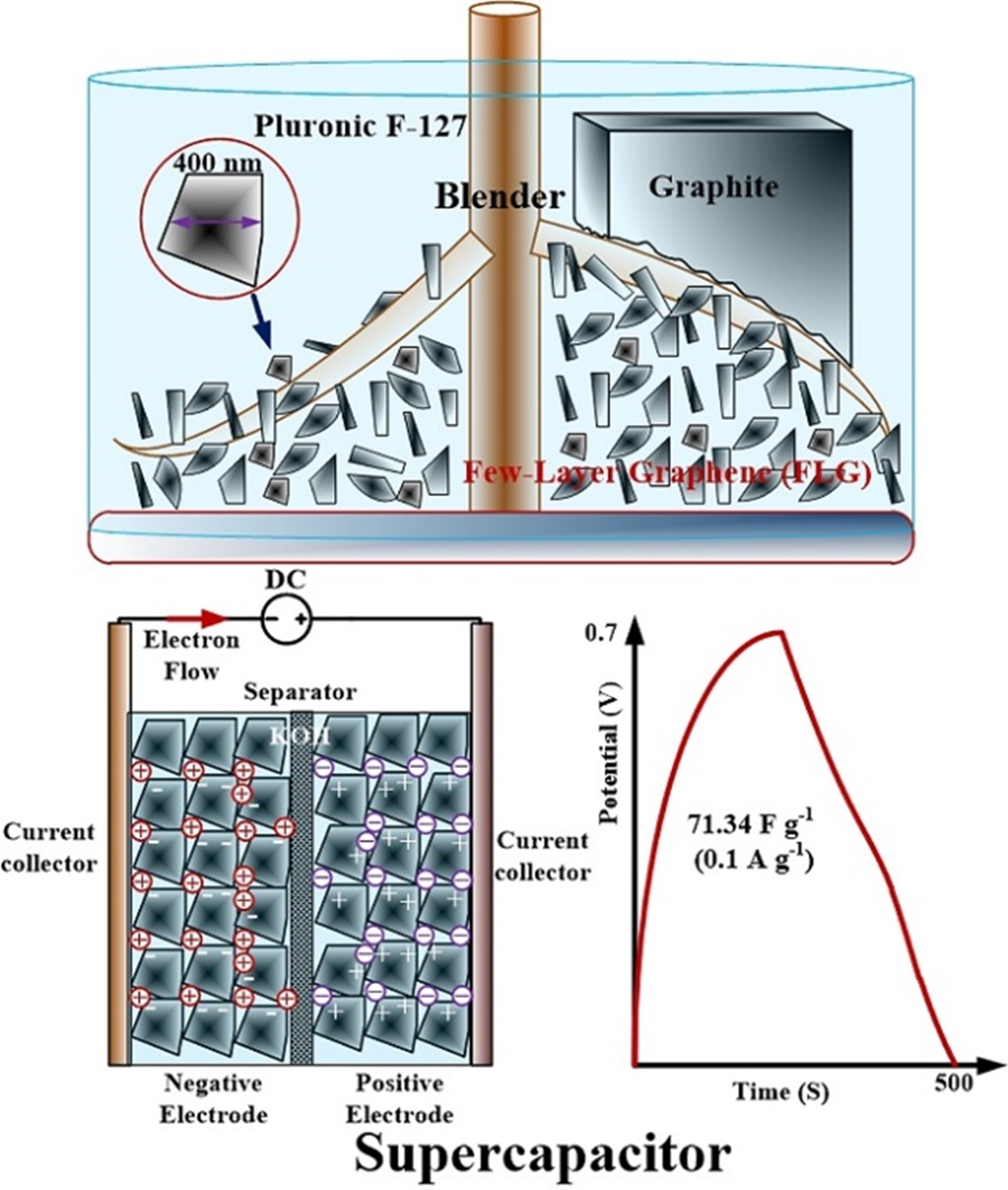
Downloads
References
P Simon and Y Gogotsi. Materials for electrochemical capacitors. Nature Materials 2008; 7(11), 845-854.
Y Zhu, S Murali, W Cai, X Li, JW Suk, JR Potts and RS Ruoff. Graphene and graphene oxide: Synthesis, properties, and applications. Advanced Materials 2010; 22(35), 3906-3924.
K Ullah, BM Khan, AU Rashid and WC Oh. Graphene based nanocomposites for supercapacitor electrodes. In: ZM Stevic (Ed.). Updates on supercapacitors. IntechOpen, London, 2022.
A Yasmin, JJ Luo and IM Daniel. Processing of expanded graphite reinforced polymer nanocomposites. Composites Science and Technology 2006; 66(9), 1182-1189.
S Eigler, M Enzelberger‐Heim, S Grimm, P Hofmann, W Kroener, A Geworski, C Dotzer, M Röckert, J Xiao, C Papp, O Lytken, HP Steinrück, P Müller and A Hirsch. Wet chemical synthesis of graphene. Advanced Materials 2013; 25(26), 3583-3587.
TC Achee, W Sun, JT Hope, SG Quitzau, CB Sweeney, SA Shah, T Habib and MJ Green. High-yield scalable graphene nanosheet production from compressed graphite using electrochemical exfoliation. Scientific Reports 2018; 8(1), 14525.
P Song, Z Cao, Y Cai, L Zhao, Z Fang and S Fu. Fabrication of exfoliated graphene-based polypropylene nanocomposites with enhanced mechanical and thermal properties. Polymer 2011; 52(18), 4001-4010.
ATH Mtibe, M Mokhothu, MJ John, TC Mokhena and MJ Mochane. Fabrication and characterization of various engineered nanomaterials. In: CM Hussain (Ed.). Handbook of nanomaterials for industrial applications. Elsevier, Amsterdam, Switzerland, 2018, p. 151-171.
CS Lee, SJ Shim and TH Kim. Scalable Preparation of Low-Defect Graphene by Urea-Assisted Liquid-Phase Shear Exfoliation of Graphte and Its Application in Doxorubicin Analysis. Nanomaterials 2020; 10(2), 267.
SM Alhassan, S Qutubuddin and DA Schiraldi. Graphene arrested in laponite-water colloidal glass. Langmuir 2012; 28(8), 4009-4015.
M Yi and Z Shen. Kitchen blender for producing high-quality few-layer graphene. Carbon 2014; 78, 622-626.
E Varrla, KR Paton, C Backes, A Harvey, RJ Smith, J McCauley and JN Coleman. Turbulence-assisted shear exfoliation of graphene using household detergent and a kitchen blender. Nanoscale 2014; 6(20), 11810-11819.
DT Pérez-Álvarez, J Brown and J Stafford. Modification of kitchen blenders into controllable laboratory mixers for mechanochemical synthesis of atomically thin materials. HardwareX 2023; 16, e00471.
Z Ereš and S Hrabar. Low-cost synthesis of high-quality graphene in do-it-yourself cvd reactor. Automatika 2018; 59(3-4), 254-260.
M Luengchavanon, L Chuenchom, W Limbut, K Kantakapun, R Choowang, C Putson, and S Chowdhury. Effect of Applied Graphene Nanosheets (Electrode) from the Electrolysis Process and Nanofiber-Based Separator (Electrolyte) from an Electrospinning Technique for High-Performance Supercapacitor. ACS Omega 2025; 10(29), 31348−31358.
M Lotya, PJ King, U Khan, S De and JN Coleman. High-concentration, surfactant-stabilized graphene dispersions. ACS Nano 2010, 4(6), 3155-3162.
L Guardia, MJ Fernández-Merino, JI Paredes, P Solís-Fernández, S Villar-Rodil, A Martínez-Alonso and JMD Tascón. High-throughput production of pristine graphene in an aqueous dispersion assisted by non-ionic surfactants. Carbon 2011; 49(5), 1653-1662.
KR Paton, E Varrla, C Backes, RJ Smith, U Khan, A O’Neill, C Boland, M Lotya, OM Istrate, P King, T Higgins, S Barwich, P May, P Puczkarski, I Ahmed, M Moebius, H Pettersson, E Long, J Coelho, SE O Brien, EK McGuire, BM Sanchez, GS Duesberg, N McEvoy, TJ Pennycook, C Downing, A Crossley, V Nicolosi and JN Coleman. Scalable production of large quantities of defect-free few-layer graphene by shear exfoliation in liquids. Nature Materials 2014; 13(6), 624-630.
PG Karagiannidis, SA Hodge, L Lombardi, F Tomarchio, N Decorde, S Milana, I Goykhman, Y Su, S Mesite, D Johnstone, RK Leary, PA Midgley, NM Pugno, F Torrisi and AC Ferrari. Microfluidization of graphite and formulation of graphene-based conductive inks. ACS Nano 2016; 11(3), 2742-2755
U Khan, H Porwal, A O’Neill, K Nawaz, P May and JN Coleman. Solvent-exfoliated graphene at extremely high concentration. Langmuir 2011; 27(15), 9077-9082.
AC Ferrari, JC Meyer, V Scardaci, C Casiraghi, M Lazzeri, F Mauri, S Piscanec, D Jiang, KS Novoselov, S Roth and AK Geim. Raman spectrum of graphene and graphene layers. Physical Review Letters 2006; 97(18), 187401.
A Mendhe and HS Panda. A review on electrolytes for supercapacitor device. Discover Materials 2023; 3(1), 29.
R Kötz and M Carlen. Principles and applications of electrochemical capacitors. Electrochimica Acta 2000; 45(15-16), 2483-2498.
RJ Smith, M Lotya and JN Coleman. The importance of repulsive potential barriers for the dispersion of graphene using surfactants. New Journal of Physics 2010; 12, 125008.
C Backes, KR Paton, D Hanlon, S Yuan, MI Katsnelson, J Houston, RJ Smith, D McCloskey, JF Donegan and JN Coleman. Spectroscopic metrics allow in situ measurement of mean size and thickness of liquid-exfoliated few-layer graphene nanosheets. Nanoscale 2016; 8(7), 4311-4323.
U Khan, A O’Neill, M Lotya, S De and JN Coleman. High‐concentration solvent exfoliation of graphene. Small 2010; 6(7), 864-871.
J Phiri, P Gane and TC Maloney. High-concentration shear-exfoliated colloidal dispersion of surfactant-polymer-stabilized few-layer graphene sheets. Journal of Materials Science 2017; 52(13), 8321-8337.
L Liu, Z Shen, M Yi, X Zhang and S Ma. A green, rapid and size-controlled production of high-quality graphene sheets by hydrodynamic forces. RSC Advances 2014; 4(69), 36464-36470.
W Zhang, W He and X Jing. Preparation of a stable graphene dispersion with high concentration by ultrasound. The Journal of Physical Chemistry B 2010; 114(32), 10368-10373.
W Liu, VA Tanna, BM Yavitt, C Dimitrakopoulos and HH Winter. Fast production of high-quality graphene via sequential liquid exfoliation. ACS Applied Materials & Interfaces 2015; 7(49), 27027-27030.
M Döbbelin, A Ciesielski, S Haar, S Osella, M Bruna, A Minoia, L Grisanti, T Mosciatti, F Richard, EA Prasetyanto, LD Cola, V Palermo, R Mazzaro, V Morandi, R Lazzaroni, AC Ferrari, D Beljonne and P Samorì. Light-enhanced liquid-phase exfoliation and current photoswitching in graphene-azobenzene composites. Nature Communications 2016; 7(1), 11090.
H Ma, Z Shen, M Yi, S Ben, S Liang, L Liu, Y Zhang, X Zhang and S Ma. Direct exfoliation of graphite in water with addition of ammonia solution. Journal of Colloid and Interface Science 2017; 503, 68-75.
J Tian, L Guo, X Yin and W Wu. The liquid-phase preparation of graphene by shear exfoliation with graphite oxide as a dispersant. Materials Chemistry and Physics 2019; 223, 1-8.
CS Lee, SJ Shim and TH Kim. Scalable preparation of low-defect graphene by urea-assisted liquid-phase shear exfoliation of graphite and its application in doxorubicin analysis. Nanomaterials 2020; 10(2), 267.
JN Israelachvili. Intermolecular and surface forces. Academic Press, Cambridge, 2011, p. 506-550.
PD Gennes. Polymers at an interface; a simplified view. Advances in Colloid and Interface Science 1987; 27(3-4), 189-209.
S Wang, M Yi and Z Shen. The effect of surfactants and their concentration on the liquid exfoliation of graphene. RSC Advances 2016; 6(61), 56705-56710.
M Yi, Z Shen and J Zhu. A fluid dynamics route for producing graphene and its analogues. Chinese Science Bulletin 2014; 59(16), 1794-1799.
TS Tran, SJ Park, SS Yoo, TR Lee and TY Kim. High shear-induced exfoliation of graphite into high quality graphene by taylor-couette flow. RSC Advances 2016; 6(15), 12003-12008.
M Ma, L Cheng, A Zhao, H Zhang and A Zhang. Pluronic-based graphene oxide-methylene blue nanocomposite for photodynamic/photothermal combined therapy of cancer cells. Photodiagnosis and Photodynamic Therapy 2020; 29, 101640.
KS Novoselov, AK Geim, SV Morozov, D Jiang, Y Zhang, SV Dubonos, IV Grigorieva and AA Firsov. Electric field effect in atomically thin carbon films. Science 2004; 306(5696), 666-669.
JA Garlow, LK Barrett, L Wu, K Kisslinger, Y Zhu and JF Pulecio. Large-area growth of turbostratic graphene on Ni(111) via physical vapor deposition. Scientific Reports 2016; 6(1), 19804.
U Khan, A O’Neill, H Porwal, P May, K Nawaz and JN Coleman. Size selection of dispersed, exfoliated graphene flakes by controlled centrifugation. Carbon 2012; 50(2), 470-475.
LM Malard, MA Pimenta, G Dresselhaus and MS Dresselhaus. Raman spectroscopy in graphene. Physics Reports 2009; 473(5), 51-87.
T Shimada, T Sugai, C Fantini, M Souza, LG Cançado, A Jorio, MA Pimenta, R Saito, A Grüneis, G Dresselhaus, M. Dresselhaus, Y Ohno, T Mizutani and H Shinohara. Origin of the 2450 cm−1 raman bands in hopg, single-wall and double-wall carbon nanotubes. Carbon 2005; 43, 1049-1054.
DL Mafra, G Samsonidze, LM Malard, DC Elias, JC Brant, F Plentz, ES Alves and MA Pimenta. Determination of la and to phonon dispersion relations of graphene near the dirac point by double resonance raman scattering. Physical Review B 2007; 76(23), 233407.
AA Green and MC Hersam. Solution phase production of graphene with controlled thickness via density differentiation. Nano Letters 2009; 9(12), 4031-4036.
SE Veras, E Espada, S Collazo, M Grau, R Katiyar, VI Makarov, BR Weiner and G Morell. Hydrogenated graphene systems: A novel growth and hydrogenation process. Carbon Trends 2024; 15, 100360.
K Ishimaru, T Hata, P Bronsveld, T Nishizawa and Y Imamura. Characterization of sp2- and sp3-bonded carbon in wood charcoal. Journal of Wood Science 2007; 53(5), 442-448
Y Liu, Z Liu, WS Lew and QJ Wang. Temperature dependence of the electrical transport properties in few-layer graphene interconnects. Nanoscale Research Letters 2013; 8(1), 335.
JLS Gascho, SF Costa, AAC Recco and SH Pezzin. Graphene oxide films obtained by vacuum filtration: X-ray diffraction evidence of crystalline reorganization. Journal of Nanomaterials 2019; 2019(1), 5963148.
HH Huang, KKHD Silva, GRA Kumara and M Yoshimura. Structural evolution of hydrothermally derived reduced graphene oxide. Scientific Reports 2018; 8(1), 6849.
RM Allaf, IV Rivero, SS Spearman and LJ Hope-Weeks. On the preparation of as-produced and purified single-walled carbon nanotube samples for standardized x-ray diffraction characterization. Materials Characterization 2011; 62(9), 857-864.
B Gürünlü, Ç Taşdelen-Yücedağ and M Bayramoğlu. Graphene synthesis by ultrasound energy-assisted exfoliation of graphite in various solvents. Crystals 2020; 10(11), 1037.
R Zhang, B Zhang and S Sun. Preparation of high-quality graphene with a large-size by sonication-free liquid-phase exfoliation of graphite with a new mechanism. RSC Advances 2015; 5(44), 783-791.
R Weber, AJ Louli, KP Plucknett and JR Dahn. Resistance growth in lithium-ion pouch cells with LiNi0.80Co0.15Al 0.05O2 positive electrodes and proposed mechanism for voltage dependent charge-transfer resistance. Journal of the Electrochemical Society 2019; 166, A1779.
M Faraji and F Gobal. Preparation and electrochemical performances of nanoporous/ cracked cobalt oxide layer for supercapacitors. Applied Physics A 2014; 117(4), 2087-2094.
C Xia, Y Xie, Y Wang, W Wang, H Du and F Tian. Preparation and capacitance performance of polyaniline/titanium nitride nanotube hybrid. Journal of Applied Electrochemistry 2013; 43, 1225-1233.
T Girija and M Sangaranarayanan. Analysis of polyaniline-based nickel electrodes for electrochemical supercapacitors. Journal of Power Sources 2006; 156(2), 705-711.
S Breitenbach, A Lumetzberger, MA Hobisch, C Unterweger, S Spirk, D Stifter, C Fürst and AW Hassel. Supercapacitor electrodes from viscose-based activated carbon fibers: Significant yield and performance improvement using diammonium hydrogen phosphate as impregnating agent. C 2020; 6(2), 17.
Y Barsukov and J Macdonald. Impedance spectroscopy: Theory, experiment, and applications. Journal of the American Chemical Society 2005; 127(35), 12431.
MMM Mohammed and DM Chun. Electrochemical performance of few-layer graphene nano-flake supercapacitors prepared by the vacuum kinetic spray method. Coatings 2018; 8(9), 302.
MAAM ABID, MI Radzi, M Mupit, H Osman, RF Munawar, KF Samat, MSM Suan, K Isomura and M Islam. Cyclic voltammetry and galvanostatic charge-discharge analyses of polyaniline/graphene oxide nanocomposite based supercapacitor. Malaysian Journal on Composites Science and Manufacturing 2020; 3(1), 14-26.
S Teng, G Siegel, W Wang and A Tiwari. Carbonized wood for supercapacitor electrodes. ECS Solid State Letters 2014; 3(5), M25-M28.
V Marcelina, N Syakir, S Wyantuti, YW Hartati and R Hidayat. Characteristic of thermally reduced graphene oxide as supercapacitors electrode materials. IOP Conference Series: Materials Science and Engineering 2017; 196(1), 012034.
RE Williams, S Sukumaran, Q Abbas and MRC Hunt. Few-layer graphene as an ‘active’ conductive additive for flexible aqueous supercapacitor electrodes. Carbon 2024; 218, 118744.
Published
How to Cite
Issue
Section
License
Copyright (c) 2025 Walailak University

This work is licensed under a Creative Commons Attribution-NonCommercial-NoDerivatives 4.0 International License.





