
Antibacterial Activities of Biosynthesized Zinc Oxide Nanoparticles and Silver-Zinc Oxide Nanocomposites using Camellia Sinensis Leaf Extract
DOI:
https://doi.org/10.48048/tis.2023.5649Keywords:
Biosynthesis, ZnO nanocomposites, Antibacterial resistant, Gram negative bacteria, Gram positive bacteria, Disinfectant, Household materialsAbstract
Green route of nanomaterials synthesis is increasing in demand due to ecofriendly to the environment. In this research, objective is to biosynthesize and evaluate the antibacterial performance of pure ZnO and Ag/ZnO nanocomposites using Camellia sinensis leaf extracts. Pure ZnO nanoparticles and Ag/ZnO nanocomposites were synthesized using Camellia sinensis leaf extract. The antibacterial effectiveness against gram-positive (Staphylococcus aureus) and gram-negative (Escherichia coli) bacteria were examined and compared with 1 % Chlorox as a commercial disinfectant by well diffusion method based on the zone of inhibition. Pure ZnO nanoparticles and Ag/ZnO nanocomposites had hexagonal shape ZnO nanoparticles and rectangular shape Ag nanoparticles in Ag/ZnO nanocomposites with a particle crystal size between 20 - 30 nm with carboxylic and phenolic functional group attached on it. Ag/ZnO nanocomposites exhibited antibacterial effectiveness against both gram-positive and gram-negative bacteria, while pure ZnO nanoparticles exhibited antibacterial effectiveness against only gram-positive bacteria. Conversely, 1 % Chlorox and 1 % DMSO showed no significant antibacterial activity against gram-positive and gram-negative bacteria. Camellia sinensis mediated ZnO and Ag/ZnO nanoparticles showed antibacterial potential against S. aureus and E. coli suggesting that green route to synthesis of antibacterial nanoparticles can be an excellent strategy to develop eco-friendly disinfectant products
HIGHLIGHTS
- Zinc oxide nanocomposites biosynthesis by Camellia sinensis at low pH, Antibacterial properties of ZnO nanoparticles and Ag/ZnO nanocomposites on Escherichia coli ATCC 8739 and Staphylococcus aureus ATCC 6538P strains, Disinfection application.
GRAPHICAL ABSTRACT 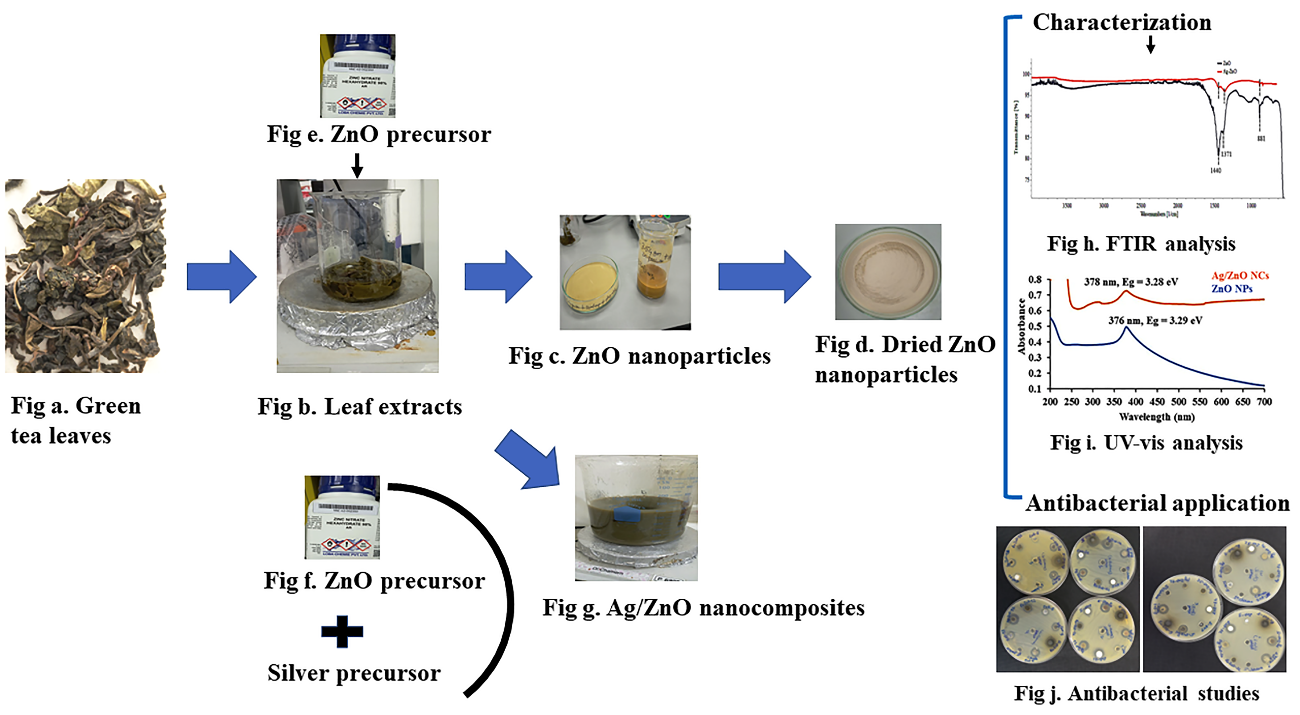
Downloads
References
CL Ventola. The antibiotic resistance crisis. Part 1: Causes and threats. Pharm. Therapeut. 2015; 40, 277-83.
Y Jang, K Lee, S Yun, M Lee, J Song, B Chang and NH Choe. Efficacy evaluation of commercial disinfectants by using Salmonella enterica serovar Typhimurium as a test organism. J. Vet. Sci. 2017; 18, 209-16.
J Wang, J Shen, D Ye, X Yan, Y Zhang, W Yang, X Li, J Wang, L Zhang and L Pan. Disinfection technology of hospital wastes and wastewater: Suggestions for disinfection strategy during coronavirus disease 2019 (COVID-19) pandemic in China. Environ. Pollut. 2020; 262, 114665.
JL Sagripanti and A Bonifacino. Bacterial spores survive treatment with commercial sterilants and disinfectants. Appl. Environ. Microbiol. 1999; 65, 4255-60.
H Bahadar, F Maqbool, K Niaz and M Abdollahi. Toxicity of nanoparticles and an overview of current experimental models. Iran. Biomed. J. 2016; 20, 1-11.
C Liao, Y Li and SC Tjong. Bactericidal and cytotoxic properties of silver nanoparticles. Int. J. Mol. Sci. 2019; 20, 449.
S Agnihotri, S Mukherji and S Mukherji. Size-controlled silver nanoparticles synthesized over the range 5-100 nm using the same protocol and their antibacterial efficacy. RSC Adv. 2014; 4, 3974-83.
A Sirelkhatim, S Mahmud, A Seeni, NHM Kaus, LC Ann, SKM Bakhori, H Hasan and D Mohamad. Review on zinc oxide nanoparticles: Antibacterial activity and toxicity mechanism. Nano-Micro Lett. 2015; 7, 219-42.
S Kasraei, L Sami, S Hendi, MY Alikhani, L Rezaei-Soufi and Z Khamverdi. Antibacterial properties of composite resins incorporating silver and zinc oxide nanoparticles on Streptococcus mutans and Lactobacillus. Restor. Dent. Endod. 2014; 39, 109-14.
J Shang, Y Sun, T Zhang, Z Liu and H Zhang. Enhanced antibacterial activity of Ag nanoparticle-decorated ZnO nanorod arrays. J. Nanomater. 2019; 2019, 3281802.
S Jiang, K Lin and M Cai. ZnO nanomaterials: Current advancements in antibacterial mechanisms and applications. Front. Chem. 2020; 8, 580.
Y Qing, L Cheng, R Li, G Liu, Y Zhang, X Tang, J Wang, H Liu and Y Qin. Potential antibacterial mechanism of silver nanoparticles and the optimization of orthopedic implants by advanced modification technologies. Int. J. Nanomed. 2018; 13, 3311-27.
I Ijaz, E Gilani, AF Nazir and A Bukhari. Detail review on chemical, physical and green synthesis, classification, characterizations and applications of nanoparticles. Green Chem. Lett. Rev. 2020; 13, 223-45.
M Naseer, U Aslam, B Khalid and B Chen. Green route to synthesize zinc oxide nanoparticles using leaf extracts of Cassia fistula and Melia azadarach and their antibacterial potential. Sci. Rep. 2020; 10, 9055.
JY Song, HK Jang and BS Kim. Biological synthesis of gold nanoparticles using Magnolia kobus and Diopyros kaki leaf extracts. Process Biochem. 2009; 44, 1133-8.
J Huang, Q Li, D Sun, Y Lu, Y Su, X Yang, H Wang, Y Wang, W Shao, N He, J Hong and C Chen. Biosynthesis of silver and gold nanoparticles by novel sundried Cinnamomum camphora leaf. Nanotechnology 2007; 18, 105104.
CD Medina, E Mostafavi, A Vernet-Crua, H Barabadi, V Shah, JL Cholula-Díaz, G Guisbiers and TJ Webster. Green nanotechnology-based zinc oxide (ZnO) nanomaterials for biomedical applications: A review. J. Phys. Mater. 2020; 3, 034005.
G Amin, MH Asif, A Zainelabdin, S Zaman, O Nur and M Willander. Influence of pH, precursor concentration, growth time, and temperature on the morphology of ZnO nanostructures grown by the hydrothermal method. J. Nanomater. 2011; 2011, 5.
K Chitra and G Annadurai. Antibacterial activity of pH-dependent biosynthesized silver nanoparticles against clinical pathogen. Biomed. Res. Int. 2014; 2014, 725165.
J Santhoshkumar, SV Kumar and S Rajeshkumar. Synthesis of zinc oxide nanoparticles using plant leaf extract against urinary tract infection pathogen. Resour. Effic. Tech. 2017; 3, 459-65.
S Alamdari, MS Ghamsari, C Lee, W Han, HH Park, MJ Tafreshi, H Afarideh and MHM Ara. Preparation and characterization of zinc oxide nanoparticles using leaf extract of Sambucus ebulus. Appl. Sci. 2020; 10, 3620.
NYT Nguyen, N Grelling, CL Wetteland, R Rosario and H Liu. Antimicrobial activities and mechanisms of magnesium oxide nanoparticles (nMgO) against pathogenic bacteria, yeasts, and biofilms. Sci. Rep. 2018; 8, 16260.
R Shashanka, H Esgin, VM Yilmaz and Y Caglar. Fabrication and characterization of green synthesized ZnO nanoparticle based dye-sensitized solar cells. J. Sci. Adv. Mater. Device. 2020; 5, 185-91.
P Sánchez-López, J Antúnez-García, S Fuentes-Moyado, DH Galván, V Petranovskii and F Chávez-Rivas. Analysis of theoretical and experimental X-ray diffraction patterns for distinct mordenite frameworks. J. Mater. Sci. 2019; 54, 7745-57.
M Zare, K Namratha, S Alghamdi, YHE Mohammad, A Hezam, M Zare, QA Drmosh, K Byrappa, BN Chandrashekar, S Ramakrishna and X Zhang. Novel green biomimetic approach for synthesis of ZnO-Ag nanocomposite; antimicrobial activity against food-borne pathogen, biocompatibility and solar photocatalysis. Sci. Rep. 2019; 9, 8303.
A Taha, MB Aissa and E Da'na. Green synthesis of an activated carbon-supported Ag and ZnO nanocomposite for photocatalytic degradation and its antibacterial activities. Molecules 2020; 25, 1586.
SW Balogun, OO James, YK Sanusi and OH Olayinka. G reen synthesis and characterization of zinc oxide nanoparticles using bashful (Mimosa pudica), leaf extract: A precursor for organic electronics applications. SN Appl. Sci. 2020; 2, 504.
P Fageria, S Gangopadhyay and S Pande. Synthesis of ZnO/Au and ZnO/Ag nanoparticles and their photocatalytic application using UV and visible light. RSC Adv. 2014; 4, 24962-72.
WMH Oo, MD McCluskey, AD Lalonde and M Norton. Infrared spectroscopy of ZnO nanoparticles containing CO2 impurities. Appl. Phys. Lett. 2005; 86, 073111.

Downloads
Published
How to Cite
Issue
Section
License
Copyright (c) 2022 Walailak University

This work is licensed under a Creative Commons Attribution-NonCommercial-NoDerivatives 4.0 International License.





