
Distribution of Pyroclastic Deposits around Lake Maninjau Agam District, West Sumatera, Indonesia based on Magnetic Susceptibility
DOI:
https://doi.org/10.48048/tis.2022.3218Keywords:
Lake Maninjau, Magnetic susceptibility, Pyroclastic deposit, Contour maps, Magnetic mineralAbstract
Lake Maninjau is an erupting volcano in West Sumatra Province. The results of the eruption have now settled in various places and scattered in all directions due to the transportation process. The process of transporting volcanic material is caused by several factors such as wind and rain. This study aims to analyze the distribution pattern of volcanic material that is scattered around Lake Maninjau, Agam Regency. We have 25 types of samples divided into 3 categories. There are pumice, lava, and ash. This research was conducted at the FMIPA UNP Laboratory using the rock magnetization method. In this study, a Bartington MS2 with MS2B sensor was used by calculating the magnetic susceptibility value based on the mass of the sample. The results of the magnetic susceptibility analysis obtained varied between 74.7×10⁻⁸ - 3956.7×10-8 m3/kg which is included in the ilmenite (FeTiO3) group. The highest value of vulnerability was 2800×10-8 - 4000×10-8 m3/kg found at the core of Lake Maninjau ± 5.0 km seen from the green contour map. The lowest magnetic susceptibility values 0 - 800×10-8 m3/kg were found in the western part of Lake Maninjau and the material was deposited at a distance of ± 13 km from the core of the Maninjau caldera. Deposits were also found in the eastern part of Lake Maninjau ± 22.4 km from the core of Lake Maninjau and to the Middle East ± 23 miles from the core of the Maninjau caldera. The white color represents 1600 - 2000×10-8 m3/kg which is included in the moderate magnetic susceptibility value, which is ± 4 km to the southeast of the Maninjau caldera. The benefit that can be taken from this research in the ink industry is the presence of a magnetic mineral distribution map based on suseptibility values and makes it easier to find raw materials for making ink around Lake Maninjau.
HIGHLIGHTS
- Lake Maninjau stores various elements contained in the released material. The elements that make up magnetic minerals are Fe, Si, Ca, Al, K, Ti. The collection of several elements forms the raw magnetic mineral
- Volcanic material contains the mineral ilmenite which in theory can be used as a raw material for making TiO2 pigments, ferrous metals and chemical compounds containing iron. In the industrial field TiO2 is widely used as a paint pigment, additives in the paper-making process, ceramic raw materials, pharmaceutical industry raw materials and TiO2 is also widely used for photoclinic materials
- Superparamagnetic minerals are present in volcanic rock samples resulting from an eruption, the magnetic sensibility values at high frequencies are slightly lower than the magnetic susceptibility values at low frequencies. If there are no superparamagnetic minerals (SP)
- It can be assumed that the ancient volcanic eruptions of Maninjau belong to the type of plinia eruption which is highly exposed from magma with high viscosity or acid magma, the composition of the magma is andesitic to rhyolitic
GRAPHICAL ABSTRACT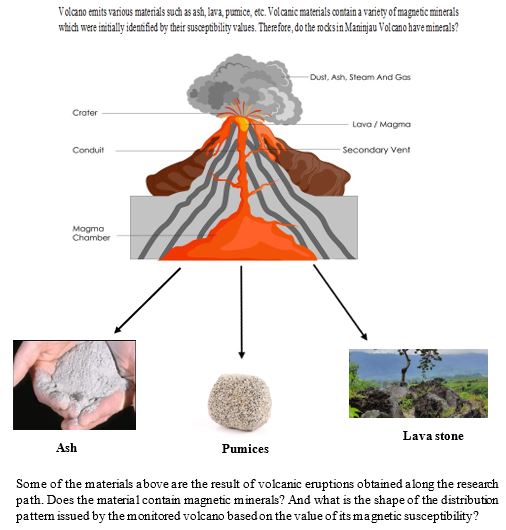
Downloads
References
G Nichols. Sedimentology and stratigraphy. John Wiley & Sons, West Susse, 2009.
A Pribadi. Mekanisme erupsi ignimbrit Kaldera Maninjau, Sumatera Barat (in Indonesian). Indones. J. Geosci. 2006; 2, 31-41.
A Andreas and A Putra. Perbandingan karakteristik batuan beku erupsi gunung Gamalama dan gunung Talang (in Indonesian). Jurnal Fisika Unand 2018; 7, 293-8.
M Ikhsan, D Puryanti and AB Pengaruh. Penambahan polyethylene glycol (PEG) terhadap sifat magnetik (γ-Fe2O3) Yang disintesis dari magnetit batuan besi (Fe3O4) (in Indonesian). Jurnal Ilmu Fisika Universitas Andalas 2017; 9, 103-9.
E Yulianti, Y Yulizar and C Kerja. Enkapsulasi nanopartikel magnetik (in Indonesian). Indonesian. J. Mater. Sci. 2008; 10, 228-32.
A Yulianto, MP Aji and N Idayanti. Fabrikasi MnZn-ferit dari bahan alam pasir besi serta aplikasinya untuk core induktor (in Indonesian). In: Proceedings of the Prosiding Pertemuan Ilmiah XXIV HFI Jateng & DIY, Semarang, Indonesia. 2010, p. 128-33.
D Ortega and QA Pankhurst. Magnetic hyperthermia. In: P O'Brien (Ed.). Nanoscience. RSC Publishing, London, 2012, p. 60-88.
S Hei, Y Jin and F Zhang. Fabrication of γ-Fe2O3 nanoparticles by solid-state thermolysis of a metal-organic framework, MIL-100(Fe), for heavy metal ions removal. J. Chem. 2014; 2014, 546956.
WD Callister. Materials science and engineering: An introduction. 2nd ed. John Wiley & Sons, New York, 1991, p. 59.
DJ Dunlop and O Ozdemir. Rock magnetism: Fundamental and frontiers. Cambridge University Press, Cambridge, 1997.
MR Fadila, H Rifai1, ED Ningsih, R Putra, CBD Maisonneuve, F Forni, S Eisele and M Phua. Magnetic susceptibility of pre- and post caldera lavas from Maninjau, West Sumatra. J. Phys. Conf. Ser. 2020; 1481, 012017.
Z Li and G Fu. Application of magnetic susceptibility parameters in research of igneous rock in chepaizi. J. Phys. Conf. Ser. 2019; 1176, 042068.
M Rongkonusa, G Tamuntuan and G Pasau. Analisis anisotropi suseptibilitas magnetik batuan beku lengan Utara Sulawesi (in Indonesian). Jurnal MIPA 2017; 6, 8-12.
RA Pratiwi, AG Prakoso, R Darmasetiawan, E Agustine, KH Kirana and D Fitriani. Identifikasi sifat magnetik tanah di daerah tanah longsor (in Indonesian). Prosiding Seminar Nasional Fisika (E-Journal) 2016; 5, SNF2016-EPA.
RN Fajri, R Putra, CBD Maisonneuve, A Fauzi, Yohandri and H Rifai. Analysis of magnetic properties rocks and soils around the Danau Diatas, West Sumatra. J. Phys. Conf. Ser. 2019; 1185, 012024.
S Salomo, SA Purba and R Syech. Studi sifat magnetik dan ukuran partikel abu vulkanik erupsi gunung sinabung kabupaten karo menggunakan probe pasco 2162. Komunikasi Fisika Indonesia 2018; 15, 7-15.
CP Hunt, BM Moskowitz and SK Banerjee. Magnetic properties of rocks and minerals. American Geophysical Union, Washington DC, 1995, p. 189-204.
MO Kanu, OC Meludu and SA Oniku. A preliminary assessment of soil pollution in some parts of Jalingo metropolis, Nigeria Using magnetic susceptibility method. Jordan J. Earth Environ. Sci. 2013; 5, 53-61.
VA Tiwow, MJ Rampe and M Arsyad. Study of frequency-dependent magnetic susceptibility to the iron sand in Takalar Regency (in Indonesian). Jurnal Sainsmat 2018; VII, 136-46.
J Dearing. Environmental magnetic susceptibility using the bartington MS2 system. Cambridge University Press, Cambridge, 1997.
Downloads
Published
How to Cite
Issue
Section
License

This work is licensed under a Creative Commons Attribution-NonCommercial-NoDerivatives 4.0 International License.





