
Structure–Function Correlation in ZnO-Modified PVDF-HFP Nanofibers Enabling Antibacterial Membrane Performance
DOI:
https://doi.org/10.48048/tis.2026.13966Keywords:
PVDF-HFP, ZnO, Electrospinning, Hydrophobicity, Antibacterial activityAbstract
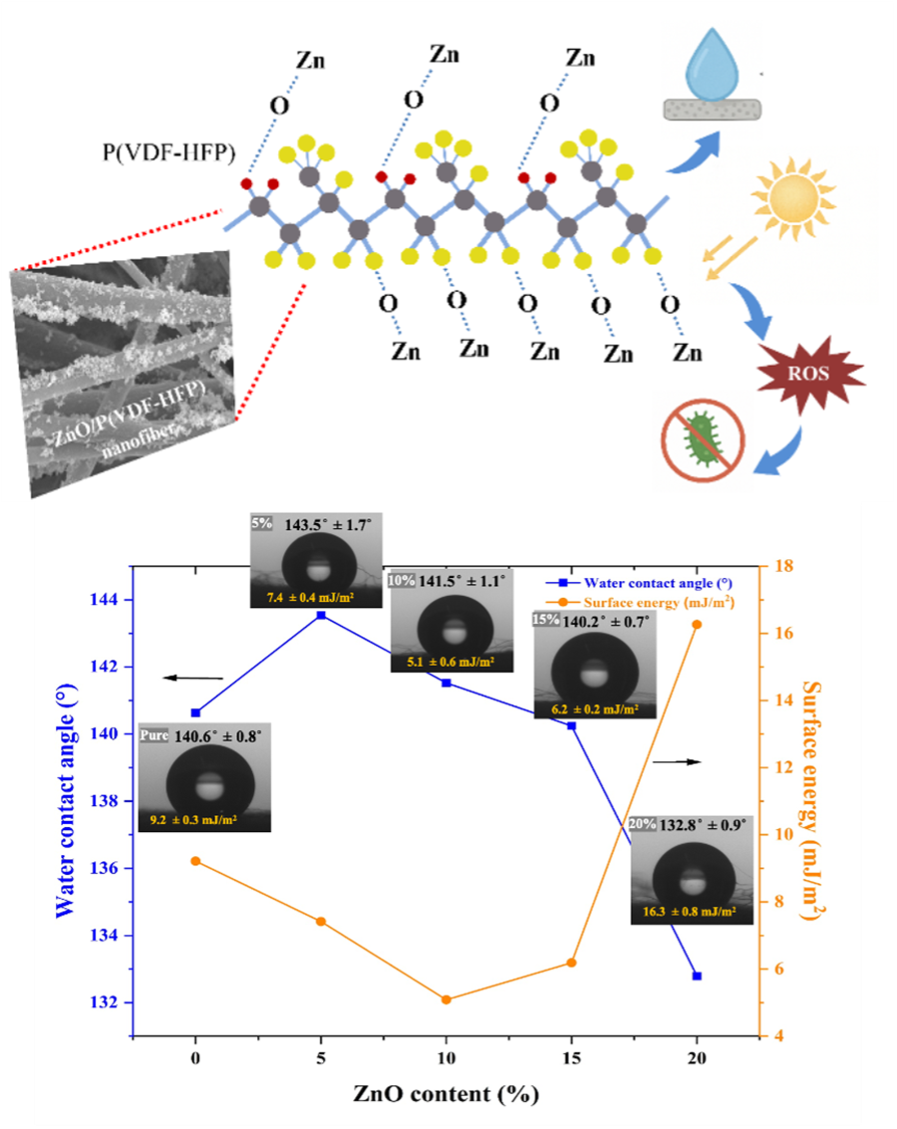
Electrospun nanofibers of poly(vinylidene fluoride-co-hexafluoropropylene) (PVDF-HFP) were successfully functionalized with zinc oxide (ZnO) nanoparticles (NPs) to develop multifunctional membranes with enhanced hydrophobicity and antibacterial performance, aimed at self-cleaning air filtration applications. ZnO NPs, synthesized via a precipitation method and deposited at various loadings (5 - 20 wt%), were uniformly coated on the surfaces of PVDF-HFP nanofibers, as confirmed by SEM-EDX, FTIR, and XRD analyses. The incorporation of ZnO significantly increased the crystallinity of the nanofibers from 25.1% for uncoated fibers to 55.4% at 20 wt% ZnO content, improving both structural ordering and thermal resistance up to 525 °C. Notably, the 5 wt% ZnO-coated composite exhibited the highest water contact angle of 143.5° and the lowest surface energy of 7.4 mJ/m², indicating superior hydrophobicity favorable for self-cleaning. Furthermore, mechanical testing revealed balanced tensile strength of 2.48 MPa and flexibility at moderate ZnO loadings (10% - 15%), demonstrating strong interfacial bonding between ZnO NPs and the polymer matrix. Antibacterial assays against Staphylococcus aureus and Staphylococcus epidermidis showed clear inhibition zones up to 17.1 mm, confirming potent bactericidal efficacy arising from reactive oxygen species generation and Zn2+ ion release. Collectively, these results highlight that ZnO/PVDF-HFP nanofiber membranes possess high hydrophobicity, thermal stability, mechanical durability, and antibacterial activity, making them promising candidates for smart air filtration and protective mask applications.
HIGHLIGHTS
- ZnO modification enhances β-phase evolution and increases crystallinity of PVDF-HFP nanofibers from 25.1% to 55.4%, resulting in improved thermal stability (up to 525 - 700 °C) through strong nanoscale interfacial bonding.
- Hierarchical surface roughness generated by ZnO deposition significantly boosts hydrophobicity, yielding a maximum water contact angle of 143.5°, together with balanced mechanical properties suitable for durable and self-cleaning membrane applications.
- ZnO-induced reactive oxygen species generation and Zn2+ release provide strong antibacterial activity against Staphylococcus aureus and Staphylococcus epidermidis, supporting their use in high-performance air-filtration and protective-mask systems.
- A clear structure function correlation links ZnO-driven phase evolution and surface engineering to the enhanced antibacterial, thermal, and filtration performance of the nanofiber membranes.
GRAPHICAL ABSTRACT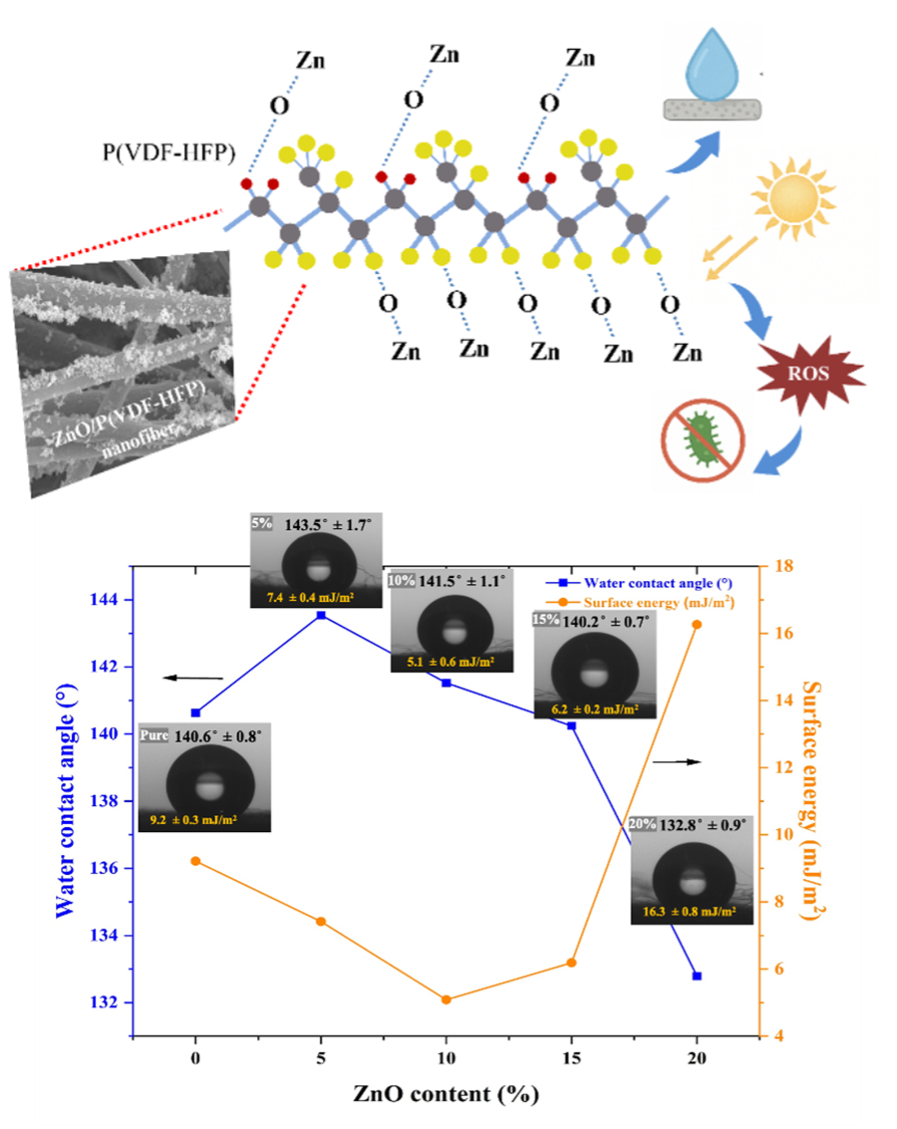
Downloads
References
WWF Leung and Q Sun. Charged PVDF multilayer nanofiber filter in filtering simulated airborne novel coronavirus (COVID-19) using ambient nano-aerosols. Separation and Purification Technology 2020; 245, 116887.
N Chen, M Zhou, X Dong, J Qu, F Gong, Y Han, Y Qiu, J Wang, Y Liu, Y Wei, J Xia, T Yu, X Zhang and L Zhang. Epidemiological and clinical characteristics of 99 cases of 2019 novel coronavirus pneumonia in Wuhan, China: A descriptive study. The Lancet 2020; 395(10223), 507-513.
S Karimzadeh, R Bhopal and NT Huy. Review of infective dose, routes of transmission and outcome of COVID-19 caused by the SARS-COV-2: Comparison with other respiratory viruses. Epidemiol Infect 2021; 149, e96.
AL Rasmussen, K Escandón and SV Popescu. Facial Masking for Covid-19. The New England Journal of Medicine 2020; 383(21), 2092-2094.
M Liang, L Gao, C Cheng, Q Zhou, JP Uy, K Heiner and C Sun. Efficacy of face mask in preventing respiratory virus transmission: A systematic review and meta-analysis. Travel Medicine and Infectious Disease 2020; 36, 101751.
JAT Ruiz, A Vitale and L Pattelli. Solvent role for the electrospinning of PVDF-HFP nanofibrous coatings for passive radiative cooling applications. The European Physical Journal Conferences 2024; 309, 13009.
S Aghayari. PVDF composite nanofibers applications. Heliyon 2022; 8(11), e11620.
P Filip, J Zelenkova and P Peer. Electrospinning of a copolymer PVDF-co-HFP solved in DMF/Acetone: Explicit relations among viscosity, polymer concentration, DMF/Acetone ratio and mean nanofiber diameter. Polymers 2021; 13(19), 3418.
KČ Barabaszová, S Holešová, M Hundáková, K Hrabovská, L Plesník, D Kimmer, K Joszko, B Gzik-Zroska and M Basiaga. Antimicrobial PVDF nanofiber composites with the ZnO - vermiculite - chlorhexidine based nanoparticles and their tensile properties. Polymer Testing 2021; 103, 107367.
F Russo, C Ursino, E Avruscio, G Desiderio, A Perrone, S Santoro, F Galiano and A Figoli. Innovative Poly (Vinylidene Fluoride) (PVDF) electrospun nanofiber membrane preparation using DMSO as a low toxicity solvent. Membranes 2020; 10(3), 36.
D Abbas, MS Mu'min, M Bonanno, S Thiele and T Böhm. Active solution heating and cooling in electrospinning enabling spinnability from various solvents. Journal of Applied Polymer Science 2022; 139, e52730.
K Liu, Z Chen, M Guan, J Jin, C Ren, S Gu and W Zhang. High-performance coupled nanogenerators based on electrospun porous PU@PVDF-ZnO nanofibers with core–shell structure. Advanced Engineering Materials 2025; 27(19), 2500549.
RK Singh, SW Lye and J Miao. Holistic investigation of the electrospinning parameters for high percentage of β-phase in PVDF nanofibers. Polymer 2021; 214, 123366.
H Parangusan, D Ponnamma and MAA Al-Maadeed. Stretchable electrospun PVDF-HFP/Co-ZnO nanofibers as piezoelectric nanogenerators. Scientific Reports 2018; 8(1), 754.
J Chen, J Fan, M Livojevic, M Gupta, T Tang and C Ayranci. Enhancing piezoelectric properties of PVDF-HFP composite nanofibers with cellulose nanocrystals. Materials Today Communications 2024; 39, 108872.
B Chamam, RB Dassi, J Abderraouf, JP Mericq, C Faur, I Trabelsi, LE Mir and M Heran. Incorporation of Ag-ZnO nanoparticles into PVDF membrane formulation to enhance dye retention, permeability, and antibacterial properties. Polymers 2025; 17(9), 1269.
Y Niu, Q Jia, S Yan, J Zhang, and L Han. Co-electrospun PU–PVDF/TiO₂ nanofiber membranes: A multifunctional strategy for durable, antibacterial, and low-resistance air filters. Journal of Materials Science 2025; 60, 20384-20395.
VR Lebaka, P Ravi, MC Reddy, C Thummala and TK Mandal. Zinc oxide nanoparticles in modern science and technology: Multifunctional roles in healthcare, environmental remediation, and industry. Nanomaterials 2025; 15(10), 754.
S Baskoutas and G Bester. Conventional optics from unconventional electronics in ZnO quantum dots. The Journal of Physical Chemistry C 2010; 114(20), 9301-9307.
S Dey, Dl Mohanty, N Divya, V Bakshi, A Mohanty, D Rath, S Das, A Mondal, S Roy and R Sabui. A critical review on zinc oxide nanoparticles: Synthesis, properties and biomedical applications. Intelligent Pharmacy 2025; 3(1), 53-70.
E Rincon-Suarez, JM Mozo, A Romero-López, S Alcántara-Iniesta, FJ Flores-Ruiz and LE Serrano. Structural, optical and electrical properties of ZnO thin films deposited in the plane direction (002) by ultrasonic spray pyrolysis using nitrogen as carrier gas. Materials Science and Engineering: B 2025; 320, 118430.
J Lu, P Dong, Y Zhao, Y Zhao and Y Zeng. 3D printing of TPMS structural ZnO ceramics with good mechanical properties. Ceramics International 2021; 47(9), 12897-12905.
SR Kelly, X Shi, S Back, L Vallez, SY Park, S Siahrostami, X Zheng and JK Nørskov. ZnO As an active and selective catalyst for electrochemical water oxidation to hydrogen peroxide. ACS Catalysis 2019; 9(5), 4593-4599.
L Foster, JA Foppiani, H Xun, D Lee, B Utz, AH Alvarez, MJ Domingo-Escobar, IC Taritsa, D Gavlasova, TC Lee, GJ Lin, U Choudry and SJ Lin. Zinc in dermatology: Exploring its emerging role in enhancing botulinum toxin formulations and clinical efficacy. Current Issues in Molecular Biology 2024; 46(11), 12088-12098.
N Padmavathy and R Vijayaraghavan. Enhanced bioactivity of ZnO nanoparticles-an antimicrobial study. Science and Technology of Advanced Materials 2008; 9(3), 035004.
XQ Zhou, Z Hayat, DD Zhang, MY Li, S Hu, Q Wu, YF Cao and Y Yuan. Zinc oxide nanoparticles: Synthesis, characterization, modification, and applications in food and agriculture. Processes 2023; 11(4), 1193.
R Rohani, NSF Dzulkharnien, NH Harun and IA Ilias. Green approaches, potentials, and applications of Zinc Oxide nanoparticles in surface coatings and films. Bioinorganic Chemistry and Applications 2022; 2022, 3077747.
AEA Yagoub, GM Al-Shammari, LN Al-Harbi, P Subash-Babu, R Elsayim, MA Mohammed, MA Yahya and SZA Fattiny. Antimicrobial properties of zinc oxide nanoparticles synthesized from Lavandula pubescens shoot methanol extract. Applied Sciences 2022; 12(22), 11613.
S Shaheen, A Iqbal, M Ikram, M Imran, S Naz, A Ul-Hamid, A Shahzadi, W Nabgan, J Haider and A Haider. Graphene oxide-ZnO nanorods for efficient dye degradation, antibacterial and in-silico analysis. Applied Nanoscience 2022; 12, 165-177.
Mohammed, JK Oleiwi, AJM Jawad, AM Mohammed, AF Osman, R Rahman, T Adam, BO Betar, SCB Gopinath and OS Dahham. Effect of zinc oxide surface treatment concentration and nanofiller loading on the flexural properties of unsaturated polyester/kenaf nanocomposites. Heliyon 2023; 9(9), e20051.
S Pethuan, N Tammachat, C Kaew-On, R Siri, N Tohluebaji, P Channuie and J Yuennan. Transparent P(VDF-HFP) coatings for enhancing fungal resistance, hydrophobicity, and durability of Krajood-based natural fibers. Trends in Sciences 2025; 22(7), 10441.
R Şomoghi, A Semenescu, V Pasăre, OR Chivu, DF Nițoi, DF Marcu and B Florea. The impact of ZnO nanofillers on the mechanical and anti-corrosion performances of epoxy composites. Polymers 2024; 16(14), 2054.
J Yuennan, S Nawae, N Tohluebaji, C Putson and N Muensit. Preparation of superhydrophobic surface on P(VDF-HFP) fibers by electrospinning technique. Journal of Physics: Conference Series 2021; 1719, 012069.
N Tohluebaji, R Siri, N Muensit, C Putson, P Channuie, P Porrawatkul and J Yuennan. Hydrophobic and optical properties of P(VDF-HFP) nanofiber filled with Nickel (II) chloride hexahydrate for dye-sensitized solar cells application. Trends in Sciences 2024; 21(9), 8762.
Y Zhai and J Yang. Fabrication and modification of PVDF membrane by PDA@ZnO for enhancing hydrophilic and antifouling property. Arabian Journal of Chemistry 2023; 16, 105206.
C Du, Z Wang, G Liu, W Wang and D Yu. One-step electrospinning PVDF/PVP-TiO2 hydrophilic nanofiber membrane with strong oil-water separation and anti-fouling property. Colloids and Surfaces A: Physicochemical and Engineering Aspects 2021; 624, 126790.
BK Čech, H Sylva, Š Kateěrina, R Michal and K Jana. Hybrid antibacterial nanocomposites based on the Vermiculite/Zinc oxide-chlorhexidine. Journal of Nanoscience and Nanotechnology 2019; 19(5), 3041-3048.
Y Wang, D Lei, L Wu, N Hu, H Ning, Alamusi and Y Liu. Preparation of PVDF-HFP/CB/Ni nanocomposite films for piezoelectric energy harvesting. Reviews on Advanced Materials Science 2023; 62, 20230146.
S Paliwal, SK Gupta and CMS Negi. Structure–property correlation in PVDF-HFP/Carbon black nanocomposites: Insights from XRD, FESEM, and raman studies. Journal of Macromolecular Science, Part B 2026; 16(34), 32496-32512.
N Sedefoglu. Characterization and photocatalytic activity of ZnO nanoparticles by green synthesis method. Optik 2023; 288, 171217.
N Tohluebaji, N Muensit, C Putson, GA Ashraf, P Channuie, P Porrawatkul, U Wanthong and J Yuennan. Multi-functional enhancement of P(VDF-HFP) nanocomposites through MWCNTs loading for piezoelectric sensing. Journal of Materials Research and Technology 2025; 36, 8475-8491.
HH Singh, S Singh and N Khare. Enhanced β-phase in PVDF polymer nanocomposite and its application for nanogenerator. Polymers for Advanced Technologies 2017; 29(1), 143-150.
P Kumar, M Mohil, S Negi, J Sharma, NNK Borah, Siddhartha, M Singh, C Kapoor, MI Quresh and MM Haque. Sustainable fabrication of ZnO nanorod/PVDF nanocomposites for ultraviolet photodetection and energy harvesting. SPE Polymers 2025; 6(3), e70014.
SP Muduli, L Lipsa and S Parida. Current trends of characterization techniques for PVDF and related composite piezoelectric materials for nanogenerator. Discover Polymers 2025; 2, 14.
N Tohluebaji, C Putson, N Muensit and J Yuennan. Electrostrictive and structural properties of Poly(Vinylidene Fluoride-Hexafluoropropylene) composite nanofibers filled with Polyaniline (Emeraldine Base). Polymers 2021; 13(19), 3250.
AU Khan, N Malik, B Singh, NH Ansari, M Rehman and A Yadav. Biosynthesis, and characterization of zinc oxide nanoparticles (ZnONPs) obtained from the extract of waste of strawberry. Journal of Umm Al-Qura University for Applied Sciences 2023; 9, 268-275.
J Yuennan, C Nateethorn, P Samakphong, R Siri, N Tohluebaji, GA Ashraf, A Khanklaeo and P Channuie. Structural and shielding properties of P(VDF-HFP)-Bi2O3 multilayered polymer composites. Journal of Science: Advanced Materials and Devices 2025; 10(4), 100990.
C Shee, S Banerjee, S Bairagi, A Baburaj, KSK Naveen, AK Aliyana, DM Mulvihill, R Alagirusamy and SW Ali. A critical review on polyvinylidene fluoride (PVDF)/Zinc oxide (ZnO)-based piezoelectric and triboelectric nanogenerators. Journal of Physics: Energy 2024; 6(3), 032001.
M Spasova, N Manolova, N Markova and I Rashkov. Tuning the properties of PVDF or PVDF-HFP fibrous materials decorated with ZnO nanoparticles by applying electrospinning alone or in conjunction with electrospraying. Fibers and Polymers 2017; 18, 649-657.
OV Zakharova, IA Vasyukova, SP Chebotaryova, EY Koiava, SS Razlivalova, GV Grigoriev, PA Baranchikov and AA Gusev. Dose-dependent effects of ZnO nanoparticles towards the microalgae lobosphaera: Compensation of salt stress at low concentration and toxicity at high concentrations. International Journal of Molecular Sciences 2025; 26(19), 9455.
H Ali, S Ali, K Ali, S Ullah, PM Ismail, M Humayun and C Zeng. Impact of the nanoparticle incorporation in enhancing mechanical properties of polymers. Results in Engineering 2025; 27, 106151.
A Sharma, K Akash, S Kumari, K Chauhan, A James, R Goel, J Singh, R Nagraik and D Kumar. Biogenic zinc oxide nanoparticles: An insight into the advancements in antimicrobial resistance. ECS Journal of Solid State Science and Technology 2024; 13(4), 047002.
K Kalra, V Chhabra and N Prasad. Antibacterial activities of zinc oxide nanoparticles: A mini review. Journal of Physics: Conference Series 2022; 2267, 012049.
NM Elmayah, MI Abou-Dobara, ZAM Baka, A Elgaml, AE Khodir, HM Salama and MM El-Zahed. A novel green synthesized ZnO-based antimicrobial nanocomposite: Synergistic action, in vitro cytotoxicity, and molecular docking studies of ceftazidime, metformin, and chitosan against multidrug-resistant Salmonella enterica. Microbial Cell Factories 2026; 25, 58.
A Popova, DY Advakhova, AN Sheveyko, KA Kuptsov, P Slukin, SG Ignatov, A Ilnitskaya, RV Timoshenko, AS Erofeev, AA Kuchmizhak, B Subramanian and DV Shtansky. Synergistic bactericidal effect of Zn2+ ions and reactive oxygen species generated in response to either UV or X-ray irradiation of Zn-Doped plasma electrolytic oxidation TiO2 coatings. ACS Applied Bio Materials 2024; 7(8), 5579-5596.
P Porrawatkul, P Nuengmatcha, A Kuyyogsuy, R Pimsen and P Rattanaburi. Effect of Na and Al doping on ZnO nanoparticles for potential application in sunscreens. Journal of Photochemistry and Photobiology B: Biology 2023; 240, 112668.
L Zhang, M Yan, X Li, C Chen, J Ma and Z Wang. Interfacial interaction between Zn2+ and surface functional groups impacting self-assembly of ZnO on cellulose nanofibrils. Langmuir 2024; 40(44), 23415-23423.
P Porrawatkul, R Pimsen, A Kuyyogsuy, P Rattanaburi and P Nuengmatcha. Morphology-dependent photocatalytic performance of ZnO nanostructures in organic dye and antibiotic degradation. International Journal of Environmental Science and Technology 2024; 21, 7397-7414.
Downloads
Published
How to Cite
Issue
Section
License
Copyright (c) 2026 Walailak University

This work is licensed under a Creative Commons Attribution-NonCommercial-NoDerivatives 4.0 International License.





