
Effect of Ni, Cu, Ni/Cu Co-Doping on the Structural and Optical Properties of ZnO Rods Grown on Porous Silicon
DOI:
https://doi.org/10.48048/tis.2026.13778Keywords:
Porous silicon (PSi), ZnO rods, Nickel doping, Copper doping, Ni/Cu co-doping, HydrothermalAbstract
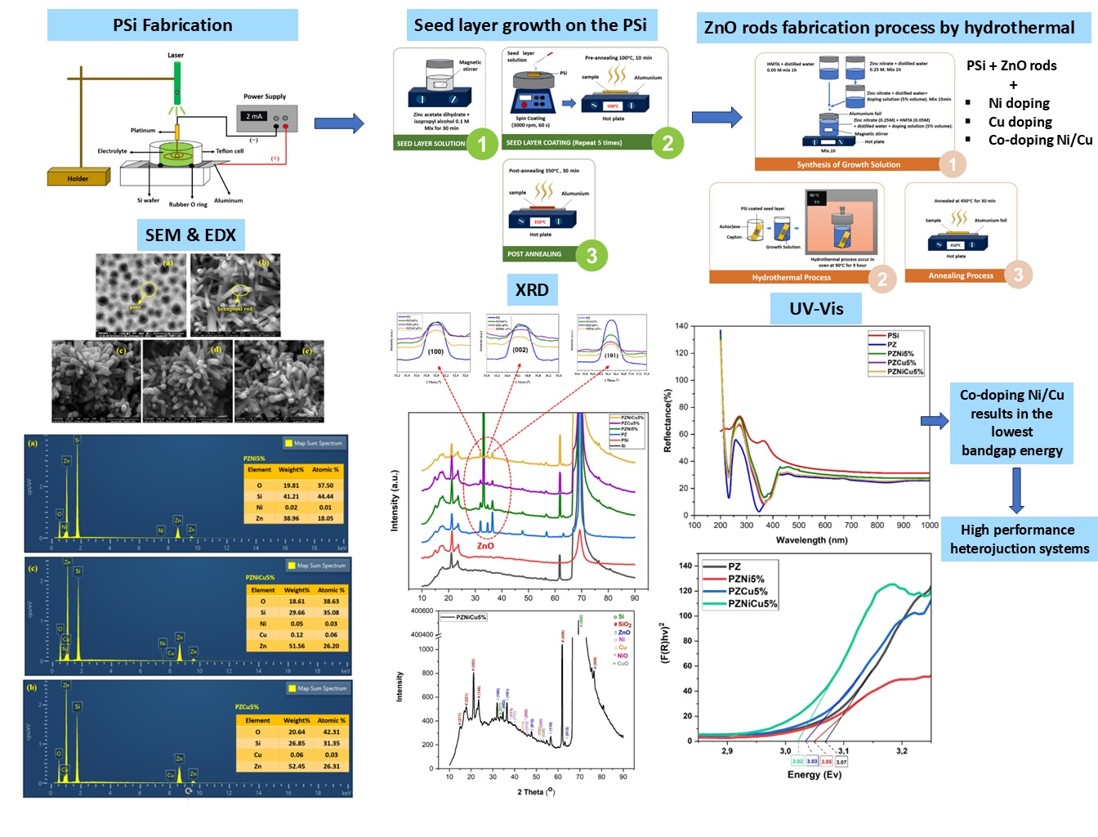
Zinc oxide (ZnO) is primarily used as a semiconductor material for photoanode applications, but its wide bandgap, fast charge recombination, and low conductivity limit its performance. Doping with Ni or Cu is necessary to narrow the bandgap, improve visible-light absorption, and enhance charge separation. Porous silicon (PSi) is employed as a substrate to enhance ZnO nucleation, increase surface area, and improve light absorption through its porous structure. Therefore, this study investigated the structural and optical properties of the Ni-doped, Cu-doped, and Ni/Cu-co-doped ZnO rods grown on porous silicon (PSi) substrates to optimize their potential for photoanodes. PSi was fabricated on n-type Si (100) wafers using the green laser-assisted electrochemical anodization method at 2 mA/cm2 for 10 min. Ni-doped, Cu-doped, and Ni/Cu-co-doped ZnO solutions were coated on the PSi substrates using a spin coater, and then the hydrothermal techniques were performed at 90°C for 9 h and followed by annealing at 450°C for 30 min. SEM analysis revealed hexagonal ZnO rods with average diameters ranging from 156.59 to 211.94 nm, increasing with Ni/Cu doping. XRD confirmed the presence of hexagonal wurtzite ZnO along with cubic phases of Si, Ni, Cu, and NiO, triclinic SiO₂ and monoclinic CuO. UV-Vis reflectance spectra showed enhanced reflectance and reduced bandgap energy with doping, indicating successful incorporation of Ni²⁺/Cu²⁺ into the ZnO. Specifically, the estimated band gap energies were 3.07 eV for pure ZnO (PZ), 3.05 eV for for Ni-doped ZnO rods (PZNi5%), 3.03 eV for Cu-doped ZnO rods (PZCu5%), and 3.02 eV for Ni/Cu-co-doped ZnO rods (PZNiCu5%). The smallest band gap (3.02 eV for PZNiCu5%) is advantageous for heterojunction solar cells as it enables broader visible-light harvesting.
HIGHLIGHTS
- Ni-doped ZnO rods, Cu-doped ZnO rods, and Ni/Cu-co-doped ZnO rods were successfully grown on porous silicon (PSi) substrates using a hydrothermal method.
- Doping modified the morphology of ZnO rods, producing flower-like hexagonal structures and increasing the average rod diameter.
- Successful incorporation of Ni²⁺ and Cu²⁺ ions into the ZnO lattice was verified by EDX, XRD, and optical analyses.
- Ni and Cu incorporation reduced the ZnO bandgap energy from 3.07 eV to 3.02 eV, indicating enhanced visible-light absorption.
- Ni/Cu co-doped ZnO rods exhibited the lowest bandgap and improved crystallinity, demonstrating strong potential for heterojunction photoanode applications.
GRAPHICAL ABSTRACT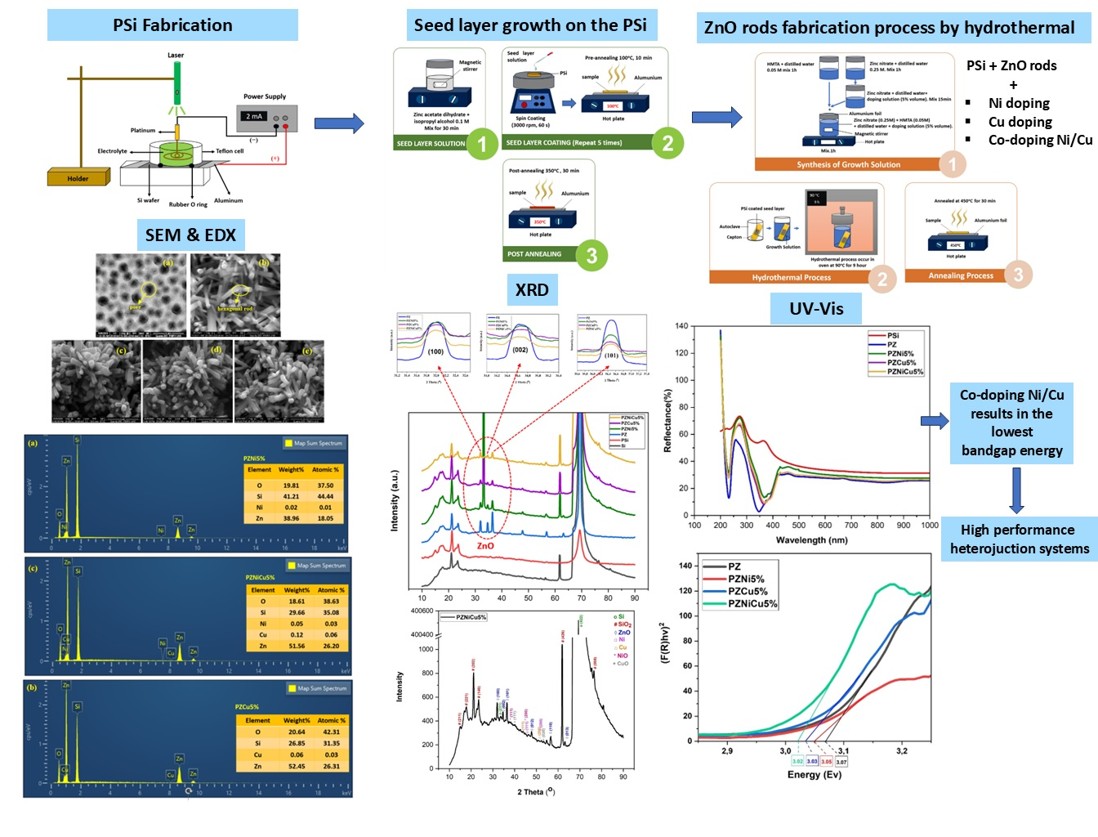
Downloads
References
PM Shirage, AK Rana, Y Kumar, S Sen, SG Leonardi and G Neri. Sr-and Ni-doping in ZnO nanorods synthesized by a simple wet chemical method as excellent materials for CO and CO2 gas sensing. RSC Advances 2016; 6(86), 82733-82742.
S Raha and M Ahmaruzzaman. ZnO nanostructured materials and their potential applications: Progress, challenges and perspectives. Nanoscale Advances 2022; 4(8), 1868-1925.
A Kołodziejczak-Radzimska and T Jesionowski. Zinc oxide—from synthesis to application: A review. Materials 2014; 7(4), 2833-2881.
V Saravade, ZC Feng, MT Nafisa, C Zhou, N Lu, B Klein and I Ferguson. Advances in growth, doping, and devices and applications of zinc oxide. Journal of Vacuum Science & Technology A 2024; 42(2), 020802.
GA Alharshan, AM Aboraia, MAM Uosif, IM Sharaf, ER Shaaban, M Saad, H ALMohiy and MM Elsenety. Optical band gap tuning, DFT understandings, and photocatalysis performance of ZnO nanoparticle-doped Fe compounds. Materials 2023; 16(7), 2676.
N Ben Moussa, M Lajnef, N Jebari, C Villebasse, F Bayle, J Chaste, A Madouri, R Chtourou and E Herth. Synthesis of ZnO sol-gel thin-films CMOS-Compatible. RSC Advances 2021; 11(37), 22723-22733.
S Goktas and A Göktaş. A comparative study on recent progress in efficient ZnO based nanocomposite and heterojunction photocatalysts: A review. Journal of Alloys and Compounds 2021; 863, 158734.
MH Jawad, AA Assi and AM Hameed. Hydrothermal synthesis of zinc oxide nanostructures using varied reactor designs: a comparative study. Plasmonics 2025; 20(9), 7883-7894.
M Julita, M Shiddiq and M Khair. Determination of band gap energy of ZnO/Au nanoparticles resulting in laser ablation in liquid. Indonesian Journal of Chemical Research 2022; 10(2), 83-87.
A Das and D Basak. Efficacy of ion implantation in zinc oxide for optoelectronic applications: A review. ACS Applied Electronic Materials 2021; 3(9), 3693-3714.
D Chu and S Li. Growth and electrical properties of doped ZnO by electrochemical deposition. New Journal of Glass and Ceramics 2012; 2(1), 13.
Y Zaman, MZ Ishaque, K Waris, M Shahzad, AB Siddique, MI Arshad, H Zaman, HM Ali, F Kanwal, M Aslam and M Mustaqeem. Modified physical properties of Ni doped ZnO NPs as potential photocatalyst and antibacterial agents. Arabian Journal of Chemistry 2023; 16(11), 105230.
MY Ali, MKR Khan, AMMT Karim, MM Rahman and M Kamruzzaman. Effect of Ni doping on structure, morphology and opto-transport properties of spray pyrolised ZnO nano-fiber. Heliyon 2020; 6(3), e03588.
Z Ma, F Ren, X Ming, Y Long and AA Volinsky. Cu-doped ZnO electronic structure and optical properties studied by first-principles calculations and experiments. Materials 2019; 12(1), 196.
U Jabeen, A Iqbal, M Aamir, Q Wali, I Ahmad, MNK Malghani and J Akhtar. Synthesis of Cu-doped ZnO for bulk heterojunction hybrid solar cells. Chemical Papers 2022; 76(8), 4743-4748.
M Anujency, MM Ibrahim, S Vinoth, V Ganesh and R Ade. Enhancing the properties of ZnO nanorods by Ni doping via the hydrothermal method for photosensor applications. Journal of Photochemistry and Photobiology A: Chemistry 2024; 449, 115379.
M Babikier, D Wang, J Wang, Q Li, J Sun, Y Yan, Q Yu and S Jiao. Cu-doped ZnO nanorod arrays: The effects of copper precursor and concentration. Nanoscale Research Letters 2014; 9(1), 199.
S N Sarangi, V Siva, B K Padhi and P K Sahoo. Synthesis of Cu doped ZnO nanorods for photosensitive UV detection application. Advanced Materials Letters 2017; 8(4), 524-530.
J Chauhan, N Shrivastav, A Dugaya and D Pandey. Synthesis and characterization of Ni and Cu doped ZnO. MOJ Polymer Science 2017; 1(1), 26-34.
HMS Ajmal, F Khan, NU Huda, S Lee, K Nam, HY Kim, T-H Eom and SD Kim. High-performance flexible ultraviolet photodetectors with Ni/Cu-codoped ZnO nanorods grown on PET substrates. Nanomaterials 2019; 9(8), 1067.
R Suryana, N Usholihah and M Diantoro. The effect of PSi pore structure on the characteristics of ZnO rods fabricated by hydrothermal method. Iranian Journal of Materials Science & Engineering 2024; 21(2), 1.
Y Rati, A A Umar, Y Hamzah and A S Rini. Seed mediated synthesis of hexagonal S-doped ZnO nanorod and its physical properties. Spektra: Jurnal Fisika dan Aplikasinya 2021; 6(1), 19-24.
JJ Dong, J Wu, HY Hao, J Xing, H Liu and H Gao. Synthesis of ZnO nanocrystals and application in inverted polymer solar cells. Nanoscale Research Letters 2017; 12(1), 529.
NS Ridhuan, K Abdul Razak, Z Lockman and A Abdul Aziz. Structural and morphology of ZnO nanorods synthesized using ZnO seeded growth hydrothermal method and its properties as UV sensing. PLoS One 2012; 7(11), e50405.
R Shabannia. Vertically aligned ZnO nanorods on porous silicon substrates: Effect of growth time. Progress in Natural Science: Materials International 2015; 25(2), 95-100.
R Suryana and NQ Aini. Analysis of porous silicon formation on N-type Si (100) using laser-assisted electrochemical anodization method. Journal of Physics and its Applications 2022; 4(2), 28-32.
Sehati, Cari, A Supriyanto, MH Abdullah and R Suryana. Current density effects on the morphological characteristic and reflectance of n-type porous silicon prepared the laser-assisted anodization. Journal of Physics: Conference Series 2025; 2945(1), 012036.
NI Rusli, M Tanikawa, MR Mahmood, K Yasui and AM Hashim. Growth of high-density zinc oxide nanorods on porous silicon by thermal evaporation. Materials 2012; 5(12), 2817-2832.
R Dalvand, S Mahmud and J Rouhi. Direct growth of flower-like ZnO nanostructures on porous silicon substrate using a facile low-temperature technique. Materials Letters 2015; 160, 444-447.
F Yuliasari, A Aprilia and R Hidayat. Improved dye-sensitized solar cell performance with hedgehog-like shaped ZnO nanorods grown using ZnO nanoparticles seed layer. Materials Today: Proceedings 2022; 52, 248-251.
M Shirvani and L Naji. Interface engineering of electrochemically deposited ZnO nanorods as electron transport layer in polymer solar cells using organic dyes. Materials Chemistry and Physics 2021; 259, 124064.
K Nam, S Lee, JH Kim, GY Hong and SD Kim. Comparative evaluation of ZnO nanorod material properties and UV photodetector performance with various transition metal dopings. Journal of Materials Science: Materials in Electronics 2021; 32(23), 27596-27606.
SY Pung, CS Ong, KM Isha and MH Othman. Synthesis and characterization of Cu-doped ZnO nanorods. Sains Malaysiana 2014; 43(2), 273-281.
M Ashokkumar and S Muthukumaran. Microstructure, optical and FTIR studies of Ni, Cu co-doped ZnO nanoparticles by co-precipitation method. Optical Materials 2014; 37, 671-678.
S Anandan and S Muthukumaran. Microstructural, crystallographic and optical characterizations of Cu-doped ZnO nanoparticles co-doped with Ni. Journal of Materials Science: Materials in Electronics 2015; 26(6), 4298-4307.
MR Al-Mamun, MZ Iqbal Rokon, MA Rahim, MI Hossain, MS Islam, MR Ali, MS Bacchu, H Waizumi, T Komeda and MZ Hossain Khan. Enhanced photocatalytic activity of Cu and Ni-doped ZnO nanostructures: A comparative study of methyl orange dye degradation in aqueous solution. Heliyon 2023; 9(5), e16506.
R Rooydell, S Brahma, RC Wang, MR Modaberi, F Ebrahimzadeh and CP Liu. Cu doped ZnO nanorods with controllable Cu content by using single metal organic precursors and their photocatalytic and luminescence properties. Journal of Alloys and Compounds 2017; 691, 936-945.
PB Negi, M Pathak, KS Rawat, N Sahoo, A Rana, C Tewari, S Biswas, YC Jung and NG Sahoo. Green synthesis and machine learning driven analysis of SiO2 mixed carbon nanomaterial from agriwaste (Rice Husk) for supercapacitor applications. Materials Chemistry and Physics 2026; 348(1), 131536.
AJ Tzou, KF Chien, HY Lai, JT Ku, L Lee, WC Fan and WC Chou. The study of self-assembled ZnO nanorods grown on Si (111) by plasma-assisted molecular beam epitaxy. Journal of Crystal Growth 2013; 378, 466-469.
ZA Rahmatika and M Toifur. Determining the particle size of Cu and Ni in thin Cu/Ni films using the Williamson-Hall method. Journal of Novel Engineering Science and Technology 2023; 2(01), 26-33.
ZH Alhashem. Ni-doped ZnO nanoparticles derived by the sol-gel method: Structural, optical, and magnetic characteristics. Arabian Journal of Chemistry 2024; 17(5), 105701.
E Asikuzun, O Ozturk, L Arda and C Terzioglu. Preparation, growth and characterization of nonvacuum Cu-doped ZnO thin films. Journal of Molecular Structure 2018; 1165, 1-7.
AE Adeoye, V Owoeye and E Ogunmola. Structural, optical and rectifying properties of spray deposited Ni doped and undoped ZnO thin films. IOSR Journal of Applied Physics 2021; 13(3), 74-79.
SY Han, BK Paul and C-H Chang. Nanostructured ZnO as biomimetic anti-reflective coatings on textured silicon using a continuous solution process. Journal of Materials Chemistry 2012; 22(43), 22906-22912.
X Pu, J Liu, J Liang, Y Xia, W Feng, Y Wang and X Yu. Effective CdS/ZnO nanorod arrays as antireflection coatings for light trapping in c-Si solar cells. RSC Advances 2014; 4(44), 23149-23154.
L Agarwal, BK Singh, S Tripathi and P Chakrabarti. Fabrication and characterization of Pd/cu doped ZnO/Si and Ni/cu doped ZnO/Si Schottky diodes. Thin Solid Films 2016; 612, 259-266.
K Mosalagae, DM Murape and LM Lepodise. Effects of growth conditions on properties of CBD synthesized ZnO nanorods grown on ultrasonic spray pyrolysis deposited ZnO seed layers. Heliyon 2020; 6(7), e04458.
D Tamilselvi, N Velmani and K Rathidevi. Effect of ni-doping on the structural and optical properties of ZnO nanoparticles prepared by chemical precipitation method. Journal of Ovonic Research 2020; 16(2), 123-130.
J Ridwan, J Yunas, AA Umar, AM Raub, AA Hamzah, J Kazmi, ABD Nandiyanto, RE Pawinanto and I Hamidah. Vertically aligned Cu-doped ZnO nanorods for photocatalytic activity enhancement. International Journal of Electrochemical Science 2022; 17(8), 220813.
MS Salleh, MS Aziz, MF Omar, U Niaz, F Abdullah, N Mufti, MS Roslan, N Sholeha and AI Rahmawati. The impact of nickel doping on the structural, morphological, optical and magnetic characteristics of zinc oxide nanorods. Journal of Physics: Conference Series 2025; 2974(1), 012018.
WD Hussain, MH Jawad, SF Khaleel and KA Aadim. Effect of laser energy on the properties of SnO:Cd nanoparticles synthesized via pulsed laser ablation in liquid. Russian Physics Journal 2025; 68(11), 1750-1757.
Downloads
Published
How to Cite
Issue
Section
License
Copyright (c) 2026 Walailak University

This work is licensed under a Creative Commons Attribution-NonCommercial-NoDerivatives 4.0 International License.





