
Partial Least Squares Regression Combined with Various Variable Selection Techniques to Determine Pork Adulteration in Ground Beef and Lamb Using Visible Near Infrared Hyperspectral Imaging
DOI:
https://doi.org/10.48048/tis.2026.13765Keywords:
Adulteration, Hyperspectral imaging, Meat, Partial least square regression, Wavelength selectionAbstract
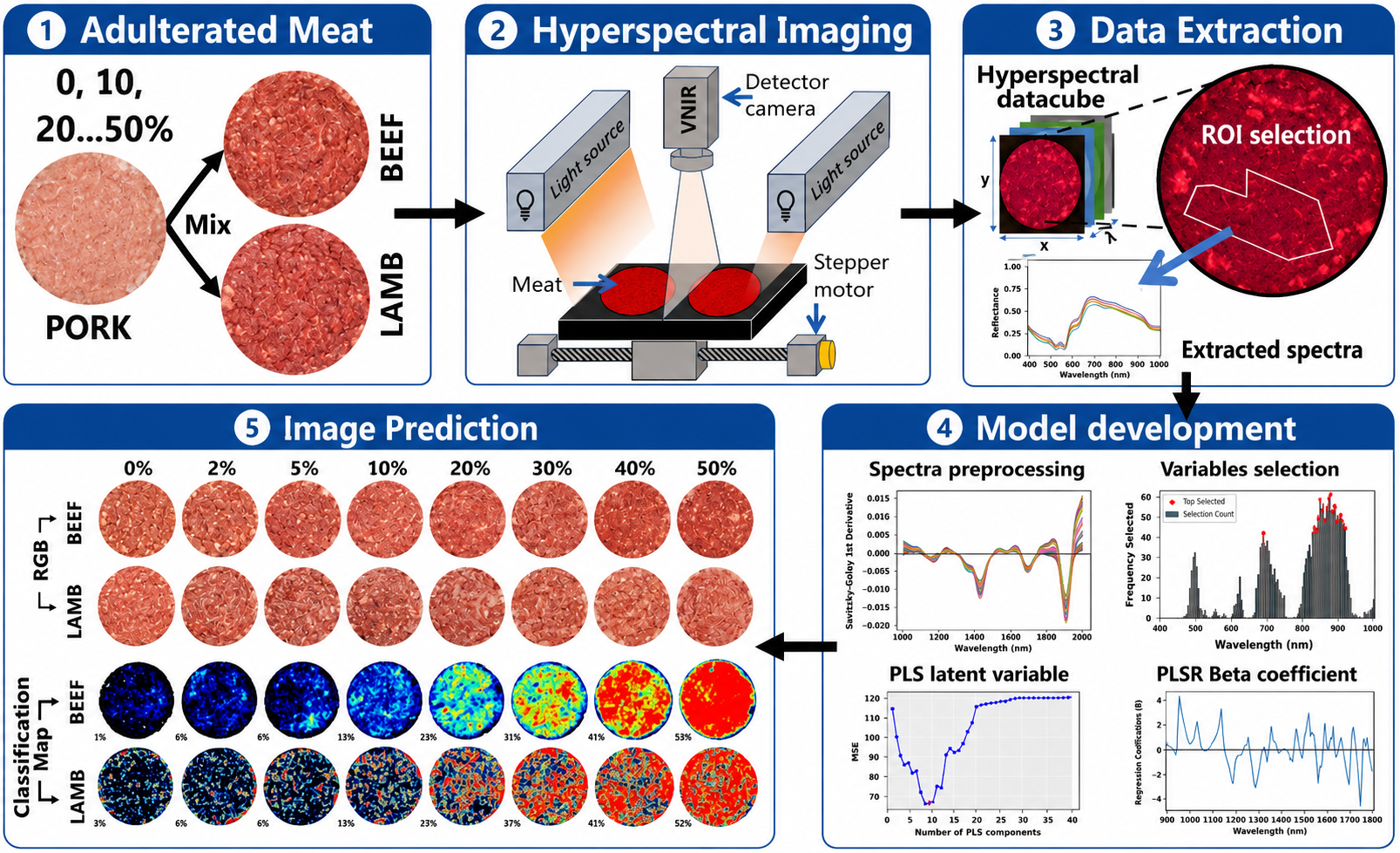
Meat adulteration raises special concerns regarding quality, safety, and socio-cultural values. This study integrated visible-near-infrared hyperspectral imaging (Vis-NIR HSI) at 397.4 - 1,003.8 nm and partial least squares regression (PLSR) to determine the concentration of pork added in ground beef and lamb. Moreover, this study compared various wavelength-selection methods, i.e., Competitive Adaptive Reweighted Sampling (CARS), Monte Carlo Uninformative Variables Elimination (MCUVE), Successive Projections Algorithm (SPA), and Variable Importance in Projection (VIP). Pork at concentrations of 2%, 5%, 10%, 20%, 30%, 40%, and 50% by weight was added to ground beef and lamb, and the 34 samples were scanned using the Vis-NIR HSI. PLSR models were developed using full-wavelength and selected-wavelength data obtained from CARS, MCUVE, SPA, and VIP. Among feature-selection approaches, the SPA produced the most accurate models with coefficient determination (R²) values of 0.974 for calibration, 0.952 for cross-validation, and 0.955 for prediction for the Beef + Pork model, as well as yielded R² values of 0.922 for calibration, 0.847 for cross-validation, and 0.803 for prediction for the Lamb + Pork model. Chemical maps visualized the distribution of pork adulterants, with clearer spatial patterns in beef than in lamb. The results confirm the use of Vis-NIR HSI for rapid, non-destructive detection of meat adulteration.
HIGHLIGHTS
- Vis-NIR HSI (400 - 1,000 nm) quantified pork adulteration in beef and lamb.
- Preprocessing affected PLSR accuracy.
- SPA-selected wavelengths improved PLSR prediction of pork concentration in beef and lamb.
- At the NIR region, beef samples showed higher separability from pork than from lamb.
- Pixel-level prediction enabled spatial mapping of pork distribution in beef and lamb.
GRAPHICAL ABSTRACT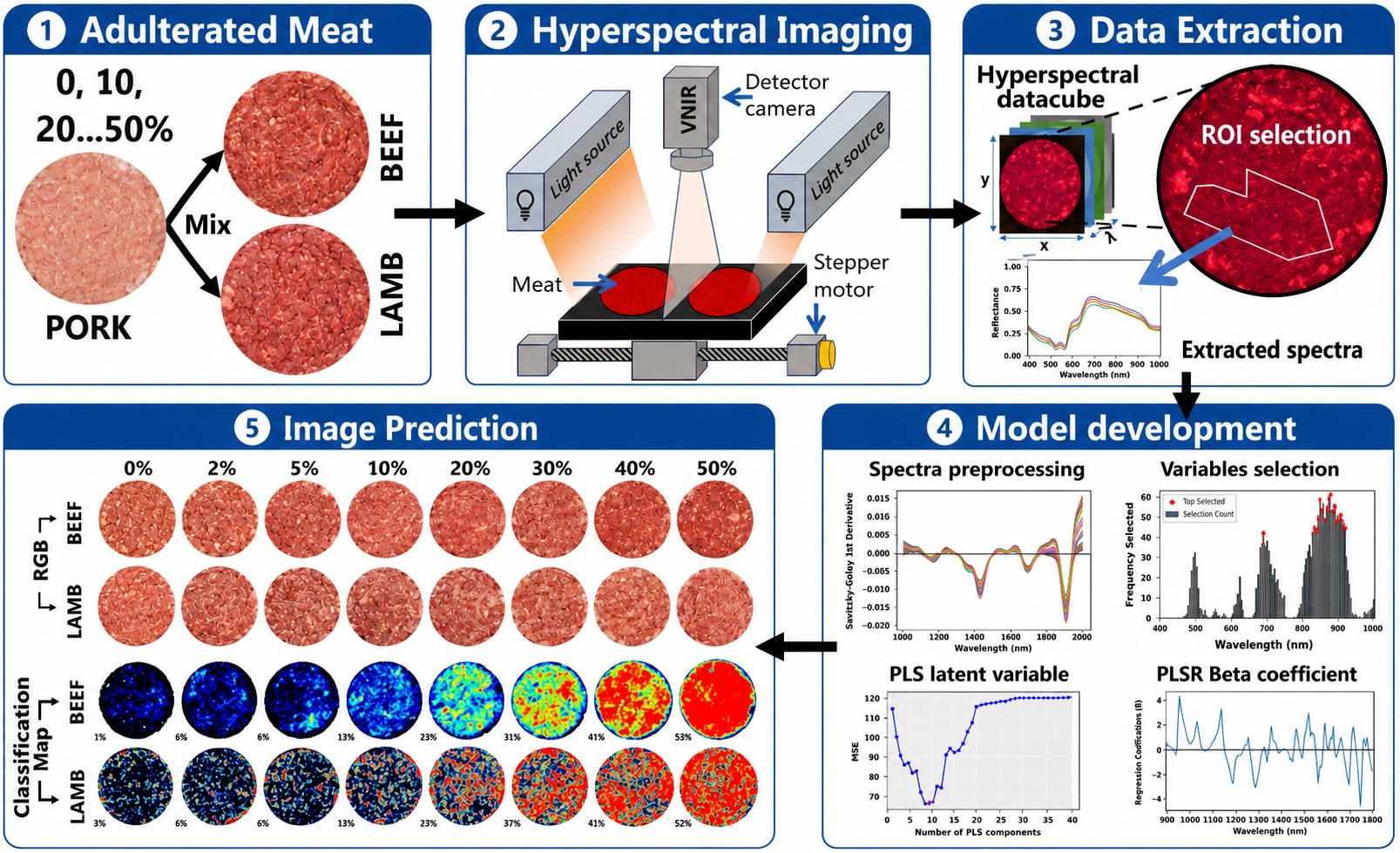
Downloads
References
MM Bhat, H Jalal, PA Para, SA Bukhari, S Ganguly, AA Bhat, R Wakchaure and K Qadri. Fraudulent adulteration/Substitution of meat: A review. Journal of Recent Research and Applied Studies 2015; 2(12), 21-33.
L Manning and JM Soon. Food safety, food fraud, and food defense: A fast evolving literature. Journal of Food Science 2016; 81(4), R823-R834.
R Johnson. Food fraud and ‘Economically motivated adulteration’ of food and food ingredients. Congressional Research Service, Washington DC, 2014.
Z Chen. Food adulteration: Understanding the risks and safeguarding our health. Journal of Food Microbiology, Safety & Hygiene 2023; 8(1), 1-2.
K Robson, M Dean, S Brooks, S Haughey and C Elliott. A 20-year analysis of reported food fraud in the global beef supply chain. Food Control 2020; 116, 107310.
X Li, M Zang, D Li, K Zhang, Z Zhang and S Wang. Meat food fraud risk in Chinese markets 2012-2021. npj Science of Food 2023; 7(1), 12.
MR Lozano, JH Chávez, FR López, RM Medina, ED Suárez, RM Medina and TM Ngapo. Horse meat sold as beef and consequent clenbuterol residues in the unregulated Mexican marketplace. Food Control 2020; 110, 107028.
M Font-i-Furnols and L Guerrero. Consumer preference, behavior and perception about meat and meat products: An overview. Meat Science 2014; 98(3), 361-371.
M Tura, MA Gagliano, E Valli, M Petracci and TG Toschi. A methodological review in sensory analyses of chicken meat. Poultry Science 2024; 103(11), 104083.
C Ruiz-Capillas and AM Herrero. Sensory analysis and consumer research in new product development. Foods 2021; 10(3), 582.
C Yang, G Zhong, S Zhou, Y Guo, D Pan, S Wang, Q Liu, Q Xia and Z Cai. Detection and characterization of meat adulteration in various types of meat products by using a high-efficiency multiplex polymerase chain reaction technique. Frontiers in Nutrition 2022; 9, 979977.
C Alamprese, JM Amigo, E Casiraghi and SB Engelsen. Identification and quantification of turkey meat adulteration in fresh, frozen-thawed and cooked minced beef by FT-NIR spectroscopy and chemometrics. Meat Science 2016; 121, 175-181.
M Modzelewska-Kapituła and S Jun. The application of computer vision systems in meat science and industry-A review. Meat Science 2022; 192, 108904.
IC Setiadi, AM Hatta, S Koentjoro, S Stendafity, NN Azizah and WY Wijaya. Adulteration detection in minced beef using low-cost color imaging system coupled with deep neural network. Frontiers in Sustainable Food Systems 2022; 6, 1073969.
RE Masithoh, A Zahroh, MFR Pahlawan and L Rahmawati. Pork adulteration in beef and mutton detection using visible near-infrared (Vis-NIR) spectroscopy and chemometrics. Pertanika Journal of Science & Technology 2025; 33(85), 109-119.
S Weng, B Guo, P Tang, X Yin, F Pan, J Zhao, L Huang and D Zhang. Rapid detection of adulteration of minced beef using Vis/NIR reflectance spectroscopy with multivariate methods. Spectrochimica Acta Part A: Molecular and Biomolecular Spectroscopy 2020; 230, 118005.
A Rady and A Adedeji. Assessing different processed meats for adulterants using visible-near-infrared spectroscopy. Meat Science 2018; 136, 59-67.
A López-Maestresalas, K Insausti, C Jarén, C Pérez-Roncal, O Urrutia, MJ Beriain and S Arazuri. Detection of minced lamb and beef fraud using NIR spectroscopy. Food Control 2019; 98, 465-473.
F Mabood, R Boqué, AY Alkindi, A Al-Harrasi, IS Al Amri, S Boukra, F Jabeen, J Hussain, G Abbas, Z Naureen, QMI Haq, HH Shah, A Khan, SK Khalaf and I Kadim. Fast detection and quantification of pork meat in other meats by reflectance FT-NIR spectroscopy and multivariate analysis. Meat Science 2020; 163, 108084.
T Leng, F Li, L Xiong, Q Xiong, M Zhu and Y Chen. Quantitative detection of binary and ternary adulteration of minced beef meat with pork and duck meat by NIR combined with chemometrics. Food Control 2020; 113, 107203.
M Manley. Near-infrared spectroscopy and hyperspectral imaging: Non-destructive analysis of biological materials. Chemical Society Reviews 2014; 43(24), 8200-8214.
Y Liu, H Pu and DW Sun. Hyperspectral imaging technique for evaluating food quality and safety during various processes: A review of recent applications. Trends in Food Science & Technology 2017; 69, 25-35.
WH Su and DW Sun. Evaluation of spectral imaging for inspection of adulterants in terms of common wheat flour, cassava flour and corn flour in organic Avatar wheat (Triticum spp.) flour. Journal of Food Engineering 2017; 200, 59-69.
RE Masithoh, MFR Pahlawan, J Kim, MAA Arief, H Kurniawan, RAP Hernanda, HZ Amanah and BK Cho. Shortwave infrared hyperspectral imaging for the determination of pork adulteration in minced beef and lamb. Food Control 2024; 166, 110736.
RE Masithoh, RAP Hernanda, MFR Pahlawan, J Kim, HZ Amanah and BK Cho. Shortwave near infrared-hyperspectral imaging spectra to detect pork adulteration in beef using partial least square regression coupled with VIP wavelength selections method. Optics 2025; 6(1), 1.
M Kamruzzaman, DW Sun, G ElMasry and P Allen. Fast detection and visualization of minced lamb meat adulteration using NIR hyperspectral imaging and multivariate image analysis. Talanta 2013; 103, 130-136.
M Peyvasteh, A Popov, A Bykov and I Meglinski. Meat freshness revealed by visible to near-infrared spectroscopy and principal component analysis. Journal of Physics Communications 2020; 4(9), 095011.
MM Hasan, MMA Chaudhry, C Erkinbaev, J Paliwal, SP Suman and A Rodas-Gonzalez. Application of Vis-NIR and SWIR spectroscopy for the segregation of bison muscles based on their color stability. Meat Science 2022; 188, 108774.
SD Osborne, RB Jordan and R Künnemeyer. Method of wavelength selection for partial least squares. Analyst 1997; 122(12), 1531-1537.
J Jin and Q Wang. Evaluation of informative bands used in different PLS regressions for estimating leaf biochemical contents from hyperspectral reflectance. Remote Sensing 2019; 11(2), 11-15.
J Fu, HD Yu, Z Chen and YH Yun. A review on hybrid strategy-based wavelength selection methods in analysis of near-infrared spectral data. Infrared Physics & Technology 2022; 125, 104231.
SC Seidemen, HR Cross, GC Smith and PR Durland. Factors associated with fresh meat color: A review. Journal of Food Quality 1984; 6, 211-237.
F Pedregosa, G Varoquaux, A Gramfort, V Michel, B Thirion, O Grisel, M Blondel, A Müller, J Nothman, G Louppe, P Prettenhofer, R Weiss, V Dubourg, J Vanderplas, A Passos, D Cournapeau, M Brucher, M Perrot and É Duchesnay. Scikit-Learn: Machine learning in Python. Journal of Machine Learning Research 2011; 12, 2825-2830.
P Virtanen, R Gommers, TE Oliphant, M Haberland, T Reddy, D Cournapeau, E Burovski, P Peterson, W Weckesser, J Bright, SJ van der Walt, M Brett, J Wilson, KJ Millman, N Mayorov, ARJ Nelson, E Jones, R Kern, E Larson, …, P van Mulbregt. SciPy 1.0: Fundamental algorithms for scientific computing in Python. Nature Methods 2020; 17(3), 261-272.
L Zhang, J Sun, X Zhou, A Nirere, X Wu and R Dai. Classification detection of saccharin jujube based on hyperspectral imaging technology. Journal of Food Processing and Preservation 2020; 44(8), e14591.
T Mehmood, KH Liland, L Snipen and S Sæbø. A review of variable selection methods in partial least squares regression. Chemometrics and Intelligent Laboratory Systems 2012; 118, 62-69.
M Talebi, G Schuster, RA Shellie, R Szucs and PR Haddad. Performance comparison of partial least squares-related variable selection methods for quantitative structure retention relationships modelling of retention times in reversed-phase liquid chromatography. Journal of Chromatography A 2015; 1424, 69-76.
F Buckermann, S Heil and A Krause. AUSWAHL - A scikit-learn compatible package for wavelength selection, Available at: https://auswahl.readthedocs.io/en/latest/index.html, accessed January 2026.
H Liu, Y Yuan, G Wang, W Xu, L Zhao and J Li. An advanced variable selection method based on information gain and Fisher criterion reselection iteration for multivariate calibration. Chemometrics and Intelligent Laboratory Systems 2023; 235, 104796.
DW Gee, R Phitayakorn, A Khatri, K Butler, JT Mullen and ER Petrusa. A pilot study to gauge effectiveness of standardized patient scenarios in assessing general surgery milestones. Journal of Surgical Education 2016; 73(6), e1-e8.
EA Elamir. A graphical approach for Friedman test: Moments approach. arXiv 2022; 2202, 09131.
M Terpiłowski. scikit-posthocs: Pairwise multiple comparison tests in Python. Journal of Open Source Software 2019; 4(36), 1169.
A Kazemi, A Mahmoudi, H Veladi, A Javanmard and M Khojastehnazhand. Rapid identification and quantification of intramuscular fat adulteration in lamb meat with VIS - NIR spectroscopy and chemometrics methods. Journal of Food Measurement and Characterization 2022; 16(3), 2400-2410.
Å Rinnan, F van den Berg and SB Engelsen. Review of the most common pre-processing techniques for near-infrared spectra. TrAC Trends in Analytical Chemistry 2009; 28(10), 1201-1222.
I Bilbao, J Bilbao and C Feniser. Adopting some good practices to avoid overfitting in the use of machine learning. WSEAS Transactions on Mathematics 2018; 17, 274-279.
J Rodrigues, A Alves, H Pereira, DDS Perez, G Chantre and M Schwanninger. NIR PLSR results obtained by calibration with noisy, low-precision reference values: Are the results acceptable? Holzforschung 2006; 60(4), 402-408.
CPJ Chen, RR White and R Wright. Common pitfalls in evaluating model performance and strategies for avoidance in agricultural studies. Computers and Electronics in Agriculture 2025; 234, 110126.
SS Vasanthadev and P Shanthi. Influence of data pre-processing techniques for PLSR model to predict blood glucose by NIR spectroscopy. Optics and Spectroscopy 2022; 130(5), 613.
RA Klein, KA Ratliff, M Vianello, RB Adams, Š Bahník, MJ Bernstein, K Bocian, MJ Brandt, B Brooks, CC Brumbaugh, Z Cemalcilar, J Chandler, W Cheong, WE Davis, T Devos, M Eisner, N Frankowska, D Furrow, EM Galliani, …, BA Nosek. Investigating variation in replicability: A ‘many labs’ replication project. Social Psychology 2014; 45(3), 142-152.
J Engel, J Gerretzen, E Szymańska, JJ Jansen, G Downey, L Blanchet and LM Buydens. Breaking with trends in pre-processing? TrAC Trends in Analytical Chemistry 2013; 50, 96-106.
M Enser, K Hallett, B Hewitt, GAJ Fursey and JD Wood. Fatty acid content and composition of English beef, lamb and pork at retail. Meat Science 1996; 42(4), 443-456.
A Listrat, B Lebret, I Louveau, T Astruc, M Bonnet, L Lefaucheur, B Picard and J Bugeon. How muscle structure and composition influence meat and flesh quality. The Scientific World Journal 2016; 2016(1), 3182746.
L Lefaucheur. A second look into fibre typing - Relation to meat quality. Meat Science 2010; 84(2), 257-270.
S Schiaffino and C Reggiani. Fiber types in mammalian skeletal muscles. Physiological Reviews 2011; 91(4), 1447-1531.
T Mehmood, S Sæbø and KH Liland. Comparison of variable selection methods in partial least squares regression. Journal of Chemometrics 2020; 34(6), e3226.
Z Xiaobo, Z Jiewen, MJW Povey, M Holmes and M Hanpin. Variables selection methods in near-infrared spectroscopy. Analytica Chimica Acta 2010; 667(1-2), 14-32.
CE Agbangba, ES Aide, H Honfo and RG Kakai. On the use of post-hoc tests in environmental and biological sciences: A critical review. Heliyon 2024; 10(3), e25131.
H Li, Y Liang, Q Xu and D Cao. Key wavelengths screening using competitive adaptive reweighted sampling method for multivariate calibration. Analytica Chimica Acta 2009; 648(1), 77-84.
W Cai, Y Li and X Shao. A variable selection method based on uninformative variable elimination for multivariate calibration of near-infrared spectra. Chemometrics and Intelligent Laboratory Systems 2008; 90(2), 188-194.
H Ayaz, M Ahmad, A Sohaib, MN Yasir, MA Zaidan, M Ali, MH Khan and Z Saleem. Myoglobin-based classification of minced meat using hyperspectral imaging. Applied Sciences 2020; 10(19), 6862.
A Aït-Kaddour, M Loudiyi, O Boukria, J Safarov, S Sultanova, D Andueza, A Listrat and Y Cahyana. Beef muscle discrimination based on two-trace two-dimensional correlation spectroscopy (2T2D COS) combined with snapshot visible-near infrared multispectral imaging. Meat Science 2024; 214, 109533.
MA Hashem, A Ahmmed and MM Hasan. Non-destructive discrimination of fresh, aged, and frozen-thawed beef using portable near-infrared spectroscopy combined with explainable artificial intelligence. LWT 2025; 236, 118659.
N Morsy and DW Sun. Robust linear and non-linear models of NIR spectroscopy for detection and quantification of adulterants in fresh and frozen-thawed minced beef. Meat Science 2013; 93(2), 292-302.
G ElMasry, DW Sun and P Allen. Non-destructive determination of water-holding capacity in fresh beef by using NIR hyperspectral imaging. Food Research International 2011; 44(9), 2624-2633.
D Cozzolino and I Murray. Identification of animal meat muscles by visible and near infrared reflectance spectroscopy. LWT - Food Science and Technology 2004; 37(4), 447-452.
M Kamruzzaman and S Oshita. Hyperspectral imaging in tandem with multivariate analysis and image processing for non-invasive detection and visualization of pork adulteration in minced beef. Analytical Methods 2015; 7, 7496-7502.
X Zheng, Y Li, W Wei and Y Peng. Detection of adulteration with duck meat in minced lamb meat by using visible near-infrared hyperspectral imaging. Meat Science 2019; 149, 55-62.
S León-Ecay, K Insausti, A López-Maestresalas and N Prieto. Non-destructive spectroscopy-based technologies for meat and meat product discrimination - A review. Meat Science 2025; 228, 109893.
A Dashti, J Müller-Maatsch, E Roetgerink, M Wijtten, Y Weesepoel, H Parastar and H Yazdanpanah. Comparison of a portable Vis-NIR hyperspectral imaging and a snapscan SWIR hyperspectral imaging for evaluation of meat authenticity. Food Chemistry: X 2023; 18, 100667.
A Dashti, J Müller-Maatsch, Y Weesepoel, H Parastar, F Kobarfard, B Daraei, MHS AliAbadi and H Yazdanpanah. The feasibility of two handheld spectrometers for meat speciation combined with chemometric methods and its application for halal certification. Foods 2021; 11(1), 71.
D Wu and D Sun. Advanced applications of hyperspectral imaging technology for food quality and safety analysis and assessment: A review - Part II: Applications. Innovative Food Science & Emerging Technologies 2013; 19, 15-28.
Downloads
Published
How to Cite
Issue
Section
License
Copyright (c) 2026 Walailak University

This work is licensed under a Creative Commons Attribution-NonCommercial-NoDerivatives 4.0 International License.





