
Influence of Extraction Temperature on Physicochemical Characteristics of Indigenous Java Coffee Bean Extract
DOI:
https://doi.org/10.48048/tis.2026.12678Keywords:
Coffee bean, Ethanol, Soxhlet extraction, Temperature, YieldAbstract
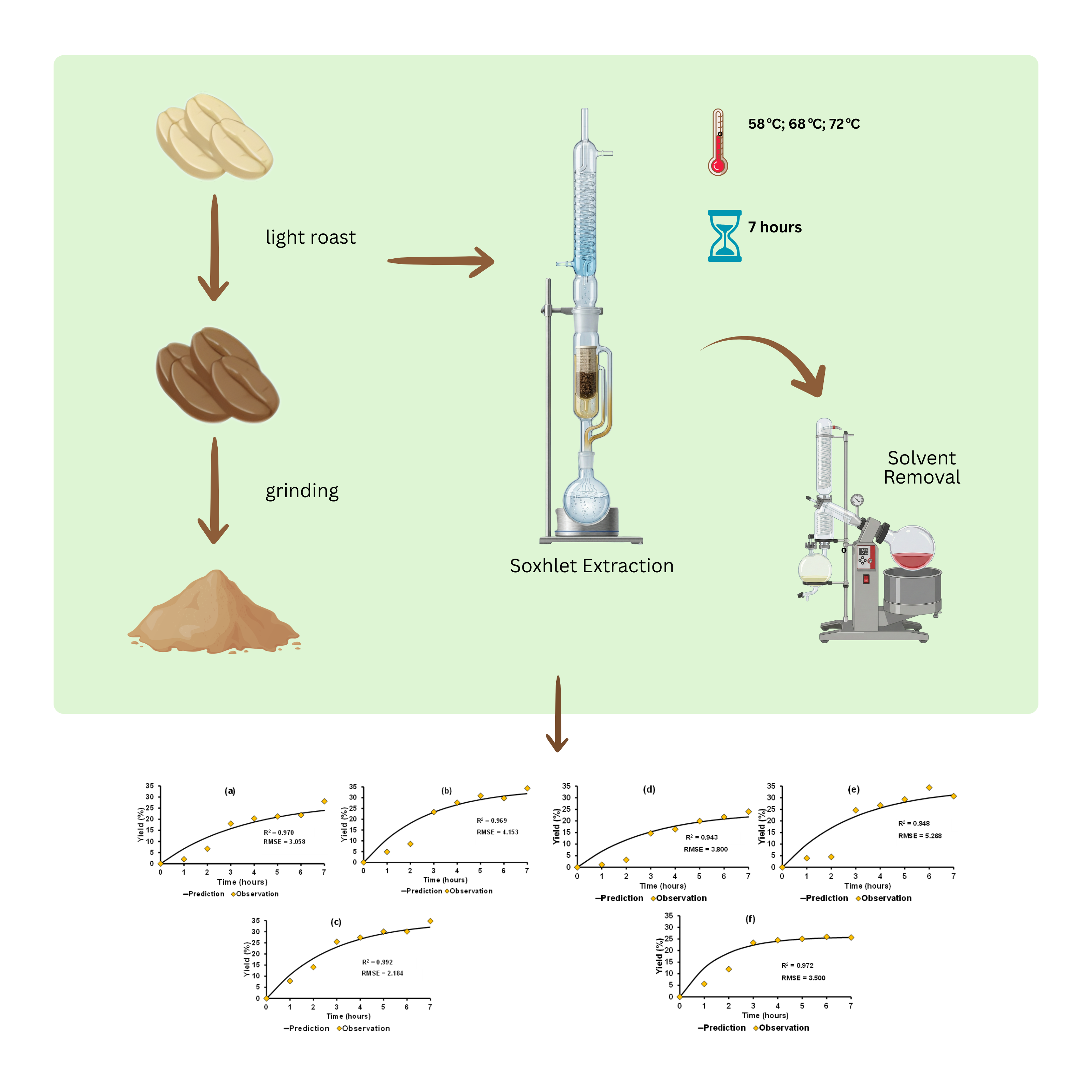
This study investigated the influence of extraction temperature on the physicochemical characteristics of Arabica and Robusta coffee bean extracts from Indonesia using Soxhlet extraction with 50% ethanol as a solvent. Light-roasted coffee beans were extracted at three different temperatures: 58 ± 2 °C, 68 ± 2 °C, and 76 ± 2 °C. The results showed that extraction yield increased over time; however, at higher temperatures, yield declined after 6 h, likely due to compound degradation or solvent saturation. Kinetic modelling effectively described the extraction process, with the extraction rate for Arabica increasing from 0.398 to 0.480 %/h (R² = 0.953 to 0.981), while Robusta was more temperature-sensitive, rising from 0.394 to 0.686 %/h (R² = 0.921 to 0.971). As the extraction temperature increased, Robusta extracts exhibited higher refractive index and specific gravity than Arabica. Additionally, significant colour changes were observed in both coffee types (p < 0.05) based on L*, a*, b*, and Hue angle values, with Arabica extracts appearing darker than Robusta. Higher temperatures also resulted in increased total fat content, rising from 0.64 to 3.05 %wb in Arabica and from 0.62 to 1.86 %wb in Robusta. In contrast, phenolic content decreased with increasing temperature, from 0.10 to 0.09 g GA/g in Arabica and from 0.17 to 0.13 g GA/g in Robusta. The optimal extraction temperature for maximizing yield and physicochemical properties may vary depending on the coffee type (Arabica or Robusta).
HIGHLIGHTS
- Soxhlet extraction using ethanol was validated as a green alternative to hexane for indigenous Java coffee.
- Increasing temperature significantly improved extraction rates, especially for Robusta.
- High temperatures maximized oil yield but degraded heat-sensitive phenolic compounds.
- Refractive index and specific gravity increased with temperature, reflecting higher solute concentration.
GRAPHICAL ABSTRACT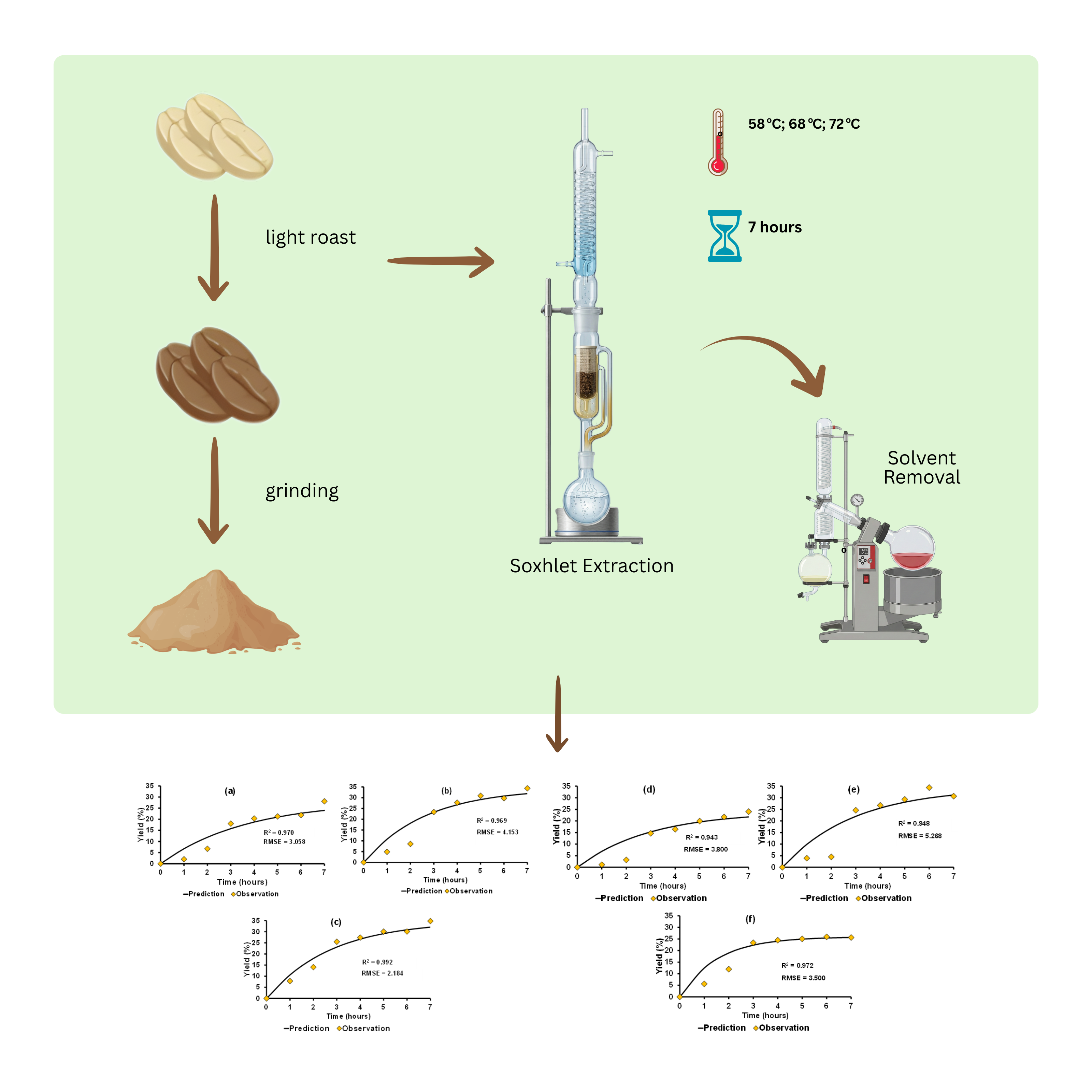
Downloads
References
USDA. Agricultural Statistics 2010. U.S. Government Printing, America, 2011.
Badan Pusat Statistik, Available at: https://webapi.bps.go.id, accessed January 2024.
MS Kusmulyono, RA Rachman and VP Gunawan. Five forces analysis of coffee business industry in Temanggung Regency of Central Java. Maker: Jurnal Manajemen 2023; 9(1), 76-89.
A Farah. Coffee Constituents. In: YF Chu (Ed.). Coffee: Emerging Health Effects and Disease Prevention. Blackwell Publishing Ltd., Oxford, 2012, pp. 21-58.
T Leroy, F Ribeyre, B Bertrand, P Charmetant, M Dufour, C Montagnon, P Marraccini and D Pot. Genetics of coffee quality. Brazilian Journal of Plant Physiology 2006; 18(1), 229-242.
HF Nadya, U Ahmad and S Samsudin. Improving the Taste of robusta coffee by fermentation with yeast inoculum and its effect on caffeine content. Jurnal Teknik Pertanian Lampung 2024; 13(2), 298-308.
G Yeni, K Syamsu, E Mardliyati and H Muchtar. Determination of process technology on making of pure gambier and standardized catechin from raw gambier. Journal of Industrial R & D 2017; 7(1), 1-10.
YH Dulanlebit and Hernani. Overview of extraction methods for extracting seaweed and its applications. Jurnal Penelitian Pendidikan IPA 2023; 9(2), 817-824.
K Patel, N Panchal and P Ingle. Review of extraction techniques extraction methods: Microwave, Ultrasonic, Pressurized Fluid, Soxhlet Extraction, Etc. International Journal of Advanced Research in Chemical Science 2019; 6(3), 6-21.
D Naviglio, P Scarano, M Ciaravolo and M Gallo. Rapid solid-liquid dynamic extraction (RSLDE): A powerful and greener alternative to the latest solid-liquid extraction techniques. Foods 2019; 8(7), 245.
B Zhuang, G Ramanauskaite, ZY Koa and ZG Wang. Like dissolves like: A first-principles theory for predicting liquid miscibility and mixture dielectric constant. Science Advances 2021; 7(7), 7275.
QW Zhang, LG Lin and WC Ye. Techniques for extraction and isolation of natural products: A comprehensive review. Chinese Medicine 2018; 13, 20.
SLR De Luna, RE Ramírez-Garza and SOS Saldívar. Environmentally friendly methods for flavonoid extraction from plant material: Impact of their operating conditions on yield and antioxidant properties. The Scientific World Journal 2020; 2020, 6792069.
F Chemat, N Rombaut, AG Sicaire, A Meullemiestre, AS Fabiano-Tixier and M Abert-Vian. Ultrasound assisted extraction of food and natural products. Mechanisms, techniques, combinations, protocols and applications. A review. Ultrasonics Sonochemistry 2017; 34, 540-560.
I Luksta and K Spalvins. Methods for extraction of bioactive compounds from products: A review. Environmental and Climate Technologies 2023; 27(1), 422-437.
NS Caetano, VFM Silvaa and TM Mata. Valorization of coffee grounds for biodiesel production. Chemical Engineering Transactions 2012; 26, 267-272.
I Efthymiopoulos, P Hellier, N Ladommatos, A Russo-Profili, A Eveleigh, A Aliev, A Kay and B Mills-Lamptey. Influence of solvent selection and extraction temperature on yield and composition of lipids extracted from spent coffee grounds. Industrial Crops and Products 2018; 119, 49-56.
RC Ribeiro, MFS Mota, RMV Silva, DC Silva, FJM Novaes, VFDV Jr, HR Bizzo, RSS Teixeira and CM Rezende. Coffee oil extraction methods: A review. Foods 2024; 13(16), 2601.
B Panchal, S Deshmukh and M Sharma. Optimization of oil extraction and characterization from tamarindus indica linn seed oil. International Journal of Oil, Gas and Coal Engineering 2014; 2(1), 1-6.
L Shen, S Pang, M Zhong, Y Sun, A Qayum, Y Liu, A Rashid, B Xu, Q Liang, H Ma and X Ren. A comprehensive review of ultrasonic assisted extraction (UAE) for bioactive components: Principles, advantages, equipment, and combined technologies. Ultrasonics Sonochemistry 2023; 101, 106646.
ISC Sulaiman, M Basri, HRF Masoumi, WJ Chee, SE Ashari and M Ismail. Effects of temperature, time, and solvent ratio on the extraction of phenolic compounds and the anti-radical activity of Clinacanthus nutans Lindau leaves by response surface methodology. Chemistry Central Journal 2017; 11, 54.
M Jalilvand, H Kamali and A Nematollahi. Pressurized fluid extraction of rice bran oil using a modified supercritical fluid extractor and a central composite design for optimization. Journal of Liquid Chromatography & Related Technologies 2013; 36(11), 1562-1574.
AT Getachew, SL Holdt, AS Meyer and C Jacobsen. Effect of extraction temperature on pressurized liquid extraction of bioactive compounds from Fucus vesiculosus. Marine Drugs 2022; 20(4), 263.
E Gil-Martín, T Forbes-Hernández, A Romero, D Cianciosi, F Giampieri and M Battino. Influence of the extraction method on the recovery of bioactive phenolic compounds from food industry by-products. Food Chemistry 2022; 378, 131918.
A Lamona and S Nurman. Studi awal komponen minyak biji kopi arabika (Coffea arabica L.) dari kabupaten bener meriah, provinsi aceh menggunakan GC-MS. Jurnal Agripet 2018; 1(1), 62-72.
W Anggestia, S Utami, Darmawangsa, WP Sari and D Dirgantara. Effect of solvent type on the amount of yield from maceration of moringa plants (Moringa oleifera). e-GiGi 2024; 12(2), 221-226.
E Wibowo, N Ulya, MR Farizi and N Fitriyanti. Derivation of Newton’s law of cooling and heating: Heating the water then cooling it down naturally to the room temperature. Momentum: Physics Education Journal 2023; 7(1), 78-92.
D Wenjiang, C Qiyu, W Changqing, H Rongsuo, L Yuzhou, Z Ying and C Zhong. Comparison of the effect of extraction methods on the quality of green coffee oil from Arabica coffee beans: Lipid yield, fatty acid composition, bioactive components, and antioxidant activity. Ultrasonics Sonochemistry 2021; 74, 105578.
Badan Standarisasi Nasional, Available at: https://akses-sni.bsn.go.id/viewsni/baca/3376, accessed April 2025.
L Palaniappan and V Velusamy. Some explanations about the equivalence of specific gravity to relative density. Latin-American Journal of Physics Education 2014; 8(4), 4311-1-4311-3.
MR Mclellan, LR Lind and RW Kime. Hue angle determination and statistical analysis for multiquadrant hunter L,a,b Data. Journal of Food Quality 1995; 18(3), 235-240.
J Nirmalasari, M Setyawan, S Jamilatun, S Suhendra and M Othman. Characterisasion and rate determination of lipid extraction from Nannochloropsis using stirring method. CHEMICA: Jurnal Teknik Kimia 2024; 10(3), 136-143.
CDS Araújo, WC Vimercati, LL Macedo and CJ Pimenta. Effect of solvent, method, time and temperature of extraction on the recovery of phenolic compounds and antioxidants from spent coffee grounds. International Journal of Food Engineering 2022. https://doi.org/10.1515/ijfe-2021-0292
G Puerta. Composición química de una taza de café. Avances Técnicos Cenicafé, Colombia, 2011.
MA Ayub, I Iram, R Waseem, I Ayub, A Hussain, MA Abid and SZ Iqbal. Optimizing the extraction of essential oil yield from Pistacia lentiscus oleo-gum resin by superheated steam extraction using response surface methodology. Scientific Reports 2024; 14, 25791.
JMA Araújo and D Sandi. Extraction of coffee diterpenes and coffee oil using supercritical carbon dioxide. Food Chemistry 2007; 101(3), 1087-1094.
S Raheem, A Al-yaqoobi, H Znad and HR Abid. Caffeine extraction from spent coffee grounds by solid-liquid and ultrasound-assisted extraction: Kinetic and thermodynamic study. Iraqi Journal of Chemical and Petroleum Engineering 2024; 25(1), 49-57.
D Chicco, MJ Warrens and G Jurman. The coefficient of determination R-squared is more informative than SMAPE, MAE, MAPE, MSE and RMSE in regression analysis evaluation. PeerJ Computer Science 2021; 7, 623.
L Fatma, NF Lu’Aili, BA Fachri, Z Mumtazah and HW Amini. Kinetics of extraction of arabica coffee bean (Coffea arabica). JOBC: Journal of Biobased Chemicals 2024; 4(2), 112-125.
HF Izza, DY Susanti, S Mariyam and AD Saputro. Performance of microwave-assisted extraction of proanthocyanidins from red sorghum grain in various power and citric acid concentration. Journal of the Saudi Society of Agricultural Sciences 2023; 22(7), 480-492.
BR Böger, ALB Mori, MC Viegas and MT Benassi. Quality attributes of roasted Arabica coffee oil extracted by pressing: Composition, antioxidant activity, sun protection factor and other physical and chemical parameters. Grasas y Aceites 2021; 72(1), 394.
IA Dewi, AM Prastyo, S Wijana and A Ihwah. Characterization of essential oil from baby java orange (Citrus sinensis) solid waste. IOP Conference Series: Earth and Environmental Science 2019; 230, 012087.
S Rahmawati, T Utomo, S Hidayati and E Suroso. Kajian ekstraksi komponen aromatik bunga kopi robusta (Coffea chanepora). Journal of Tropical Upland Resources 2020; 2(1), 121-131.
MM Jiménez-Carmona, JL Ubera and MDL de Castro. Comparison of continuous subcritical water extraction and hydrodistillation of marjoram essential oil. Journal of Chromatography A 1999; 855(2), 625-632.
K Speer and I Kölling-Speer. The lipid fraction of the coffee bean. Brazilian Journal of Plant Physiology 2006; 18(1), 201-216.
P Górnaś, A Siger, I Pugajeva, J Czubinski, A Waśkiewicz and K Polewski. New insights regarding tocopherols in arabica and robusta species coffee beans: RP-UPLC-ESI/MSn and NP-HPLC/FLD study. Journal of Food Composition and Analysis 2014; 36(1-2), 117-123.
HA Schuette, MA Cowley and CY Chang. The characteristics and composition of coffee bean oil. Journal of the American Chemical Society 1934; 56, 2085-2086.
ER Oliveira, GR Carvalho, MA Cirillo and F Queiroz. Effect of ecofriendly bio-based solvents on oil extraction from green coffee bean and its industrial press cake. Brazilian Journal of Chemical Engineering 2019; 39(4), 1739-1753.
Y Praptiningsih, Tamtarini, Ismawati and S Wijayanti. Sifat-sifat kopi instan gula kelapa dari berbagai rasio kopi robusta-arabika dan gula kelapa-gula pasir. Jurnal Agroteknologi 2012; 6(1), 70-77.
G Hiller. Color measurement - the CIE color space. Datacolor, Germany, 2019.
PJ Woo, Y Veshanya and LT Gew. Addressing the consumer food waste crisis: A decade of psychological interventions. Applied Environmental Research 2024; 46(4), 059.
OR Portillo and AC Arévalo. Caffeine. A critical review of contemporary scientific literature. Revista Bionatura 2022; 7(3), 16.
S Mulato. Kandungan zat gizi pada biji kopi, Available at: https://www.cctcid.com/2023/04/09/kandungan-zat-gizi-pada-biji-kopi/, accessed January 2024.
E Ibañez, A Kubátová, FJ Señoráns, S Cavero, G Reglero and SB Hawthorne. Subcritical water extraction of antioxidant compounds from rosemary plants. Journal of Agricultural and Food Chemistry 2003; 51(2), 375-382.
A Antony and M Farid. Effect of temperatures on polyphenols during extraction. Applied Sciences 2022; 12(4), 2107.
UHH Asy’Ari and DR Umiyati. Antioxidant activity and total phenolic compounds of arabica and robusta coffee at different roasting levels. Journal of Physics: Conference Series 2021; 1764, 012033.
F Shahidi, V Varatharajan, WY Oh and H Peng. Phenolic compounds in agri-food by-products, their bioavailability and health effects. Journal of Food Bioactives 2019; 5, 57-119.
Published
How to Cite
Issue
Section
License
Copyright (c) 2026 Walailak University

This work is licensed under a Creative Commons Attribution-NonCommercial-NoDerivatives 4.0 International License.





