
Support Vector Machine Coupled with Modular Visible-Near Infrared Spectroscopy for Chili (Capsicum annuum) Seed Viability Discrimination
DOI:
https://doi.org/10.48048/tis.2025.9546Keywords:
Capsicum annuum, Gaussian SVM, Viability, Spectroscopy, Variable importance in projectionAbstract
This work investigated the performance of spectroscopic data in conjunction with a Gaussian support vector machine (SVM) for non-destructive discrimination of chili pepper (CP) seed viability. This present study also involved 2 wavelength selection methods, namely variable important in projection (VIP) and backward PLS (bPLS), which were realized and examined. The spectra data of CP seeds were collected at 2 regions: Visible-near infrared (Vis/NIR, 400 - 1000 nm) and shortwave near-infrared (SWNIR, 1000 - 1700 nm). The individual and mixed (generalized) discrimination models were then examined. This study demonstrated that a generalized model with effective Vis/NIR wavelengths through VIP achieved the optimum discrimination prediction accuracy (97.22 %). Thus, our findings successfully provided a general calibration model in a non-destructive way to discriminate CP seed viability. Our findings hold promises for practical implementation in the seed industry.
HIGHLIGHTS
- Vis/NIR spectroscopy was used to discriminate the chili seed viability.
- Gaussian SVM produced 97.22 % accuracy.
- VIP method significantly reduced the number of wavelengths.
GRAPHICAL ABSTRACT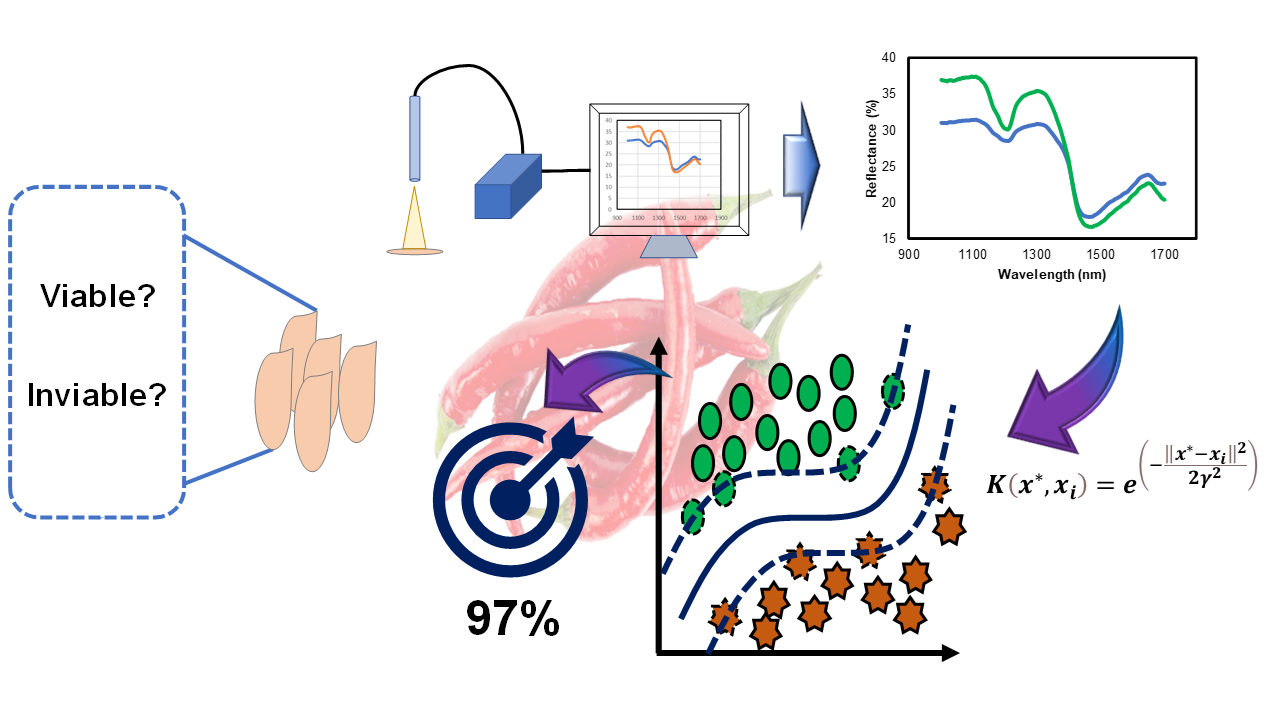
Downloads
References
A Azlan, S Sultana, CS Huei and MR Razman. Antioxidant, anti-obesity, nutritional and other beneficial effects of different chili pepper: A review. Molecules 2022; 27(3), 898.
BK Saleh, A Omer and B Teweldemedhin. Medicinal uses and health benefits of chili pepper (Capsicum spp.): A review. MOJ Food Processing and Technology 2018; 6(4), 325-328.
JT Sawma and CL Mohler. Evaluating seed viability by an unimbibed seed crush test in comparison with the tetrazolium test. Weed Technology 2002; 16(4), 781-786.
A Ambrose, S Lohumi, WH Lee and BK Cho. Comparative nondestructive measurement of corn seed viability using Fourier transform near-infrared (FT-NIR) and Raman spectroscopy. Sensors and Actuators B: Chemical 2016; 224, 500-506.
F Corbineau. The effects of storage conditions on seed deterioration and ageing: How to improve seed longevity. Seeds 2024; 3(1), 56-75.
LEPD Guzman, OB Zamora, TH Borromeo, PCS Cruz and TC Mendoza. Seed viability and vigor testing of Jatropha curcas L. Philippine Journal of Crop Science 2011; 36(3), 10-18.
CRDS Grzybowski, ODC Ohlson, RCD Silva and M Panobianco. Viability of barley seeds by the tetrazolium test. Revista Brasileira de Sementes 2012; 34(1), 47-54.
SMC Carvalho, SB Torres, EC Sousa, DMM Sousa, KTO Pereira, EPD Paiva, JR Matias and BRVD Santos. Viability of Carica papaya L. seeds by the tetrazolium test. Journal of Agricultural Science 2018; 10(2), 335-340.
S Lohumi, S Lee, H Lee and BK Cho. A review of vibrational spectroscopic techniques for the detection of food authenticity and adulteration. Trends in Food Science and Technology 2015; 46(1), 85-98.
RAP Hernanda, J Lee and H Lee. Spectroscopy imaging techniques as in vivo analytical tools to detect plant traits. Applied Sciences 2023; 13(18), 10420.
J Ryu, S Wi and H Lee. Snapshot-based multispectral imaging for heat stress detection in southern-type garlic. Applied Sciences 2023; 13(14), 8133.
RAP Hernanda, J Kim, MA Faqeerzada, HZ Amanah, BK Cho, MS Kim, I Baek and H Lee. Rapid and noncontact identification of soybean flour in edible insect using NIR spectral imager: A case study in Protaetia brevitarsis seulensis powder. Food Control 2025; 169, 111019.
HZ Amanah, S Rahayoe, E Harmayani, RAP Hernanda, Khoirunnisaa, AS Rohmat and H Lee. Construction of a sustainable model to predict the moisture content of porang powder (Amorphophallus oncophyllus) based on pointed-scan visible near-infrared spectroscopy. Open Agriculture 2024; 9(1), 20220268.
R Listanti, RE Masithoh, AD Saputro and HZ Amanah. Identification of maturity stage of cacao using visible near infrared (Vis-NIR) and shortwave near infrared (SW-NIR) reflectance spectroscopy. In: Proceedings of the 4th International Conference on Smart and Innovative Agriculture, Yogyakarta, Indonesia. 2023, p. 6003.
H Lee, BK Cho, MS Kim, WH Lee, J Tewari, H Bae, SI Sohn and HY Chi. Prediction of crude protein and oil content of soybeans using Raman spectroscopy. Sensors and Actuators B: Chemical 2013; 185, 694-700.
D Kusumaningrum, H Lee, S Lohumi, C Mo, MS Kim and BK Cho. Non-destructive technique for determining the viability of soybean (Glycine max) seeds using FT-NIR spectroscopy. Journal of the Science of Food and Agriculture 2018; 98(5), 1734-1742.
G Qiu, E Lü, H Lu, S Xu, F Zeng and Q Shui. Single-kernel FT-NIR spectroscopy for detecting supersweet corn (Zea mays L. saccharata sturt) seed viability with multivariate data analysis. Sensors 2018; 18(4), 1010.
C Peng, L Zhong, L Gao, L Li, L Nie, A Wu, R Huang, W Tian, W Yin, H Wang, Q Miao, Y Zhang and H Zang. Implementation of near-infrared spectroscopy and convolutional neural networks for predicting particle size distribution in fluidized bed granulation. International Journal of Pharmaceutics 2024; 655, 124001.
Y Ding, Y Yan, J Li, X Chen and H Jiang. Classification of tea quality levels using near-infrared spectroscopy based on CLPSO-SVM. Foods 2022; 11(11), 1658.
C Wakholi, LM Kandpal, H Lee, H Bae, E Park, MS Kim, C Mo, WH Lee and BK Cho. Rapid assessment of corn seed viability using short wave infrared line-scan hyperspectral imaging and chemometrics. Sensors and Actuators B: Chemical 2018; 255(1), 498-507.
Y Yu, Y Chai, Y Yan, Z Li, Y Huang, L Chen and H Dong. Near-infrared spectroscopy combined with support vector machine for the identification of Tartary buckwheat (Fagopyrum tataricum (L.) Gaertn) adulteration using wavelength selection algorithms. Food Chemistry 2025; 463(4), 141548.
CYE Tachie, D Obiri-Ananey, M Alfaro-Cordoba, NA Tawiah and ANA Aryee. Classification of oils and margarines by FTIR spectroscopy in tandem with machine learning. Food Chemistry 2024; 431, 137077.
A Windarsih, TH Jatmiko, AS Anggraeni and L Rahmawati. Machine learning-assisted FT-IR spectroscopy for identification of pork oil adulteration in tuna fish oil. Vibrational Spectroscopy 2024; 134, 103715.
TA Teklemariam. Raman and mid-infrared spectroscopy coupled with machine-deep learning for adulterant detection in ground turmeric. Applied Spectroscopy Practica 2024; 2(2), 1-19.
KND Bhavanee, A Krishnamoorthi, HM Rathva, SC Mareguddikar, A Singh, BP Singh, Nageshwar and K Chittibomma. Advancements in genetic engineering for enhanced traits in horticulture crops: A comprehensive review. Journal of Advances in Biology and Biotechnology 2024; 27(2), 90-110.
M Bhattacharjee, S Meshram, J Dayma, N Pandey, N Abdallah, A Hamwieh, N Fouad and S Acharjee. Genetic engineering: A powerful tool for crop improvement. In: Frontier technologies for crop improvement. Springer, Singapore, 2024, p. 223-258.
Hernanda RAP, H Lee, J il Cho, G Kim, BK Cho and MS Kim. Current trends in the use of thermal imagery in assessing plant stresses: A review. Computers and Electronics in Agriculture 2024; 224, 109227.
YW Seo, CK Ahn, H Lee, E Park, C Mo and BK Cho. Non-destructive sorting techniques for viable pepper (Capsicum annuum L.) seeds using Fourier transform near-infrared and Raman spectroscopy. Journal of Biosystems Engineering 2016; 41(1), 51-59.
B Wen. Seed germination ecology of Alexandra palm (Archontophoenix alexandrae) and its implication on invasiveness. Scientific Reports 2019; 9(1), 4057.
O Devos, C Ruckebusch, A Durand, L Duponchel and JP Huvenne. Support vector machines (SVM) in near infrared (NIR) spectroscopy: Focus on parameters optimization and model interpretation. Chemometrics and Intelligent Laboratory Systems 2009; 96(1), 27-33.
J Sun, A Nirere, KD Dusabe, Z Yuhao and G Adrien. Rapid and nondestructive watermelon (Citrullus lanatus) seed viability detection based on visible near-infrared hyperspectral imaging technology and machine learning algorithms. Journal of Food Science 2024; 89(7), 4403-4418.
S Shrestha, LC Deleuran and R Gislum. Classification of different tomato seed cultivars by multispectral visible-near infrared spectroscopy and chemometrics. Journal of Spectral Imaging 2016; 5(1), a1.
JAF Pierna, O Abbas, V Baeten and P Dardenne. A Backward Variable Selection method for PLS regression (BVSPLS). Analytica Chimica Acta 2009; 642(1-2), 89-93.
SS Tunny, HZ Amanah, MA Faqeerzada, C Wakholi, MS Kim, I Baek and BK Cho. Multispectral wavebands selection for the detection of potential foreign materials in fresh-cut vegetables. Sensors 2022; 22(5), 1775.
F Pedregosa, G Varoquaux, A Gramfort, V Michel, B Thirion, O Grisel, M Blondel, P Prettenhofer, R Weiss, V Dubourg, J Vanderplas, A Passos, D Cournapeau, M Brucher, M Perrot and É Duchesnay. Scikit-learn: Machine learning in python. Journal of Machine Learning Research 2011; 12, 2825-2830.
J Yasmin, MR Ahmed, S Lohumi, C Wakholi, MS Kim and BK Cho. Classification method for viability screening of naturally aged watermelon seeds using FT-NIR spectroscopy. Sensors 2019; 19(5), 1190.
S Yang, QB Zhu, M Huang and JW Qin. Hyperspectral image-based variety discrimination of maize seeds by using a multi-model strategy coupled with unsupervised joint skewness-based wavelength selection algorithm. Food Analytical Methods 2017; 10(2), 424-433.
M Tigabu, A Daneshvar, R Jingjing, P Wu, X Ma and PC Odén. Multivariate discriminant analysis of single seed near infrared spectra for sorting dead-filled and viable seeds of three pine species: Does one model fit all species? Forests 2019; 10(6), 469.
T Zhang, S Fan, Y Xiang, S Zhang, J Wang and Q Sun. Non-destructive analysis of germination percentage, germination energy and simple vigour index on wheat seeds during storage by Vis/NIR and SWIR hyperspectral imaging. Spectrochimica Acta Part A: Molecular and Biomolecular Spectroscopy 2020; 239, 118488.
S Zhu, L Zhou, P Gao, Y Bao, Y He and L Feng. Near-infrared hyperspectral imaging combined with deep learning to identify cotton seed varieties. Molecules 2019; 24(18), 3268.
SJ Hong, S Park, A Lee, SY Kim, E Kim, CH Lee and G Kim. Nondestructive prediction of pepper seed viability using single and fusion information of hyperspectral and X-ray images. Sensors and Actuators A: Physical 2023; 350, 114151.
A Dharmawan, RE Masithoh and HZ Amanah. Development of PCA-MLP model based on visible and shortwave near infrared spectroscopy for authenticating arabica coffee origins. Foods 2023; 12(11), 2112.
MA Faqeerzada, T Akter, U Aline, MFR Pahlawan and BK Cho. Application of hyperspectral imaging for rapid and nondestructive detection of paraffine-contaminated rice. In: Proceedings of the 4th International Conference on Smart and Innovative Agriculture, Yogyakarta, Indonesia. 2023, p. 1001.
D Ooms and MF Destain. Evaluation of chicory seeds maturity by chlorophyll fluorescence imaging. Biosystems Engineering 2011; 110(2), 168-177.
HZ Amanah, C Wakholi, M Perez, MA Faqeerzada, SS Tunny, RE Masithoh, MG Choung, KH Kim, WH Lee and BK Cho. Near-infrared hyperspectral imaging (NIR-HSI) for nondestructive prediction of anthocyanins content in black rice seeds. Applied Sciences 2021; 11(11), 4841.
S Ozturk, A Bowler, A Rady and NJ Watson. Near-infrared spectroscopy and machine learning for classification of food powders during a continuous process. Journal of Food Engineering 2023; 341, 111339.
IG Chong and CH Jun. Performance of some variable selection methods when multicollinearity is present. Chemometrics and Intelligent Laboratory Systems 2005; 78(1), 103-112.
Y Sun, S Ding, Z Zhang and W Jia. An improved grid search algorithm to optimize SVR for prediction. Soft Computing 2021; 25(7), 5633-5644.
Published
How to Cite
Issue
Section
License
Copyright (c) 2025 Walailak University

This work is licensed under a Creative Commons Attribution-NonCommercial-NoDerivatives 4.0 International License.





