
Integrative Analysis of miR-SNP–Associated Alterations in miRNA Expression and Regulatory Networks in Breast Cancer: A Systematic Review
DOI:
https://doi.org/10.48048/tis.2026.13699Keywords:
Breast cancer, miR-SNP, MicroRNA expression, rs2910164, rs11614913, rs3746444, Meta-analysisAbstract
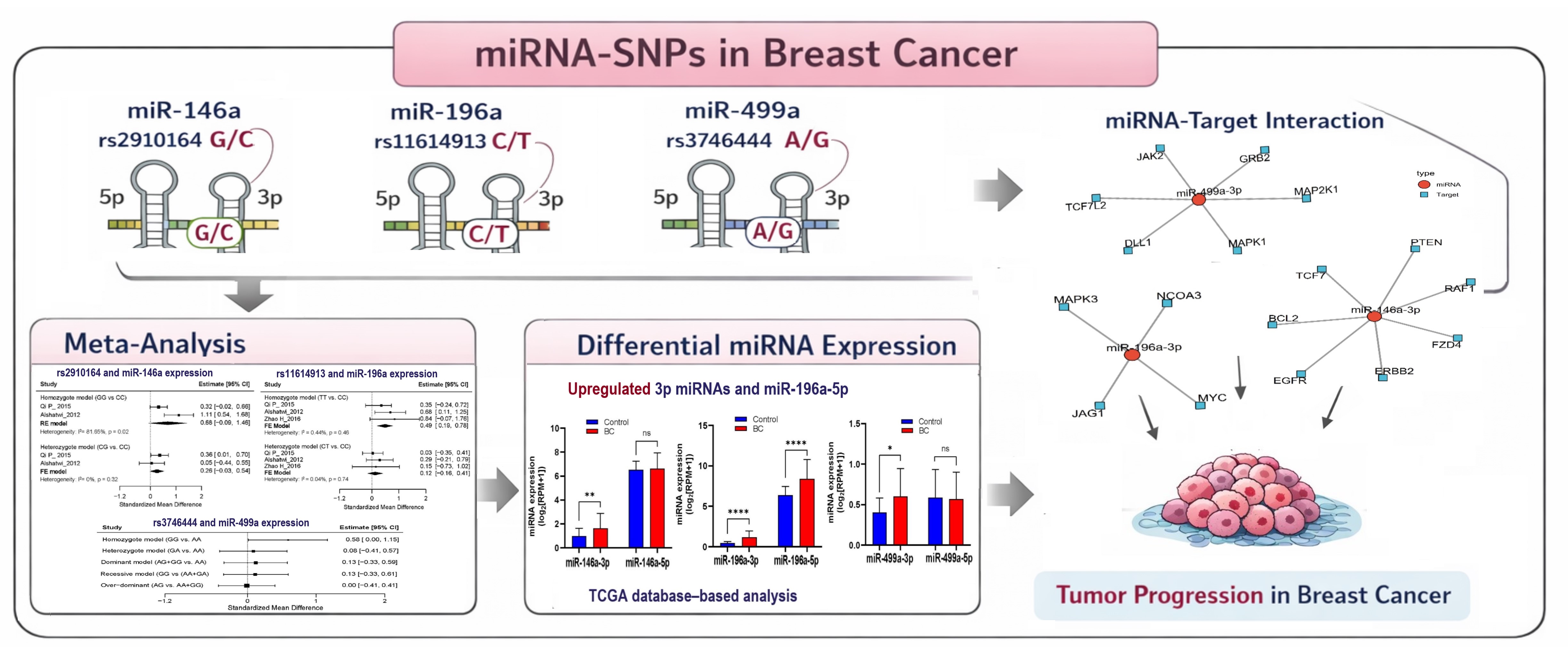
Genetic variants located within mature miRNA-coding regions (miR-SNPs) have been implicated in breast cancer susceptibility; however, their regulatory effects on mature miRNA expression and downstream function remain incompletely characterized and inconsistently reported. In this study, we performed an integrative analysis of 3 miR-SNPs (rs11614913, rs2910164 and rs3746444) by combining evidence from population-based studies, TCGA transcriptomic data, and in silico analyses. A systematic literature search identified eligible population-based and cell-based studies examining rs11614913 (miR-196a), rs2910164 (miR-146a), or rs3746444 (miR-499a) in relation to mature miRNA expression. Meta-analyses were conducted under codominant, dominant, recessive, and over-dominant genetic models using standardized mean difference (SMD, Hedges’ g) to accommodate heterogeneous expression metrics. Expression patterns of mature miRNAs were further examined using TCGA-BRCA miRNA-sequencing data, while miRNA–target interaction networks and binding energy changes (ΔG) were analyzed in silico to explore potential regulatory alterations. Population-based meta-analyses revealed genetic model-dependent associations, including a moderate association between rs11614913 and miR-196a-5p expression under the homozygote model (SMD = 0.49, 95% CI: 0.19 - 0.78, p = 0.001) and a small but significant association between rs2910164 and miR-146a-5p expression under the dominant model (SMD = 0.41, 95% CI: 0.13 - 0.69, p = 0.004), whereas evidence for rs3746444 was limited to single-study data. Cell-based experiments demonstrated strand-specific effects, with rs11614913 preferentially affecting miR-196a-5p expression and rs2910164 primarily influencing miR-146a-3p levels, highlighting context-dependent regulatory patterns. TCGA analyses showed significant upregulation of miR-146a-3p and miR-499a-3p in breast cancer tissues, while both miR-196a strands were upregulated; however, genotype-specific associations could not be assessed. In silico predictions suggested that these miR-SNPs may alter miRNA–target interaction networks involving cancer-related pathways. Collectively, this study provides preliminary and exploratory evidence that miR-SNPs are associated with strand- and genetic model–dependent variation in miRNA expression. Given the limited number of eligible studies and the lack of genotype-resolved tumor data, these findings should be interpreted with caution and are intended to provide a structured framework for future functional and clinical investigations.
HIGHLIGHTS
- An integrative analysis was performed to evaluate the regulatory relevance of 3 miR-SNPs (rs11614913, rs2910164, rs3746444) in breast cancer.
- Population-based meta-analyses identified genetic model–dependent associations between miR-SNPs and mature miRNA expression.
- Cell-based studies demonstrated context-dependent and strand-specific regulatory effects of miR-SNPs.
- TCGA miRNA-seq data revealed arm-specific dysregulation in breast cancer, including predominant upregulation of miR-146a-3p, miR-499a-3p, and both miR-196a strands.
- This study provides exploratory evidence and a structured framework for future functional and clinical investigations of miR-SNP–mediated regulation.
GRAPHICAL ABSTRACT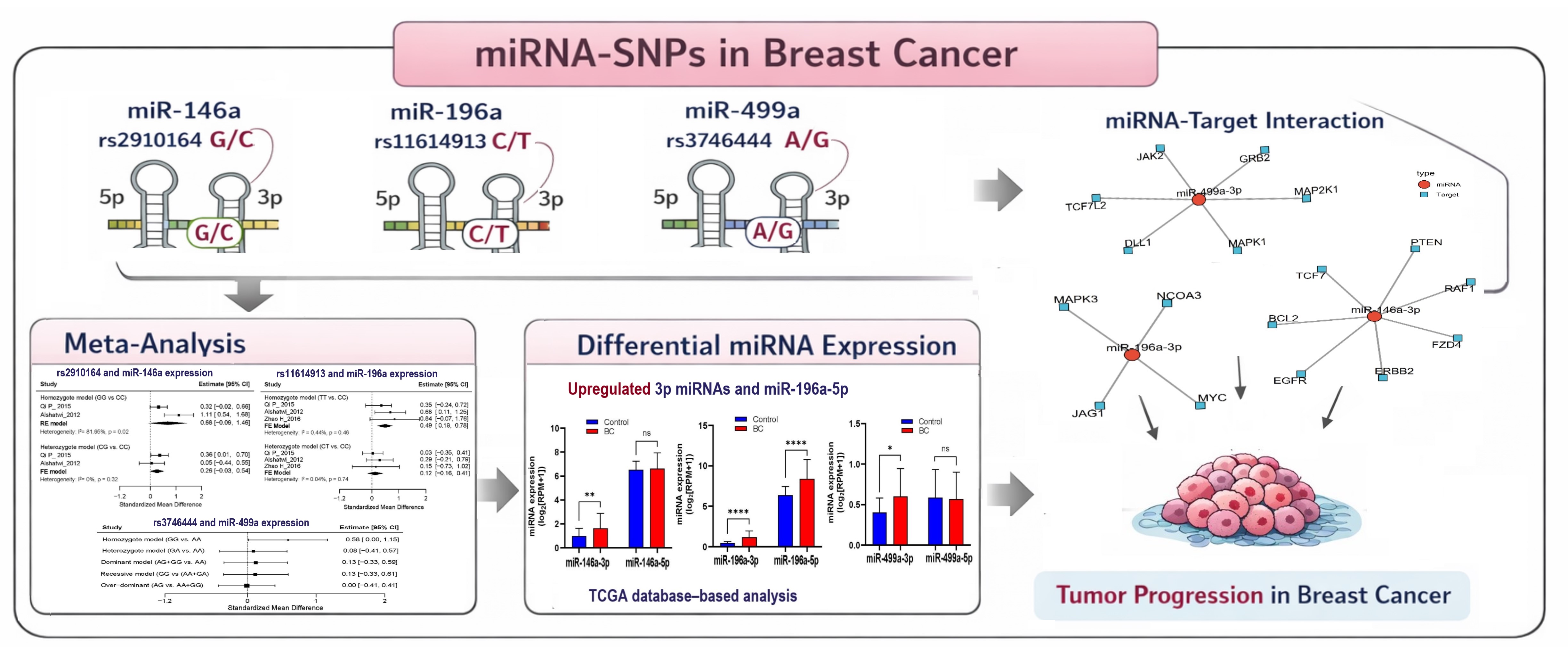
Downloads
References
F Bray, M Laversanne, H Sung, J Ferlay, RL Siegel, I Soerjomataram and A Jemal. Global cancer statistics 2022: GLOBOCAN estimates of incidence and mortality worldwide for 36 cancers in 185 countries. CA: A Cancer Journal for Clinicians 2024; 74(3), 229-263.
N Harbeck, F Penault-Llorca, J Cortes, M Gnant, N Houssami, P Poortmans, K Ruddy, J Tsang and F Cardoso. Breast cancer. Nature Reviews Disease Primers 2019; 5(1), 66.
JK Jallah, TJ Dweh, A Anjankar and O Palma. A review of the advancements in targeted therapies for breast cancer. Cureus 2023; 15(10), e47847.
H Kim, YY Lee and VN Kim. The biogenesis and regulation of animal microRNAs. Nature Reviews Molecular Cell Biology 2024; 26(4), 276-296.
LFR Gebert and IJ MacRae. Regulation of microRNA function in animals. Nature Reviews Molecular Cell Biology 2019; 20(1), 21-37.
M Abolghasemi, SS Tehrani, T Yousefi, A Karimian, A Mahmoodpoor, A Ghamari, F Jadidi-Niaragh, M Yousefi, HS Kafil, M Bastami, M Edalati, S Eyvazi, M Naghizadeh, N Targhazeh, B Yousefi, A Safa, M Majidinia and V Rameshknia. MicroRNAs in breast cancer: Roles, functions, and mechanism of actions. Journal of Cellular Physiology 2020; 235(6), 5008-5029.
J Xiao, L Zhang, R Su, B Zhao, Y Dang, C Zhao, S Wang, T Qi and F Ji. MicroRNAs in breast cancer-new frontiers in diagnosis, targeted therapy, and prognosis assessment. Frontiers in Oncology 2025; 15, 1529907.
P Mohan Lal, M Hamza Siddiqui, A Soulat, A Mohan, D Tanush, K Tirath, S Raja, M Khuzzaim Khan, A Raja, A Chaulagain and U Tejwaney. MicroRNAs as promising biomarkers and potential therapeutic agents in breast cancer management: A comprehensive review. Annals of Medicine and Surgery 2024; 86(6), 3543-3550.
P Malhotra, GH Read and JB Weidhaas. Breast cancer and miR-SNPs: The importance of miR germ-line genetics. Non-Coding RNA 2019; 5(1), 27.
M Machowska, P Galka-Marciniak and P Kozlowski. Consequences of genetic variants in miRNA genes. Computational and Structural Biotechnology Journal 2022; 20, 6443-6457.
Y Chhichholiya, AK Suryan, P Suman, A Munshi and S Singh. SNPs in miRNAs and target sequences: Role in cancer and diabetes. Frontiers in Genetics 2021; 12, 793523.
TTN Nguyen, TTC Duong and HT Nguyen. Comprehensive meta-analysis of 28 miRNA-SNPs reveals first pooled evidence for five variants associated with breast cancer susceptibility. Asian Pacific Journal of Cancer Prevention 2025; 26(12), 4433-4446.
H Zhang, Y Zhang, W Yan, W Wang, X Zhao, X Ma, X Gao and S Zhang. Association between 3 functional microRNA polymorphisms (miR-499 rs3746444, miR-196a rs11614913 and miR-146a rs2910164) and breast cancer risk: A meta-analysis. Oncotarget 2017; 8(1), 393-407.
T Arancibia, S Morales-Pison, E Maldonado and L Jara. Association between single-nucleotide polymorphisms in miRNA and breast cancer risk: An updated review. Biological Research 2021; 54(1), 26.
GI Hina, NU Khan, ST Muntaha, A Ullah, S Khan, AR Alanzi, I Ali and T Chen. Association analysis of miRNA-146a and miRNA-196a polymorphism with breast cancer risk in Khyber Pakhtunkhwa, Pakistan: A preliminary study. Molecular Biology Reports 2024; 51(1), 827.
S Morales-González, GM Calaf, M Acuña, JC Tapia and L Jara. The miR-146a single nucleotide polymorphism rs2910164 promotes proliferation, chemoresistance, migration, invasion, and apoptosis suppression in breast cancer cells. Cells 2025; 14(8), 612.
XP Ma, T Zhang, B Peng, L Yu and K Jiang de. Association between microRNA polymorphisms and cancer risk based on the findings of 66 case-control studies. PLoS One 2013; 8(11), e79584.
MJ Page, JE McKenzie, PM Bossuyt, I Boutron, TC Hoffmann, CD Mulrow, L Shamseer, JM Tetzlaff, EA Akl, SE Brennan, R Chou, J Glanville, JM Grimshaw, A Hróbjartsson, MM Lalu, T Li, EW Loder, E Mayo-Wilson, S McDonald, …, D Moher. The PRISMA 2020 statement: An updated guideline for reporting systematic reviews. BMJ 2021; 372, n71.
National Institutes of Health. OHAT risk of bias rating tool for human and animal studies, Available at: https://ntp.niehs.nih.gov/sites/defa
ult/files/ntp/ohat/pubs/riskofbiastool_508.pdf, accessed January 2026.
Handbook for Conducting a Literature-Based Health Assessment Using OHAT Approach for Systematic Review and Evidence Integration, Available at: https://ntp.niehs.nih.gov/sites/defau
lt/files/ntp/ohat/pubs/handbookmarch2019_508.pdf, accessed January 2026.
Y Ru, KJ Kechris, B Tabakoff, P Hoffman, RA Radcliffe, R Bowler, S Mahaffey, S Rossi, GA Calin, L Bemis and D Theodorescu. The multiMiR R package and database: Integration of microRNA-target interactions along with their disease and drug associations. Nucleic Acids Research 2014; 42(17), e133.
CH Chou, NW Chang, S Shrestha, SD Hsu, YL Lin, WH Lee, CD Yang, HC Hong, TY Wei, SJ Tu, TR Tsai, SY Ho, TY Jian, HY Wu, PR Chen, NC Lin, HT Huang, TL Yang, CY Pai, CS Tai, WL Chen, CY Huang, CC Liu, SL Weng, KW Liao, WL Hsu and HD Huang. miRTarBase 2016: Updates to the experimentally validated miRNA-target interactions database. Nucleic Acids Research 2015; 44(D1), D239-D247.
M Mann, PR Wright and R Backofen. IntaRNA 2.0: Enhanced and customizable prediction of RNA-RNA interactions. Nucleic Acids Research 2017; 45(W1), W435-W439.
S Cammaerts, M Strazisar, J Dierckx, J Del Favero and P De Rijk. miRVaS: A tool to predict the impact of genetic variants on miRNAs. Nucleic Acids Research 2016; 44(3), e23.
JPT Higgins, J Chandler, M Cumpston, T Li, MJ Page and VA Welch. Cochrane handbook for systematic reviews of interventions. 6th ed. Cochrane, London, 2019.
AC Mean difference, standardized mean difference (SMD) and their use in meta-analysis: As simple as it gets. The Journal of Clinical Psychiatry 2020; 81(5), 20f13681.
MedCalc. Meta-analysis: Continuous measure, Available at: https://www.medcalc.org/en/manu
al/meta-analysis-continuousmeasure.php, accessed January 2026.
JP Ioannidis, NA Patsopoulos and E Evangelou. Heterogeneity in meta-analyses of genome-wide association investigations. PLoS One 2007; 2(9), e841.
RC Johnson, GW Nelson, JL Troyer, JA Lautenberger, BD Kessing, CA Winkler and SJ O'Brien. Accounting for multiple comparisons in a genome-wide association study (GWAS). BMC Genomics 2010; 11(1), 724.
P Qi, L Wang, B Zhou, WJ Yao, S Xu, Y Zhou and ZB Xie. Associations of miRNA polymorphisms and expression levels with breast cancer risk in the Chinese population. Genetics and Molecular Research 2015; 14(2), 6289-6296.
AA Alshatwi, G Shafi, TN Hasan, NA Syed, AA Al-Hazzani, MA Alsaif and AA Alsaif. Differential expression profile and genetic variants of microRNAs sequences in breast cancer patients. PLoS One 2012; 7(2), e30049.
H Zhao, J Xu, D Zhao, M Geng, H Ge, L Fu and Z Zhu. Somatic mutation of the SNP rs11614913 and its association with increased MIR 196A2 expression in breast cancer. DNA and Cell Biology 2016; 35(2), 81-87.
AE Hoffman, T Zheng, C Yi, D Leaderer, J Weidhaas, F Slack, Y Zhang, T Paranjape and Y Zhu. microRNA miR-196a-2 and breast cancer: A genetic and epigenetic association study and functional analysis. Cancer Research 2009; 69(14), 5970-5977.
J Shen, CB Ambrosone, RA DiCioccio, K Odunsi, SB Lele and H Zhao. A functional polymorphism in the miR-146a gene and age of familial breast/ovarian cancer diagnosis. Carcinogenesis 2008; 29(10), 1963-1966.
Z Eslami-S, M Tahmaseb and A Ghaderi. The investigation of miR-196a2 rs11614913 with breast cancer susceptibility in south of IRAN. Meta Gene 2018; 17, 43-47.
Z Hu, J Liang, Z Wang, T Tian, X Zhou, J Chen, R Miao, Y Wang, X Wang and H Shen. Common genetic variants in pre-microRNAs were associated with increased risk of breast cancer in Chinese women. Human Mutation 2009; 30(1), 79-84.
DJ Jedlinski, PN Gabrovska, SR Weinstein, RA Smith and LR Griffiths. Single nucleotide polymorphism in hsa-mir-196a-2 and breast cancer risk: A case control study. Twin Research and Human Genetics 2011; 14(5), 417-421.
M Ahmad, S Ahmad, B Rahman, TU Haq, F Jalil and AA Shah. Association of MIR146A rs2910164 variation with a predisposition to sporadic breast cancer in a Pakistani cohort. Annals of Human Genetics 2019; 83(5), 325-330.
HM Brincas, DG Augusto, C Mathias, IJ Cavalli, RS Lima, F Kuroda, CA Urban, DF Gradia, J de Oliveira, RC de Almeida and E Ribeiro. A genetic variant in microRNA-146a is associated with sporadic breast cancer in a Southern Brazilian Population. Genetics and Molecular Biology 2020; 42(4), e20190278.
I Catucci, R Yang, P Verderio, S Pizzamiglio, L Heesen, K Hemminki, C Sutter, B Wappenschmidt, M Dick, N Arnold, P Bugert, D Niederacher, A Meindl, RK Schmutzler, CC Bartram, F Ficarazzi, L Tizzoni, D Zaffaroni, S Manoukian, M Barile, MA Pierotti, P Radice, B Burwinkel and P Peterlongo. Evaluation of SNPs in miR-146a, miR196a2 and miR-499 as low-penetrance alleles in German and Italian familial breast cancer cases. Human Mutation 2010; 31(1), E1052-E1057.
S Ding and P Wang. The life of microRNAs: Biogenesis, function and decay in cancer. Biomolecules 2025; 15(10), 1393.
D Pinhal, LB Gonçalves, JF Campos and JG Patton. Decoding microRNA arm switching: A key to evolutionary innovation and gene regulation. Cellular and Molecular Life Sciences 2025; 82(1), 197.
PY Wang, ZH Gao, ZH Jiang, XX Li, BF Jiang and SY Xie. The associations of single nucleotide polymorphisms in miR-146a, miR-196a and miR-499 with breast cancer susceptibility. PLoS One 2013; 8(9), e70656.
Downloads
Published
How to Cite
Issue
Section
License
Copyright (c) 2026 Walailak University

This work is licensed under a Creative Commons Attribution-NonCommercial-NoDerivatives 4.0 International License.





