
Integrated Dose-Response Modeling and Phytochemical Profiling Reveal the Bioherbicidal Potential of Mimosa Pigra Leaf Extract against Eleusine indica
DOI:
https://doi.org/10.48048/tis.2026.13662Keywords:
Mimosa pigra, Eleusine indica, Allelopathy, Bioherbicide, Dose-response modeling, HPLC-UV-DAD, Phytotoxicity, Phenolic compounds, Weed managementAbstract
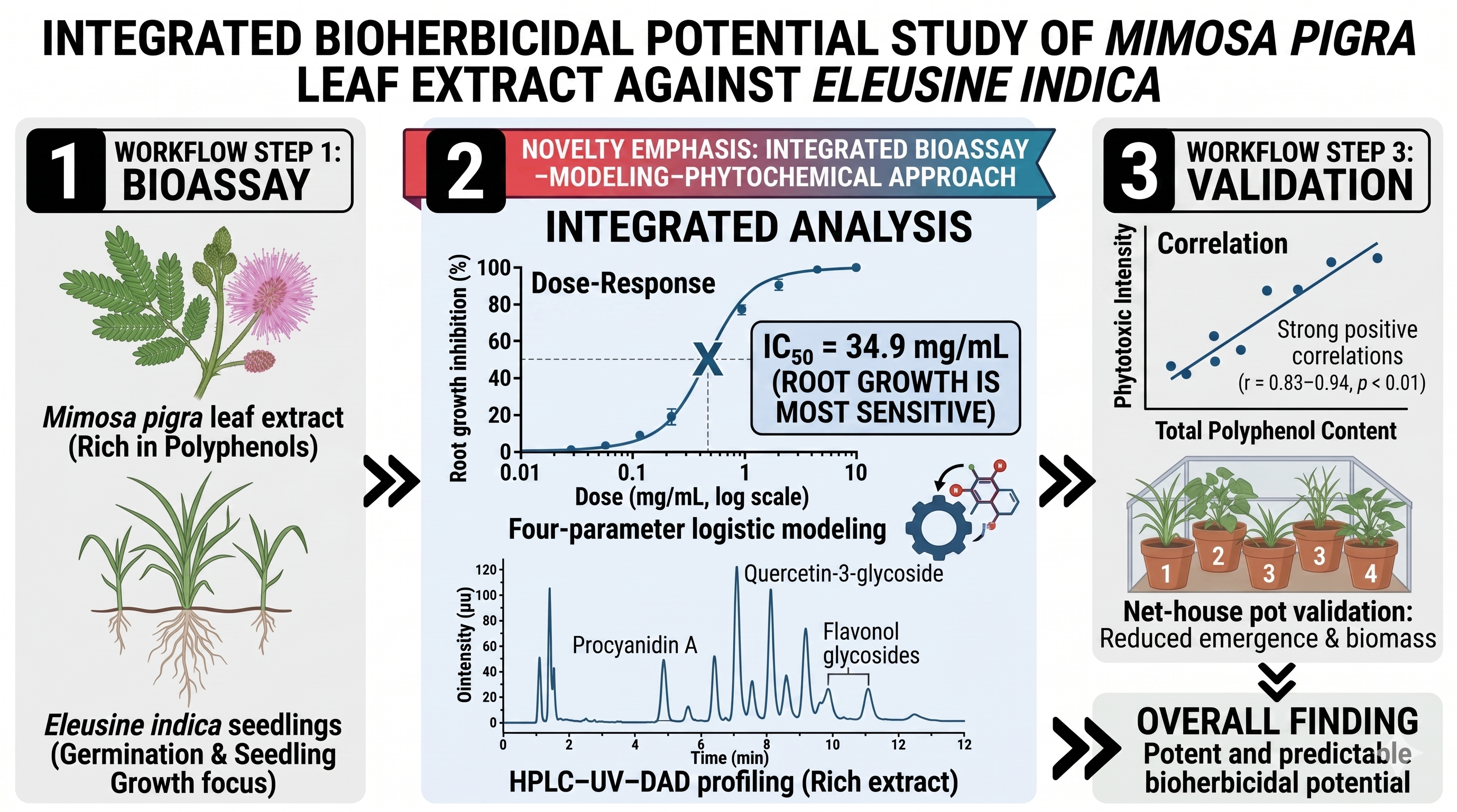
Eleusine indica (goosegrass) is a globally problematic grass weed with increasing herbicide resistance, highlighting the need for sustainable plant-derived alternatives. This study evaluated the bioherbicidal potential of an ethanolic leaf extract of Mimosa pigra through an integrated approach combining dose–response modeling, phytochemical profiling, and soil-based validation. In Petri-dish assays (0 - 160 mg mL⁻¹), the extract significantly inhibited germination and early seedling growth in a concentration-dependent manner. Four-parameter logistic modeling identified root growth as the most sensitive endpoint (IC₅₀ = 34.9 mg mL⁻¹), followed by germination inhibition (IC₅₀ = 46.8 mg mL⁻¹) and shoot inhibition (IC₅₀ = 57.6 mg mL⁻¹). The extract contained high levels of total phenolics and flavonoids (TPC = 128.6 ± 6.4 mg GAE g⁻¹; TFC = 71.8 ± 4.1 mg QE g⁻¹) and exhibited a polyphenol-rich profile dominated by flavan-3-ols/proanthocyanidins and flavonol glycosides. Phytochemical indices were strongly positively correlated with phytotoxicity (r = 0.83 - 0.94, p < 0.01). Under net-house pot conditions (21 DAT), the extract markedly reduced weed emergence, plant height, and shoot biomass, with biomass reduction reaching 77.4% at 160 mg mL⁻¹. By integrating quantitative bioassays with phytochemical characterization and soil-based validation, this study provides a more comprehensive basis for advancing M. pigra leaf extract as a natural bioherbicidal candidate. Future studies should focus on large-scale field trials to further evaluate the practical applicability of Mimosa pigra leaf extract as a bioherbicidal agent.
HIGHLIGHTS
- Mimosa pigra leaf extract strongly inhibits the germination and growth of Eleusine indica in a dose-dependent manner.
- Dose–response modeling identifies root growth as the most sensitive endpoint, with an IC₅₀ value of 34.9 mg mL⁻¹.
- HPLC–UV–DAD profiling confirms that the extract is rich in procyanidins and flavonol glycosides.
- Phytotoxic intensity shows a strong positive correlation with phytochemical abundance.
- Integrated bioassays and net-house validation confirm the strong bioherbicidal potential of the extract.
GRAPHICAL ABSTRACT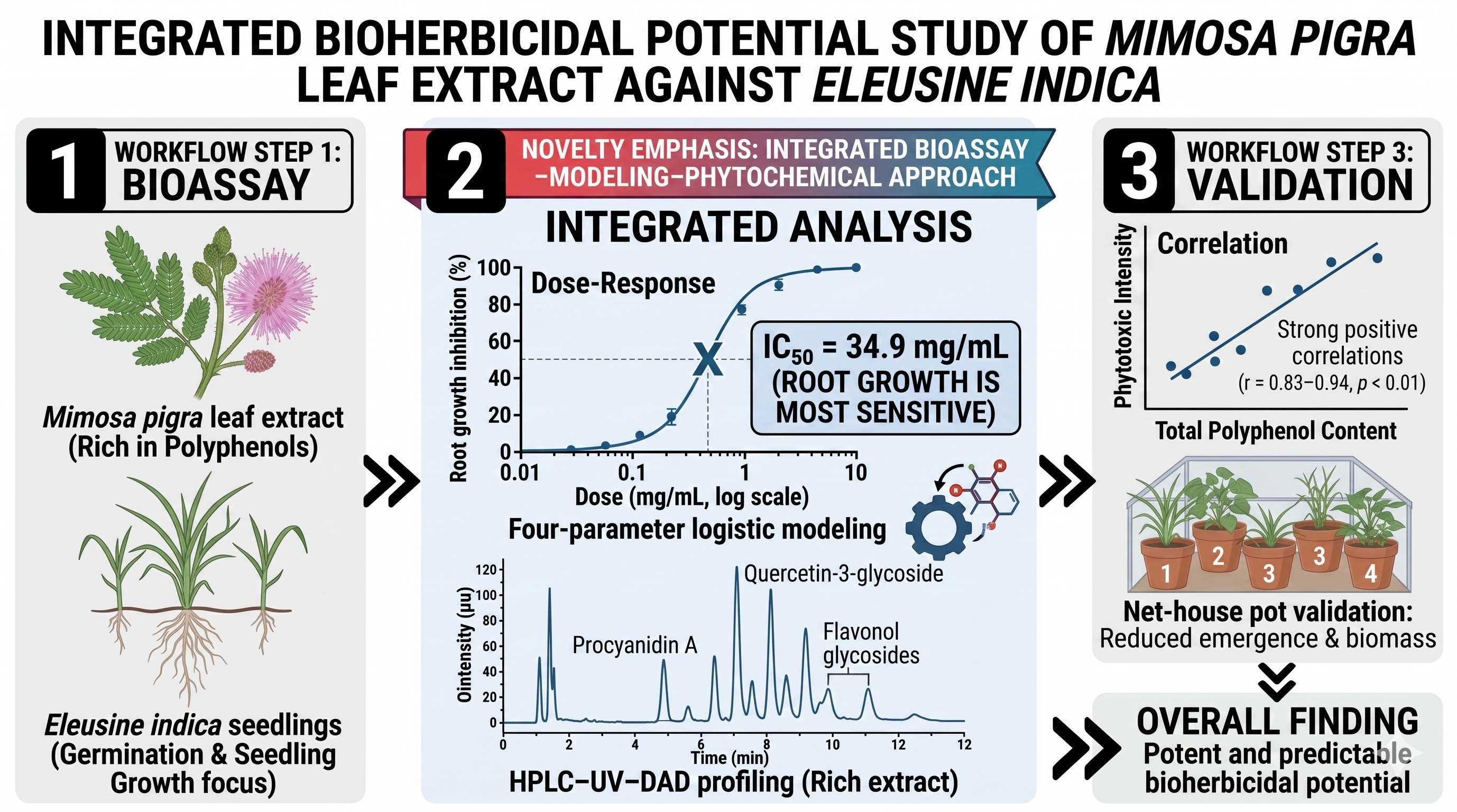
Downloads
References
RLC Alcantara-De, LBXD Silva, HK Takano, LHB Junior and KF Mendes. The rise of Eleusine indica as Brazil’s most troublesome weed. Agronomy 2025; 15(8), 1759.
F Sarghini, M Esposito and A Maggio. Use of new weed management approaches and artificial intelligence to obtain neutral weed communities, Available at: http://www.fedoa.unina.it/15054/1/Esposito_Marco_35.pdf, accessed December 2025.
L da Silva Araujo, NM Correia, VL Tornisielo, MTV Labate, SM Tsai, CA Carbonari and RV Filho. Goosegrass (Eleusine indica) resistant to multiple herbicide modes of action in Brazil. Weed Science 2023; 71(3), 189-197.
CP Nath, RG Singh, VK Choudhary, D Datta, R Nandan and SS Singh. Challenges and alternatives of herbicide-based weed management. Agronomy 2024; 14(1), 126.
J Roberts, S Florentine, WGD Fernando and KU Tennakoon. Achievements, developments and future challenges in the field of bioherbicides for weed control: A global review. Plants 2022; 11(17), 2242.
AM Islam, SMR Karim, SA Kheya and S Yeasmin. Unlocking the potential of bioherbicides for sustainable and environment friendly weed management. Heliyon 2024; 10(16), e36088.
GR Ximenez, M Bianchin, JMP Carmona, SM de Oliveira, Ferrarese-Filho and LH Pastorini. Reduction of weed growth under the influence of extracts and metabolites isolated from Miconia spp. Molecules 2022; 27(17), 5356.
A Welgama, S Florentine and J Roberts. A global review of the woody invasive alien species Mimosa pigra (Giant sensitive plant): Its biology and management implications. Plants 2022; 11(18), 2366.
H Kato-Noguchi. Invasive mechanisms of one of the world’s worst alien plant species Mimosa pigra and its management. Plants 2023; 12(10), 1960.
C Kuwabara, D Wang, K Endoh, Y Fukushi, K Arakawa and S Fujikawa. Analysis of supercooling activity of tannin-related polyphenols. Cryobiology 2013; 67(1), 40-49.
Y Yu, Y Du, J Dong, Z Yin, P Chen, L Cao and Z Yan. Phytotoxic effects of the aqueous extracts of Magnolia biondii Pamp. flower litter and the joint action of allelochemicals. Plants 2025; 14(11), 1577.
N Bahrin, N Muhammad, N Abdullah, BHA Talip, S Jusoh and SW Theng. Effect of processing temperature on antioxidant activity of Ficus carica leaves extract. Journal of Science and Technology 2018; 10(2), 99-103.
DH Truong, DH Nguyen, NTA Ta, AV Bui, TH Do and HC Nguyen. Evaluation of the use of different solvents for phytochemical constituents, antioxidants, and in vitro anti-inflammatory activities of Severinia buxifolia. Journal of Food Quality 2019; 2019, 8178294.
JU Agogbua, BE Okoli and JO Osuji. Procedure for in vitro seed sterilization, germination and aseptic seedling establishment of Zehneria capillacea (Schumach) C. jeffrey. GSC Biological and Pharmaceutical Sciences 2022; 19(1), 143-148.
BS Chauhan and DE Johnson. Germination ecology of goosegrass (Eleusine indica): An important grass weed of rainfed rice. Weed Science 2008; 56(5), 699-706.
Y Yang, G Wang, L Li, R Ma, Y Kong and J Yuan. Selection of sensitive seeds for evaluation of compost maturity with the seed germination index. Waste Management 2021; 136, 238-243.
W Khan, S Shah, A Ullah, S Ullah, F Amin, B Iqbal, N Ahmad, MA Abdel-Maksoud, MK Okla and M El-Zaidy. Utilizing hydrothermal time models to assess the effects of temperature and osmotic stress on maize (Zea mays L.) germination and physiological responses. BMC Plant Biology 2023; 23(1), 414.
S Kumari, SK Chakrabarty & D Paul. Assessment of genetic diversity for seed vigor traits in rice (Oryza sativa L.) through principal component and cluster analysis. The Indian Journal of Genetics and Plant Breeding 2023, 83(3), 343-354.
Y Jiang, CH Zhu, ZH Xia and HQ Zhao. Novel quinoxalinone-1, 2, 3-triazole derivatives as potential antifungal agents for plant anthrax disease: Design, synthesis, antifungal activity and SAR study. Advanced Agrochem 2024; 3(3), 222-228.
M Alamgir and MK Hossain. Effect of pre-sowing treatments on germination and initial seedling development of Albizia saman in the nursery. Journal of Forestry Research 2005; 16(3), 200-204.
SS Ramanathan, TW Gannon and PJ Maxwell. Dose-response of five weed species to indaziflam and oxadiazon. Weed Technology 2023; 37(3), 303-312.
PO Rinthong, T Katisart and S Maneechai. Evaluation of the phytochemical profiling, tyrosinase inhibitory activity, and antioxidant potential of various extracts of Acacia concinna (Willd.) DC. Trends in Sciences 2024; 21(10), 8334-8334.
RNS Yadav and M Agarwala. Phytochemical analysis of some medicinal plants. Journal of Phytology 2011; 3(12), 10-14.
CC Chang, MH Yang, HM Wen and JC Chern. Estimation of total flavonoid content in propolis by two complementary colorimetric methods. Journal of Food and Drug Analysis 2002; 10(3), 178-182.
NSM Hanapi, SA Amraa, AL Anis, N Zaini, WNW Ibrahim and NN Bonnia. Rapid and sensitive determination of polycyclic aromatic hydrocarbons in green tea samples by dispersive liquid-liquid microextraction coupled to high-performance liquid chromatography-diode array detection. Trends in Sciences 2022; 19(20), 6232-6232.
Z Spacil, L Novakova and P Solich. Analysis of phenolic compounds by high performance liquid chromatography and ultra performance liquid chromatography. Talanta 2008; 76(1), 189-199.
L Novakova, Z Spacil, M Seifrtova, L Opletal and P Solich. Rapid qualitative and quantitative ultra high performance liquid chromatography method for simultaneous analysis of twenty nine common phenolic compounds of various structures. Talanta 2010; 80(5), 1970-1979.
I Suliansyah, F Arlius, I Chaniago, NTT Xuan, VTH Duong, NP Dung and PV Quang. Simulation of maize biomass and yield in An Giang, Vietnam, under climate variabilities. Trends in Sciences 2024; 21(3), 7490-7490.
X Wang, C Sun, S Gao, L Wang and H Shuokui. Validation of germination rate and root elongation as indicator to assess phytotoxicity with Cucumis sativus. Chemosphere 2001; 44(8), 1711-1721.
H Kato-Noguchi. Allelopathy and allelochemicals of Imperata cylindrica as an invasive plant species. Plants 2022; 11(19), 2551.
MM Williams, RA Boydston and AS Davis. Crop competitive ability contributes to herbicide performance in sweet corn. Weed Research 2008; 48(1), 58-67.
HMK Bashar, AS Juraimi, MS Ahmad-Hamdani, MK Uddin, N Asib, MP Anwar, SMR Karim, F Rahaman, MA Haque and A Hossain. Documentation of phytotoxic compounds existing in Parthenium hysterophorus L. leaf and their phytotoxicity on Eleusine indica (L.) Gaertn. and Digitaria sanguinalis (L.) Scop. Toxins 2022; 14(8), 561.
M Hasan, MS Ahmad-Hamdani, AM Rosli and H Hamdan. Bioherbicides: An eco-friendly tool for sustainable weed management. Plants 2021; 10(6), 1212.
MJB Ashraf, M Zubair, N Azam, N Zahra, R Nisar, BE Ayomide, S Abbas and MM Khan. Unlocking the allelopathic and phytotoxic potential of indigenous bio-herbicide weeds (Withania coagulans and Achyranthes aspera) against staple crops. International Journal of Science and Research Archive 2025; 16(3), 653-665.
P Akter and R Begum. Allelopathic effects of aqueous and methanolic extracts from Ageratum conyzoides L. on the germination of selected vegetables. Tropical Agroecosystems 2024; 5(1), 01-09.
AM Islam and H Kato-Noguchi. Phytotoxic activity of Ocimum tenuiflorum extracts on germination and seedling growth of different plant species. The Scientific World Journal 2014; 2014, 676242.
A Windarsih, MF Ahla, AW Indrianingsih, Suratno, E Noviana, DK Bhattacharjya and MI Sulistyowaty. In vitro evaluation of antioxidant, antibacterial, and antidiabetes of billygoat weed leaves, stem, and flower (Ageratum conyzoides L.) concurrent with its phytochemical constituents. Waste and Biomass Valorization 2025; 16(9), 4711-4725.
D Dhianawaty, RG Dwiwina and W Mayasari. Quantification of four phytochemical parameters of Imperata cylindrica leaves to promote its use as a medicinal plant. Pharmacognosy Journal 2024; 16(1), 108-117.
F Raposo, R Borja and JA Gutierrez-Gonzalez. A comprehensive and critical review of the unstandardized Folin-Ciocalteu assay to determine the total content of polyphenols: The conundrum of the experimental factors and method validation. Talanta 2024; 272, 125771.
K Rizwan, I Majeed, M Bilal, T Rasheed, A Shakeel and S Iqbal. Phytochemistry and diverse pharmacology of genus Mimosa: A review. Biomolecules 2022; 12(1), 83.
CJ Okonkwo, OU Njoku, TJ Okonkwo, OE Afieroho and P Proksch. Two new acylated flavonol glycosides from mimosa pigra L. Leaves Sub-Family mimosoideae. Future Journal of Pharmaceutical Sciences 2016; 2(2), 71-75.
MF Hawwal, Z Ali, OI Fantoukh, AG Chittiboyina and IA Khan. Phytochemical investigation of Mimosa pigra leaves, a sensitive species. Biochemical Systematics and Ecology 2021; 99, 104354.
R Radhakrishnan, AA Alqarawi and EFA Allah. Bioherbicides: Current knowledge on weed control mechanism. Ecotoxicology and Environmental Safety 2018; 158, 131-138.
I Koodkaew, C Senaphan, N Sengseang and S Suwanwong. Characterization of phytochemical profile and phytotoxic activity of Mimosa pigra L. Agriculture and Natural Resources 2018; 52(2), 162-168.
HP Singh, DR Batish, S Kaur and RK Kohli. Phytotoxic interference of Ageratum conyzoides with wheat (Triticum aestivum). Journal of Agronomy and Crop Science 2003; 189(5), 341-346.
YM Muflihah, G Gollavelli and YC Ling. Correlation study of antioxidant activity with phenolic and flavonoid compounds in 12 Indonesian indigenous herbs. Antioxidants 2021; 10(10), 1530.
PV Quang, DV Nha, NTT Hang, LH Phuoc and NTT Xuan. Effects of accumulated growing degree days (GDDs) on sesame (Sesamum indicum) growth and yield under greenhouse condition in the Mekong Delta, Vietnam. IOP Conference Series: Earth and Environmental Science 2024; 1306(1), 012012.
ACD Wandscheer, MA Rizzardi and M Reichert. Competitive ability of corn in coexistence with goosegrass. Planta Daninha 2013; 31(2), 281-289.
DT Khang, HD Dieu, NK Dung, BT Giang, TLN Thao, LTT Tien, TT Men, HV Loi, NT Tuan, NV Ay and NP Thuy. Anticancer and antioxidant of chloroform extracts from medical plants in the Mekong Delta, Vietnam. Asian Journal of Plant Sciences 2020; 19, 398-405.
WT Gao and WH Su. Weed management methods for herbaceous field crops: A review. Agronomy 2024; 14(3), 486.
Downloads
Published
How to Cite
Issue
Section
License
Copyright (c) 2026 Walailak University

This work is licensed under a Creative Commons Attribution-NonCommercial-NoDerivatives 4.0 International License.





