
Potential of Indigenous Rhizosphere N2-Fixing Bacteria in Improving Soil Properties, Growth and Yield of Maize on Alluvial Soils in the Dyke System
DOI:
https://doi.org/10.48048/tis.2025.10446Keywords:
Enterobacter asburiae ASD-07, E. asburiae ASD-28, Nitrogen fixation, Rhizospheric bacteria, VietnamAbstract
Nitrogen (N) deficiency hinders maize cultivation in diked alluvial soils (AS), and chemical N fertilizers can harm the environment. This study aimed to (i) select N2-fixing bacteria from maize rhizospheres in AS; (ii) evaluate their effects on soil fertility, N uptake, and maize growth and yield. Thirty-six soil samples from maize fields in An Giang, Vietnam, were collected to isolate bacteria. A pot experiment followed with 9 treatments: (i) 100 % N of the recommended fertilizer dose (RFD), (ii) 85 % N of RFD, (iii) 70% N of RFD, (iv) 55% N of RFD, (v) 85% N of RFD with 2 N2-fixing rhizospheric bacteria (RB) isolates, (vi) 70% N of RFD with RB, (vii) 55% N of RFD with RB, (viii) 0% N of RFD with RB, and (ix) 0% N of RFD. Out of 67 isolates, Enterobacter asburiae ASD-07 and E. asburiae ASD-28 were selected. The amount of available nitrogen in the soil was high in the treatments with low nitrogen fertilization, specifically 0% N + RB and 55% N + RB. However, the amount of nitrogen absorbed by the plants was highest in the treatments with 100% N and 85% N + RB. The highest grain yield was observed in the 85% N + RB treatment, which increased by 7.2% compared to 100% N fertilization and by 12.6% compared to the treatment receiving 85% N. These results indicate that E. asburiae ASD-07 and ASD-28 may have the potential to reduce the use of inorganic fertilizers and minimize environmental impact.
HIGHLIGHTS
- Top N2-Fixing Isolates: Enterobacter asburiae ASD-07 and ASD-28, identified via 16S rDNA sequencing, were the most effective among 17 N2-fixing isolates from 67 tested.
- Nutrient boost: increased NH4+ uptake by 7.4 mg kg−1 and total N by 0.87 g pot−1 compared to no biofertilizer.
- Growth and Yield Gains: Biofertilizer raised plant height by 5.3%, stem diameter by 6.0%, cob length by 9.2%, and yield by 12.6% compare to 85% N of RFD.
- Fertilizer Reduction: The isolates replaced 15% of inorganic N fertilizer without compromising maize growth and yield, suggesting field study potential.
GRAPHICAL ABSTRACT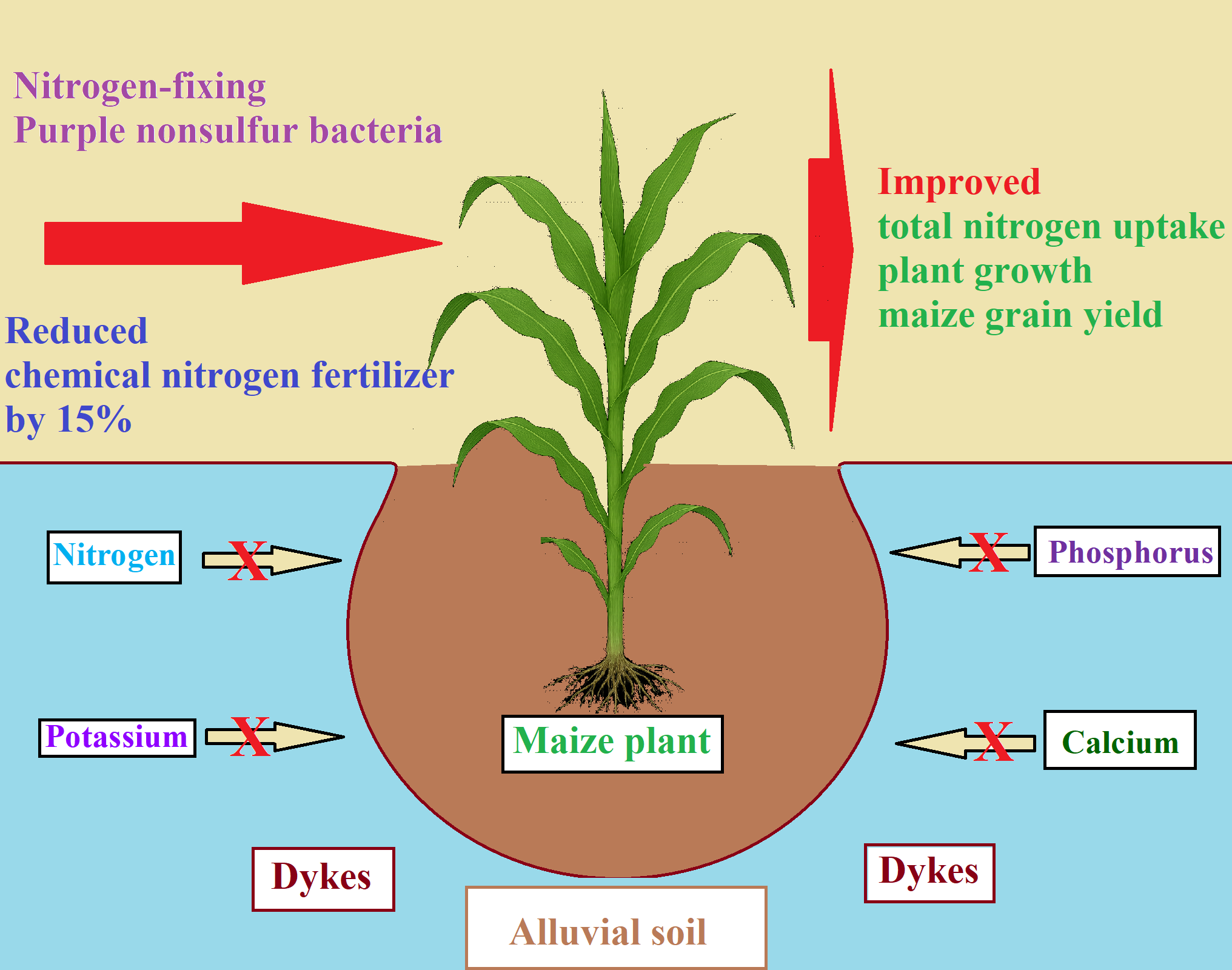
Downloads
References
CJ Stevens. Nitrogen in the environment. Science 2019; 363(6427), 578-580.
S Raza, N Miao, P Wang, X Ju, Z Chen, J Zhou and Y Kuzyakov. Dramatic loss of inorganic carbon by nitrogen-induced soil acidification in Chinese croplands. Global Change Biology 2020; 26(6), 3738-3751.
C Hu, X Xia, Y Chen and X Han. Soil carbon and nitrogen sequestration and crop growth as influenced by long-term application of effective microorganism compost. Chilean Journal of Agricultural Research 2018; 78(1), 13-22.
R Wang, J Min, HJ Kronzucker, Y Li and W Shi. N and P runoff losses in China's vegetable production systems: Loss characteristics, impact, and management practices. Science of The Total Environment 2019; 663(2019), 971-979.
X Wang, J Fan, Y Xing, G Xu, H Wang, J Deng, Y Wang, F Zhang, P Li and Z Li. The effects of mulch and nitrogen fertilizer on the soil environment of crop plants. In: DL Sparks (Ed.). Advances in agronomy. Academic Press, Cambridge, Massachusetts, United States, 2019, p. 121-173.
NO Igiehon and OO Babalola. Rhizosphere microbiome modulators: Contributions of nitrogen fixing bacteria towards sustainable agriculture. International Journal of Environmental Research and Public Health 2018; 15(4), 574.
JC Gaby and DH Buckley. Assessment of nitrogenase diversity in the environment. In: FJD Bruijn (Ed.). Biological nitrogen fixation. John Wiley & Sons, Inc., Hoboken, New Jersey, United States, 2015, p. 209-216.
LN Tandzi and CS Mutengwa. Estimation of maize (Zea mays L.) yield per harvest area: Appropriate methods. Agronomy 2020; 10(1), 29.
J Shrestha, DN Yadav, LP Amgain and JP Sharma. Effects of Nitrogen and Plant Density on Maize (Zea mays L.) Phenology and Grain Yield. Current Agriculture Research Journal 2018; 6(2), 175.
J Fang and Y Su. Effects of soils and irrigation volume on maize yield, irrigation water productivity, and nitrogen uptake. Scientific Reports 2019; 9(1), 7740.
H Zhao, S Bian, T Peng, N Sun, W Yan and S Feng. Effects of nitrogen application on nitrogen dynamic changes and nitrogen use efficiency in maize. Agricultural Science & Technology 2013; 14(12), 1797-1803.
BY Guo, H Gao, C Tang, T Liu and GX Chu. Response of water coupling with N supply on maize nitrogen uptake, water and N use efficiency, and yield in drip irrigation condition. Chinese Journal of Applied Ecology 2015; 26(12), 3679-3686.
G Liu, P Hou, R Xie, B Ming, K Wang, W Xu, W Liu, Y Yang and S Li. Canopy characteristics of high-yield maize with yield potential of 22.5 Mgha−1. Field Crops Research 2017; 213(4-7), 221-230.
J Nasar, W Khan, MZ Khan, HI Gitari, JF Gbolayori, AA Moussa, A Mandozai, N Rizwan and G Anwari. Photosynthetic activities and photosynthetic nitrogen use efficiency of maize crop under different planting patterns and nitrogen fertilization. Journal of Soil Science and Plant Nutrition 2021; 21(3), 2274-2284.
M Imran, A Ali and ME Safdar. The impact of different levels of nitrogen fertilizer on maize hybrids performance under two different environments. Asian Journal of Agriculture and Biology 2021; 4(2021), 1-10.
Y Cheng, HQ Wang, P Liu, ST Dong, JW Zhang, B Zhao and BZ Ren. Nitrogen placement at sowing affects root growth, grain yield formation, N use efficiency in maize. Plant and Soil 2020; 457(1-2), 355-373.
HM Hammad, MS Chawla, R Jawad, A Alhuqail, HFSG Bakha, W Farhad, F Khan, M Mubeen, AN Shah, K Liu, MT Harrison, S Saud and S Fahad. Evaluating the impact of nitrogen application on growth and productivity of maize under control conditions. Frontiers in Plant Science 2022; 13(2022), 885479.
S Ahmad, GY Wang, I Muhammad, YX Chi, M Zeeshan, J Nasar and XB Zhou. Interactive effects of melatonin and nitrogen improve drought tolerance of maize seedlings by regulating growth and physiochemical attributes. Antioxidants 2022; 11(2), 359.
JU Xiao-Tang, LIU Xue-Jun, FS Zhang and P Christie. Effect of long-term fertilization on organic nitrogen forms in a calcareous alluvial soil on the north china plain. Pedosphere 2006; 16(2), 224-229.
BTM Phụng, PV Toàn, HC Khánh and NH Chiếm. Study on the quantity and nutrients content of sediment in the full-dyke and semi-dyke systems in An Giang province. Can Tho University Journal of Science (in Vietnamese) 2017; 1(2017), 146-152.
CA Jote. The impacts of using inorganic chemical fertilizers on the environment and human health. Organic & Medicinal Chemistry International Journal 2023; 13(3), 555864.
NQ Khuong, LT Quang, LV Thuca, TN Huua, LTM Thua, TTB Vana, DT Xuan, NH Huea, NTT Le, PD Tien, TC Nhan, LNT Xuan and NTT Xuan. Potential of endophytic phosphorus-solubilizing bacteria to improve soil fertility, P uptake, and yield of maize (Zea mays L.) cultivated in alluvial soil in dikes in Vietnam. Bulgarian Journal of Agricultural Science 2022; 28(2), 217-228.
NQ Khuong, LV Thuc, HH Duc, TN Huu, TTB Van, LTM Thu, LT Quang, DT Xuan, TC Nhan, NTT Xuan and LNT Xuan. Potential of N2-fixing endophytic bacteria isolated from maize roots as biofertiliser to enhance soil fertility, N uptake, and yield of Zea mays L. cultivated in alluvial soil in dykes. Australian Journal of Crop Science 2022; 16(04), 461-470.
T Kantha, D Kantachote and N Klongdee. Potential of biofertilizers from selected Rhodopseudomonas palustris strains to assist rice (Oryza sativa L. subsp. indica) growth under salt stress and to reduce greenhouse gas emissions. Annals of Microbiology 2015; 65(4), 2109-2118.
J Dobereiner. Forage grasses and grain crops. In: FJ Bergersen (Ed). Methods for evaluating biological N fixation. John Wiley and Sons, Chichester UK, 1980, p. 535-555.
DL Eskew, DD Focht and IP Ting. Nitrogen fixation, denitrification, and pleomorphic growth in a highly pigmented Spirillum lipoferum. Applied and Environmental Microbiology 1977; 34(5), 582-585.
D Nelson. Determination of ammonium in KCl extracts of soils by the salicylate method. Communications in Soil Science and Plant Analysis 1983; 14(11), 1051-1062.
Y Suzuki, DK Shelly, MK Kenneth and FB Jillian. Microbial populations stimulated for hexavalent uranium reduction in uranium mine sediment. Applied and Environmental Microbiology 2003; 69(3), 1337-1346.
JD Thompson, TJ Gibson and DG Higgins. Multiple sequence alignment using clustalW and clustalX. Current Protocols in Bioinformatics 2023; 1(2023), 2-3.
K Tamura, G Stecher, D Peterson, A Filipski and S Kumar. MEGA6: Molecular evolutionary genetics analysis version 6.0. Molecular Biology and Evolution 2013; 30(12), 2725-2729.
K Tamura, M Nei and S Kumar. Prospects for inferring very large phylogenies by using the neighbor-joining method. Proceedings of the National Academy of Sciences of the United States of America 2004; 101(30), 11030-11035.
J Felsenstein. Confidence limits on phylogenies: an approach using the bootstrap. Evolution 1985; 39(4), 783-791.
DL Sparks, AL Page, PA Helmke, RH Loeppert, PN Soltanpour, MA Tabatabai, CT Johnston and ME Sumner. Methods of soil analysis, part 3: Chemical methods. Soil science society of America book series. American Society of Agronomy, Inc., Madison, Wisconsin, United States, 1996, p. 1424.
VTB Thuy, LT Quang, LV Thuc, TN Huu, LTM Thu, LTH Nhu, DT Xuan, LNT Xuan, NH Hue and NQ Khuong. Enhancement of green soybean growth and yield in alluvial soil by potent N2-fixing rhizospheric bacteria. Pakistan Journal of Biological Sciences 2022; 25(6), 549-559.
BA Ojung’a, IN Mutavi and D Masika. Influence of Dykes’ characteristics on food crop production in lower river nyando basin, Kenya. East African Journal of Agriculture and Biotechnology 2023; 6(1), 306-318.
GL Miner, JA Delgado, JA Ippolito, CE Stewart, DK Manter and SJD Grosso. Assessing manure and inorganic nitrogen fertilization impacts on soil health, crop productivity, and crop quality in a continuous maize agroecosystem. Journal of Soil and Water Conservation 2020; 75(4), 481-498.
GY Wang, YX Hu, YX Liu, S Ahmad and XB Zhou. Effects of supplement irrigation and nitrogen application levels on soil carbon-nitrogen content and yield of one-year double cropping maize in subtropical region. Water 2021; 13(9), 1180.
J Zheng, J Fan, F Zhang, J Guo, S Yan, Q Zhuang, N Cui and L Guo. Interactive effects of mulching practice and nitrogen rate on grain yield, water productivity, fertilizer use efficiency and greenhouse gas emissions of rainfed summer maize in northwest China. Agricultural Water Management 2021; 248(11), 106778.
LV Tan, T Tran and HH Loc. Soil and water quality indicators of diversified farming systems in a saline region of the Mekong Delta, Vietnam. Agriculture 2020; 10(2), 38.
HT Quyen and H Chu. Selection of nitrogen fixation and phosphate solubilizing bacteria from cultivating soil samples of Hung Yen province in Vietnam. Journal of Vietnamese Environment 2020; 12(2), 162-168.
LT Dat, LNT Xuan, TC Nhan, LT Quang and NQ Khuong. Isolating, selecting, and identifying Na+, H+, Al3+, Fe2+, Mn2+-resistant purple non-sulfur bacteria solubilizing insoluble phosphorus compounds from salt-contaminated acid sulfate soil derived from rice-shrimp system. Australian Journal of Crop Science 2024; 18(04), 192-199.
J Toribio-Jiménez, MÁ Rodríguez-Barrera, G Hernández-Flores, JC Ruvacaba-Ledezma, M Castellanos-Escamilla, and Y Romero-Ramírez. Isolation and screening of bacteria from Zea mays plant growth promoters. Revista Internacional de Contaminación Ambiental 2017; 33(2017), 143-150.
NTT Xuan, NHA Tinh, TC Nhan, LNT Xuan, NQ Khương and PV Quang. Effects of nitrogen-fixing bacteria and nitrogen fertilizer levels on growth, yield and nitrogen absorption of corn (Zea mays L.). Science and Technology journal of Agriculture and Rural development 2022; 10(2022), 41-48.
P Verma, N Agrawal and SK Shahi. Effect of rhizobacterial strain Enterobacter cloacae strain PGLO9 on potato plant growth and yield. Plant Archives 2018; 18(2), 2528-2532.
C Ji, Z Liu, L Hao, X Song, C Wang, Y Liu, H Li, C Li, Q Gao and X Liu. Effects of Enterobacter cloacae HG-1 on the nitrogen-fixing community structure of wheat rhizosphere soil and on salt tolerance. Frontiers in Plant Science 2020; 11(2020), 1094.
A Ullah, M Farooq, F Nadeem, . Zinc application in combination with zinc solubilizing Enterobacter sp. MN17 improved productivity, profitability, zinc efficiency, and quality of desi chickpea. Journal of Soil Science and Plant Nutrition 2020; 20(4), 2133-2144.
S Pattnaik, D Dash, S Mohapatra, M Pattnaik, AK Marandi, S Das and DP Samantaray. Improvement of rice plant productivity by native Cr(VI) reducing and plant growth promoting soil bacteria Enterobacter cloacae. Chemosphere 2020; 240(2020), 124895.
MAM Roslan, NN Zulkifli, ZM Sobri, ATK Zuan, SC Cheak and NAA Rahman. Seed biopriming with P-and K-solubilizing Enterobacter hormaechei sp. improves the early vegetative growth and the P and K uptake of okra (Abelmoschus esculentus) seedling. PloS one 2020; 15(7), e0232860.
PA Roussos, D Gasparatos, K Kechrologou, P Katsenos and P Bouchagier. Impact of organic fertilization on soil properties, plant physiology and yield in two newly planted olive (Olea europaea L.) cultivars under Mediterranean conditions. Scientia Horticulturae 2017; 220(2017), 11-19.
Y Li, F Pan and H Yao. Response of symbiotic and asymbiotic nitrogen-fixing microorganisms to nitrogen fertilizer application. Journal of Soils and Sediments 2019; 19(8), 1-11.
P Chakraborty, RK Sarker, R Roy, A Ghosh, D Maiti and P Tribedi. Bioaugmentation of soil with Enterobacter cloacae AKS7 enhances soil nitrogen content and boosts soil microbial functional-diversity. 3 Biotech 2019; 9(7), 253.
M Sembiring, S Anwar and T Sabrina. Potential test of non-symbiotic nitrogen-fixing bacteria in increasing nitrogen in Andisol soil. IOP Conference Series: Earth and Environmental Science 2021; 782(4), 042069.
NH Anh, CT Phat, LM Nhut, TLT My, ND Trong, LT Quang, LNT Xuan, TC Nhan, NT Phong and KN Quoc. Effectiveness of nitrogen-fixing bacteria rhodobacter sphaeroides in soil–plant nitrogen and rice performance in extremely saline acid sulfate soil over two consecutive seasons. Sustainability 2025; 17(5), 2228.
LV Thuc, TN Huu, TM Ngoc, NH Hue, LT Quang, DT Xuan, TC Nhan, LNT Xuan, LTM Thu, I Akagi, JI Sakagami, and NQ Khuong. Effects of nitrogen fertilization and nitrogen fixing endophytic bacteria supplementation on soil fertility, N uptake, growth, and yield of sesame (Sesamum indicum L.) cultivated on alluvial soil in Dykes. Applied and Environmental Soil Science 2022; 2022(1), 1972585.
Y Sondang, K Anty and R Siregar. The effect of biofertilizer and inorganic fertilizer toward the nutrient uptake in maize plant (Zea mays L.). Journal of Applied Agricultural Science and Technology 2019; 3(2), 213-225.
P Verma, N Agrawal and SK Shahi. Enterobacter cloacae strain PGLO9: Potential source of maize growth promoting rhizobacteria. International Journal of Botany Studies 2018; 3(2), 172-175.
LPD Salvo, GC Cellucci, ME Carlino and IEGD Salamone. Plant growth-promoting rhizobacteria inoculation and nitrogen fertilization increase maize (Zea mays L.) grain yield and modified rhizosphere microbial communities. Applied Soil Ecology 2018; 126(2018), 113-120.
EMS Gheith, OZ El-Badry, SF Lamlom, HM Ali, MH Siddiqui, Y Ghareeb, MH El-Sheikh, J Jebril, NR Abdelsalam and E Kandil. Maize (Zea mays L.) productivity and nitrogen use efficiency in response to nitrogen application levels and time. Frontiers in Plant Science 2022; 13(2022), 941343.
J Wang, R Li, H Zhang, G Wei and Z Li. Beneficial bacteria activate nutrients and promote wheat growth under conditions of reduced fertilizer application. BMC Microbiology 2020; 20(1), 38.
Published
How to Cite
Issue
Section
License
Copyright (c) 2025 Walailak University

This work is licensed under a Creative Commons Attribution-NonCommercial-NoDerivatives 4.0 International License.





