
Toward Sustainable Biosensing: Green-Synthesized Gold Nanoparticles from Ocimum Americanum Enhance the Performance of NcCDH-Based Lactose Biosensor
DOI:
https://doi.org/10.48048/tis.2026.13641Keywords:
AuNPs, Biosynthesis, Electrochemical, Biosensor, Neurospora crassa, Cellobiose dehydrogenase, Ocimum americanumAbstract
The increasing demand for sustainable biosensing calls for alternative approaches that integrate green chemistry and nanotechnology. This study reports an eco-friendly and facile method for synthesizing gold nanoparticles (AuNPs) utilizing Ocimum americanum leaves extract as a bioreductant. Furthermore, we demonstrate their application to improve the performance of lactose biosensor employing cellobiose dehydrogenase from Neurospora crassa (NcCDH) as a promising approach for lactose detection in the dairy industry. Ultrasound-assisted extraction of dehydrated Ocimum americanum leaves for 3 min shows highest antioxidant activity (IC50 = 83.53) which was subsequently used as the bioreductant for the green synthesis of AuNPs. Characterization of AuNPs spectra, zeta potential and imaging results confirmed that the chemically synthesized AuNPs were monodisperse and stable while green synthesized AuNPs were smaller but polydisperse. Electrodeposition at varying concentration of chitosan showed highest current response at 0.1% chitosan, while highest immobilization efficiency (40.51 ± 3.56%) was achieved at 0.5% chitosan. Cyclic voltammetry characterization revealed 2 distinct electron transfer pathways of NcCDH via the FAD and heme domains. The incorporation of chemically synthesized AuNPs increased current responses by 327.77% (FAD) and 14.23% (heme), whereas Green-AuNPs yielded 549.74% (FAD) and 14.23% (heme) in comparison to the modified SPCEs without AuNPs. Chemical-AuNPs resulted in higher sensitivity, but Green-AuNPs provided lower detection limit to the biosensor analytical performance. Both chemically and green synthesized AuNPs-modified electrodes showed good stability up to 21 days, exceeding the control electrode which showed 2.5-times higher activity lost within 21 days. Our findings confirmed that AuNPs, particularly Green-AuNPs, significantly enhance the analytical performance of NcCDH-based lactose biosensor by facilitating electron transfer between the enzyme and electrode through both the FAD and heme domain.
HIGHLIGHTS
- An ultrasound-assisted extraction method was developed to produce Ocimum americanum extract with high antioxidant activity for biosynthesis of AuNPs.
- The highest current response obtained from chitosan electrodeposition at a concentration of 0.1%, while the highest enzyme immobilization efficiency was at chitosan concentration of 0.5%.
- Green-synthesized AuNPs were smaller and had a lower detection limit than chemically synthesized AuNPs, stable for up to 21 days.
- The two electrode transfer pathways of NcCDH (FAD and heme mediated) were investigated, and the FAD domain current response was better with green-AuNPs.
GRAPHICAL ABSTRACT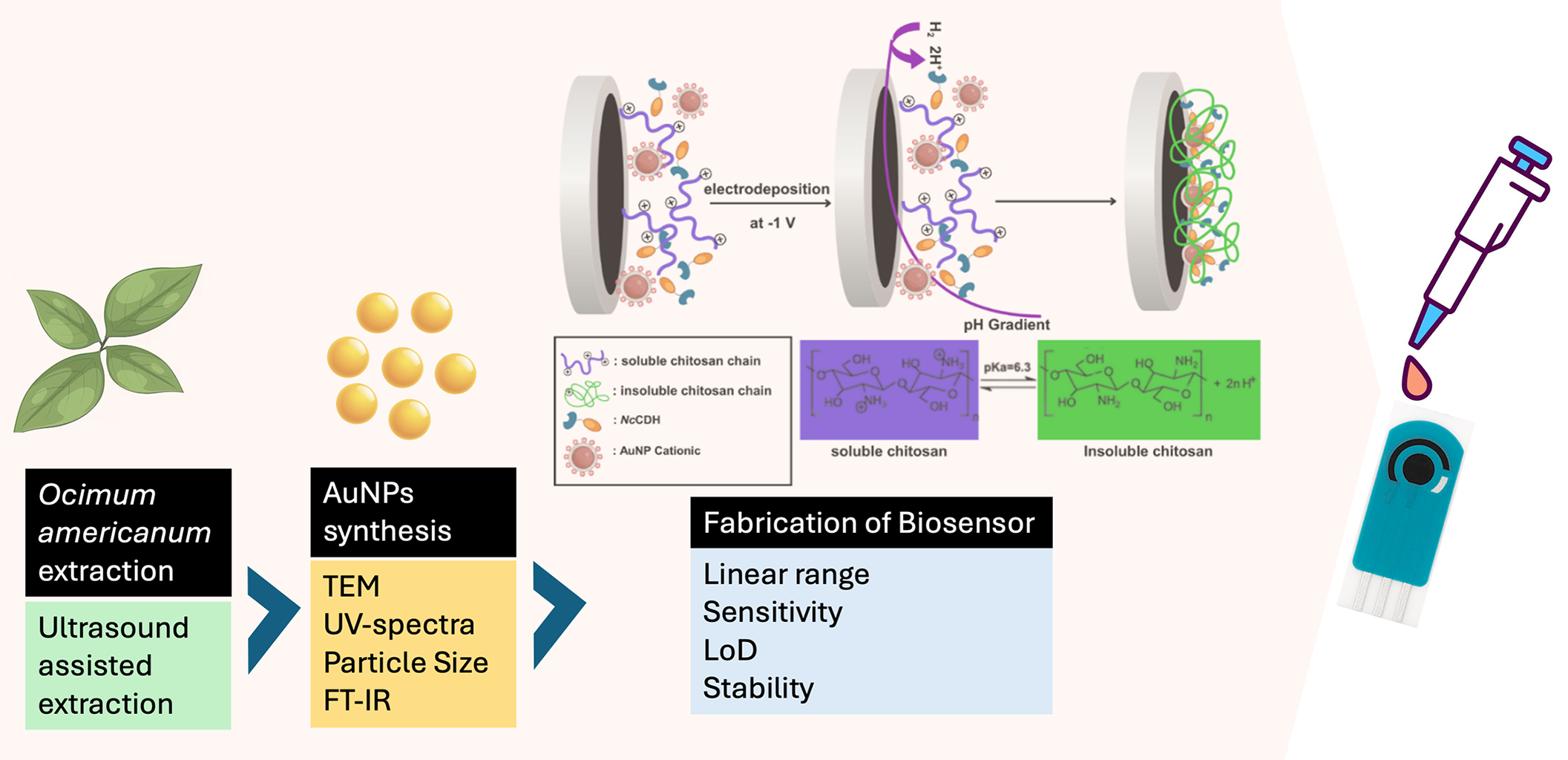
Downloads
References
N Bhalla, P Jolly, N Formisano and P Estrela. Introduction to biosensors. Essays in Biochemistry 2016; 60(1), 1-8.
X Wang, J Zhou and H Wang. Bioreceptors as the key components for electrochemical biosensing in medicine. Cell Reports Physical Science 2024; 5(2), 101801.
SD Wijayanti, L Tsvik and D Haltrich. Recent advances in electrochemical enzyme-based biosensors for food and beverage analysis. Foods 2023; 12(18), 3355.
OY Dudchenko, VM Pyeshkova, OO Soldatkin, B Akata, BO Kasap, AP Soldatkin and SV Dzyadevych. Development of silicalite/glucose oxidase-based biosensor and its application for glucose determination in juices and nectars. Nanoscale Research Letters 2016; 11, 59.
S Dominici, F Marescotti, C Sanmartin, M Macaluso, I Taglieri, F Venturi, A Zinnai and MS Facioni. Lactose: Characteristics, food and drug-related applications, and its possible substitutions in meeting the needs of people with lactose intolerance. Foods 2022; 11(10), 1486.
C Sygmund, D Kracher, S Scheiblbrandner, K Zahma, AKG Felice, W Harreither, R Kittl and R Ludwig. Characterization of the two Neurospora crassa cellobiose dehydrogenases and their connection to oxidative cellulose degradation. Applied and Environmental Microbiology 2012; 78(17), 6161-6171.
G Kovacs, R Ortiz, V Coman, W Harreither, IC Popescu, R Ludwig and L Gorton. Graphite electrodes modified with Neurospora crassa cellobiose dehydrogenase: Comparative electrochemical characterization under direct and mediated electron transfer. Bioelectrochemistry 2012; 88, 84-91.
P Bollella, R Ludwig and L Gorton. Cellobiose dehydrogenase: Insights on the nanostructuration of electrodes for improved development of biosensors and biofuel cells. Applied Materials Today 2017; 9, 319-332.
R Ludwig, W Harreither, F Tasca and L Gorton. Cellobiose dehydrogenase: A versatile catalyst for electrochemical applications. ChemPhysChem 2010; 11(13), 2674-2697.
F Csarman, L Wohlschlager and R Ludwig. Cellobiose dehydrogenase. Elsevier, Netherland, 2020, p. 457-489.
A Giorgianni, A Zenone, L Sützl, F Csarman and R Ludwig. Exploring class III cellobiose dehydrogenase: Sequence analysis and optimized recombinant expression. Microbial Cell Factories 2024; 23, 146.
M Tavahodi, R Ortiz, C Schulz, A Ekhtiari, R Ludwig, B Haghighi and L Gorton. Direct electron transfer of cellobiose dehydrogenase on positively charged polyethyleneimine gold nanoparticles. ChemPlusChem 2016; 82(4), 546-552.
S Ma, CVFP Laurent, M Meneghello, J Tuoriniemi, C Oostenbrink, L Gorton, PN Bartlett and R Ludwig. Direct electron-transfer anisotropy of a site-specifically immobilized cellobiose dehydrogenase. ACS Catalysis 2019; 9(8), 7607-7615.
B Motycka, F Csarman, M Rupp, K Schnabel, G Nagy, K Karnpakdee, S Scheiblbrandner, R Tscheliessnig, C Oostenbrink, M Hammel and R Ludwig. Amino acid residues controlling domain interaction and interdomain electron transfer in cellobiose dehydrogenase. ChemBioChem 2023; 24(22), e202300431.
T Tangkuaram, C Ponchio, T Kangkasomboon, P Katikawong and W Veerasai. Design and development of a highly stable hydrogen peroxide biosensor on screen printed carbon electrode based on horseradish peroxidase bound with gold nanoparticles in the matrix of chitosan. Biosensors and Bioelectronics 2007; 22(9-10), 2071-2078.
H Liu, D Lu, P Li, Y Chen, Y Zhou and T Lu. One-step electrodeposition of chitosan/phosphonate iron(III) hybrids film and its pH-controlled switchable electrocatalytic behavior. Journal of Electroanalytical Chemistry 2014; 717-718, 125-130.
Y Tan, W Deng, C Chen, Q Xie, L Lei, Y Li, Z Fang, M Ma, J Chen and S Yao. Immobilization of enzymes at high load/activity by aqueous electrodeposition of enzyme-tethered chitosan for highly sensitive amperometric biosensing. Biosensors and Bioelectronics 2010; 25(12), 2644-2650.
P Bollella, F Mazzei, G Favero, G Fusco, R Ludwig, L Gorton and R Antiochia. Improved DET communication between cellobiose dehydrogenase and a gold electrode modified with a rigid self-assembled monolayer and green metal nanoparticles: The role of an ordered nanostructuration. Biosensors and Bioelectronics 2017; 88, 196-203.
M Huston, M DeBella, M DiBella and A Gupta. Green synthesis of nanomaterials. Nanomaterials 2021; 11(8), 2130.
MA Qaeed, A Hendi, AS Obaid, AA Thahe, AM Osman, A Ismail, A Mindil, AA Eid, F Aqlan, NMA Osman, A AL-Farga, SM Al-Maaqar and AA Saif. The effect of different aqueous solutions ratios of Ocimum basilicum utilized in AgNPs synthesis on the inhibition of bacterial growth. Scientific Reports 2023; 13, 5866.
BT Aluko, OI Oloyede and AJ Afolayan. Polyphenolic contents and free radical scavenging potential of extracts from leaves of Ocimum americanum L. Pakistan Journal of Biological Sciences 2013; 16(1), 22-30.
AKA Genfi, C Larbie, BO Emikpe, AA Oyagbemi, CK Firempong and CO Adjei. Modulation of oxidative stress and inflammatory cytokines as therapeutic mechanisms of Ocimum americanum L. extract in carbon tetrachloride and acetaminophen-induced toxicity in rats. Journal of Evidence-Based Integrative Medicine 2020; 25, 1-13.
M Shanaida, O Golembiovska, I Jasicka-Misiak, O Oleshchuk, N Beley, I Kernychna and PP Wieczorek. Sedative effect and standardization parameters of herbal medicinal product obtained from the Ocimum americanum L. herb. European Pharmaceutical Journal 2021; 68(1), 1-9.
G Zengin, C Ferrante, DE Gnapi, KI Sinan, G Orlando, L Recinella, A Diuzheva, J Jekő, Z Cziáky, A Chiavaroli, S Leone, L Brunetti, C Picot-Allain, MF Mahomoodally, P Angelini, S Covino, R Venanzoni, B Tirillini and L Menghini. Comprehensive approaches on the chemical constituents and pharmacological properties of flowers and leaves of American basil (Ocimum americanum L.). Food Research International 2019; 125, 108610.
B Islam, D Samir, C Sara and N Janetta. Ocimum basilicum L. leaves extract-mediated green synthesis of MnO NPs: Phytochemical profile, characterization, catalytic and thrombolytic activities. Results in Surfaces and Interfaces 2024; 17, 100284.
N Aggarwal, P Mehta, J Bhambra, A Sharma, D Ali, NK Sharma, S Sharma, G Kumar and N Kumar. Biosynthesis of Ocimum basilicum leaf extract mediated zinc oxide nanoparticles and their cytotoxic activity. Biomass Conversion and Biorefinery 2023; 13, 8373-8380.
DB Manikandan, A Sridhar, RK Sekar, B Perumalsamy, S Veeran, M Arumugam, P Karuppaiah, T Ramasamy. Green fabrication, characterization of silver nanoparticles using aqueous leaf extract of Ocimum americanum (Hoary Basil) and investigation of its in vitro antibacterial, antioxidant, anticancer and photocatalytic reduction. Journal of Environmental Chemical Engineering 2021; 9, 104845.
İ Gulcin and SH Alwasel. DPPH radical scavenging assay. Processes 2023; 11(8), 2248.
TP Patil, AA Vibhute, SL Patil, TD Dongale and AP Tiwari. Green synthesis of gold nanoparticles via Capsicum annum fruit extract: Characterization, antiangiogenic, antioxidant and anti-inflammatory activities. Applied Surface Science Advances 2023; 13, 100372.
AEF Oliveira, AC Pereira, MAC Resende and LF Ferreira. Gold nanoparticles: A didactic step-by-step of synthesis using Turkevich method, mechanisms and characterization. Analytica 2023; 4(2), 250-263.
I Jasicka-Misiak, M Shanaida, N Hudz and PP Wieczorek. Phytochemical and pharmacological evaluation of the residue by-product developed from the Ocimum americanum (Lamiaceae) postdistillation waste. Foods 2021; 10(12), 3063.
ADS Backiam, S Duraisamy, P Karuppaiya, S Balakrishnan, A Sathyan, A Kumarasamy and A Raju. Analysis of the main bioactive compounds from Ocimum basilicum for their antimicrobial and antioxidant activity. Biotechnology and Applied Biochemistry 2023; 70(6), 2038-2051.
A Itam, MS Wati, V Agustin, N Sabri, RA Jumanah and M Efdi. Comparative study of phytochemical, antioxidant, and cytotoxic activities and phenolic content of Syzygium aqueum (Burm. f. Alston f.) extracts growing in West Sumatera Indonesia. The Scientific World Journal 2021; 2021, 5537597.
SB Rad, H Mumivand, S Mollaei and A Khadivi. Effect of drying methods on phenolic compounds and antioxidant activity of Capparis spinosa L. fruits. BMC Plant Biology 2025; 25, 133.
DM Cuong, DK Kim, MK Ediriweera, JE Park, JY Moon and SK Cho. Effects of drying method and extraction solvent on antioxidant and anti-inflammatory activity of Melosira nummuloides bioproducts. Applied Biological Chemistry 2023; 66, 59.
NPE Hikmawanti, S Fatmawati, Z Arifin, N Cahyaningrum and MA Fauzan. The effect of pre-extraction preparation on antioxidant compounds of Sauropus androgynus (L.) Merr. leaves extracts. Pharmaceutical Sciences and Research 2021; 8(3), 128-135.
ASM Sayem, T Ahmed, MUK Mithun, M Rashid and MR Rana. Optimising ultrasound-assisted extraction conditions for maximising phenolic, flavonoid content and antioxidant activity in hog plum peel and seed: A response surface methodology approach. Journal of Agriculture and Food Research 2024; 18, 101312.
MI Prawira-Atmaja and S Puangpraphant. Effects of ultrasound-assisted bath, probe, and extraction time on bioactive compounds and antioxidant activity in white tea (Camellia sinensis) extracts from purple- and green-leaf cultivars. Journal of the Saudi Society of Agricultural Sciences 2025; 24, 10.
MA Ali, TAS Eldin, GME Moghazy, IM Tork and II Omara. Detection of E. coli O157:H7 in feed samples using gold nanoparticles sensor. International Journal of Current Microbiology and Applied Sciences 2014; 3(6), 697-708.
JM Gisbert-González, W Cheuquepán, A Ferre-Vilaplana, E Herrero and JM Feliu. Citrate adsorption on gold: Understanding the shaping mechanism of nanoparticles. Journal of Electroanalytical Chemistry 2020; 875, 114015.
AT Algahiny, OS Elmitwalli, DA Kassim, GR Deen, S Akhtar and FZ Henari. Gum Arabic-assisted green synthesis of gold nanoparticles as fluorescence modulator for potential analytical applications. Exploratory BioMat-X 2024; 1, 190-201.
A Dabhade, S Jayaraman and B Paramasivan. Development of glucose oxidase-chitosan immobilized paper biosensor using screen-printed electrode for amperometric detection of Cr(VI) in water. 3 Biotech 2021; 11, 183.
VP Hitaishi, R Clement, N Bourassin, M Baaden, AD Poulpiquet, S Sacquin-Mora, A Ciaccafava and E Lojou. Controlling redox enzyme orientation at planar electrodes. Catalysts 2018; 8(5), 192.
K Karnpakdee, D Kracher and R Ludwig. Electron transfer of cellobiose dehydrogenase in polyethyleneimine films. ChemElectroChem 2024; 11(8), 202300679.
A Chmayssem, I Shalayel, S Marinesco and A Zebda. Investigation of GOx stability in a chitosan matrix: Applications for enzymatic electrodes. Sensors 2023; 23(1), 465.
DM Radulescu, VA Surdu, A Ficai, D Ficai, AM Grumezescu and E Andronescu. Green synthesis of metal and metal oxide nanoparticles for recent applications. International Journal of Molecular Sciences 2023; 24(20), 15397.
M Popescu and C Ungureanu. Biosensors in food and healthcare industries: Bio-Coatings based on biogenic nanoparticles and biopolymers. Coatings 2023; 13(3), 486.
P Bollella, C Schulz, G Favero, F Mazzei, R Ludwig, L Gorton and R Antiochia. Green synthesis and characterization of gold and silver nanoparticles and their application for development of a third generation lactose biosensor. Electroanalysis 2016; 29(1), 77-86.
S Garehbaghi, V Adam, J Přibyl, L Richtera and AM Ashrafi. An enzyme cascade biosensor based on multiwalled carbon nanotube-RuO2 nanocomposite for selective amperometric determination of lactose in milk samples. Microchemical Journal 2024; 204, 111138.
F Tasca, R Ludwig, L Gorton and R Antiochia. Determination of lactose by a novel third generation biosensor based on a cellobiose dehydrogenase and aryl diazonium modified single wall carbon nanotubes electrode. Sensors and Actuators B: Chemical 2013; 177, 64-69.
G Halpin, S McEntee, C Dwyer, F Lawless and E Dempsey. Lactose biosensor development and deployment in dairy product analysis. Journal of The Electrochemical Society 2022; 169(3), 037528.
B Çakıroğlu, YC Demirci, E Gökgöz and M Özacar. A photoelectrochemical glucose and lactose biosensor consisting of gold nanoparticles, MnO2 and g-C3N4 decorated TiO2. Sensors and Actuators B: Chemical 2019; 282, 282-289.
Downloads
Published
How to Cite
Issue
Section
License
Copyright (c) 2026 Walailak University

This work is licensed under a Creative Commons Attribution-NonCommercial-NoDerivatives 4.0 International License.





