
Hypoxic Mesenchymal Stem Cell Secretome Restores Hematopoiesis and Modulates Immune Responses in A Murine Model of Aplastic Anemia
DOI:
https://doi.org/10.48048/tis.2026.13487Keywords:
Aplastic anemia, Mesenchymal stem cell secretome, Hypoxia, Hematopoiesis, Immunomodulation, Busulfan, Murine modelAbstract
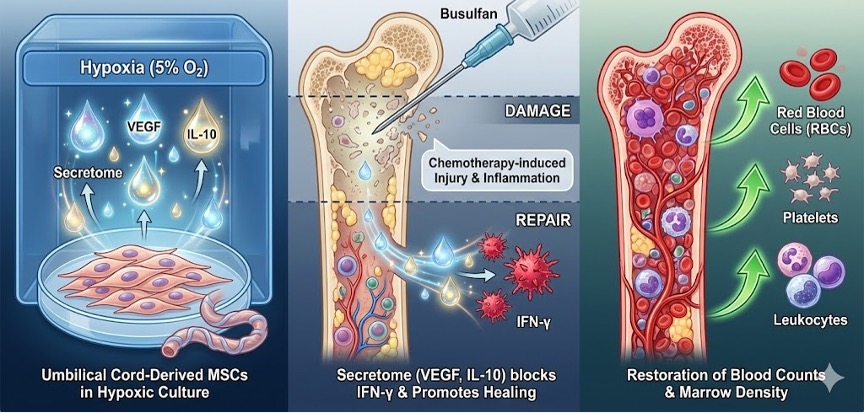
Aplastic anemia (AA) is a severe bone marrow failure syndrome characterized by pancytopenia and hypocellular marrow, driven by disrupted hematopoietic stem/progenitor cell (HSPC) pathways and elevated inflammatory cytokines, particularly IFN-γ. Current therapies have limitations, underscoring the need for innovative regenerative approaches. The mesenchymal stem cell (MSC) secretome, especially from hypoxic preconditioning (SH-MSCs), exhibits enhanced paracrine factor secretion, survival, and immunomodulatory efficacy by mimicking the bone marrow niche. This study evaluated the therapeutic potential of SH-MSC secretome in a busulfan-induced AA mouse model. Thirty Balb/c mice were divided into 5 groups: Healthy, AA (control negative), AA + standard medication (control positive), AA + 200 µL SH-MSCs, and AA + 200 µL SH-MSCs + standard medication. AA was induced by busulfan injection. SH-MSCs were isolated from human umbilical cords and cultured under hypoxic conditions (2% O₂). Hematological parameters (RBC, platelets, leukocytes, hemoglobin), gene expression {IL-3, IFN-γ}, EPO levels, and bone marrow cellularity were assessed. The AA model exhibited significant reductions in RBC, platelet, and leukocyte counts compared to healthy controls (p < 0.05). SH-MSCs (200 µL) significantly restored RBC counts, while SH-MSCs alone and combination therapy significantly increased platelet, leukocyte, and hemoglobin levels compared with AA controls (p < 0.05). IFN-γ expression was significantly reduced, and bone marrow cellularity was markedly enhanced by both treatments (p < 0.05). No significant differences were observed between SH-MSCs alone and combination therapy for RBCs, hemoglobin, or other parameters (p > 0.05). These findings demonstrate that hypoxic preconditioned MSC secretome effectively promotes hematopoiesis, suppresses inflammation, and restores bone marrow function in AA, offering comparable efficacy to combination therapy and strong potential as a novel standalone or adjunctive treatment.
HIGHLIGHTS
- Hypoxia-conditioned MSC (SH-MSC) secretome improves blood recovery in a busulfan-induced aplastic anemia model.
- SH-MSCs support red blood cell production and bone marrow repair via paracrine and immune effects.
- SH-MSC treatment restores RBCs, platelets, and white blood cells, and lowers IFN-γ levels.
- SH-MSCs show similar effectiveness to standard immunosuppressive therapy, suggesting strong clinical potential.
GRAPHICAL ABSTRACT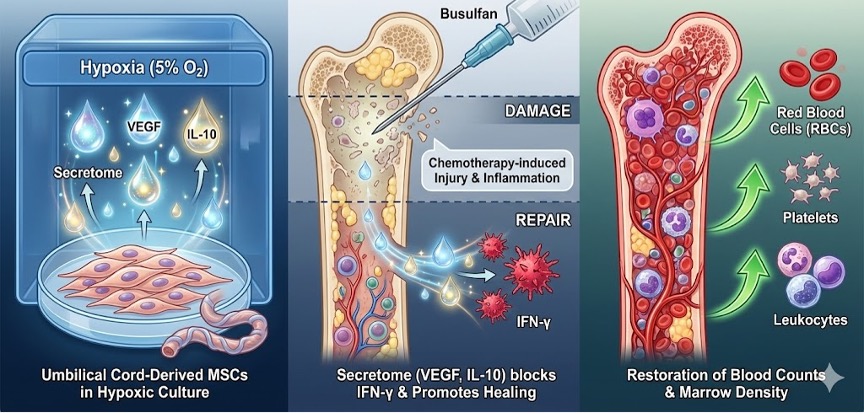
Downloads
References
R Agarwal, V Bharat, BK Gupta, S Jain, R Bansal, A Choudhary and G Tiwari. Clinical and hematological profile of pancytopenia. International Journal of Clinical Biochemistry and Rerearch 2015; 2(1), 48-53.
RA Brodsky and RJ Jones. Acquired aplastic anemia. Academic Press, California, 2014, p. 685-694.
NS Young. Aplastic anemia. New England Journal of Medicine 2018; 379, 1643-1656.
MZA Hi, SAA Khaled, DG Mahran and MM Aly. Platelet indices as a predictor in patients with aplastic anemia and immune thrombocytopenic purpura: A retrospective case–control study. The Egyptian Journal of Internal Medicine 2024; 36, 92.
V Stavi, N Khaire, JH Lipton and R Kumar. Haploidentical hematopoietic stem cell transplantation for patients with severe aplastic anemia—single-centre experience. Current Oncology 2024; 31(3), 1246-1252.
JM Speth, J Hoggatt, P Singh and LM Pelus. Pharmacologic increase in HIF1α enhances hematopoietic stem and progenitor homing and engraftment. Blood 2014; 123(2), 203-207.
PM Campeau, M Rafei, M François, E Birman, KA Forner and J Galipeau. Mesenchymal stromal cells engineered to express erythropoietin induce anti-erythropoietin antibodies and anemia in allorecipients. Molecular Therapy 2009; 17(2), 369-372.
B Fattizzo, M Michel, A Zaninoni, J Giannotta, S Guillet, H Frederiksen, JMI Vos, FR Mauro, B Jilma, A Patriarca, F Zaja, A Hill, S Berentsen and W Barcellini. Efficacy of recombinant erythropoietin in autoimmune hemolytic anemia: A multicenter international study. Haematologica 2021; 106(2), 622-625.
L Zhang, X Han, Q Zhu, Y Qin and Y Jia. Clinical utility of hematological parameters in aplastic anemia. Scientific Reports 2025; 15, 2946.
P Pan, C Chen, J Hong and Y Gu. Autoimmune pathogenesis, immunosuppressive therapy and pharmacological mechanism in aplastic anemia. International Immunopharmacology 2023; 117, 110036.
AD Slonim, EK Bish and RS Xie. Red blood cell transfusion safety: Probabilistic risk assessment and cost/ benefits of risk reduction strategies. Annals of Operations Research 2014; 221, 377-406.
M Medinger, B Drexler, C Lengerke and J Passweg. Pathogenesis of acquired aplastic anemia and the role of the bone marrow microenvironment. Frontiers in Oncology 2018; 8, 587.
H Li, L Wang, Y Pang, Z Jiang, Z Liu, H Xiao, H Chen, X Ge, H Lan and Y Xiao. In patients with chronic aplastic anemia, bone marrow-derived MSCs regulate the Treg/Th17 balance by influencing the Notch/RBP-J/FOXP3/RORγt pathway. Scientific Reports 2017; 7, 42488.
A Piekarska, K Pawelec, A Szmigielska-Kapłon and M Ussowicz. The state of the art in the treatment of severe aplastic anemia: Immunotherapy and hematopoietic cell transplantation in children and adults. Frontiers in Immunology 2024; 15, 1378432.
MI Sari, NK Jusuf, Di Munir, A Putra, T Bisri, S Ilyas, F Farhat, AM Muhar, M Rusda and MM Amin. The role of mesenchymal stem cell secretome in the inflammatory mediators and the survival rate of rat model of sepsis. Biomedicines 2023; 11(8), 2325.
B Isildar, S Ozkan, H Sahin, M Ercin, S Gezginci-Oktayoglu and M Koyuturk. Preconditioning of human umbilical cord mesenchymal stem cells with deferoxamine potentiates the capacity of the secretome released from the cells and promotes immunomodulation and beta cell regeneration in a rat model of type 1 diabetes. International Immunopharmacology 2024; 129, 111662.
TO Ribeiro, BM Silveira, MC Meira, ACO Carreira, MC Sogayar, R Meyer and V Fortuna. Investigating the potential of the secretome of mesenchymal stem cells derived from sickle cell disease patients. PLoS One 2019; 14(10), 0222093.
Y Yang, EH Lee and Z Yang. Hypoxia-conditioned mesenchymal stem cells in tissue regeneration application. Tissue Engineering Part B: Reviews 2022; 28(5), 966-977.
Y Yang, Y Wu, D Yang, SH Neo, ND Kadir, D Goh, JX Tan, V Denslin, EH Lee and Z Yang. Secretive derived from hypoxia preconditioned mesenchymal stem cells promote cartilage regeneration and mitigate joint inflammation via extracellular vesicles. Bioactive Materials 2023; 27, 98-112.
J Beegle, K Lakatos, S Kalomoiris, H Stewart, RR Isseroff, JA Nolta and FA Fierro. Hypoxic preconditioning of mesenchymal stromal cells induces metabolic changes, enhances survival, and promotes cell retention in vivo. Stem Cells 2015; 33(6), 1818-1828.
S Wang, J Huo, Y Liu, L Chen, X Ren, X Li, M Wang, P Jin, J Huang, N Nie, J Zhang, Y Shao, M Ge and Y Zheng. Impaired immunosuppressive effect of bone marrow mesenchymal stem cell-derived exosomes on T cells in aplastic anemia. Stem Cell Research & Therapy 2023; 14, 285.
R Ni, L Fan, L Zhang, Y Song, H Wang, A Wang and B Liu. A mouse model of irradiation and spleen-thymus lymphocyte infusion induced aplastic anemia. Hematology 2022; 27(1), 932-945.
J Chen. Animal models for acquired bone marrow failure syndromes. 2005; 3(2), 102-108.
FM Gibson, CM Andrews, P Diamanti, S Rizzo, G Macharia, EC Gordon-Smith, T Williams and J Turton. A new model of busulphan-induced chronic bone marrow aplasia in the female BALB/c mouse. International Journal of Experimental Pathology 2003; 84(1), 31-48.
BT Dirja, EH Wardoyo, A Putra and ND Amalina. Enhanced third degree burn wound healing by hypoxic mesenchymal stem cells’ secretome: IL-10 upregulation and TNF-α/PGE2 suppression. Trends in Sciences 2024; 21(10), 8288.
J Angelina, A Putra, S Trisnadi, D Hermansyah, E Setiawan, T Sumarawati and ND Amalina. Hypoxia-conditioned mesenchymal stem cell (MSC) exosomes attenuate ultraviolet-B (UVB)-mediated malondialdehyde (MDA) and matrix metalloproteinase-1 (MMP-1) upregulation in collagen loss models. Med Glas 2025; 22(1), 9-14.
L Restimulia, S Ilyas, D Munir, A Putra, T Madiadipoera, F Farhat, RJ Sembiring, M Ichwan and ND Amalina. Rats’ umbilical-cord mesenchymal stem cells ameliorate mast cells and Hsp70 on ovalbumin-induced allergic rhinitis rats. Med Glas 2022; 19(1), 52-59.
M Fredianto, H Herman, YD Ismiarto, A Putra, I Alif, ND Amalina and MA Nazar. Secretome of hypoxia-preconditioned mesenchymal stem cells enhance the expression of HIF-1a and bFGF in a rotator cuff tear model. Med Glas 2023; 20(2), 242-248.
PP Priya and AR Subhashree. Role of absolute reticulocyte count in evaluation of Pancytopenia-a hospital based study. Journal of Clinical and Diagnostic Research 2014; 8(8), FC01-FC03.
Y Zeng and E Katsanis. The complex pathophysiology of acquired aplastic anaemia. Clinical and Experimental Immunology 2015; 180(3), 361-370.
S Fu, Y Du, T Pan, F Ma, H He and Y Li. Causal role of immune cells in aplastic anemia: Mendelian randomization (MR) study. Scientific Reports 2024; 14, 18010.
B Serio, V Giudice and C Selleri. All roads lead to Interferon-γ: From known to untraveled pathways in acquired aplastic anemia. Medicina 2023; 59(12), 2170.
K Kaito, H Otsubo, N Usui and M Kobayashi. Th1/Th2 lymphocyte balance in patients with aplastic anemia. Rinsho Byori 2004; 52(7), 569-573.
H Sunarto, S Trisnadi, A Putra, NAC Sa'dyah, A Tjipta and Chodidjah. The role of hypoxic mesenchymal stem cells conditioned medium in increasing vascular endothelial growth factors (VEGF) levels and collagen synthesis to accelerate wound healing. Indonesian Journal of Cancer Chemoprevention 2020; 11(3), 134-143.
V Razban, AS Lotfi, M Soleimani, H Ahmadi, M Massumi, S Khajeh, M Ghaedi, S Arjmand, S Najavand and A Khoshdel. HIF-1α overexpression induces angiogenesis in mesenchymal stem cells. BioResearch Open Access 2012; 1(4), 174-183.
P Scheinberg, C Finelli, EH Montaňo-Figueroa, C Vallejo, L Norasetthada, RT Calado, M Turgut, RP de Latour, U Kriemler-Krahn, J Haenig, J Clark and J Jang. Activity and safety of eltrombopag in combination with cyclosporin A as first‑line treatment of adults with severe aplastic anaemia (SOAR): A phase 2, single-arm study. Lancet Haematolgy 2024; 11(3), 206-215.
LF Martins, RO Costa, JR Pedro, P Aguiar, SC Serra, FG Teixeira, N Sousa, AJ Salgado and RD Almeida. Mesenchymal stem cells secretome-induced axonal outgrowth is mediated by BDNF. Scientific Reports 2017; 7, 4153.
FD Liu, K Tam, N Pishesha, Z Poon and KJV Vliet. Improving hematopoietic recovery through modeling and modulation of the mesenchymal stromal cell secretome. Stem Cell Research & Therapy 2018; 9, 268.
Q Zhao, K Larios, Y Naaldijk, LS Sherman, A Chemerinski, K Okereke, P Rameshwar, A Lemenze, NC Douglas and SS Morelli. Mesenchymal stem cell secretome alters gene expression and upregulates motility of human endometrial stromal cells. Reproduction 2023; 166(2), 161-174.
AE Gilchrist and BAC Harley. Connecting secretome to hematopoietic stem cell phenotype shifts in an engineered bone marrow niche. Integrative Biology 2020; 12(7), 175-187.
E Daryanti, A Putra, T Sumarawati, ND Amalina, A Prasetio and HA Sidiq. The comparison of normoxic and hypoxic mesenchymal stem cells in regulating platelet-derived growth factors and collagen serial levels in skin excision animal models. Open Access Macedonian Journal of Medical Sciences 2023; 11, 181-187.
Y Han, J Yang, J Fang, Y Zhou, E Candi, J Wang, D Hua, C Shao and Y Shi. The secretion profile of mesenchymal stem cells and potential applications in treating human diseases. Signal Transduction and Targeted Therapy volume 2022; 7, 92.
F Zhao, Q Tang and J Liu. Functional impacts of lactylation in Hypoxia-primed mesenchymal stromal cells. Frontiers in Cell and Developmental Biology 2025; 13, 1678282.
L Chen, Y Xu, J Zhao, Z Zhang, R Yang, J Xie, X Liu and S Qi. Conditioned medium from hypoxic bone marrow-derived mesenchymal stem cells enhances wound healing in mice. PLoS One 2014; 9(4), 0096161.
M Hodgson-Garms, MJ Moore, MM Martino, K Kelly and JE Frith. Proteomic profiling of iPSC and tissue-derived MSC secretomes reveal a global signature of inflammatory licensing. npj Regenerative Medicine 2025; 10, 7.
A González-González, D García-Sánchez, M Dotta, JC Rodríguez-Rey and FM Pérez-Campo. Mesenchymal stem cells secretome: The cornerstone of cell-free regenerative medicine. World Journal of Stem Cells 2020; 12, 1529-1552.
J Srivastava, K Kundal, B Rai, P Saxena, S Katiyar, N Tripathy, S Yadav, R Gupta, R Kumar, S Nityanand and CP Chaturvedi. Global microRNA profiling of bone marrow-MSC derived extracellular vesicles identifies miRNAs associated with hematopoietic dysfunction in aplastic anemia. Scientific Reports 2024; 14, 19654.
X Xu, L Zheng, Q Yuan, G Zhen, JL Crane, X Zhou and X Cao. Transforming growth factor-β in stem cells and tissue homeostasis. Bone Research 2018; 6, 2.
JL Crane and X Cao. Bone marrow mesenchymal stem cells and TGF-β signaling in bone remodeling. Journal of Clinical Investigation 2014; 124(2), 466-472.
YY Tang, DC Wang, YY Chen, WD Xu and AF Huang. Th1-related transcription factors and cytokines in systemic lupus erythematosus. Frontiers in Immunology 2023; 14, 1305590.
W Akhter, J Nakhle, L Vaillant, G Garcin, CL Saout, M Simon, C Crozet, F Djouad, C Jorgensen, ML Vignais and J Hernandez. Transfer of mesenchymal stem cell mitochondria to CD4+ T cells contributes to repress Th1 differentiation by downregulating T-bet expression. Stem Cell Research & Therapy 2023; 14, 12.
K Miyasako, A Nakashima, N Ishiuchi, Y Tanaka, K Morimoto, K Sasaki, S Nagamatsu, G Matsuda and T Masaki. Impact of immunosuppressive drugs on efficacy of mesenchymal stem cell therapy for suppressing renal fibrosis. Stem Cells Translational Medicine 2024; 13(11), 1067-1085.
TM Archer, C Mulligan, L Narayanan, C Riggs, C Fellman, JM Thomason, RW Wills, DM Boothe, C Cruz-Espindola, R Harmon and AJ Mackin. Effects of oral administration of 5 immunosuppressive agents on activated T-cell cytokine expression in healthy dogs. Journal of Veterinary Internal Medicine 2020; 34(3), 1206-1213.
YQ Li, Y Zhong, XP Xiao, DD Li, Z Zhou and YY Tian. IL-33/ST2 axis promotes the inflammatory response of nasal mucosal epithelial cells through inducing the ERK1/2 pathway. Innate Immunity 2020; 26(6), 505-513.
EK Jun, Q Zhang, BS Yoon, JH Moon, G Lee, G Park, PJ Kang, JH Lee, A Kim and S You. Hypoxic conditioned medium from human amniotic fluid-derived mesenchymal stem cells accelerates skin wound healing through TGF-β/SMAD2 and PI3K/AKT pathways. International Journal of Molecular Sciences 2014; 15(1), 605-628.
R El-Qashty, J Youssef and E Hany. The role of erythropoietin-loaded hydrogel versus adipose derived stem cell secretome in the regeneration of tongue defects. BMC Oral Health 2024; 24, 1109.
Downloads
Published
How to Cite
Issue
Section
License
Copyright (c) 2026 Walailak University

This work is licensed under a Creative Commons Attribution-NonCommercial-NoDerivatives 4.0 International License.





