
The Dynamic Changes of Chlorogenic Acids and Alkaloids in Coffee Processing and Brewing: A Systematic Literature Review
DOI:
https://doi.org/10.48048/tis.2026.13444Keywords:
Caffeine, Chlorogenic acids, Coffea arabica, Coffea canephora, Trigonelline, Theobromine, Roasting, BrewingAbstract
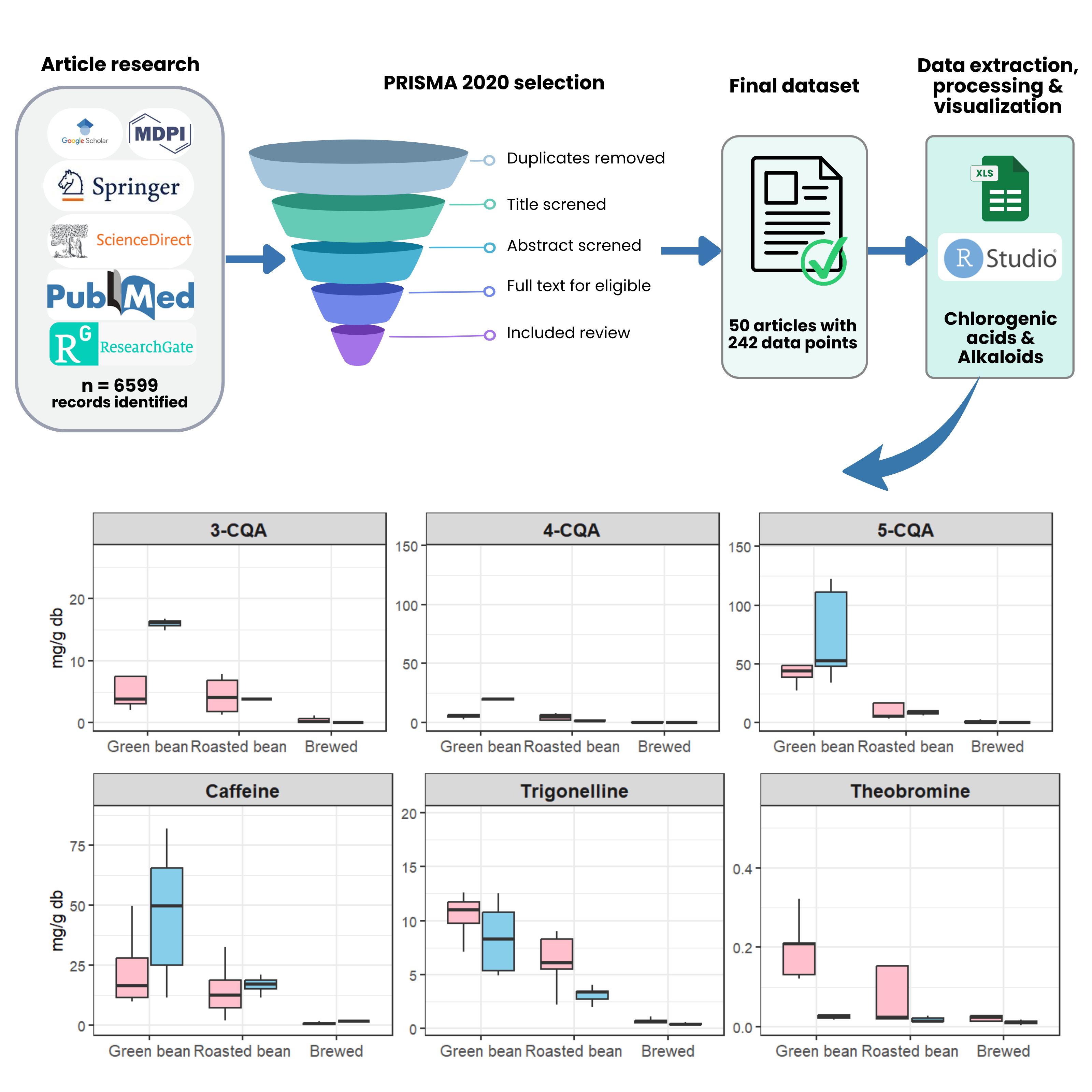
Coffee is one of the most consumed beverages worldwide, and its quality and health-related properties are strongly influenced by bioactive compounds such as chlorogenic acids (CQAs) and alkaloids (caffeine, trigonelline, theobromine). Their concentrations vary considerably depending on processing steps, including postharvest, roasting, and brewing. This systematic review, conducted following PRISMA 2020 guidelines, evaluated the stability and changes of CQAs and alkaloids in Arabica (Coffea arabica) and Robusta (Coffea canephora) across green beans, roasted beans, and brewed coffee. Articles were retrieved from multiple databases using specific keywords, and quantitative data were extracted and analyzed using Microsoft Excel and R Studio. Results showed that Arabica green beans contained 12.50 - 160.10 mg/g CQAs, which de-creased by up to 99% after roasting and brewing, while Robusta initially contained 32.10 - 185.60 mg/g with reductions of 56% - 92%. Caffeine was more stable, averaging 22.15 ± 15.22 mg/g in Arabica and 45.58 ± 22.14 mg/g in Robusta green beans, with moderate reductions through processing. Trigonelline consistently decreased by 80% - 94% in Ara-bica and 68% - 77% in Robusta, while theobromine remained at low levels with further reductions. Overall, roasting and brewing significantly degrade CQAs and trigonelline, while caffeine shows relative stability, providing insight into processing strategies that may optimize coffee’s bioactive profile.
HIGHLIGHTS
- Coffee processing drives major changes in CQAs and alkaloids
- Roasting intensity governs chlorogenic acid and trigonelline degradation
- Arabica and Robusta show distinct bioactive compound stability patterns
- Brewing methods determine final CQAs and alkaloid levels in coffee beverages
GRAPHICAL ABSTRACT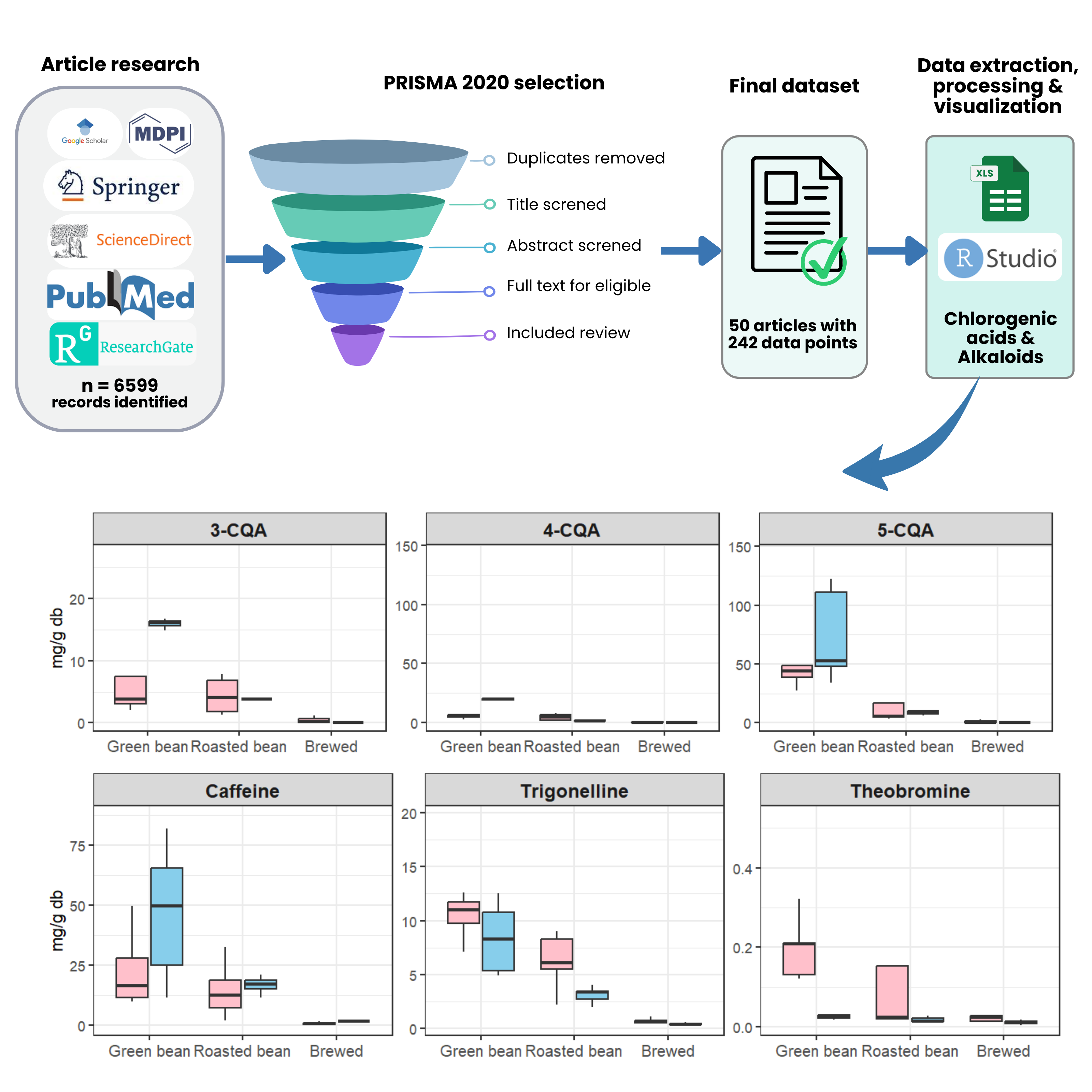
Downloads
References
N Farhaty and Muchtaridi. Tinjauan kimia dan aspek farmakologi senyawa asam klorogenat pada biji kopi: Review (in Indonesian). Jurnal Farmaka 2016; 14(1), 214-227.
International Coffee Organization. Coffee report and outlook. International Coffee Organization, London, 2023.
HL Wachamo. Review on health benefit and risk of coffee consumption. Medicinal & Aromatic Plants 2017; 6(4), 1-12.
A Farah. Coffee: Emerging health effect and disease prevention. 1st ed. John Wiley and Sons, New Jersey, 2012.
LT Anh-Dao, T Chi-Thien, N Nhut-Truong, T Tu-Chi, D Minh-Huy, N Thanh-Nho and N Cong-Hau. Changes in the total phenolic contents, chlorogenic acid, and caffeine of coffee cups regarding different brewing methods. Food Research 2024; 8(6), 71-79.
S Mangiwa and YR Yabansabra. Kadar trigonelin dalam biji kopi Arabika (Coffea arabica) asal Wamena, Kabupaten Jayawijaya, Papua. SAINS: Jurnal MIPA Dan Pengajarannya 2016; 16(1), 29-34.
PC Ayu. 2017, Pengembangan model penentuan kandungan kimia utama pembentuk flavour biji kopi java preanger menggunakan FT-NIRS (in Indonesian). Graduate’s Thesis. Institut Pertanian Bogor, Bogor, Indonesia.
CF Tsai and IPJ Jioe. The analysis of chlorogenic acid and caffeine content and its correlation with coffee bean color under different roasting degree and sources of coffee (Coffea arabica typica). Processes 2021; 9(11), 2040.
M Jeszka-Skowron, R Frankowski and A Zgola-Grzeskowiak. Comparison of methylxantines, trigonelline, nicotinic acid and nicotinamide contents in brews of green and processed Arabica and Robusta coffee beans-Influence of steaming, decaffeination and roasting processes on coffee beans. LWT 2020; 125, 109344.
Y Yulianti, N Andarwulan, DR Adawiyah, D Herawati and D Indrasti. Physicochemical characteristics and bioactive compound profiles of Arabica Kalosi Enrekang with different postharvest processing. Food Science and Technology 2022; 42, 67622.
KM Santosa, S Supriyadi and Y Rahmadian. Sensory analysis, caffeine, chlorogenic acid and non-volatile taste compounds of arabica coffee (Coffea arabica) fermented with sugar addition for brew taste. Indonesian Food and Nutrition Progress 2020; 17(2), 37-44.
M Reza, D Herawati and F Kusnandar. Perbandingan asam fenolat dan total fenolik kopi Arabika Bogor pengolahan pascapanen dan tingkat sangrai berbeda (in Indonesian). Jurnal Mutu Pangan 2023; 10(2), 93-99.
M Jeszka-Skowron, A Sentkowska, K Pryzynska and MPD Pena. Chlorogenic acids, caffeine content and antioxidant properties of green coffee extracts: Influence of green coffee bean preparation. European Food Research and Technology 2016; 242(8), 1403-1409.
DS da Costa, TG Albuquerque, HS Costa and APA Bragotto. Thermal contaminants in coffee induced by roasting: A review. International Journal of Environmental Research and Public Health 2023; 20(8), 5586
FBR Yeison, NG Guzman and JG Hernandez. Effect of the postharvest processing method on the biochemical composition and sensory analysis of arabica coffee. Engenharia Agrícola 2020; 40(2), 177-183.
R Rusinek, B Dobrzanski, M Gawrysiak-Witulska, A Siger, A Zytek, H Karami, A Umar, T Lipa and M Gancarz. Effect of the roasting level on the content of bioactive and aromatic compounds in Arabica coffee beans. International Agrophysics 2024; 38(1), 31-42.
D Herawati, MS Armawan, N Nurhaliza, FA Mu’Arij, D Hunaefi and S Noviasari. Impact of bean origin and brewing methods on bioactive compounds, bioactivities, nutrition, and sensory perception in coffee brews: An Indonesian coffee gastronomy study. International Journal of Gastronomy and Food Science 2024; 35, 100892.
K Socala, A Szopa, A Serefko, E Poleszak and P Wlaz. Neuroprotective effects of coffee bioactive compounds: A review. International Journal of Molecular Sciences 2020; 22(1), 107.
PRISMA 2020. PRISMA statement, Available at: http://www.Prisma-Statement.Org/, accessed March 2025
P Orpong, W Sriwiang, S Chookaew, J Eamsiri, Saengkorakot, K Kehemthong, K Kamdee, R Photinam and R Picha. Comprehensive analysis of elemental profiles, caffeine and chlorogenic acid contents, antioxidant activities, and isotope ratios in Thai single-origin green coffee beans. Measurement: Food 2025; 20, 100265.
RCE Dias, SEW Opitz and C Yeretzian. Bioactive compounds in blends of coffee defects originating from the harvesting. Coffee Science 2022; 17, e172027.
RCE Dias, SEW Opitz and C Yeretzian. Bioactive compounds in blends of coffee defects originating from the harvesting. Coffee Science 2022; 17, e172027.
MF Pompelli, GM Pompelli, AF de Oliveira and WC Antunes. The effect of light and nitrogen availability on the caffeine, theophylline and allantoin contents in the leaves of Coffea arabica L. AIMS Environmental Science 2013; 1(1), 1-11.
M Halagarda and P Obrok. Influence of post-harvest processing on functional properties of coffee (Coffea arabica L.). Molecules 2023; 28(21), 7386.
M Bolka and S Emire. Effects of coffee roasting technologies on cup quality and bioactive compounds of specialty coffee beans. Food Science & Nutrition 2020; 8(11), 5765-6297.
M Gorecki and E Hallmann. The antioxidant content of coffee and its in vitro activity as an effect of its production method and roasting and brewing time. Antioxidants 2020; 9(4), 308
M Gigl, O Frank, L Irmer and T Hofmann. Identification and quantitation of reaction products from chlorogenic acid, caffeic acid, and their thermal degradation products with odor-active thiols in coffee beverages. Journal of Agricultural and Food Chemistry 2022; 70(17), 5427-5437.
RH Stadler, N Varga, J Hau, FA Vera and DH Welti. Alkylpyridinium. 1. Formation in model system via thermal degradation of trigonelline. Journal of Agricultural and Food Chemistry 2002; 50, 1192-1199.
A Santanatoglia, E Schievano, I Menegazzo, L Fioretti, G Caprioli, S Vittori, G Sagratini and L Alessandroni. Cafestol and Kahweol content in different specialty coffee brews: Exploration by NMR analysis and evaluation of brewing parameters. Journal of Food Composition and Analysis 2025; 137, 106929.
Y Yu, Z Zhang and C Chang. Chlorogenic acid intake guidance: Sources, health benefits, and safety. Asia Pacific Journal of Clinical Nutrition 2022; 31(4), 602-610.
H Lu, Z Tian, Y Cui, Z Liu and X Ma. Chlorogenic acid: A comprehensive review of the dietary sources, processing effects, bioavailability, beneficial properties, mechanisms of action, and future directions. Comprehensive Reviews in Food Science and Food Safety 2020; 19(6), 3130-3158.
European Food Safety Authority. Scientific opinion on the safety of caffeine. Efsa Journal 2015; 13(5), 4102.
G Angeloni, L Guerrini, P Masella, M Innocenti, M Bellumori and A Parenti. Characterization and comparison of cold brew and cold drip coffee extraction methods. Journal of the Science of Food and Agriculture 2019; 99(1), 391-399.
D Bauer, J Abreu, N Jordao, JSD Rosa, O Freitas-Silva and A Teodoro. Effect of roasting levels and drying process of Coffea canephora on the quality of bioactive compounds and cytotoxicity. International Journal of Molecular Sciences 2018; 19(11), 3407.
M Worku, B De Meulenaer, L Duchateau and P Boeckx. Effect of altitude on biochemical composition and quality of green arabica coffee beans can be affected by shade and postharvest processing method. Food Research International 2018; 105, 278-285.
Z Asfew and A Dekebo. Determination of caffeine content in Wollega Zones, Ethiopian coffee bean, pulp and leaves by high performance liquid chromatography. Trend in Phytochemical Research 2019; 3(4), 261-274.
CA Pinheiro, LL Pereira, DB Fioresi, DD Oliveira, VM Osorio, JA da Silva, UA Pereira, MAG Ferrao, EM Riva-Souza, AFA da Fonseca and PF Pinheiro. Physico-chemical properties and sensory profile of Coffea canephora genotypes in high-altitudes. Australian Journal of Crop Science 2019; 13(12), 2046-2052.
P Wongsa, N Khampa, S Horadee, J Chaiwarith and N Rattanapanone. Quality and bioactive compounds of blends of Arabica and Robusta spray-dried coffee. Food Chemistry 2019; 283, 579-587.
N Chindapan, S Soydok and S Devahastin. Roasting kinetics and chemical composition changes of Robusta coffee beans during hot air and superheated steam roasting. Journal of Food Science 2019; 84(2), 292-302.
IW Budiastra, M Sutrisno, S Widyotomo and PC Ayu. Determination of trigonelline and chlorogenic acid (CGA) concentration in intact coffee beans by NIR spectroscopy. AgricEbgInt: CIGR Journal 2020; 22(1), 162-168
S Jung, S Gu, SH Lee and Y Jeong. Effect of roasting degree on the antioxidant properties of espresso and drip coffee extracted from Coffea arabica cv. Java. Applied Sciences 2021; 11(15), 7025.
S Awwad, R Issa, L Alnsour, D Albals and I Al-Momani. Quantification of caffeine and chlorogenic acid in green and roasted coffee samples using HPLC-DAD and evaluation of the effect of degree of roasting on their levels. Molecules 2021; 26(24), 7502.
J Montenegro, LS dos Santos, RG de Souza, LGB Lima, DS Mattos, BPPB Viana, ASCF Bastos, L Muzzi, CA Conte-Junior, EPR Gimba, O Freitas-Silva and AJ Teodoro. Bioactive compounds, antioxidant activity and antiproliferative effects in prostate cancer cells of green and roasted coffee extracts obtained by microwave-assisted extraction (MAE). Food Research International 2021; 140, 110014.
MC Espindula, FJE Botelho, ADS Clemente, AL Teixeira, GQF Alves and RME Oliveira. Quality evaluation of Coffea canephora ‘Apoata’ seeds for rootstock production. Coffee Science 2018; 13(1), 1.
A Duangjai, S Saokaew, BH Goh and P Phisalprapa. Shifting of physicochemical and biological characteristics of coffee roasting under ultrasound-assisted extraction. Frontiers in Nutrition 2021; 8, 724591.
A Muzykiewicz-Szymanska, A Nowak, D Wira and A Klimowicz. The effect of brewing process parameters on antioxidant activity and caffeine content in infusions of roasted and unroasted Arabica coffee beans originated from different countries. Molecules 2021; 26(12), 3681.
N Cordoba, FL Moreno, C Osorio, S Velasquez and Y Ruiz. Chemical and sensory evaluation of cold brew coffees using different roasting profiles and brewing methods. Food Research International 2021; 141, 110141.
A Analianasari, EW Kenali, D Berliana, M Yulia and S Shintawati. Evaluasi pasca panen, cacat mutu dan atribut kimia (kafein, asam klorogenat) kopi robusta Lampung Barat (in Indonesian). Jurnal Teknologi & Industri Hasil Pertanian 2022; 27(1), 42-52.
CDS Portela, IF de Almeida, TADD Reis, BRB Hickmann and MDT Benassi. Effects of brewing conditions and coffee species on the physicochemical characteristics, preference and dynamics of sensory attributes perception in cold brews. Food Research International 2022; 151, 110860.
MC Espindula, FJE Botelho, ADS Clemente, AL Teixeira, GQF Alves and RME Oliveira. Quality evaluation of Coffea canephora ‘Apoata’ seeds for rootstock production. Coffee Science 2018; 13(1), 1.
A Prasetya, MA Moulina, HM Arif and R Nofriansyah. Chemical quality, preference, and business analysis of Kepahiang Robusta coffee by roasting equipment type. SINTA Journal (Science, Technology, and Agricultural) 2022; 3(1), 33-40.
LE Yulianti, DP Putri, IF Azizah, S Witman, MA Karim and A Rahayuningtyas. Physicochemical properties of ‘Cisalak’ Robusta coffee with hot air based roasting method. BIO Web of Conferences 2023; 69, 03014.
A Santanatoglia, S Angeloni, D Bartolucci, L Fioretti, G Sagratini, S Vittori and G Caprioli. Effect of brewing methods on acrylamide content and antioxidant activity: Studying eight different filter coffee preparations. Antioxidants 2023; 12(10), 1888.
AF Ramadhani and FC Nisa. Differences in chemical characteristics due to different roasting of robusta coffee beans. Coffee Science 2023; 18, e182116.
R Dong, M Zhu, Y Long, Q Yu, C Li, J Xie, Y Huang and Y Chen. Exploring correlations between green coffee bean components and thermal contaminants in roasted coffee beans. Food Research International 2023; 167, 112700.
AA Oksari, N Hasanah and RTM Sutamihardja. Characteristics of ground coffee quality on variations in temperature and roasting time for Robusta coffee (Coffea canephora Pierre Ex A.Froehner) green bean. Indonesian Journal of Applied Research 2023; 4(1), 11-16.
J Gallardo-Ignacio, A Santibanez, O Oropeza-Mariano, R Salazar, RM Montiel-Ruiz, S Cabrera-Hilerio, M Gonzales-Cortazar, F Cruz-Sosa and P Nicasio-Torres. Chemical and biological characterization of green and processed coffee beans from Coffea arabica varieties. Molecules 2023; 28(12), 4685.
AP Arum, SB Patricia, OF Alit, B Kusmanadhi, Setiyono and DA Savitri. Study of organic acid and caffeine content of Arabica coffee beans (Coffea arabica) processing of the Java Ijen Sukosari Bondowoso Farmers Group. IOP Conference Series: Earth and Environmental Science 2025; 1497(1), 012023.
M Linda, F Bastian, M Mahendradatta, AB Tawali and A Laga. The effect of several postharvest processing on the quality of Robusta Coffee (Coffea canephora). IOP Conference Series: Earth and Environmental Science 2023; 1200, 012011.
M Misto, S Indarti, Y Safitri, M Mutmainnah, T Mulyono and DD Alawiyah. Identification of chlorogenic acid, caffeine, melanoidin, sucrose, and protein content of local Indonesia Arabica coffee base on its cupping and variety variation. BIO Web of Conferences 2024; 101, 01003.
Y Abubakar, MR Alya, A Karim and YD Fazlina. Effect of variety and farm altitude on chemical content of Arabica coffee (Coffea arabica) grown in Gayo Highland, Indonesia. IOP Conference Series: Earth and Environmental Science 2024; 1356, 012030.
RA Firnabillah, E Mustaro and E Marwani. Biochemical composition and volatile profile analysis of three varieties of Coffea arabica and their correlation with the microclimate of Mount Tangkuban Perahu, West Java, Indonesia. Journal of Biological Diversity 2024; 25(2), 3264-3276.
LB Acre, T Viencz, JS Francisco, RB Rocha, EA Alves and MT Benassi. Composition of Coffea canephora varieties from the Western Amazon. Journal of the Brazilian Chemical Society 2024; 35(8), e-20240031.
LF Echeverri-Giraldo, VO Perez, CT Arboleda, LJV Gutierrez and LCI Quinchua. Content of acidic compounds in the bean of Coffea arabica L., produced in the Department of Cesar (Colombia), and its relationship with the sensorial attribute of acidity. Separations 2024; 11(2), 52.
I Rahmawati and SH Asrori. Comparative analysis of caffeine content in cold and hot brewed robusta coffee using high-performance liquid chromatography (HPLC). JKPK 2024; 9(1), 15.
YA Jeon, P Natraj, SC Kim, JK Moon and YJ Lee. Comparative analysis of phytochemical and functional profiles of Arabica coffee leaves and green beans across different cultivars. Foods 2024; 13(23), 3744.
N Fitri, N Nurhaliza, ES Anggraeni, D Herawati, D Hunaefi and S Noviasari. Chemical composition, antioxidant activity, and sensory profile of espresso-based Arabica coffee from different bean origins. Beverage Plant Research 2024; 5(1), e008.
BW Duke, MA Mokonon, ND Mekonin and KD Kuffi. Effects of roasting degree and grinding size on caffeine content and sensorial quality of coffee. Journal of Food Quality 2025; 2025, 2405668.
LC Souza, MAG Ferrao, AFAD Fonseca, PS Volpi, M Comerio, LL Pereira, JAM Carvalho, SH Saraiva, PF Pinheiro, ALD Silva Junior and TCB Soares. An interdisciplinary approach for evaluating beverage quality in Coffea canephora. Anais da Academia Brasileira de Ciencias 2025; 97(2), e20240084.
RS Katarzyna, AP Anna, B Maciej, SM Lidia, S Tomasz and SS Kinga. Roasting temperature as a factor modifying the caffeine and phenolic content of Ethiopian coffee. Processes 2025; 13(7), 2037.
Published
How to Cite
Issue
Section
License
Copyright (c) 2026 Walailak University

This work is licensed under a Creative Commons Attribution-NonCommercial-NoDerivatives 4.0 International License.





