
Antioxidant Capacity and Acetylcholinesterase Inhibitory Activity of Ethanolic Rhizome Extract of Curcuma xanthorrhiza: An Integrated in Vitro and in Silico Study
DOI:
https://doi.org/10.48048/tis.2026.13412Keywords:
Acetylcholinesterase inhibitors, Alzheimer’s disease, Bioactive compounds, Curcuma xanthorrhiza, Molecular docking, PharmacokineticsAbstract
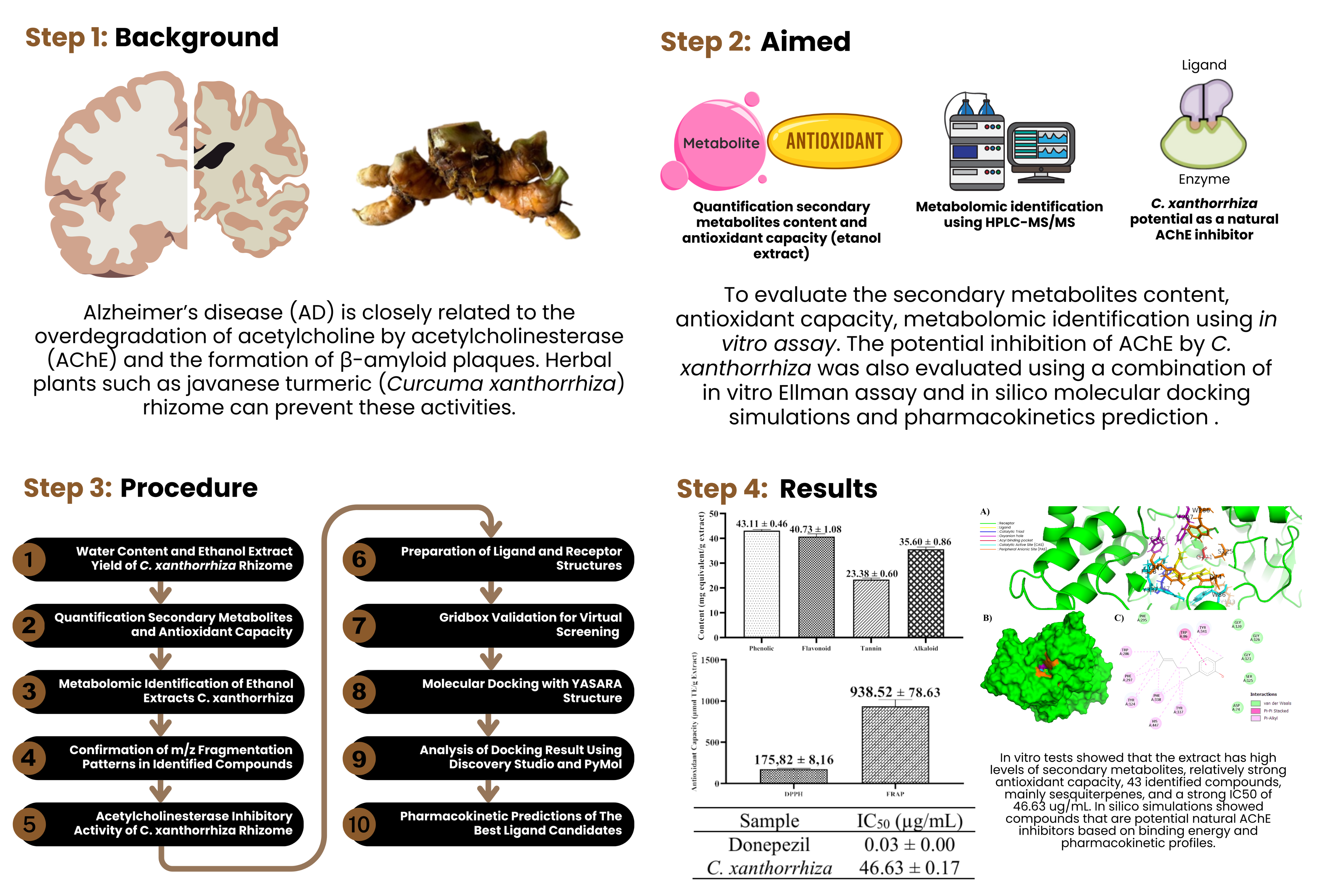
Alzheimer’s disease (AD) is the leading cause of dementia and is characterized by progressive memory loss and cognitive decline. A key pathological mechanism involves excessive hydrolysis of acetylcholine by acetylcholinesterase (AChE), resulting in impaired cholinergic neurotransmission. Therefore, AChE remains a major therapeutic target. Curcuma xanthorrhiza rhizome contains diverse bioactive compounds with reported neuroprotective potential. This study presents the first integrated metabolomics-bioactivity-ADMET workflow applied to ethanolic C. xanthorrhiza extract to systematically identify potential natural AChE inhibitors. Secondary metabolites, including total phenolics, flavonoids, tannins, and alkaloids, were quantified by colorimetric methods. Antioxidant capacity was evaluated using DPPH, FRAP, and lipid peroxidation inhibition assays. Metabolite profiling was conducted by UHPLC-Q-Orbitrap-HRMS, and AChE inhibitory activity was assessed using the Ellman method, with donepezil as the reference drug. Molecular docking against AChE (PDB ID: 6O4W) and in silico ADMET prediction were performed to elucidate binding interactions and pharmacokinetic suitability. The extract exhibited strong antioxidant activity and significant AChE inhibition (IC₅₀ 46.63 µg/mL), while donepezil showed very strong inhibition (IC₅₀ 0.03 µg/mL). Metabolomic analysis identified 43 compounds, predominantly curcuminoids and sesquiterpenes, with xanthorrhizol quantified as a major constituent. Docking analysis revealed several high-affinity ligands; bisdemethoxycurcumin showed the strongest binding energy (ΔGbind −11.55 kcal/mol) but less favorable ADMET properties. In contrast, xanthorrhizol (ΔGbind −8.63 kcal/mol) demonstrated balanced binding interactions and a more favorable predicted pharmacokinetic profile. Overall, this integrative approach enables rational prioritization of bioactive constituents from complex plant extracts and highlights xanthorrhizol as a promising candidate for further experimental validation as a natural AChE inhibitor.
HIGHLIGHTS
- Ethanolic extract of Curcuma xanthorrhiza showed strong antioxidant capacity.
- Ethanolic extract of Curcuma xanthorrhiza showed strong inhibition of acetylcholinesterase.
- High levels of phenolics, flavonoids, tannins, and alkaloids are quantified prior to metabolomic profiling.
- UHPLC-Q-Orbitrap-HRMS-based metabolomics identifies 43 bioactive compounds in ethanolic extract.
- In silico docking reveals xanthorrhizol and bisdemethoxycurcumin as key acetylcholinesterase binders.
GRAPHICAL ABSTRACT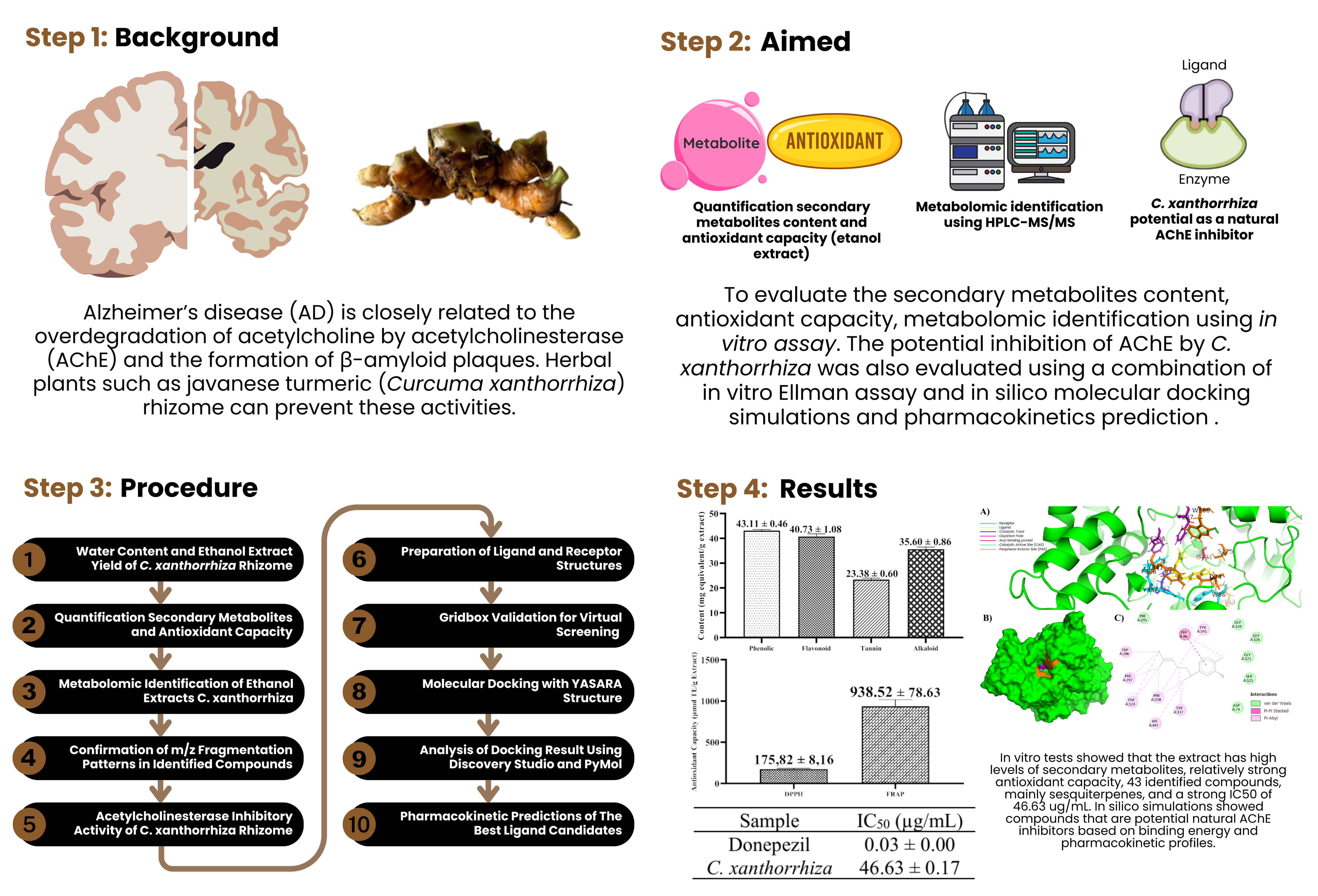
Downloads
References
G Livingston, J Huntley, KY Liu, SG Costafreda, G Selbæk, S Alladi, D Ames, S Banerjee, A Burns, C Brayne, NC Fox, CP Ferri, LN Gitlin, R Howard, HC Kales, M Kivimäki, EB Larson, N Nakasujja, K Rockwood, Q Samus and N Mukadam. Dementia prevention, intervention, and care: 2024 report of the Lancet standing commission. The Lancet 2024; 404(10452), 572-628.
A Houldsworth. Role of oxidative stress in neurodegenerative disorders: A review of reactive oxygen species and prevention by antioxidants. Brain Communications 2024, 6(1), fcad356.
World Health Organization. Global dementia observatory dementia. World Health Organization, 2022.
YTA Reubun, S Kumala, S Setyahadi and P Simanjuntak. Inhibition of acetylcholinesterase by extracts of gotu kola (Centella asiatica (L.) Urb), moringa (Moringa oleifera Lam.) leaves and their combinations. PHARMACY: Jurnal Farmasi Indonesia 2021; 17(2), 451-458.
F Az-Zahra, J Afidika, SDA Diamantha, AE Rahmani, S Fatimah, DL Aulifa, AA Elaine and BDP Sitinjak. In silico study of betel leaves compound (Piper betle L.) as acetylcholinesterase (AChE) enzyme inhibitor in Alzheimer disease. Indonesia Journal of Biological Pharmacy 2022; 2(2), 44-58.
N Bittner, CSM Funk, A Schmidt, F Bermpohl, EJ Brandl, EEA Algharably, R Kreutz and TG Riemer. Psychiatric adverse events of acetylcholinesterase inhibitors in Alzheimer’s disease and Parkinson’s dementia: Systematic review and meta-analysis. Drugs & Aging 2023; 40, 953-964.
Y Harun, Y Diansari, S Marisdina and Y Felistia. Effectivity of donepezil in cognitive function of postoperative intracranial tumour patients. Neurona 2020; 37(2), 143-151.
M Safithri, EB Koendhori, D Andrianto, R Kurniasih, MA Dwicesaria, EYY Nurinsani, MA Umar and M Hufdayanti. Analysis of bioactive compounds Piper crocatum as inhibitors of acetylcholinesterase in silico and in vitro. Trends in Sciences 2025; 22(4), 9437.
N Jusril, ANN Muhamad Juhari, SI Abu Bakar, WM Md Saad and MI Adenan. Combining in silico and in vitro studies to evaluate the acetylcholinesterase inhibitory profile of different accessions and biomarker triterpenes of Centella asiatica. Molecules 2020; 25(15), 3353.
MA Khairinisa, TM Fakih and DSF Ramadhan. Bioactive potential of Centella asiatica leaf extract in acetylcholinesterase inhibition: Insights from multiple ligand mapping. Computers in Biology and Medicine 2025; 197(A), 110970.
MAS Kurniawan, MJ Baari, Sariyanti and Finarisnawati. QSAR analysis using semi-empirical AM1 method, molecular docking, and ADMET studies of chalcone derivatives as antimalarial compounds. Jurnal Kimia Riset 2023; 8(2), 186-199.
W Nurcholis, R, Alfadzrin, N Izzati, R Arinati, BÁ Vinnai, F Sabri, E Kristof and MI Artika. Effects of methods and durations of extraction on total flavonoid and phenolic contents and antioxidant activity of Java cardamom (Amomum compactum Soland Ex Maton) fruit. Plants 2022. 11(17), 2221.
M Safithri, S Indariani and D Septiyani. Antioxidant activity and total phenolic content of functional beverages nanoencapsulation based on red betel extract. Indonesian Journal of Human Nutrition 2020; 7(1), 69-83.
TB Yuniasih, M Safithri and Syaefudin. In vitro analysis of gradual water extract of red betel lead (Piper crocatum) as free radical scavenging and inhibitor of α-glucosidase. Current Biochemistry 2023; 10(1), 38-45.
W Nurcholis, R, Alfadzrin, N Izzati, R Arinati, BÁ Vinnai, F Sabri, E Kristof and MI Artika. Effects of methods and durations of extraction on total flavonoid and phenolic contents and antioxidant activity of java cardamom (Amomum compactum Soland Ex Maton) fruit. Plants 2022; 11(17), 2221.
Fitriani, A Karim and HA Wardani. Determination of total tannin content of temulawak rhizomes (Curcuma xanthorrhiza Roxb) in various boiling time variations using UV-Vis spectrophotometry method. Journal Pharmacy of Pelamonia 2023; 3(1), 47-52.
S Wahyuni and MP Marpaung. Determination of total alkaloid levels extracts of akar kuning (Fibraurea chloreleuca Miers) based on the differences of ethanol concentrations by spectrophotometry UV-Vis method. Dalton 2020; 3(2), 52-61.
F Tunnisa, DN Faridah, A Afriyanti, D Rosalina, MA Syabana, N Darmawan and ND Yliana. Antioxidant and antidiabetic compounds identification in several Indonesian underutilized Zingiberaceae spices using SPME-GC/MS-based volatilomics and in silico methods. Food Chemistry X 2022; 14, 100285.
UMS Purwanto, K Aprilia and Sulistiyani. Antioxidant activity of telang (Clitoria ternatea L.) extract in inhibiting lipid peroxidation. Current Biochemistry 2022; 9(1), 26-37.
BFD Zaelani, M Safithri and D Andrianto. In vitro study of Piper crocatum Ruiz & Pav potency as HMG-CoA reductase and malondialdehyde formation inhibitor. Indonesian Journal of Applied Research 2024; 5(3), 185-195.
EW Purnama, M Safithri and D Andrianto. Clusterization of red betel leaves (Piper crocatum) from various regions in Indonesia based on secondary metabolite fingerprint analysis and cytotoxicity values. Indonesian Journal of Applied Research 2023; 4(2), 170-182.
EYY Nurinsani, D Andrianto and M Safithri. Acetylcholinesterase inhibition activity and phytochemical screening of red betel leaf (Piper crocatum Ruiz & Pav as anti-dementia agents. BIO Web of Conferences 2024; 123, 02009.
SK Whardhani, S Abdillah and R Djamil. Acetylcholinesterase inhibition and determination of quality parameters polyherbal and combination extracts from Moringa oleifera Lam., Phyllanthus niruri L., and Nigella sativa L. Health Science Journal of Indonesia 2023; 14(2), 57-64.
MO Hassan and RA Mohamed. In-silico screening for potential natural compounds against acetylcholinesterase, causing Alzheimer disease. International Journal of Agriculture, Forestry and Plantation 2024; 15, 65-68.
RAP Irsal, GM Gholam, MA Dwicesaria, TF Mansyah and F Chairunisa. Exploring the potential of Scabiosa columbaria in Alzheimer’s disease treatment: An in silico approach. Journal of Taibah University Medical Sciences 2024; 19(5), 947-960.
CPM da Silva, GM das Neves, GLV Poser, VL Eifler-Lima and SMK Rates. In silico prediction of ADMET/drug-likeness properties of bioactive phloroglucinols from Hypericum gents. Medicinal Shemistry 2023; 19(10), 1002-1017.
Indriati, F Jalung and F Umamy. Determination of curcumin levels in Curcuma xanthorrhiza rhizome extract with maceration and remaceration techniques. Journal of Pharmaceutical and Sciences 2022; 5(2), 505-510.
FM Lubis, AS Daulay, HM Nasution and Ridwanto. Optimization of modified corn flour production based on protein content through fermentation with lactic acid bacteria (LAB). Journal of Health and Medical Science 2022; 1(3), 219-229.
A Karim, D Ma’ruf and R Haeruddin. Uji efektivitas fraksi ekstrak etanol rimpang temulawak (Curcuma zanthorrhiza Roxb) dari Kabupaten Takalar sebagai antibakteri terhadap staphylococcus aureus (in Indonesian). Journal Pharmacy of Pelamonia 2024; 4(2), 97-102.
I Widyastuti, HZ Kuthfah, YI Hartono, R Islamadina, AT Can and A Rohman. Antioxidant activity of temulawak (Curcuma xanthorrhiza Roxb.) and its classification with chemometrics. Indonesian Journal of Chemometric and Pharmaceutical Analysis 2021; 1(1), 29-42.
I El Mannoubi. Impact of different solvents on extraction yield, phenolic composition, in vitro antioxidant and antibacterial activities of deseeded Opuntia stricta fruit. Journal of Umm Al-Qura University for Applied Sciences 2023; 9(2), 176-184.
Suryani, AC Al Anshory, IM Artika, L Ambarsari and W Nurcholis. Variability total phenolic content and antioxidant activity of Curcuma zanthorrhiza and C. aeruginosa cultivates in three different locations in West Java, Indonesia. Biodiversitas 2022; 23(4), 1998-2003.
NS Ngadirin, R Hasham, NJ Sulaiman and NHM Ariffin. Effect of Curcuma xanthorrhiza extract on the phytochemical content, antioxidant activity and Lactobacillus casei growth. Bioprocessing and Biomass Technology 2024; 3(1), 7-11.
YSW Manuhara, S Sugiharyo, AN Kristanti, NS Aminah, AT Wibowo, AP Wardana, YK Putro and D Sugiarso. Antioxidant activities, total phenol, flavonoid, and mineral content in the rhizome of various Indonesian herbal plants. Rasayan Journal of Chemistry 2022; 15(4), 2724-2730.
Z Haida, S Ab Ghani and M Hakiman. Extraction variables optimization on phenolics content and antioxidant activities of in-vitro propagated leaves of Curcuma caesia Roxb. using response surface methodology. BioResources 2025; 20(2), 4590-4607.
S Kartini, S Juariah, D Mardhiyani, MFA Bakar, FIA Bakar and S Endrini. Phytochemical properties, antioxidant activity and α-amilase inhibitory of Curucuma caesia. Journal of Advanced Research in Applied Sciences and Engineering Technology 2023; 30(1), 255-263.
V Isha, K Venkatesan, V Rajashree, N Senthil, R Renuka and K Chandrakumar. Evaluation of phytochemical variations among the different genotypes of black turmeric (Curcuma caesia Roxb.). Biochemical Genetics 2025. https://doi.org/10.1007/s10528-025-11304-y
R Asyhar, M Minarni, RA Arista and W Nurcholis. Total phenolic and flavonoid contents and their antioxidant capacity of Curcuma xanthorrhiza accessions from Jambi. Biodiversitas 2023; 24(9), 5007-5014.
G Yodi, IM Artika and W Nurcholis. Effect of varieties of Curcuma xanthorrhiza and extraction solvent on total phenolic, total flavonoid content, and antioxidant capacity. Biodiversitas 2023; 24(12), 6425-6431.
H Gul and E Nakilcioğlu. Proces optimization of bioactive compounds extraction from bee bread using deep eutectic solvents: A response surface methodology approach. Journal of Food Measurement and Characterization 2026. https://doi.org/10.1007/s11694-025-04019-6
A Jain, P Jain, S Bajaj, A Majumdar and P Soni. Chemoprofiling and antioxidant activity of edible curcuma species. Food and Humanity 2023; 1, 1027-1039.
L Suhendra. Antioxidant activity of turmeric powder extract (Curcuma domestica Val.). Agrotechno 2017; 2(2), 237-247.
H Kusriani, Y Mulyani, R Santoso, G Jafar, FZ Ishmah and NA Zahra. Pharmacological assessment of standardized Curcuma longa L. and Centella asiatica (L.) urban extracts for diabetes management. Journal of Pharmacy & Pharmacognosy Research 2026; 14(1), 2290.
D Davis, D Trisciuzzi, R Sreekumar, MB Jacob, K Madhu, N Gambacorta, M Catto, DGT Parambi, O Nicolotti and B Mathew. Key chemotypes for the rational design of dual AChE/BACE-1 inhibitors. Current Medicinal Chemistry 2026; 33(1), 23-41.
P Pooladgar, M Sakhabkhsh, A Taghva and S Soleiman-Meigooni. Beyond alzheimer’s disease? A narrative review of therapeutic potentials of donepezil in different diseases. Iranian Journal of Pharmaceutical Research 2022; 21(1), e128408.
TA Rants’o, DG van Greunen, CJ van der Westhuizen, DL Riley, JL Panayides, LL Koekemoer and RL van Zyl. The in silico and in vitro analysis of donepezil derivatives for Anopheles acetylcholinesterase inhibition. PLoS One 2022; 17(11), e0277363.
D Drozdowska, D Maliszewski, A Wróbel, A Ratkiewicz and M Sienkiewicz. New benzamides as multi-targeted compounds: synthesis, AChE and BACE1 inhibitory activity, and molecular docking study. International Journal of Molecular Sciences 2023; 24(19), 14901.
Z Mahmoud, HS Sayed, LW Mohamed and KO Mohamed. Development of new donepezil analogs: Synthesis, biological screening, and in silico study rationale. Medicinal Chemistry Research 2022; 31, 1754-1770.
A Perez, HA Martinez-Correa, F Parada-Alfonso, ZJS Montenegro, D Ballesteros-Vivas, G Álvarez-Rivera, A Cifuentes and E Ibáñez. Antioxidant, neuroprotective and anti-inflammatory activity of Curcuma longa: From green extraction to nanoemulsion. Frontiers in Nutrition 2025; 12, 1619725.
AV Deepa and TT Dennis. Plant extracts and phytochemicals targeting Alzheimer’s disease through acetylcholinesterase inhibition. Exploration of Neuroscience 2025; 4, 100697.
ME Klau, E Rohaeti, M Rafi, IM Artika, L Ambarsari and W Nurcholis. Metabolite profiling of Curcuma zanthorrhiza varieties grown in different regions using UHPLC-Q-Orbitrap-HRMS and chemometrics analysis. Biointerface Research in Applied Chemistry 2023; 13(1), 26.
AS Anggraeni, A Windarsih, HD Warmiko, A Rohman, Suratno, AA Styawan and A Widarti. Non-targeted metabolomics analysis of Curcuma rhizomes species from different origins using LC-orbitrap HRMS combined with chemometrics. Ecology 2026; 124, 105140.
R Budhathoki, AP Timilsina, BP Regmi, KR Sharma, N Aryal and N Parajuli. Metabolome mining of Curcuma longa L. using HPLC-MS/MS and molecular networking. Metabolites 2023; 13(8), 898.
L Yu, N Li, B Li, KX Ye, J Guo, J Shan, L Cao, M Song, Y Wang, T Lee, AB Maier and L Feng. Targeting cognitive aging with curcumin supplementation: A systematic review and meta-analysis. The Journal of Prevention of Alzheimer’s Disease 2025; 12(8), 100248.
A Lechoczki, M Fekete, T Jarecsny, V Zábó, Á Szappanos, T Csípő, Á Lipécz, M Major, V Fazekas-Pongor, P Varga and JT Varga. The neuroprotective role of curcumin: From molecular pathways to clinical translation-a narrative review. Nutrients 2025; 17(17), 2884.
A Simamora, KH Timotius, H Setiawan, FA Saputri, CR Putri, D Aryani, RA Ningrum and A Mun’im. Ultrasonic-assisted extraction of xanthorrhizol from Curcuma xanthorrhiza Roxb. Rhizomes by natural deep eutectic solvents: optimization, antioxidant activity, and toxicity profiles. Molecules 2024; 29(9), 2093.
VUM Nallal, R Padmini, B Ravindran, SW Chang, R Radhakrishman, HSM Almoallim, SA Alharbi and M Razia. Combined in vitro and in silico approach to evaluate the inhibitory potential of an underutilized allium vegetable ad its pharmacologically active compounds on multidrug resistant Candida species. Saudi Journal of Biological Sciences 2021; 28(2), 1246-1256.
HK Nivatya, A Singh, N Kumar, Sonam, L Sharma, V Singh, R Mishra, N Gaur and AK Mishra. Assessing molecular docking tools: understanding drug discovery and design. Future Journal of Pharmaceutical Sciences 2025; 11(11), 111.
F Az-Zahra, J Afidika, SDA Diamantha, AE Rahmani, S Fatimah, DL Aulifa, AA Elaine and BDP Sitinjak. Studi in silico senyawa dalam daun sirih (Piper betle L.) sebagai inhibitor enzim asetilkolinesterase (AChE) pada penyakit Alzheimer (in Indonesian). Indonesian Journal of Biological Pharmacy 2022; 2(2), 44-58
M Safithri, EB Koendhori, D Andrianto, R Kurniasih, MA Dwicesaria, EYY Nurinsani, MA Umar and M Hufdayanti. Analysis of bioactive compounds Piper crocatum as inhibitors of acetylcholinesterase in silico and in vitro. Trends in Sciences 2025; 22(4), 9437.
M Atanasova, I Dimitrov, S Ivanov, B Georgiev, S Berkov, D Zheleva-Dimitrova and I Doytchinova. Virtual screening and hit selection of natural compounds as acetylcholinesterase inhibitors. Molecules 2022; 27(10), 3139.
S Peitzika and E Pontiki. Recent approaches in molecular docking studies of novel compounds targeting acetylcholinesterase in Alzheimer’s disease. Molecules 2023; 28(3), 1084.
MF Reynoso-García, DE Nicolás-Álvarez, AY Tenorio-Barajas and A Reyes-Chaparro. Structural bioinformatics applied to acetylcholinesterase enzyme inhibition. International Journal of Molecular Sciences 2025; 26(8), 3781.
M Makarian, M Gonzalez, SM Salvador, S Lorzadeh, PK Hudson and S Pecic. Synthesis, kinetic evaluation and molecular docking studies of donepezil-based acetylcholinesterase inhibitors. Journal of Molecular Structure 2022; 1247, 131425.
M Jain, R Dhariwal, K Bhardava, S Das, M Shaikh, R Tendulkar, R Wani, M Sharma, AK Delta and P Kaushik. In silico and in vitro profiling of curcumin and its derivatives as potent acetylcholinesterase inhibitors. Biocatalysis and Agricultural Biotechnology 2024; 56, 103022.
E Salamanova, M Atanasova, I Doytchinova. A novel galantamine-curcumin hybrid inhibits butyrylcholinesterase: A molecular dynamics study. Chemistry 2024; 6(6), 1645-1657.
SA Kehinde, WP Lin, BB Lay, KY Phyo, MM San, R Pattanayaiying and S Chusri. Curcumin and dementia: A systematic review of its effects on oxidative stress and cognitive outcomes in animal models. International Journal of Molecular Sciences 2025; 26(14), 7026.
H Hussain, S Ahmad, SWA Shah, M Ghias, A Ullah, SU Rahman, Z Kamal, FA Khan, NM Khan, J Muhammad, M Almehmadi, O Abdulaziz and S Alghamdi. Neuroprotective potential of synthetic monocarbonylic curcumin analogs assessed by molecular docking studies. Molecules 2021; 26(23), 7168.
SLS Min, SY Liew, NJY Chear, BH Goh, WN Tan and KY Khaw. Plant terpenoids as a promising source of cholinesterase inhibitors for anti-Alzheimer therapy. Biology 2022; 11(2), 307.
A Jaśkiewicz, G Budryn, M Carmena-Bargueño and H Pérez-Sánchez. Evaluation of sesquiterpene lactones and chicory extracts as acetylcholinesterase inhibitors using calorimetric and docking simulation studies. Nutrients. 2022; 14(17), 3633.
N Smyrska-Wieleba and T Mroczek. Natural inhibitors of cholinesterases: Chemistry, structure–activity relationships and analytical methods. International Journal of Molecular Sciences 2023; 24(3), 2722.
A Arya, R Chahal, R Rao, MH Rahman, D Kaushik, MF Akhtar, A Saleem, SMA Khalifa, HR El-Seedi, M Kamel, GM Albadrani, MM Abdel-Daim and V Mittal. Acetylcholinesterase inhibitory potential of sesquiterpene analogues for Alzheimer’s disease therapy. Biomolecules 2021; 11(3), 350.
G Xiong, Z Wu, J Yi, L Fu, Z Yang, C Hsieh, M Yin, X Zeng, C Wu, A Lu and others. ADMETlab 2.0: An integrated online platform for accurate and comprehensive ADMET property prediction. Nucleic Acids Research 2021; 49(W1), W5-W14.
A Bayraktar, X Li, W Kim, C Zhang, H Turkez, S Shoaie and A Mardinoglu. Drug repositioning targeting glutaminase reveals drug candidates for the treatment for Alzheimer’s disease patients. Journal of Translational Medicine 2023; 21, 332.
DC Negru, SG Bungau, A Radu, DM Tit, A Radu, DC Nistor-Cseppento and PA Negru. Evaluation of alkaloids as inhibitors of human acetylcholinesterase using molecular docking and ADME prediction. In Vivo 2025; 39, 236-250.
AS Singh and C Vellapandian. In silico and pharmacokinetic assessment of echinocystic acid in Alzheimer’s disease-like pathology. Future Science OA 2023; 10(1), FSO904.
B Ghorbani-nejad, M Baghani, S Amiri, NA Delche, MH Darijani, M Soltani, A Nezami and M Rahimzadegan. Curcumin: Multifaceted biological actions and therapeutic implications - a narrative review. Inflammopharmacology 2025; 33, 6309-6327.
M Mujtaba, F Ahmad and M Fatima. In silico evaluation of daechulalkaloid A maltoxazine as a potential acetylcholinesterase inhibitor for Alzheimer’s disease. PHYTONutrients 2025; 4(1), 44-56.
U Kochman, H Sitka, J Kuźniar, M Czaja, P Kozubek, JA Beszłej, J Leszek. Targeted nanoparticles for drug delivery across the blood-brain barrier in early and late stages of Alzheimer’s disease: A review. Molecular Neurobiology 2025; 63(1), 75.
TA Rants’o, DG van Greunen, CJ van der Westhuizen, DL Riley, JL Panayides, LL Koekemoer and RL van Zyl. The in silico and in vitro analysis of donepezil derivatives for Anopheles acetylcholinesterase inhibition. PLoS One 2022; 17(11), e0277363.
HMA Hasan, HAA Khalid and F Abdulsayid. Infrared characterization and physicochemical properties of a Schiff base compound synthesized from 4-hydroxy-3-methoxybenzaldehyde and 2-amino-3-methylbutanoic acid. Journal of Research in Pharmacy and Sciences 2021; 7(3), 8-12.
N Anand, NN Quailes, MN Szobody and B Gadad. Simulations of physicochemical and ADMET properties of curcumin and its derivatives. Journal of Pharmacology and Experimental Therapeutics 2025; 392(3), 103481.
J Kuzminska, P Szyk, DT Mlynarczyk, P Bakun, I Muszalska-Kolos, K Dettlaff, A Sobczak, T Goslinski and A Jelinska. Curcumin derivatives in medicinal chemistry: Potential applications in cancer treatment. Molecules 2024; 29(22), 5321.
J Khwarg, H Lee, K Yu, E Seol and J Chung. Population pharmacokinetic modeling and simulation for dose optimization of GB-5001, a long-acting intramuscular injection of donepezil, in healthy participants. Neurological Therapy 2024; 13, 1453-1466.
R Prasetiawati, M Suherman, B Permana and Rahmawati. Molecular docking study of anthocyanidin compounds against epidermal growth factor receptor as anti-lung cancer agents. Indonesian Journal of Pharmaceutical Science and Technology 2021; 8(1), 8-20.
E Park, E Kim, K Kim, J Jeon, I Song, S Park and K Li. Revisiting donepezil metabolism in rats using non-targeted metabolomics and molecular networking. Pharmaceutics 2025; 17(1), 115.
J Lee, JL Beers, RM Geffert and KD Jackson. CYP-mediated drug interactions: Mechanisms and in vitro assessment. Biomolecules 2024; 14(1), 89.
D Klimoszek, M Jeleń, M Dołowy and B Morak-Młodawska. Lipophilicity and ADMET parameters of new anticancer diquinothiazines. Pharmaceuticals 2024; 17(6), 725.
MJ Ratain and WK Plunkett. Principles of pharmacokinetics. In: DW Kufe, RE Pollock, RR Weichselbaum, RC Bast, TS Gansler, JF Holland and E Frei (Eds.). Holland-Frei Cancer Medicine. 6th ed. BC Decker, Ontario, Canada, 2003.
Y Myung, AGC de Sá and DB Ascher. Deep-PK: Deep learning for small-molecule pharmacokinetic and toxicity prediction. Nucleic Acids Research 2024; 52(W1), W469-W475.
EV Stolaki, K Psatha and M Aivaliotis. Metabolomics and pharmacometabolomics: Advancing Precision Medicine in Drug Discovery and Development. Metabolites 2025; 15(11), 750.
N Fan, J Chen, J Wang, ZS Chen and Y Yang. Bridging data and drug development: Machine learning approaches for next-generation ADMET prediction. Drug Discovery Today 2025; 30(11), 104487.
Published
How to Cite
Issue
Section
License
Copyright (c) 2026 Walailak University

This work is licensed under a Creative Commons Attribution-NonCommercial-NoDerivatives 4.0 International License.





