
Antioxidant and Antiproliferative Activity of Black Rice Extract Against Colon Cancer Cells In-Vitro and In-Silico
DOI:
https://doi.org/10.48048/tis.2025.10397Keywords:
Antioxidant, Black rice, Cempo Ireng, Colorectal cancer, Food, Functional food, In silico, In vitro, Nutraceuticals, Antioxidant, Black rice, Cempo Ireng, Colorectal cancer, Food, Functional food, In-silico, In-vitro, NutraceuticalsAbstract
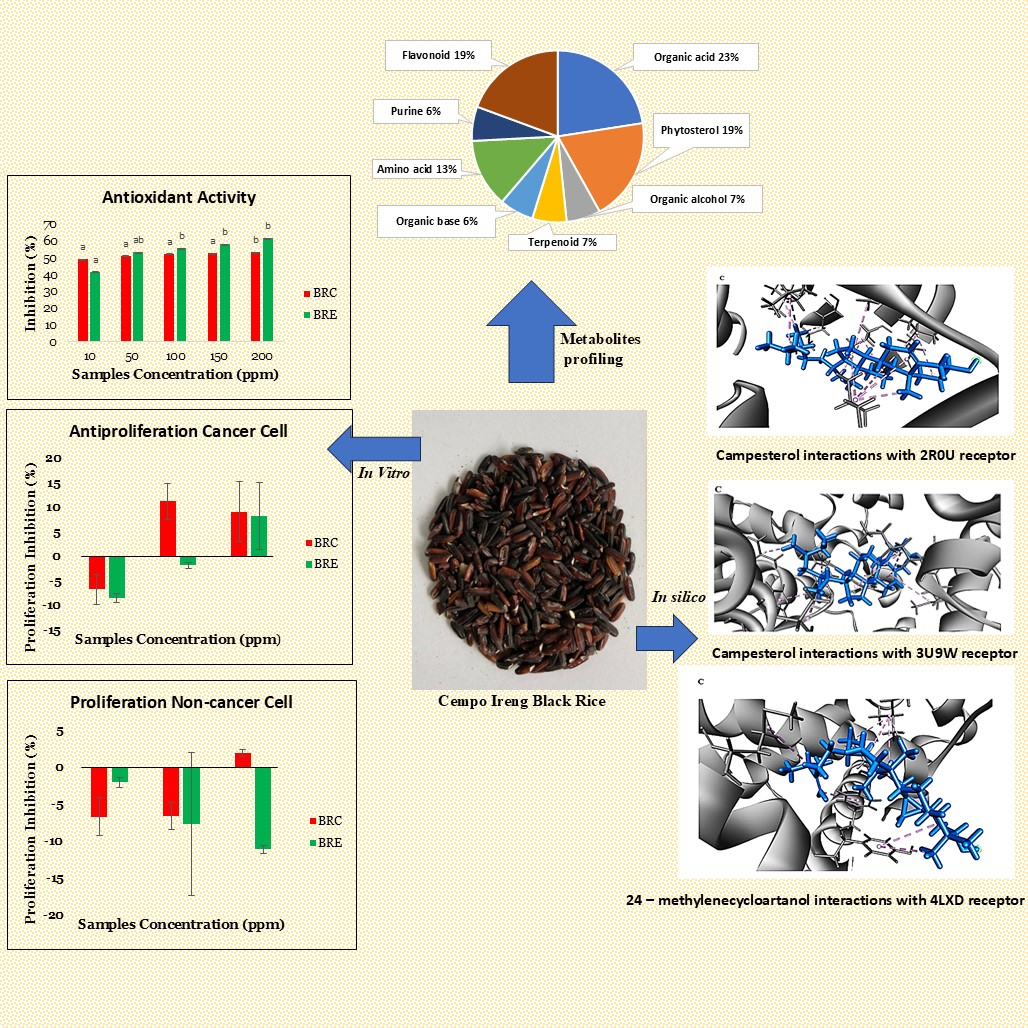
Black rice is less popular for healthy use and not widely available in different parts of Indonesia. Only a few scientific reports are available on the health benefits of black rice, specifically with an integrated in-vitro and in-silico method for varieties present in the market, showing a need for investigations regarding bioactivity. Therefore, this analysis examines the bioactivity of black rice extracts of Cempo Ireng variety in-vitro and in-silico as a source of antioxidant and antiproliferation for colon cancer cells, along with determination of the compound content. The novelty was the integration of in-vitro and in-silico methods to explore the natural antioxidant sources and the inhibition of colon cancer cell proliferation from black rice of Cempo Ireng variety. Moreover, antioxidant activity was analyzed using the 2,2-diphenyl-1-picrylhydrazyl (DPPH) method. The 3-(4,5-dimethylthiazol-2-yl)-2,5-diphenyltetrazolium bromide (MTT) assay was conducted to determine antiproliferative activity, which was further examined in-silico with metabolites from black rice extract identified using gas chromatography–mass spectrometry (GC-MS) and liquid chromatography-high resolution mass spectrometry (LC-HRMS). The results indicated black rice extract had antioxidant activity to scavenge radicals. The activity had IC50 of 4.67 µg/mL for black rice chloroform (BRC) extract and 52.45 µg/mL for black rice ethanol (BRE) extract. Additionally, black rice extract can effectively inhibit the proliferation of colorectal cancer cells (8.28% - 9.10%). Metabolite groups detected in the extract included organic acids, flavonoids, terpenoids, phytosterols, amino acids, purines, organic alcohols, and organic bases. Campesterol and 24 - methylenecycloartanol were metabolites that had the best activity in inhibiting cancer treatment target proteins in-silico. This study showed the health benefits of black rice, suggesting the development of a functional food to support digestive health.
HIGHLIGHTS
- Black rice extract of the Cempo Ireng variety was able to scavenge free radical.
- The extracts can inhibit cancer cell proliferation and are non-toxic to normal cells.
- Organic acids were the most frequently identified metabolites in black rice.
- Campesterol and 24 - methylenecycloartanol were the metabolites that had the best activity in inhibiting cancer therapy target proteins in-silico
- Black rice has a potential as a functional food that is effective as a natural antioxidant and can be used as an alternative treatment for colon cancer.
GRAPHICAL ABSTRACT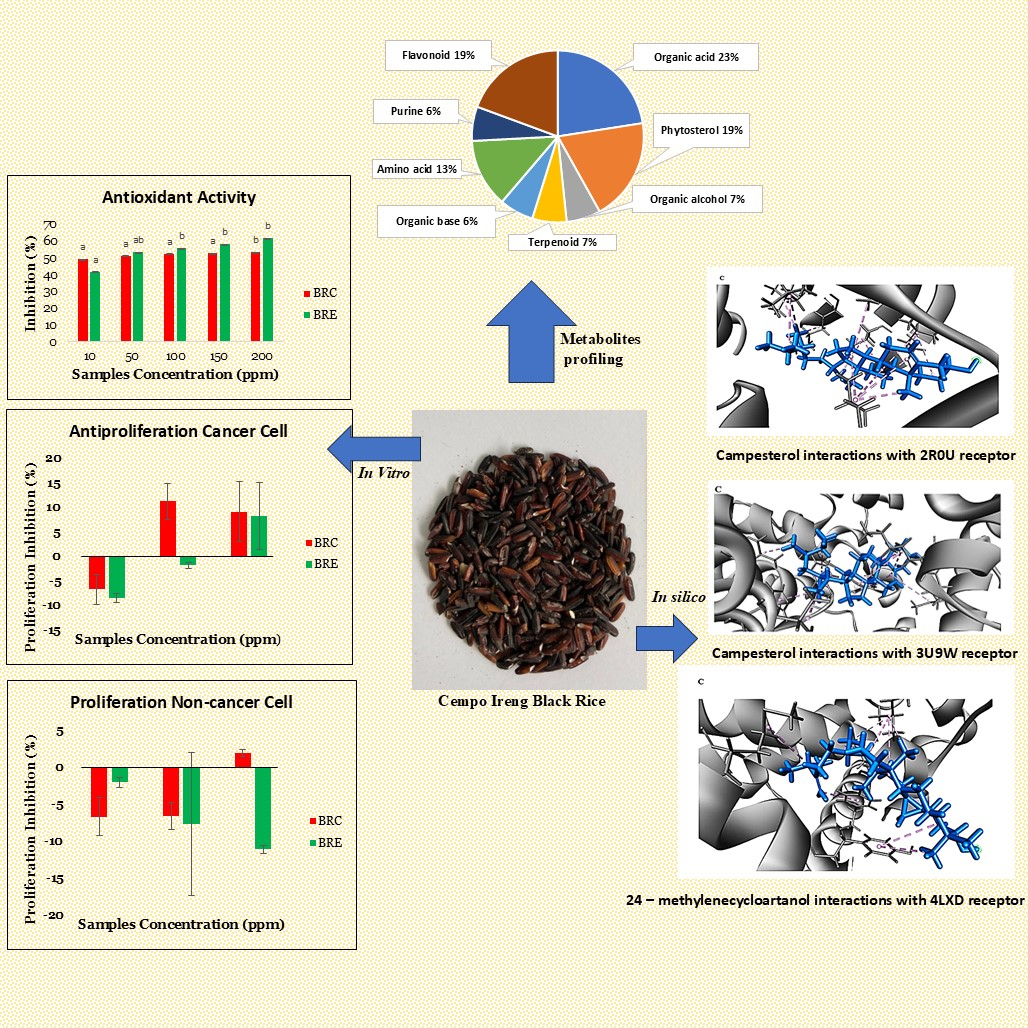
Downloads
References
U Ahuja, SC Ahuja, R Thakrar and RK Singh. Rice-a nutraceutical. Asian Agri-History 2008; 12(2), 93-108.
S Watanabe, A Hirakawa, C Nishijima, KI Ohtsubo, K Nakamura, S Beppu, P Tungtrakul, SJ Quin, ES Tee, T Tsuno, and H Ohigashi. Food as medicine: The new concept of medical rice. Advanced in Food Technology and Nutritional Sciences - Open Journal 2016; 2(2), 38-50.
TSR Priya, ARLE Nelson, K Ravichandran and U Antony. Nutritional and functional properties of coloured rice varieties of South India: A review. Journal of Ethnic Foods 2019; 6(11), 1-19.
K Periyasamy, SP Shashikanthalu and M Radhakrishnan. Traditional rice varieties: A comprehensive review on its nutritional, medicinal, therapeutic and health benefit potential. Journal of Food Composition and Analysis 2022; 114(11), 104742.
MF Dewan, M Ahiduzzaman, MN Islam and HB Shozib. Potential benefits of bioactive compounds of traditional rice grown in south and southeast Asia: A review. Rice Science 2023; 30(6), 537-551.
S Nayeem, S Sundararajan, AK Ashok, A Abusaliya and S Ramalingam. Effects of cooking on phytochemical and antioxidant properties of pigmented and non-pigmented rare Indian rice landraces. Biocatalysis and Agricultural Biotechnology 2021; 32, 101928.
A Tyagi, U Shabbir, X Chen, R Chelliah, F Elahi, HJ Ham and DH Oh. Phytochemical profiling and cellular antioxidant efficacy of different rice varieties in colorectal adenocarcinoma cells exposed to oxidative stress. PLoS One 2022; 17(6), e0269403.
L Tajasuwan, A Kettawan, T Rungruang, K Wunjuntuk and P Prombutara. Role of dietary defatted rice bran in the modulation of gut microbiota in AOM/DSS-induced colitis-associated colorectal cancer rat model. Nutrients 2023; 15(6), 1528.
S Sansenya, A Payaka, W Wannasut, Y Hua and S Chumanee. Biological activity of rice extract and the inhibition potential of rice extract, rice volatile compounds and their combination against α-glucosidase, α-amylase and tyrosinase. International Journal of Food Science & Technology 2021; 56(4), 1865-1876.
Mangestuti, Subehan, A Widyawaruyanti, SFH Zaidi and S Awale. Traditional medicine of Madura Island in Indonesia. Journal of Traditional Medicines 2007; 24(3), 90-103.
W Sumarni, S Sudarmin and SS Sumarti. The scientification of jamu: A study of Indonesian’s traditional medicine. Journal of Physics Conference Series 2019; 1321(3), 032057.
E Harmayani, AK Anal, S Wichienchot, R Bhat, M Gardjito, U Santoso, S Siripongvutikorn, J Puripaatanavong and U Payyappallimana. Healthy food traditions of Asia: Exploratory case studies from Indonesia, Thailand, Malaysia, and Nepal. Journal of Ethnic Foods 2019; 6, 1.
F Husain and BF Wahidah. Medicine from nature: Identification of medicinal plants used by belian (sasakese indigenous healer) in traditional medicine in Lombok, West Nusa Tenggara, Indonesia. AIP Conference Proceedings 2018; 2019(1), 050003.
R Pratiwi and YA Purwestri. Black rice as a functional food in Indonesia. Functional Foods in Health and Disease 2017; 7(3), 183-194.
DRT Sari, A Paemanee, S Roytrakul, JRK Cairns, A Safithri and F Fatchiyah. Black rice cultivar from Java Island of Indonesia revealed genomic, proteomic, and anthocyanin nutritional value. Acta Biochimica Polonica 2021; 68(1), 55-63.
Fatchiyah, DRT Sari, A Safitri and JRK Cairns. Phytochemical compound and nutritional value in black rice from Java Island, Indonesia. Systematic Reviews in Pharmacy 2020; 11(7), 414-421.
M Nashrurrokhman, PR Sayekti, A Safitri, YA Purwestri and R Pratiwi. Macronutrient and mineral contents of five local black rice (Oryza sativa) cultivars in Indonesia. Biodiversitas Journal of Biological Diversity 2019; 20(12), 3647-3653.
Nandariyah, E Purwanto and AN Meidini. Morphology, production, and chemical content performance of black rice Matesih accession with several comparisons. IOP Conference Series: Earth and Environmental Science 2018; 142(1), 012052.
SK Biswas, DE Kim, YS Keum and RK Saini. Metabolite profiling and antioxidant activities of white, red, and black rice (Oryza sativa L.) grains. Journal of Food Measurement and Characterization 2018; 12(4), 2484-2492.
N Nuengchamnong, T Saesong, P Ngamdee and S Jiamyangyuen. Chemical profiling of white, red, and black rice (Oryza Sativa L.) during grain development based on LC-QTOF-MS/MS. Chromatography and Spectroscopy Techniques 2020; 3(1), 39-47.
Y Dwiningsih and J Alkahtani. Potential of pigmented rice variety Cempo Ireng in rice breeding program for improving food sustainability. Journal of Biomedical Research & Environmental Sciences 2023; 4(3), 426-433.
AD Nurhayati, A Nirbaya, CP Nusa, S Soekopitojo, AL Kurniawan, DD Handoko, A Hapsari, AF Sepbrina, DOW Prastiwi, DA Puspitasari, N Athaya, MY Al Badwani and DA Araminta. Nutritional composition and organoleptic quality of instant local black rice (Cempo Ireng) with moderate glycemic index. BIO Web of Conferences 2025; 153, 03016.
A Ardiansyah, F Ariffa, RM Astuti, W David, DD Handoko, S Budijanto and H Shirakawa. Non-volatile compounds and blood pressure-lowering activity of Inpari 30 and Cempo Ireng fermented and non-fermented rice bran. AIMS Agriculture and Food 2021; 6(1), 337-359.
W Iswanti, S Budijanto and M Abdullah. Flavonoid and antioxidant activity analysis of anthocyanin black rice bran extract (ABRIBE) cv CEMPO IRENG origin from Indonesia. Journal of Microbiology, Biotechnology and Food Sciences 2024; 14(2), e10203.
Safrida, S Budijanto, L Nuraida, BP Priosoeryanto, U Saepuloh, SS Marya, A Ardiansyah and H Shirakawa. Fermented black rice bran extract inhibit colon cancer proliferation in WiDr cell lines. Food Science and Technology 2022; 42(2), e14422.
S Budijanto, W Nurtiana, A Muniroh, Y Kurniati, L Nuraida, BP Priosoeryanto, FNA Dewi, A Ardiansyah, ND Yuliana, S Safrida and H Shirakawa. Dietary supplementation of black rice bran to colon carcinogen-induced mice: Examining the development of colorectal cancer by improving environmental colon conditions. Heliyon 2023; 9(8), e18528.
M Alfarabi, FE Siagian, JM Cing, T Suryowati, Turhadi, MS Suyono, MS Febriyanti and FB Naibaho. Bioactivity and metabolite profile of papaya (Carica papaya) seed extract. Biodiversitas Journal of Biological Diversity 2022; 23(9), 4589-4600.
S Yuningtyas, AP Roswiem, D Azahra and M Alfarabi. Antioxidant activity and characterization of arrowroot (Maranta arundinacea) tuber yogurt. Biodiversitas Journal of Biological Diversity 2023; 24(5), 2850-2854.
MA Umar, M Safithri and R Pratama. In silico study of anticancer activity of red betel leaves bioactive compounds against colon cancer marker proteins. HAYATI Journal of Biosciences 2023; 30(1), 113-121.
B Jayaram, T Singh, G Mukherjee, A Mathur, S Shekhar and V Shekhar. Sanjeevini: A freely accessible web-server for target directed lead molecule discovery. BMC Bioinformatics 2012; 13(S17), S7.
AT Nursyarah, M Safithri and D Andrianto. Red betel leaf bioactive compounds as ERα receptor inhibitors in silico and MCF-7 cell anticancer in vitro. HAYATI Journal of Biosciences 2023; 30(5), 789-796.
S Bachtler and HJ Bart. Increase the yield of bioactive compounds from elder bark and annatto seeds using ultrasound and microwave assisted extraction technologies. Food and Bioproducts Processing 2021; 125, 1-13.
W Dong, Q Chen, C Wei, R Hu, Y Long, Y Zong and Z Chu. Comparison of the effect of extraction methods on the quality of green coffee oil from Arabica coffee beans: Lipid yield, fatty acid composition, bioactive components, and antioxidant activity. Ultrasonics Sonochemistry 2021; 74(4), 105578.
M Alfarabi, Turhadi, T Suryowati, NA Imaneli and PO Sihombing. Antioxidant activity and metabolite profiles of leaves and stem extracts of Vitex negundo. Biodiversitas Journal of Biological Diversity 2022; 23(5), 2663-2667.
IE Mannoubi. Impact of different solvents on extraction yield, phenolic composition, in vitro antioxidant and antibacterial activities of deseeded Opuntia stricta fruit. Journal of Umm Al-Qura University for Applied Sciences 2023; 9(2), 176-184.
HL Huang and BG Wang. Antioxidant capacity and lipophilic content of seaweeds collected from the Qingdao coastline. Journal of Agricultural and Food Chemistry 2004; 52(16), 4993-4997.
R Purushothaman, G Vishnuram and T Ramanathan. Isolation and identification of n-hexadecanoic acid from Excoecaria agallocha L. and its antibacterial and antioxidant activity. Journal of Emerging Technologies and Innovative Research 2024; 11(1), 332-342.
MS Blois. Antioxidant determinations by the use of a stable free radical. Nature 1958; 181, 1199-1200.
B Bharath, K Perinbam, S Devanesan, MSA Salhi and M Saravanan. Evaluation of the anticancer potential of hexadecanoic acid from brown algae Turbinaria ornata on HT-29 colon cancer cells. Journal of Molecular Structure 2021; 1235(2), 130229.
G Moussavou, DH Kwak, BW Obiang-Obonou, CAO Maranguy, SDD Baoutamba, DH Lee, OGM Pissibanganga, K Ko, JI Seo and YK Choo. Anticancer effects of different seaweeds on human colon and breast cancers. Marine Drugs 2014; 12(9), 4898-4911.
B Halliwell. Reflections of an aging free radical. Free Radical Biology and Medicine 2020; 161, 234-245.
M Sharifi-Rad, NVA Kumar, P Zucca, EM Varoni, L Dini, E Panzarini, J Rajkovic, PVT Fokou, E Azzini, I Peluso, AP Mishra, M Nigam, YE Rayess, ME Beyrouthy, L Polito, M Iriti, N Martins, M Martorell, AO Docea, WN Setzer, …, J Sharifi-Rad. Lifestyle, oxidative stress, and antioxidants: Back and forth in the pathophysiology of chronic diseases. Frontiers in Physiology 2020; 11, 694.
CH Yang, RX Li and LY Chuang. Antioxidant activity of various parts of Cinnamomum cassia extracted with different extraction methods. Molecules 2012; 17(6), 7294-7304.
F Martino-Morales, AJ Alonso-Castro, JR Zapata-Morales, C Carranza-Álvarez and OH Aragon-Martinez. Use of standardized units for a correct interpretation of IC50 values obtained from the inhibition of the DPPH radical by natural antioxidants. Chemical Papers 2020; 74(10), 3325-3334.
O Theanphong, W Mingvanish and T Jenjittikul. Antimicrobial and radical scavenging activitıes of essential oils from Kaempferia larsenii Sirirugsa. Trends in Science 2023; 20(6), 5212.
S Abbas, SM Latif, II Muhammad, MA Hesan and F Kormin. In vitro antioxidant and anticholinesterase activities of ethanolic turmeric crude extract. Food Research 2022; 6(4), 199-204.
R Al-Nemi, AA Makki, K Sawalha, D Hajjar and M Jaremko. Untargeted metabolomic profiling and antioxidant capacities of different solvent crude extracts of Ephedra foeminea. Metabolites 2022; 12(5), 451.
DP Putri, M Astuti and P Hastuti. Physicochemical and antioxidant properties of three varieties of Indonesian black rice. IOP Conference Series: Earth and Environmental Science 2022; 1024, 012062.
VC Ito and LG Lacerda. Black rice (Oryza sativa L.): A review of its historical aspects, chemical composition, nutritional and functional properties, and applications and processing technologies. Food Chemistry 2019; 301, 125304.
AML Seca and DCGA Pinto. Plant secondary metabolites as anticancer agents: Successes in clinical trials and therapeutic application. International Journal of Molecular Sciences 2018; 19(1), 263.
BM Twaij and MN Hasan. Bioactive secondary metabolites from plant sources: Types, synthesis, and their therapeutic uses. International Journal of Plant Biology 2022; 13(1), 4-14.
HP Hoensch and R Oertel. The value of flavonoids for the human nutrition: short review and perspectives. Clinical Nutrition Experimental 2015; 3(C), 8-14.
M Kciuk, A Gielecińska, S Mujwar, D Kołat, Ż Kałuzińska-Kołat, I Celik and R Kontek. Doxorubicin-an agent with multiple mechanisms of anticancer activity. Cells 2023; 12(4), 659.
S Budijanto, Y Kurniati Y, L Nuraida, FNA Dewi, BP Priosoeryanto, ND Yuliana, A Ardiansyah, U Saepuloh, S Ida and H Shirakawa. The inhibition of colon cancer development by black rice bran on BALB/C mice. AIMS Agriculture and Food 2024; 9(3), 789-800.
Y Zhang and T Hunter. Roles of Chk1 in cell biology and cancer therapy. International Journal of Cancer 2014; 134(5), 1013-1023.
N Oi, H Yamamoto, A Langfald, R Bai, MH Lee, AM Bode and Z Dong. LTA4H regulates cell cycle and skin carcinogenesis. Carcinogenesis 2017; 38(7), 728-737.
P Ramesh and JP Medema. BCL-2 family deregulation in colorectal cancer: Potential for BH3 mimetics in therapy. Apoptosis 2020; 25(5), 305-320.
N Shahzad, W Khan, M Shadab, A Ali, SS Saluja, S Sharma, FA Al-Allaf, Z Abduljaleel, IAA Ibrahim, AFA Wahab, MA Afify and SS Al-Ghamdi. Phytosterols as a natural anticancer agent: Current status and future perspective. Biomedicine & Pharmacotherapy 2017; 88, 786-794.
H Sun, L Zhang, B Sui, Y Li, J Yan, P Wang, Y Wang and S Liu. The effect of terpenoid natural chinese medicine molecular compound on lung cancer treatment. Evidence-Based Complementary and Alternative Medicine 2021; 2021, 3730963.
A Yuniastuti, AN Khasanah, NW Harini, W Christijanti and DH Utomo. Apoptosis potency prediction of steroid saponin from Gembili (Dioscorea esculenta) as Bcl-2 and Bcl-xL inhibitors in colon cancer. Trends in Science 2022; 19(24), 1573.
Published
How to Cite
Issue
Section
License
Copyright (c) 2025 Walailak University

This work is licensed under a Creative Commons Attribution-NonCommercial-NoDerivatives 4.0 International License.





