
Cardioprotective Effect of the F-36 Alkaloid and DKV-8 Conjugate
DOI:
https://doi.org/10.48048/tis.2026.13312Keywords:
Ca2 homeostasis, Cardioprotection, Conjugate, Isoquinoline alkaloid, Papillary muscle, Positive inotropy, SERCA2aAbstract
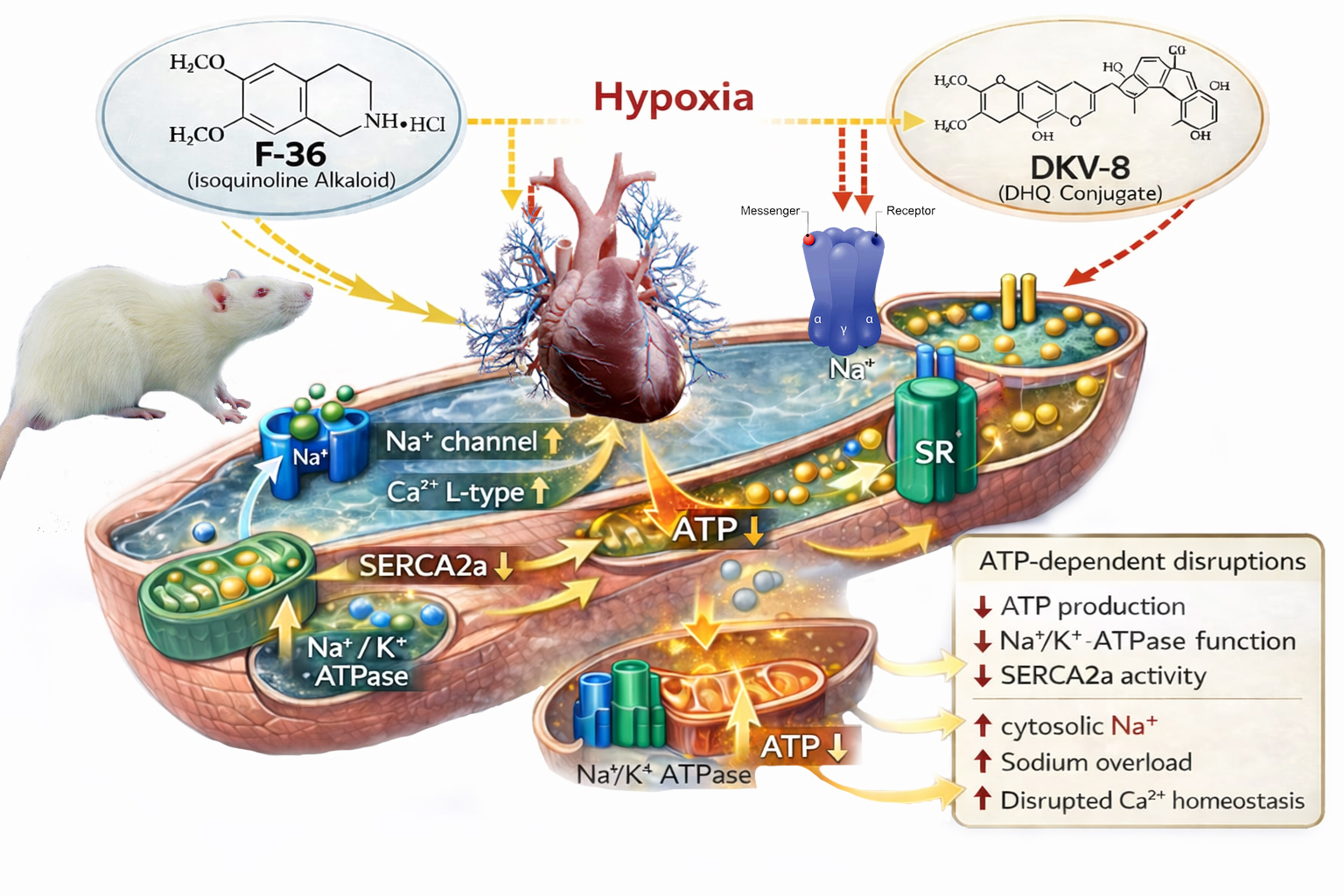
The search for new therapeutic strategies for cardiovascular diseases remains an urgent issue. This study investigated the effects of the natural compound 6,7-dimethoxy-1,2,3,4-tetrahydroisoquinoline hydrochloride (F-36) and its conjugate with dihydroquercetin, DKV-8, on the contractile activity of rat heart papillary muscle and their molecular mechanisms. In vitro mechanographic experiments showed that F-36 (5 - 100 µM) and DKV-8 (5 - 40 µM) dose-dependently increased contraction force by 75.7 ± 4.7 and 143.6 ± 5.4%, respectively. studies using specific inhibitors (lidocaine, nifedipine, NiCl₂, caffeine, and cyclopiazonic acid (CPA)) demonstrated that Na⁺ channels, L-type Ca²⁺ channels, and sarcoplasmic reticulum Ca²⁺-ATPase (SERCA2a) play a key role in the observed positive inotropic effect. Overall, F-36 and its DKV-8 conjugate enhance cardiomyocyte Ca²⁺ homeostasis mainly through regulation of SERCA2a and plasma membrane ion channels. Their effects were also confirmed under in vitro hypoxic conditions.
HIGHLIGHTS
- F-36 alkaloid and its DHQ-based conjugate DKV-8 produce a pronounced positive inotropic effect in isolated rat cardiac papillary muscle.
- The inotropic action is mediated by coordinated activation of Na⁺ and L-type Ca²⁺ channels, leading to increased intracellular Ca²⁺ availability.
- SERCA2a activation is a key mechanism underlying enhanced sarcoplasmic reticulum Ca²⁺ accumulation and stronger myocardial contraction.
- NCX and excessive RyR2 activation are not critically involved, indicating a selective and controlled Ca²⁺ regulation.
- This balanced modulation of Ca²⁺ homeostasis suggests low arrhythmogenic risk and highlights DKV-8 as a promising cardiotonic candidate.
- DKV-8 conjugate activates SERCA2a to a significant extent.
GRAPHICAL ABSTRACT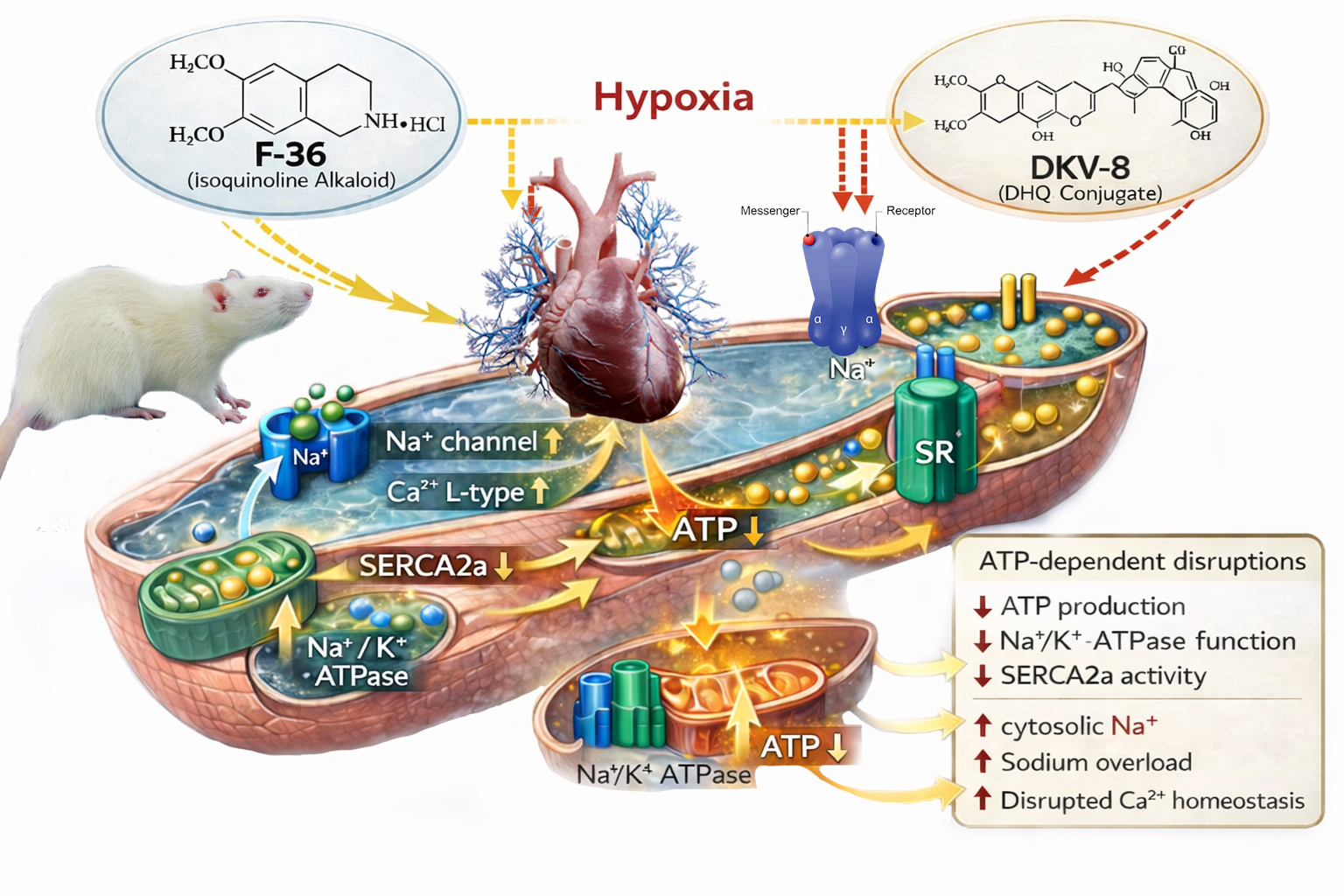
Downloads
References
VR Netala, SK Teertam, H Li and AZ Zhang. Comprehensive review of cardiovascular disease management: Cardiac biomarkers, imaging modalities, pharmacotherapy, surgical interventions, and herbal remedies. Cells 2024; 13(17), 1471.
ND Kolanu, ZR Syeda, N Joshi, P Singh and M Erukulla. The differential impact of medical therapy and lifestyle modification on cardiovascular health and risk of adverse cardiovascular events: A narrative review. Cureus 2024; 16(4), e57742.
IZ Jumaev, SN Boboev, PB Usmonov, SY Rustamov, AA Zaripov, SB Qurbonova, YT Mirzaeva, EB Ibragimov, AT Esimbetov and SM Adizov. Role of RyR2 and SERCA2a in the cardioprotective effects of vincanine and pyrazoline alkaloids. Trends in Sciences 2024; 22(1), 8626.
VV Uzbekov, BF Abdullaev, IZ Jumayev, YI Oshchepkova, PB Usmanov and SI Salikhov. Comparative study of the antiarrhythmic activity of liposomal forms of lappaconitine hydrobromide and its complex with glycyrrhizic acid monoammonium salt in the aconitine arrhythmia model. Pharmaceutical Chemistry Journal 2023; 56, 1327-1332.
YI Oshchepkova, VV Uzbekov, IZ Jumayev, SY Rustamov, PB Usmanov and SI Salikhov. Antiarrhythmic activity of ethacizine hydrochloride and its supramolecular complexes with glycyrrhizic acid and its monoammonium salt. Pharmaceutical Chemistry Journal 2025; 59(6), 21-26.
YI Oshchepkova, VV Uzbekov, IZ Jumayev, SY Rustamov, PB Usmanov and SI Salikhov. Comparative study of antiarrhythmic and inotropic activity of amiodarone hydrochloride and its complexes with glycyrrhizic acid and monoammonium salt of glycyrrhizic acid. Eksperimental’Naya i Klinicheskaya Farmakologiya 2023; 86(4), 15-22.
PB Usmonov, IZ Jumayev, SY Rustamov, AA Zaripov, AT Esimbetov, SN Juraqulov and VI Vinogradova. The combined inotropic and vasorelaxant effect of DHQ-11, a conjugate of flavonoid dihydroquercetin with isoquinoline alkaloid 1-aryl-6,7-dimethoxy-1,2,3,4-tetrahydroisoquinoline. Biomedical and Pharmacology Journal 2021; 14(2), 651-661.
SB Qurbonova, IZ Zhumaev, SN Boboev, PB Usmanov, SY Rustamov, AA Zaripov and SN Zhurakulov. Antiarrhythmic effect of 1-(3’-Bromophenyl)-6,7-methylenedioxy-1,2,3,4-tetrahydroisoquinoline hydrochloride. Biomedical and Pharmacology Journal 2025; 18(3), 2463-2473.
AA Zaripov, IZ Zhumaev, PB Usmanov, YT Mirzaeva, SY Rustamov, AT Esimbetov, GS Begdullaeva, SB Sobirov, SN Zhurakulov, DD Safarova and RI Yusupova. Mechanism of vasorelaxant action of isoquinoline alkaloid F-19 on rat aorta. Biomedical and Pharmacology Journal 2025; 18(2), 1580-1589.
AA Zaripov, IZ Jumayev, PB Usmanov, YT Mirzaeva, AT Esimbetov, SY Rustamov, SN Boboev, EB Ibragimov, SB Qurbonova and SN Zhurakulov. Protective effect of DHQ-11 against hypoxia-induced vasorelaxation. Trends in Sciences 2024; 21(11), 8192.
R Bagur and G Hajnoczky. Intracellular Ca2+ sensing: Its role in calcium homeostasis and signaling. Molecular Cell 2017; 66(6), 780-788.
L Fliegel. Molecular biology of the myocardial Na+/H+ exchanger. Journal of Molecular and Cellular Cardiology 2008; 44(2), 228-237.
S Wakabayashi, T Hisamitsu and TY Nakamura. Regulation of the cardiac Na+/H+ exchanger in health and disease. Journal of Molecular and Cellular Cardiology 2013; 61, 68-76.
DS Escudero, NG Perez and RG Diaz. Myocardial impact of NHE1 regulation by sildenafil. Frontiers in Cardiovascular Medicine 2021; 8, 617519.
H Sutanto, A Lyon, J Lumens, U Schotten, D Dobrev and J Heijman. Cardiomyocyte calcium handling in health and disease: Insights from in vitro and in silico studies. Progress in Biophysics and Molecular Biology 2020; 157, 54-75.
AL Denniss, AM Dashwood, P Molenaar and NA Beard. Sarcoplasmic reticulum calcium mishandling: Central tenet in heart failure? Biophysics Reviews 2020; 12(4), 865-878.
A Agrawal, G Suryakumar and R Rathor. Role of defective Ca2+ signaling in skeletal muscle weakness: Pharmacological implications. Journal of Cell Communication and Signaling 2018; 12(4), 645-659.
EB Ibragimov, IZ Zhumaev, AA Zaripov, PB Usmanov, SY Rustamov, AT Esimbetov, SM Adizov and AK Kurbanov. Mechanism of vasorelaxant effect of the indole alkaloid 12-hydroxynorfluorocurarine hydrochloride on aortic smooth muscle contraction. Journal of Applied Pharmaceutical Science 2026; 16(3), 283-291.
SN Zhurakulov, VA Babkin, EI Chernyak, SV Morozov, IA Grigoryev, MG Levkovich and VI Vinogradova. Aminomethylation of 1-aryl-6,7-dimethoxy-1,2,3,4-tetrahydroisoquinolines by dihydroquercetin. Chemistry of Natural Compounds 2015; 51(1), 57-61.
S Despa and DM Bers. Na+ transport in the normal and failing heart - remember the balance. Journal of Molecular and Cellular Cardiology 2013; 61, 2-10.
ZF Ziyavitdinov, UZ Ishimov, NS Berdiev, IZ Zhumaev, YI Oshchepkova, PB Usmanov, and SI Salikhov. Supramolecular complex of lappaconitine hydrobromide and the monoammonium salt of glycyrrhizic acid: Synthesis, physicochemical characteristics, and antiarrhythmic activity. Pharmaceutical Chemistry Journal 2022; 56(2), 167.
KR DeMarco and CE Clancy. Cardiac Na channels: Structure to function. Current Topics in Membranes 2016; 78, 287-311.
M Abdelsayed and C Antzelevitch. From beat to beat: How electrolytes shape the heart’s rhythmic symphony and structure. Journal of Cardiology and Cardiovascular Medicine 2025; 10(3), 070-088.
IZ Zhumaev, SN Boboev, PB Usmanov, SB Qurbonova, SY Rustamov, AT Esimbetov, GS Begdullaeva, AA Zaripov, SM Adizov. Mechanism of positive inotropic effect of vincanine on cardiac muscle contraction activity. Biomed Pharmacol J 2022; 15(4), 2309-2316
DM Bers and S Despa. Na+ transport in cardiac myocytes; Implications for excitation-contraction coupling. IUBMB Life 2009; 61(3), 215-221.
DA Eisner. Ups and downs of calcium in the heart. Journal of Physiology 2018; 596(1), 19-30.
I Jumayev, P Usmanov, S Rustamov and S Zhurakulov. Comparative inotropic effects of the some isoquinoline alkaloids. Biomedical and Pharmacology Journal 2020; 13(1), 325-333.
J Satin and EA Schroder. Autoregulation of cardiac L-type calcium channels. Trends in Cardiovascular Medicine 2009; 19(8), 268-271.
MB Bhat, J Zhao, W Zang, CW Balke, H Takeshima, WG Wier and J Ma. Caffeine-induced release of intracellular Ca2+ from Chinese hamster ovary cells expressing skeletal muscle ryanodine receptor: Effects on full-length and carboxyl-terminal portion of Ca2+ release channels. Journal of General Physiology 1997; 110(6), 749-762.
A Belevych, Z Kubalova, D Terentyev, RL Hamlin, CA Carnes and S Gyorke. Enhanced ryanodine receptor-mediated calcium leak determines reduced sarcoplasmic reticulum calcium content in chronic canine heart failure. Biophysical Journal 2007; 93(11), 4083-4092.
KA Rakhmanova, SN Zhurakulov, FM Tursunkhodjayeva, AA Azamatov, DM Saidkhodjayeva, IZ Jumayev. Analgesic and Anti-Inflammatory Effects of 1-(4'-Dimethylaminophenyl)-6, 7-Dimethoxy-1,2,3,4-Tetrahydroisoquinoline Hydrochloride. Biomed Pharmacol J 2022; 15(2), 891-895
M Karmazyn, XT Gan, RA Humphreys, H Yoshida and K Kusumoto. The myocardial Na+-H+ exchange. Circulation Research 1999; 85, 777-786.
KD Dwyer, CA Snyder and KLK Coulombe. Cardiomyocytes in hypoxia: Cellular responses and implications for cell-based cardiac regenerative therapies. Bioengineering 2025; 12(2), 154.
C Leoty, C Huchet-Cadiou, S Talon, S Choisy and W Hleihel. Caffeine stimulates the reverse mode of Na+/Ca2+ exchanger in ferret ventricular muscle. Acta Physiologica Scandinavica 2001; 172(1), 27-37.
KN Bradley, ER Flynn, TC Muir and JG McCarron. Ca2+ regulation in guinea-pig colonic smooth muscle: The role of the Na+-Ca2+ exchanger and the sarcoplasmic reticulum. Journal of Physiology 2002; 538(2), 465-482.
K Scranton, S John, M Angelini, F Steccanella, S Umar, R Zhang, JI Goldhaber, R Olcese and M Ottolia. Cardiac function is regulated by the sodium-dependent inhibition of the sodium-calcium exchanger NCX1. Nature Communications 2024; 15(1), 3831.
M Shigekawa and T Iwamoto. Cardiac Na+-Ca2+ exchange molecular and pharmacological aspects. Circulation Research 2001; 88(9), 864-876.
S Kurihara and T Sakai. Effects of rapid cooling on mechanical and electrical responses in ventricular muscle of guinea-pig. Journal of Physiology 1985; 361, 361-378.
DM Bers, JH Bridge and KW Spitzer. Intracellular Ca2+ transients during rapid cooling contractures in guinea-pig ventricular myocytes. Journal of Physiology 1989; 417, 537-553.
JA Lahorra, DF Torchiana, GT Jr, CA Bashour, C Hahn, JS Titus, GA Geffin and WM Daggett. Rapid cooling contracture with cold cardioplegia. The Annals of Thoracic Surgery 1997; 63(5), 1353-1360.
S Huke and BC Knollmann. Increased myofilament Ca2+-sensitivity and arrhythmia susceptibility. Journal of Molecular and Cellular Cardiology 2010; 48(5), 824-833.
M Periasamy, P Bhupathy and GJ Babu. Regulation of sarcoplasmic reticulum Ca2+ ATPase pump expression and its relevance to cardiac muscle physiology and pathology. Cardiovascular Research 2008; 77(2), 265-273.
KF Frank, B Bolck, E Erdmann and RH Schwinger. Sarcoplasmic reticulum Ca2+-ATPase modulates cardiac contraction and relaxation. Cardiovascular Research 2003; 57(1), 20-27.
Y Uyama, Y Imaizumi and M Watanabe. Cyclopiazonic acid, an inhibitor of Ca2+-ATPase in sarcoplasmic reticulum, increases excitability in ileal smooth muscle. British Journal of Pharmacology 1993; 110(2), 565-572.
SN Boboev, IZ Zhumaev, PB Usmanov, AA Zaripov, SY Rustamov, SB Qurbonova, EB Ibragimov, SB Sobirov, SN Zhurakulov. Role of F-4 Isoquinoline Alkaloid, Dihydroquercetin Flavonoid and Conjugate DKV-6 in Myocardial RyR2 and SERCA2a under Normal and Hypoxic Conditions. Biomed Pharmacol J 2026; 19(1), 578-591
MB Sikkel, C Hayward, KT MacLeod, SE Harding and AR Lyon. SERCA2a gene therapy in heart failure: An anti-arrhythmic positive inotrope. British Journal of Pharmacology 2014; 171(1), 38-54.
MJ Taggart and S Wray. Hypoxia and smooth muscle function: Key regulatory events during metabolic stress. Journal of Physiology 1998; 509(2), 315-325.
ShS Khushmatov, IZ Zhumaev, SN Zhurakulov, ASh Saidov, and VI Vinogradova. Synthesis And Comparative Inotropic Effects Of Several Isoquinoline Alkaloids. Pharmaceutical Chemistry Journal 2020 54(1), 9-13.
L Santacruz, AJL Arciniegas, M Darrabie, JG Mantilla, RM Baron, DE Bowles, R Mishra and DO Jacobs. Hypoxia decreases creatine uptake in cardiomyocytes, while creatine supplementation enhances HIF activation. Physiological Reports 2017; 5(16), e13382.
G Scholtysik. Cardiac Na+ channel activation as a positive inotropic principle. Journal of Cardiovascular Pharmacology 1989; 14(S3), 24-29.
YT Mirzayeva, AA Zaripov, IZ Zhumaev, PB Usmanov, SY Rustamov, SN Boboev, SB Qurbonova, EB Ibragimov, MK Musaeva, SB Sobirov, SM Adizov. The Protective Effect of Indole Alkaloid Vincanine Against Hypoxia-Induced Vasorelaxation Model of Rat Aorta. Biomed Pharmacol J 2024; 17(1), 483-491.
Downloads
Published
How to Cite
Issue
Section
License
Copyright (c) 2026 Walailak University

This work is licensed under a Creative Commons Attribution-NonCommercial-NoDerivatives 4.0 International License.





