
Role of RyR2 and SERCA2a in the Cardioprotective Effects of Vincanine and Pyrazoline Alkaloids
DOI:
https://doi.org/10.48048/tis.2025.8626Keywords:
Indole alkaloid, Papillary muscle, Inotropic activity, Sarcoplasmic reticulum, Ion-channelsAbstract
In the conducted studies, the effect of vincanine and pyrazoline indole alkaloids on cardiac muscle cell sarcoplasmic reticulum (SR) Ca2+-transport systems (RyR2 and SERCA2a) was investigated under normal and hypoxic conditions. The effect of vincanine and pyrazoline on ryanodine receptor (RyR2) was evaluated in the presence of ruthenium red and it was found that the role of RyR2 in the positive inotropic effect of these alkaloids is small. Also, in the presence of cyclopiazonic acid (IC50 = 5.6 µM), an inhibitor of sarcoplasmic reticulum Ca2+-ATPase (SERCA2a), the positive inotropic effect of vincanine and pyrazoline alkaloids was reduced. In general, the positive inotropic effects and cardioprotective properties of vincanine and pyrazoline alkaloids are mediated by modulation of SERCA2a function.
HIGHLIGHTS
- Vincanine and pyrazoline indole alkaloids have a positive inotropic effect on the force of papillary muscle contraction of the rat heart.
- Vincanine and pyrazoline indole alkaloids have a cardioprotective effect and effectively eliminate the disturbances in the papillary muscle contractile activity of the rat heart caused by hypoxia.
- Vincanine and pyrazoline alkaloids effectively reverse hypoxia-induced SERCA2a dysfunction and normalize changes in rat cardiac papillary muscle contractile activity.
GRAPHICAL ABSTRACT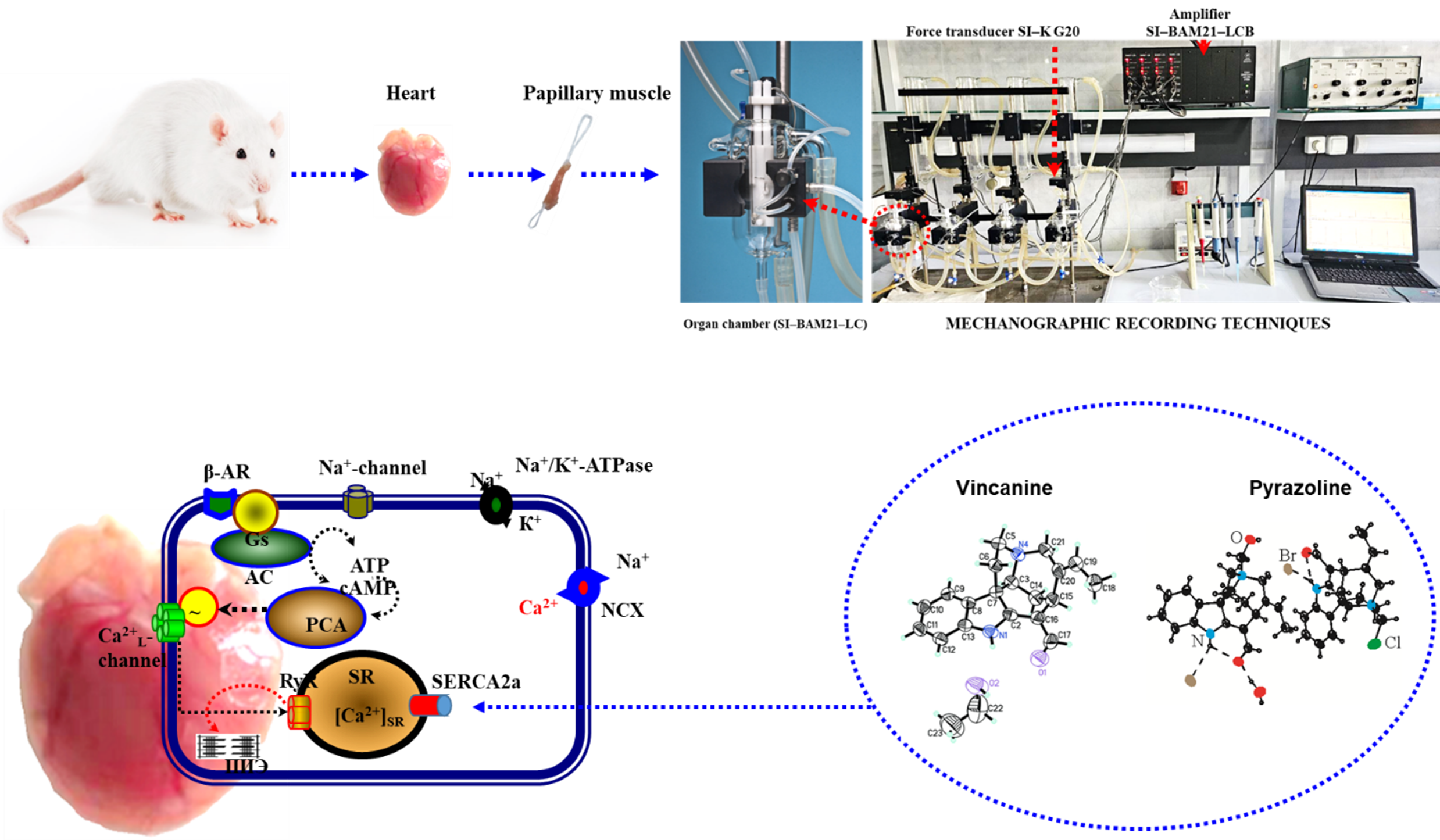
Downloads
References
AS Jadli, A Parasor, KP Gomes, R Shandilya and VB Patel. Exosomes in cardiovascular diseases: Pathological potential of nano-messenger. Frontiers in Cardiovascular Medicine 2021; 8, 767488.
E Sammels, JB Parys, L Missiaen, HD Smedt and G Bultynck. Intracellular Ca2+ storage in health and disease: A dynamic equilibrium. Cell Calcium 2010; 47(4), 297-314.
I Jumayev, P Usmanov, S Rustamov and S Zhurakulov. Comparative inotropic effects of the some isoquinoline alkaloids. Biomedical & Pharmacology Journal 2020; 13(1), 325-333.
PB Usmanov, IZ Jumayev, SY Rustamov, AA Zaripov, AT Esimbetov, SN Zhurakulov and VI Vinogradova. The combined inotropic and vasorelaxant effect of DHQ-11, a conjugate of flavonoid dihydroquercetin with isoquinoline alkaloid 1-aryl-6,7-dimethoxy-1,2.3,4-tetrahydroisoquinoline. Biomedical & Pharmacology Journal 2021; 14(2), 651-661.
ÅT Røe, M Frisk and WE Louch. Targeting cardiomyocyte Ca2+ homeostasis in heart failure. Current Pharmaceutical Design 2015; 21(4), 431-448.
K Walweel and DR Laver. Mechanisms of SR calcium release in healthy and failing human hearts. Biophysical Reviews 2015; 7(1), 33-41.
S Kurihara and N Fukuda. Regulation of myocardial contraction as revealed by intracellular Ca2+measurements using aequorin. The Journal of Physiological Sciences 2024; 74, 12.
KF Frank, B Bölck, E Erdmann and RHG Schwinger. Sarcoplasmic reticulum Ca2+-ATPase modulates cardiac contraction and relaxation. Cardiovascular Research 2003; 57(1), 20-27.
M Ottolia, N Torres, JHB Bridge, KD Philipson and JI Goldhaber. Na/Ca exchange and contraction of the heart. Journal of Molecular and Cellular Cardiology 2013; 61, 28-33.
CJ Fearnley, HL Roderick and MD Bootman. Calcium signaling in cardiac myocytes. Cold Spring Harbor Perspectives in Biology 2011; 3(11), a004242.
D Terentyev, I Györke, A Belevych and R Terentyeva. Redox modification of ryanodine receptors contributes to sarcoplasmic reticulum Ca2+ leak in chronic heart failure. Circulation Research 2008; 103(12), 1466-1472.
V Paar, P Jirak, R Larbig, NS Zagidullin, MC Brandt, M Lichtenauer, UC Hoppe and LJ Motloch. Pathophysiology of calcium mediated ventricular arrhythmias and novel therapeutic options with focus on gene therapy. International Journal of Molecular Sciences 2019; 20(21), 5304.
X Shen, JVD Brink, A Bergan-Dahl, TR Kolstad, ES Norden, Y Hou, M Laasmaa, AP Quick, EKS Espe, I Sjaastad, XHT Wehrens, AG. Edwards, C Soeller and WE Louch. Prolonged β-adrenergic stimulation disperses ryanodine receptorclusters in cardiomyocytes: Implications for heart failure. Journal of Molecular and Cellular Cardiology 2022; 173(S), S151.
E Bovo, S Huke, LA Blatter and AV Zima. The effect of PKA-mediated phosphorylation of ryanodine receptor on SR Ca2+ leak in ventricular myocytes. Journal of Molecular and Cellular Cardiology 2017; 104, 9-16.
B Xu, Y Wang, SMFM Bahriz, M Zhao, C Zhu and YK Xiang. Probing spatiotemporal PKA activity at the ryanodine receptor and SERCA2a nanodomains in cardomyocytes. Cell Communication and Signaling 2022; 20, 143.
EG Kranias and RJ Hajjar. Modulation of cardiac contractility by the phopholamban/SERCA2a regulatome. Circulation Research 2012; 110(12), 1646-1660.
JJ Bak, R Aguayo-Ortiz, N Rathod, JO Primeau, MB Khan, SL Robia, MJ Lemieux, LM Espinoza-Fonseca and HS Young. Primitive phospholamban- and sarcolipin-like peptides inhibit the sarcoplasmic reticulum calcium pump SERCA. Biochemistry 2022; 61(14), 1419-1430.
A Mattiazzi and EG Kranias. CaMKII regulation of phospholamban and SR Ca2+ load. Heart Rhythm 2011; 8(5), 784-787.
Y Sleiman, A Lacampagne and AC Meli. “Ryanopathies” and RyR2 dysfunctions: Can we further decipher them using in vitro human disease models? Cell Death & Disease 2021; 12, 1041.
B Sun, J Wei, X Zhong, W Guo, J Yao, R Wang, A Vallmitjana, R Benitez, L Hove-Madsen and SRW Chen. The cardiac ryanodine receptor, but not sarcoplasmic reticulum Ca2+-ATPase, is a major determinant of Ca2+ alternans in intact mouse hearts. Journal of Biological Chemistry 2018; 293(35), 13650-13661.
MNB Roig, T Leduc, CC Areal and V Mongrain. cellular effects of rhynchophylline and relevance to sleep regulation. Clocks & Sleep 2021, 3(2), 312-341.
IZ Zhumaev, SN Boboev, PB Usmanov, SB Qurbonova, SY Rustamov, AT Esimbetov, GS Begdullaeva, AA Zaripov and SM Adizov. mechanism of positive inotropic effect of vincanine on cardiac muscle contraction activity. Biomedical & Pharmacology Journal 2022; 15(4), 2309-2316.
ZF Ziyavitdinov, UZ Ishimov, NS Berdiev, IZ Zhumaev, YI Oshchepkova, PB Usmanov and SI Salikhov. Supramolecular complex of lappaconitine hydrobromide and the monoammonium salt of glycyrrhizic acid: Synthesis, Physicochemical characteristics, and antiarrhythmic activity. Pharmaceutical Chemistry Journal 2022; 56, 167-173.
SS Khushmatov, IZ Zhumaev, SN Zhurakulov, AS Saidov and VI Vinogradova. synthesis and comparative inotropic effects of several isoquinoline alkaloids. Pharmaceutical Chemistry Journal 2020, 54(1), 7-11.
VV Uzbekov, BF Abdullaev, IZ Jumayev, YI Oshchepkova, PB Usmanov and SI Salikhov. Comparative study of the antiarrhythmic activity of liposomal forms of lappaconitine hydrobromide and its complex with glycyrrhizic acid monoammonium salt in the aconitine arrhythmia model. Pharmaceutical Chemistry Journal 2023; 56(10), 1327-1332.
PRD Batista, DV Vassallo, MR Simões and ML Lima. Cardioprotective solutions exposure for 1 hour in hypoxia and low temperatures affects vascular reactivity differently. Brazilian Journal of Cardiovascular Surgery 2021; 36(2), 201-211.
PHL Padula, A Czerniczyniec, P Bonazzola, B Piotrkowski, V Vanasco, S Lores-Arnaiz and LE Costa. Acute hypobaric hypoxia and cardiac energetic response in prepubertal rats: Role of nitric oxide. Experimental Physiology 2021; 106(5), 1235-1248.
R Wang, M Wang, S He, G Sun and X Sun. Targeting calcium homeostasis in myocardial ischemia/reperfusion injury: An overview of regulatory mechanisms and therapeutic reagents. Frontiers in Pharmacology 2020; 11, 872.
AV Zima and SR Mazurek. Functional impact of ryanodine receptor oxidation on intracellular calcium regulation in the heart. Reviews of Physiology, Biochemistry and Pharmacology 2016; 171, 39-62.
YI Oshchepkova, VV Uzbekov, IZ Jumayev, SY Rustamov, PB Usmanov and SI Salikhov. Comparative study of antiarrhythmic and inotropic activity of amiodarone hydrochloride and its complexes with glycyrrhizic acid and monoammonium salt of glycyrrhizic acid. Eksperimental'naya i Klinicheskaya Farmakologiya 2023; 86, 15-22.
C Ferrantini, R Coppini, B Scellini, C Ferrara, JM Pioner, L Mazzoni, S Priori, E Cerbai, C Tesi and C Poggesi. R4496C RyR2 mutation impairs atrial and ventricular contractility. Journal of General Physiology 2015; 147(1), 39-52.
R Janicek, H Agarwal, AM Gómez, M Egger, GCR Ellis-Davies and E Niggli. Local recovery of cardiac calcium-induced calcium release interrogated by ultra-effective, two-photon uncaging of calcium. Journal of Physiology 2021; 599(16), 3841-3852.
S Ishii, K Oyama, SA Shintani, F Kobirumaki-Shimozawa, S Ishiwata and N Fukuda. Thermal activation of thin filaments in striated muscle. Frontiers in Physiology 2020; 11, 278.
E Tanaka, M Konishi and S Kurihara. Role of Ca2+ in the rapid cooling-induced Ca2+ release from sarcoplasmic reticulum in ferret cardiac muscles. The Journal of Physiological Sciences 2012; 62(3), 241-250.
C Hidalgo, P Aracena, G Sanchez and P Donoso. Redox regulation of calcium release in skeletal and cardiac muscle. Biological Research 2002; 35, 183-193.
M Nusier, AK Shah and NS Dhalla. Structure-function relationships and modifications of cardiac sarcoplasmic reticulum Ca2+-transport. Physiological Research 2021; 70(S4), S443-S470.
M Periasamy, P Bhupathy and GJ Babu. Regulation of sarcoplasmic reticulum Ca2+-ATPase pump expression and its relevance to cardiac muscle physiology and pathology. Cardiovascular Research 2008, 77(2), 265-273.
DA Eisner, JL Caldwell, K Kistamás and AW Trafford. Calcium and excitation-contraction coupling in the heart. Circulation Research 2017; 121(2), 181-195.
L Wang, RC Myles, IJ Lee, DM Bers and CM Ripplinger. Role of reduced sarco-endoplasmic reticulum Ca2+-ATPase function on sarcoplasmic reticulum Ca2+alternans in the intact rabbit heart. Frontiers in Physiology 2021; 12, 656516.
LA Shimoda and J Polak. Hypoxia. 4. Hypoxia and ion channel function. American Journal of Physiology-Cell Physiology 2011; 300(5), C951-C967.
Downloads
Published
How to Cite
Issue
Section
License
Copyright (c) 2024 Walailak University

This work is licensed under a Creative Commons Attribution-NonCommercial-NoDerivatives 4.0 International License.





