
Immunological Consequences of Triploidy in Penaeus monodon: Evidence from Cellular and Humoral Effectors
DOI:
https://doi.org/10.48048/tis.2026.13281Keywords:
Penaeus monodon, Black tiger shrimp, Triploid, Diploid, Cellular responses, Innate immunityAbstract
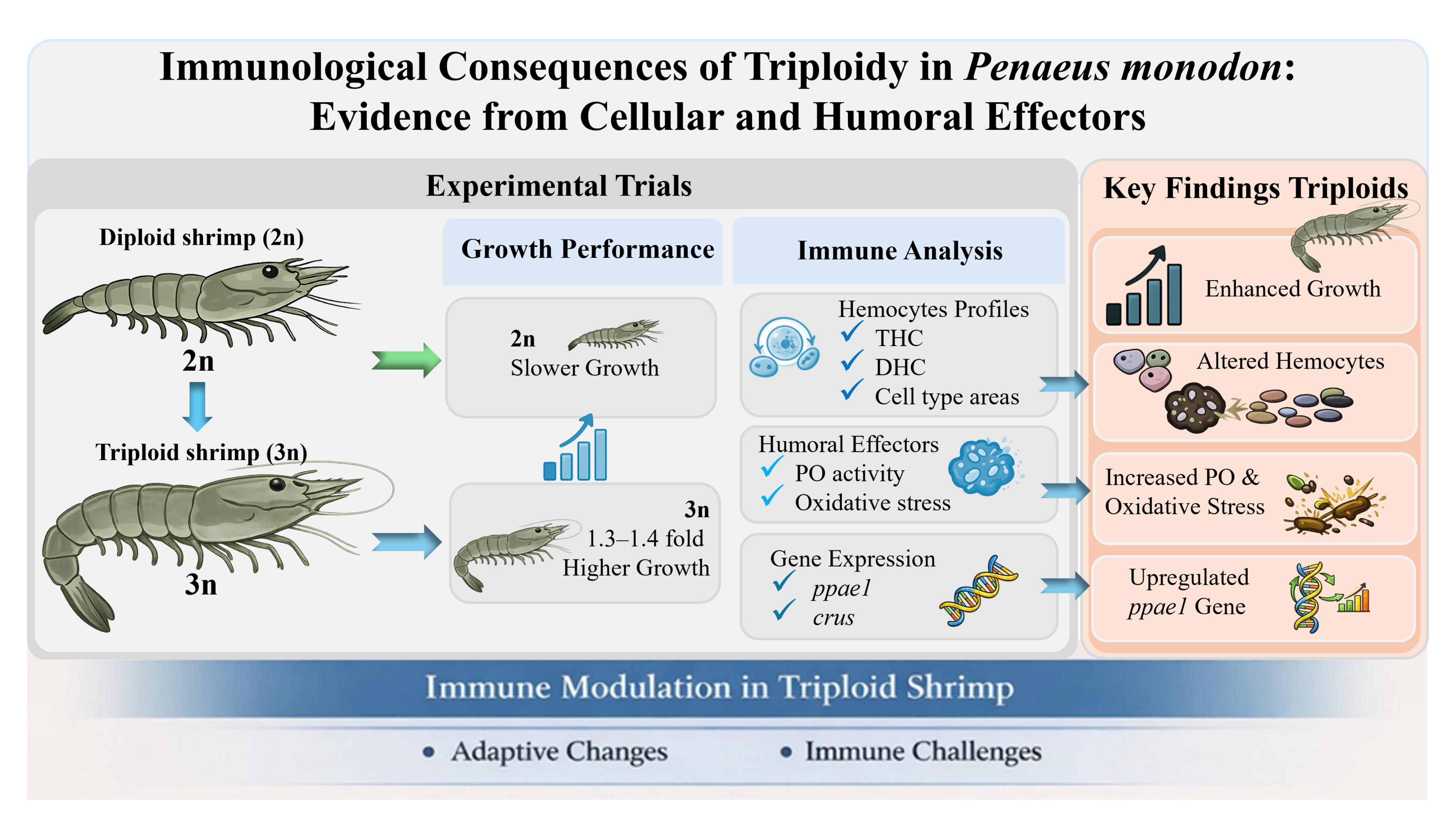
Triploidization has been applied in aquaculture to enhance growth performance and production stability; however, its implications for immune competence in penaeid shrimp remain poorly understood. This study compared growth performance, hemocyte dynamics, and innate immune responses between diploid (2n) and triploid (3n) Penaeus monodon across 2 independent trials. Triploid shrimp consistently exhibited 30% - 40% greater body weight than diploids, indicating enhanced somatic growth. Despite this advantage, triploid shrimp displayed reduced total hemocyte counts, with a modest decrease of approximately 9% in Trial 1 and a pronounced reduction of 41.49% in Trial 2. These changes were accompanied by marked alterations in hemocyte composition, characterized by lower proportions of hyaline cells and increased proportions of semi-granular and granular hemocytes. Concurrently, hemocyte size increased significantly in triploids across all cell types, with cell areas enlarged by approximately 1.3 - 1.9-fold, indicating compensatory cellular hypertrophy. Collectively, these cellular patterns support immune reorganization rather than proportional numerical scaling following genome duplication. At the functional level, triploid shrimp exhibited altered humoral and enzymatic immune profiles, including phenoloxidase-related activities, consistent with compensatory immune regulation. Molecular analyses further revealed trial- and tissue-dependent modulation of immune-related genes, including ppae1 and crus, suggesting context-dependent transcriptional responses rather than constitutive immune upregulation. Overall, these findings demonstrate that triploid P. monodon maintains immune competence through coordinated cellular and molecular compensation despite reduced hemocyte abundance, highlighting triploidization as a promising strategy to enhance growth performance without compromising innate immunity, thereby supporting its potential application in sustainable shrimp aquaculture.
HIGHLIGHTS
- Triploid shrimp achieved superior body weight without loss of immune competence.
- Reduced hemocyte abundance in triploids was compensated by increased cell size and function.
- Innate immunity in triploids reflects structural and molecular compensation mechanisms.
- Triploidization supports improved growth performance in sustainable shrimp aquaculture.
GRAPHICAL ABSTRACT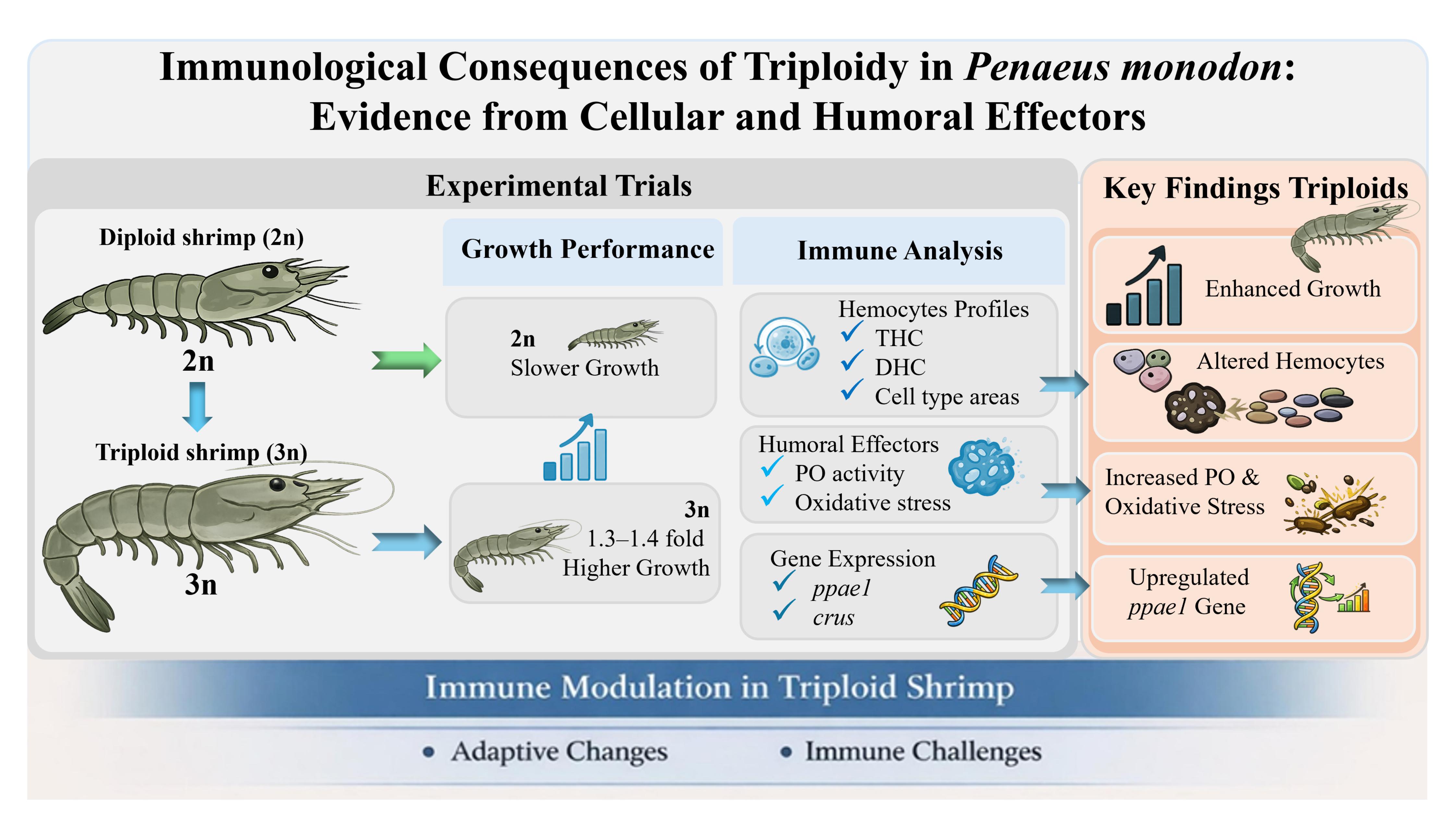
Downloads
References
H Manan and M Ikhwanuddin. Triploid induction in penaeid shrimps aquaculture: A review. Reviews in Aquaculture 2021; 13(1), 619-631.
S Keyvanshokooh. The performance of triploids versus diploids in aquaculture: A review through the omics window. Aquaculture International 2025; 33(1), 36.
FE Coman, MJ Sellars, BJ Norris, GJ Coman and NP Preston. The effects of triploidy on Penaeus (Marsupenaeus) japonicus (Bate) survival, growth and gender when compared to diploid siblings. Aquaculture 2008; 276(1-4), 50-59.
P Pongtippatee, K Laburee, P Thaweethamsewee, R Hiranphan, S Asuvapongpatana, W Weerachatyanukul, T Srisawat and B Withyachumnarnkul. Triploid Penaeus monodon: Sex ratio and growth rate. Aquaculture 2012; 356, 7-13.
MJ Sellars, A Wood, B Murphy, RM McCulloch and NP Preston. Triploid Black Tiger shrimp (Penaeus monodon) performance from egg to harvest age. Aquaculture 2012; 324-325, 242-249.
M Saearlee, W Semchuchot, R Vanichviriyakit, B Withyachumnarnkul and P Pongtippatee. Oogenesis and spermatogenesis of the triploid black tiger shrimp, Penaeus monodon. Trends in Sciences 2024; 21(11), 8217.
K Söderhäll and L Cerenius. Crustacean immunity. Annual Review of Fish Diseases 1992; 2, 3-23.
P Amparyup, W Charoensapsri and A Tassanakajon. Prophenoloxidase system and its role in shrimp immune responses against major pathogens. Fish & Shellfish Immunology 2013; 34(4), 990-1001.
L Cerenius, BL Lee and K Söderhäll. The proPO-system: Pros and cons for its role in invertebrate immunity. Trends in Immunology 2008; 29(6), 263-271.
K Supamattaya, J Ruangsri, T Itami, V Chitiwan, W Phromkunthong and K Muroga. Morphology and immunological roles of hemocytes and fixed phagocytes in black tiger shrimp Penaeus monodon. Fish Pathology 2003; 38(2), 33-39.
I Söderhäll. Crustacean hematopoiesis. Developmental & Comparative Immunology 2016; 58, 129-141.
K Supamattaya, S Kiriratnikom, M Boonyaratpalin and L Borowitzka. Effect of a Dunaliella extract on growth performance, health condition, immune response and disease resistance in black tiger shrimp (Penaeus monodon). Aquaculture 2005; 248(1-4), 207-216.
SC Zheng, JY Xu and HP Liu. Cellular entry of white spot syndrome virus and antiviral immunity mediated by cellular receptors in crustaceans. Fish & Shellfish Immunology 2019; 93, 580-588.
W Charoensapsri, P Amparyup, I Hirono, T Aoki and A Tassanakajon. Gene silencing of a prophenoloxidase activating enzyme in the shrimp, Penaeus monodon, increases susceptibility to Vibrio harveyi infection. Developmental & Comparative Immunology 2009; 33(7), 811-820.
D Banerjee, B Maiti, SK Girisha, MN Venugopal and I Karunasagar. A crustin isoform from black tiger shrimp, Penaeus monodon exhibits broad spectrum anti-bacterial activity. Aquaculture Reports 2015; 2, 106-111.
K Xu, W Wang, D Liu, C Wang, J Zhu, B Yan, H Gao and G Hu. Characterization of a crustin-like peptide involved in shrimp immune response to bacteria and Enterocytozoon hepatopenaei (EHP) infection in Palaemon carinicauda. Fish & Shellfish Immunology 2023; 139, 108871.
Z Wang, Y Qu, X Zhuo, J Li, J Zou and L Fan. Investigating the physiological responses of Pacific white shrimp Litopenaeus vannamei to acute cold-stress. PeerJ 2019; 7, e7381.
L Li, C Zhang, Q Lin, M Zhu, F Mei, S Jian and D Zhao. Role of peroxinectin in the antibacterial immune response of the Chinese mitten crab, Eriocheir sinensis. Fish & Shellfish Immunology 2022; 123, 496-505.
K Sritunyalucksana, K Wongsuebsantati, MW Johansson and K Söderhäll. Peroxinectin, a cell adhesive protein associated with the proPO system from the black tiger shrimp, Penaeus monodon. Developmental & Comparative Immunology 2001; 25(5-6), 353-363.
Y Xing, G Feng-Ying, Z Qing-Mei, J Bai, H Wang, L Hai-Hua and J Qing. Cloning and characterization of the tiger shrimp lysozyme. Molecular Biology Reports 2009; 36(6), 1239-1246.
J Wu, S Tian, K Luo, Y Zhang, H Pan, W Zhang and K Mai. Dietary recombinant human lysozyme improves the growth, intestinal health, immunity and disease resistance of Pacific white shrimp Litopenaeus vannamei. Fish & Shellfish Immunology 2022; 121, 39-52.
K Sritunyalucksana, P Sithisarn, B Withayachumnarnkul and TW Flegel. Activation of prophenoloxidase, agglutinin and antibacterial activity in haemolymph of the black tiger prawn, Penaeus monodon, by immunostimulants. Fish & Shellfish Immunology 1999; 9(1), 21-30.
L Chalmers, JF Taylor, W Roy, A Preston, H Migaud and A Adams. A comparison of disease susceptibility and innate immune response between diploid and triploid Atlantic salmon (Salmo salar) siblings following experimental infection with Neoparamoeba perurans, causative agent of amoebic gill disease. Parasitology 2017; 144(9), 1229-1242.
CA Hyndman, JD Kieffer and TJ Benfey. The physiological response of diploid and triploid brook trout to exhaustive exercise. Comparative Biochemistry and Physiology Part A: Molecular & Integrative Physiology 2003; 134(1), 167-179.
R Mahmoudi, M Naderi, H Dopeikar, SA Khorasaninasab and SH Seyedalhosseini. Interactive effects of triploidy induction and culture densities on growth performance and stress, immune, and metabolic responses in juvenile rainbow trout (Oncorhynchus mykiss). Aquaculture Reports 2025; 40, 102540.
C Brianik. 2024, Evaluation of triploid eastern oysters (Crassostrea virginica) for northeastern waters: Assessment of growth, immunity, disease and survival. Ph. D. Dissertation. State University of New York, Stony Brook, USA.
S De Decker, J Normand, D Saulnier, F Pernet, S Castagnet and P Boudry. Responses of diploid and triploid Pacific oysters Crassostrea gigas to Vibrio infection in relation to their reproductive status. Journal of Invertebrate Pathology 2011; 106(2), 179-191.
J Xiang, F Li, C Zhang, X Zhang, K Yu, L Zhou and C Wu. Evaluation of induced triploid shrimp Penaeus (Fenneropenaeus) chinensis cultured under laboratory conditions. Aquaculture 2006; 259(1-4), 108-115.
N Bhagawati and R Mahanta. Changes in haemocyte count in haemolymph of different larval stages of Eri silkworm on application of dimethoate, organophosphorus pesticide. International Journal of Recent Scientific Research 2012; 5, 396-399.
J Ruangsri, J Thawonsuwan, S Wanlem and B Withyachumnarnkul. Effect of body size and sub-optimal water quality on some hemato-immunological parameters of spotted babylon snail Babylonia areolata. Fisheries Science 2018; 84(3), 513-522.
CL Kielkopf, W Bauer and IL Urbatsch. Bradford assay for determining protein concentration. Cold Spring Harbor Protocols 2020; 2020(4), 102269.
M Muñoz, R Cedeño, J Rodrı́guez, WPWVD Knaap, E Mialhe and E Bachère. Measurement of reactive oxygen intermediate production in haemocytes of the penaeid shrimp, Penaeus vannamei. Aquaculture 2000; 191, 89-107.
B Withyachumnarnkul, I Palang, J Ruangsri, S Sirithammajak, S Jitrakorn, W Kiatpathomchai, V Saksmerprome, P Pongtippatee and B Withyachumnarnkul. Nile tilapia reared under full-strength seawater: Hemato-immunological changes and susceptibility to pathogens. Aquaculture 2017; 480, 42-50.
B Yang, W Li, Y Mao, Y Zhao, Y Xue, X Xu, Y Zhao and K Liu. Study on antimicrobial activity of sturgeon skin mucus polypeptides (rational design, self-assembly and application). Food Chemistry: X 2024; 21, 101236.
JM Fernandes, J Ruangsri and V Kiron. Atlantic cod piscidin and its diversification through positive selection. PLoS One 2010; 5(3), e9501.
JM Fernandes, MG MacKenzie, PA Wright, SL Steele, Y Suzuki, JR Kinghorn and IA Johnston. Myogenin in model pufferfish species: Comparative genomic analysis and thermal plasticity of expression during early development. Comparative Biochemistry and Physiology Part D: Genomics and Proteomics 2006; 1(1), 35-45.
J Vandesompele, K De Preter, F Pattyn, B Poppe, NV Roy, AD Paepe and F Speleman. Accurate normalization of real-time quantitative RT-PCR data by geometric averaging of multiple internal control genes. Genome Biology 2002; 3(7), research0034.1.
S Ponprateep, S Tharntada, K Somboonwiwat and A Tassanakajon. Gene silencing reveals a crucial role for anti-lipopolysaccharide factors from Penaeus monodon in the protection against microbial infections. Fish & Shellfish Immunology 2012; 32(1), 26-34.
TJ Benfey. The physiology and behavior of triploid fishes. Reviews in Fisheries Science 1999; 7(1), 39-67.
SP Otto and J Whitton. Polyploid incidence and evolution. Annual Review of Genetics 2000; 34(1), 401-437.
TL Orr-Weaver. When bigger is better: The role of polyploidy in organogenesis. Trends in Genetics 2015; 31(6), 307-315.
MM Beyea, TJ Benfey and JD Kieffer. Hematology and stress physiology of juvenile diploid and triploid shortnose sturgeon (Acipenser brevirostrum). Fish Physiology and Biochemistry 2005; 31(4), 303-313.
B Budiño, RM Cal, MC Piazzon and J Lamas. The activity of several components of the innate immune system in diploid and triploid turbot. Comparative Biochemistry and Physiology Part A: Molecular & Integrative Physiology 2006; 145(1), 108-113.
S Dorafshan, MR Kalbassi, M Pourkazemi, BM Amiri and SS Karimi. Effects of triploidy on the Caspian salmon Salmo trutta caspius haematology. Fish Physiology and Biochemistry 2008; 34(3), 195-200.
L Chalmers, KD Thompson, JF Taylor, S Black, H Migaud, B North and A Adams. A comparison of the response of diploid and triploid Atlantic salmon (Salmo salar) siblings to a commercial furunculosis vaccine and subsequent experimental infection with Aeromonas salmonicida. Fish & Shellfish Immunology 2016; 57, 301-308.
M Jearaphunt, C Noonin, P Jiravanichpaisal, S Nakamura, A Tassanakajon, I Söderhäll and K Söderhäll. Caspase-1-like regulation of the proPO-system and role of ppA and caspase-1-like cleaved peptides from proPO in innate immunity. PLoS Pathogens 2014; 10(4), e1004059.
N Yuvaraj and V Arul. Immunomodulatory effects of seagrass Halophila ovalis polysaccharide mixed feed in adult black tiger shrimp Penaeus monodon and its protective efficacy against white spot syndrome virus infection. Iranian Journal of Fisheries Sciences 2017; 16(3), 993-1007.
L Chalmers, LM Vera, JF Taylor, A Adams and H Migaud. Comparative ploidy response to experimental hydrogen peroxide exposure in Atlantic salmon (Salmo salar). Fish & Shellfish Immunology 2018; 81, 354-367.
MR Pilotto, N Argenta, J M Forte, B Hostins, FGR Menezes, R Maggioni, OVD Sousa, WW Jr, RD Rosa and LM Perazzolo. Environmental rearing conditions are key determinants of changes in immune gene expression patterns in shrimp midgut. Developmental & Comparative Immunology 2020; 106, 103618.
L Yang, Q Yang, S Jiang, Y Li, F Zhou, T Li and J Huang. Metabolic, immune responses in prawn (Penaeus monodon) exposed to ambient ammonia. Aquaculture International 2015; 23(4), 1049-1062.
RP Henry, Č Lucu, H Onken and D Weihrauch. Multiple functions of the crustacean gill: Osmotic/ionic regulation, acid-base balance, ammonia excretion, and bioaccumulation of toxic metals. Frontiers in Physiology 2012; 3, 431.
Published
How to Cite
Issue
Section
License
Copyright (c) 2026 Walailak University

This work is licensed under a Creative Commons Attribution-NonCommercial-NoDerivatives 4.0 International License.





