
Oven-Drying Kinetics and Physical Characterization of Ganyong Starch Biofoam with Various Sizes of Bagasse Filler
DOI:
https://doi.org/10.48048/tis.2025.9591Keywords:
Biofoam, Canna starch, Sugarcane bagasse, Kinetic model, DryingAbstract
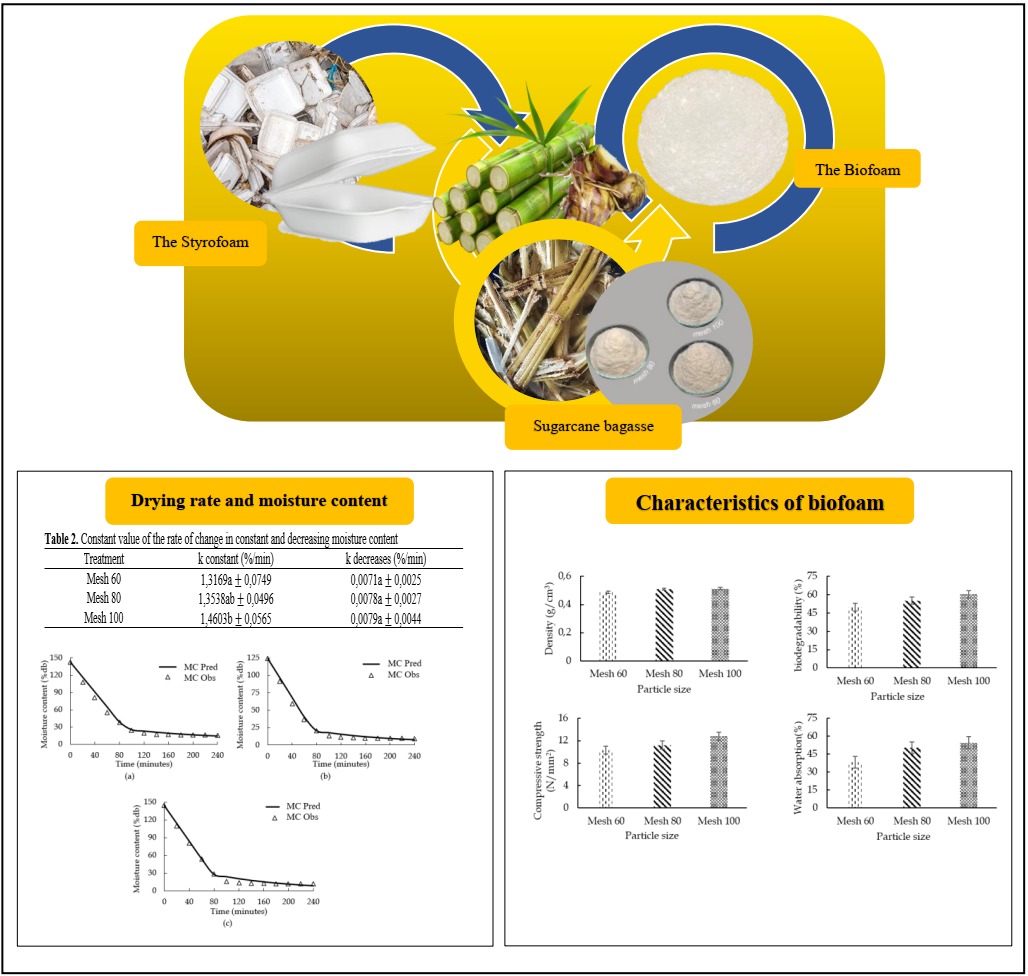
Biodegradable foam (biofoam) utilizing waste from natural materials and starch as the base and sugarcane bagasse as the filler represents an innovative alternative for controlling the use of polystyrene (PS), commonly known as styrofoam, which has been identified as the 5th most hazardous waste globally by the Environmental Protection Agency (EPA). Using waste from natural materials and starch as the base necessitates further research to produce biofoam with desirable characteristics that are safe for use in food products. Given the intended function of biofoam as a replacement for styrofoam, various factors influencing its characteristics must be considered. This study aims to examine the drying kinetics of biofoam and the effect of sugarcane bagasse particle size on biofoam characteristics. Three particle size variations were used in this study: mesh 60, 80, and 100. The observed physical characteristics parameters include moisture content, density, compressive strength, biodegradability, water absorption, and solubility. The kinetic analysis performs well in representing the data on biofoam moisture content during drying process, evidenced by an R² value close to 1 and a low RMSE. All physical characteristics parameters of biofoam, except for moisture content, exhibited improvements proportional to the decreasing particle size of the added sugarcane bagasse. The highest values for each parameter were obtained with the mesh 100 variation, with a density of 0.513 g/cm³; compressive strength of 12.81 N/mm²; biodegradability of 60.38 %; water absorption of 54.63 %; and solubility of 58.87 %, while the moisture content for the mesh 100 variation showed the lowest value at 7.86 %.
HIGHLIGHTS
- Cellulose fraction from sugarcane waste can be used as biofoam material.
- The particle size of sugarcane fiber affects the characteristics of biofoam.
- The smaller the particle size of the added bagasse, the faster the drying rate.
GRAPHICAL ABSTRACT
Downloads
References
A Akmala and E Supriyo. Optimasi konsentrasi selulosa pada pembuatan Biodegradable Foam dari selulosa dan tepung singkong. PENTANA 2020; 1(1), 27-40.
AD Cornellia, NA Ashifa, AF Churmelia, SRA Fikri and DO Radianto. Kombinasi jerami dan ampas tebu sebagai biofoam high durability dan waterproof dengan metode mixing dan molding. KOLONI 2023; 2(2), 49-54.
S Bahri, Fitriani and Jalaluddin. Pembuatan biofoam dari ampas tebu dan tepung maizena. Jurnal Teknologi Kimia Unimal 2021; 10(1), 24-32.
L Hevira, D Ariza and A Rahmi. Pembuatan biofoam berbahan dasar ampas tebu dan whey. Jurnal Kimia dan Kemasan 2021; 43(2), 75-81.
S Sumardiono, I Pudjihastuti and R Amalia. Analisis morfologi dan sifat mekanis biofoam dari tepung tapioka dan serat limbah batang jagung. Metana 2021; 17(1), 1-5.
GF Sari. The effect of proportion of ganyong starch and waste of straw rice on biodegradable foam production as sustainable packaging. IOP Conference Series: Earth and Environmental Science 2022; 1041, 12003.
DI Lailyningtyas, M Lutfi and AM Ahmad. Uji mekanik bioplastik berbahan pati umbi ganyong (Canna edulis) dengan variasi selulosa asetat dan sorbitol. Jurnal Keteknikan Pertanian Tropis dan Biosistem 2020; 8(1), 91-100.
S Selpiana, P Patricia and CP Anggraeni. Pengaruh penambahan kitosan dan gliserol pada pembuatan bioplastik dari ampas tebu dan ampas tahu. Jurnal Teknik Kimia 2016; 22(1), 18-24.
P Luna, S Darniadi, A Chatzifragkou and D Charalampopoulos. Biodegradable foams based on extracted fractions from sorghum by-products. IOP Conference Series: Earth and Environmental Science 2021; 749, 12057.
E Indarti, S Muliani, S Wulya, R Rafiqah, I Sulaiman and D Yunita. Development of environmental-friendly biofoam cup made from sugarcane bagasse and coconut fiber. IOP Conference Series: Earth and Environmental Science 2021; 711, 12011.
DY Susanti, WB Sediawan, M Fahrurrozi and M Hidayat. Foam-mat drying in the encapsulation of red sorghum extract: Effects of xanthan gum addition on foam properties and drying kinetics. Journal of the Saudi Society of Agricultural Sciences 2021; 20(4), 270-279.
DY Susanti, JNW Karyadi and S Mariyam. Drying characteristics of crackers from sorghum using tray dryer in different drying air velocities. Journal of Advanced Agricultural Technologies 2016; 3(4), 258-264.
A Mahdad, M Benhelal, M Hentabli, S Hanini and M Laidi. Modelling the drying kinetics of apple (Golab variety): Fractional calculus vs semi-empirical models. Journal of Chemist and Chemical Engineers of Croatia 2021; 70(5-6), 251-262.
D Zhang. A coefficient of determination for generalized linear mixed models. The American Statistician 2017; 71(4), 310-316.
AA Gabriel and LRP Afandi. Optimization of material formulation and process parameters in canna edulis starch-based biofoam synthesis. IOP Conference Series: Earth and Environmental Science 2022; 1114, 12097.
H Febriani, KIF Kurnia and ZD Pangarso. Pembuatan dan karakterisasi fisik biodegradable foam pati kulit pisang dan selulosa ampas tebu. Jurnal Ilmiah Penalaran dan Penelitian Mahasiswa 2021; 5(1), 1-13.
C Irawan, Aliah and Ardiansyah. Biodegradable foam derived from Musa acuminate and Ipomoea batatas L. as an environmentally friendly food packaging. Jurnal Riset Industri Hasil Hutan 2018; 10(1), 33-41.
S Sumardiono, I Pudjihastuti, R Amalia and YA Yudanto. Characteristics of biodegradable foam (bio-foam) made from cassava flour and corn fiber. IOP Conference Series: Materials Science and Engineering 2021; 1053(1), 12082.
C Togas, S Berhimpon, RI Montolalu, HA Dien and F Mentang. Karakteristik fisik edible film komposit karaginan dan lilin lebah menggunakan proses nanoemulsi. Jurnal Pengolahan Hasil Perikanan 2017; 20(3), 468-477.
PD Ananda, GS Kumar and SA Kumar. Drying kinetics and mathematical modelling of raisin production by abrasive and chemical pre-treatment of grapes. Journal of Scientific and Industrial Research 2024; 83(4), 350-361.
S Suhendra, F Nopriandy, D Perdana and A Maryam. Analisis kadar air dan laju pengeringan bahan baku pembuatan bubur pedas instan. Jurnal Engine: Energi, Manufaktur dan Material 2024; 8(1), 22-27.
N Amir, M Efendy, R Hidayat and M Gozan. Analysis and comparison of different dewatering methods on salt quality. E3S Web of Conferences 2021; 328, 5007.
A Daud, Suriati and Nuzulyanti. Kajian penerapan faktor yang mempengaruhi akurasi penentuan. Lutjanus 2019; 24(2), 11-16.
C Kapseu, DN Bup, C Tchiegang, CF Abi, F Broto and M Parmentier. Effect of particle size and drying temperature on drying rate and oil extracted yields of Buccholzia coriacea (MVAN) and Butyrospermum parkii ENGL. International Journal of Food Science and Technology 2007; 42(5), 573-578.
M Popescu, P Iancu, V Plesu, CS Bildea and FA Manolache. Mathematical modeling of thin-layer drying kinetics of tomato peels: Influence of drying temperature on the energy requirements and extracts quality. Foods 2023; 12(20), 3883.
R Marlina, Y Sumantri, SS Kusumah, A Syarbini, AA Cahyaningtyas and Ismadi. Karakterisasi komposit biodegradable foam dari kemasan pangan. Jurnal Kimia dan Kemasan 2021; 43(1), 1-11.
P Ferdiansyah, BA Harsojuwono and IW Arnata. Pengaruh konsentrasi asam stearat dan selulosa dari limbah padat pengolahan tapioka terhadap karakteristik biokomposit foam tapioka dan glukomanan. Jurnal Ilmiah Teknologi Pertanian Agrotechno 2022; 7(2), 114-122.
S Suryaningsih, PM Anggraeni and O Nurhilal. Pengaruh ukuran partikel terhadap kualitas termal dan mekanik briket campuran arang sekam padi dan kulit kopi. Jurnal Material dan Energi Indonesia 2019; 9(2), 79-85.
A Nugroho, AC Legowo, DM Maharani, Khairunnisa and A Gafur. Physical and mechanical properties of starch foam reinforced with pineapple (Ananas comosus) leaves powder. IOP Conference Series: Earth and Environmental Science 2022; 1187(1), 12016.
J Agus, S Ramadhani, PN Sabrini, DR Wulandari and ZA Ruslan. Development of starch-based biodegradable foam from corn extract with added fiber from banana stems. Jurnal Chemica 2023; 42(1), 78-86.
E Indarti, S Muliani and D Yunita. Characteristics of biofoam cups made from sugarcane bagasse with Rhizopus oligosporus as binding agent. Advances in Polymer Technology 2023; 2023, 8257317.
Rismawati, P Taba and Fahruddin. Study and characterization of biofoam from bagasse (Saccharum officinarum L.) with chitosan addition. Ecological Engineering and Environmental Technology 2024; 25(7), 11-21.
AP Wulandari, E Wulandini and I Indrawati. Biodegradasi jerami padi oleh Pennicillium spp. dengan variasi ukuran partikel Jerami. Jurnal Selulosa 2014; 4(2), 107-113.
FI Muharram. Penambahan kitosan pada biofoam berbahan dasar pati. Edufortech 2020; 5(2), 118-127.
SC Nwanonenyi and CO Chike-Onyegbula. Water absorption, flammability and mechanical properties of linear low density polyethylene/egg shell composite. Academic Research International 2013; 4(1), 352-358.
LC Platt-Lucero, B Ramirez-Wong, PI Torres-Chávez, J López-Cervantes, DI Sánchez-Machado, C Reyes-Moreno, J Milán-Carrillo and I Morales-Rosas. Improving textural characteristics of tortillas by adding gums during extrusion to obtain nixtamalized corn flour. Journal of Texture Studies 2010; 41(5), 736-755.
N Nasirpour and SM Mousavi. Effect of particle size in polyethyltene glycol-Assisted [BMIM][Cl] pretreatment of sugarcane bagasse. BioEnergy Research 2021; 14(4), 1136-1146.
AR Fauzi, U Sarofa and DF Rosida. Characteristics of biodegradable foam with proportional treatment of tapioca flour and soybean peel flour with added glycerol. Asian Journal of Applied Research for Community Development and Empowerment 2024; 8(2), 246-253.
Y Ruscahyani, S Oktorina and A Hakim. Pemanfaatan kulit jagung sebagai bahan pembuatan biodegradable foam. Jurnal Teknologi Technoscientia 2021; 14(1), 25-30.
Published
How to Cite
Issue
Section
License
Copyright (c) 2025 Walailak University

This work is licensed under a Creative Commons Attribution-NonCommercial-NoDerivatives 4.0 International License.





