
Solasodine-Loaded MCM-41 Mesoporous Silica for Targeted Anticancer Delivery: Insights from Preparation, Characterization, and Adsorption Studies
DOI:
https://doi.org/10.48048/tis.2026.11966Keywords:
MCM-41, Solasodine, Adsorption, Sonochemical preparation, Mesoporous silicaAbstract
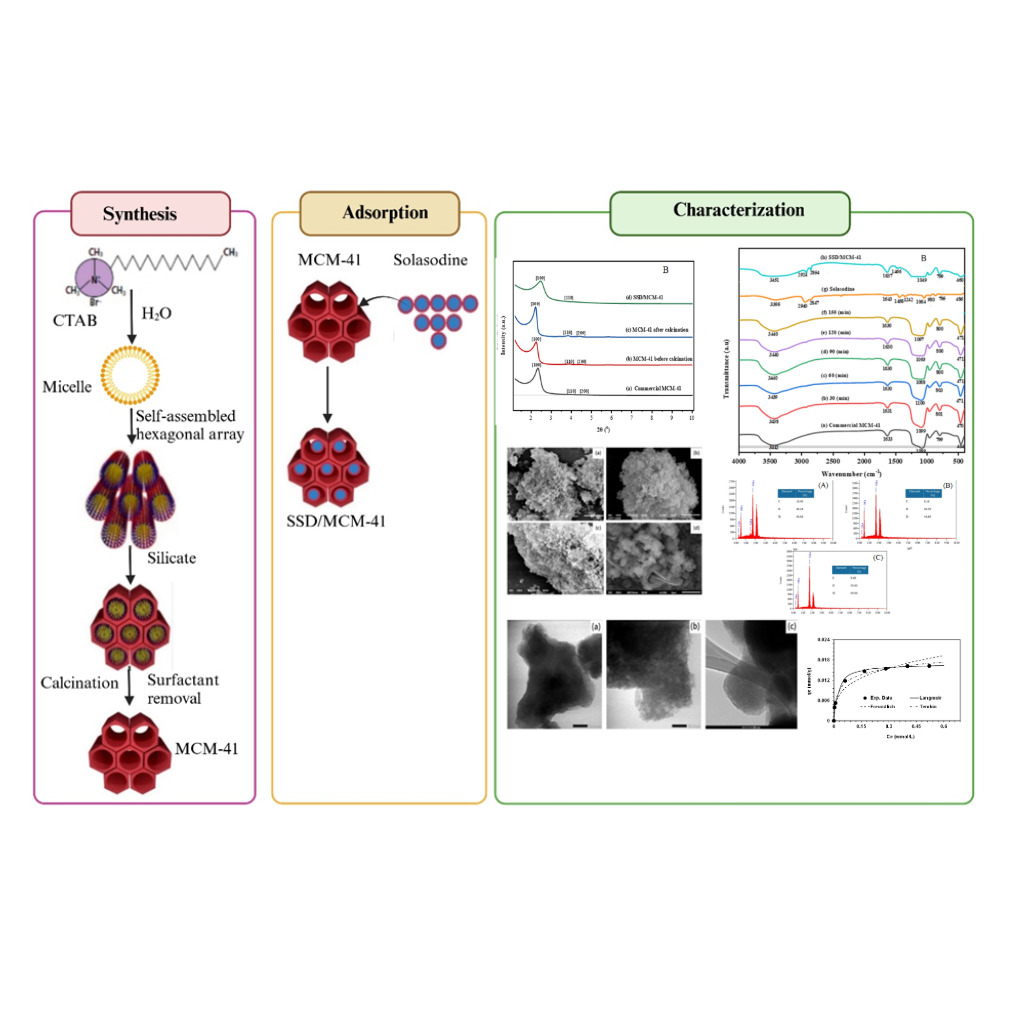
Mesoporous silica Mobil Composition of Matter No. 41 (MCM-41) has gained considerable attention as a carrier matrix because of its large surface area, adjustable pore size, and biocompatibility. This study aimed to prepare and thoroughly characterize MCM-41 using a sonochemical approach and to evaluate its potential for adsorbing solasodine, a steroidal alkaloid with anticancer properties. MCM-41 was prepared under different sonication times (30 - 150 min) and characterized using Fourier Transform Infrared Spectroscopy (FTIR, X-ray Diffraction (XRD), Transmission Electron Microscopy (TEM), Scanning Electron Microscopy coupled with Energy Dispersive X-ray (SEM-EDX), and Brunauer-Emmett-Teller (BET) techniques. XRD results confirmed the formation of a well-defined hexagonal mesostructure, with crystallinity increasing with increasing sonication time. Loading solasodine onto MCM-41 reduced diffraction intensity but preserved the structural framework. BET analysis revealed decreases in surface area (from 1129.39 to 849.31 m2/g), pore volume (from 0.87 to 0.59 cc/g), and pore diameter (from 3.41 to 2.17 nm), indicating successful solasodine incorporation. Adsorption of solasodine was optimum at pH 4, followed well a kinetic model of second order reaching equilibrium and an isotherm model of Langmuir with an adsorption capacity of 1.69×10⁻² mmol/g, indicating strong carrier affinity and monolayer adsorption.
HIGHLIGHTS
- Structurally stable and well-ordered MCM-41 was prepared using a sonochemical method.
- The structural matrix of MCM-41 was not affected after loading solasodine.
- BET analysis confirmed reduced surface area and pore diameter after loading the drug.
- Adsorption followed pseudo-second-order kinetics that attained equilibrium.
- The Langmuir isotherm exhibited high affinity and monolayer adsorption of solasodine.
GRAPHICAL ABSTRACT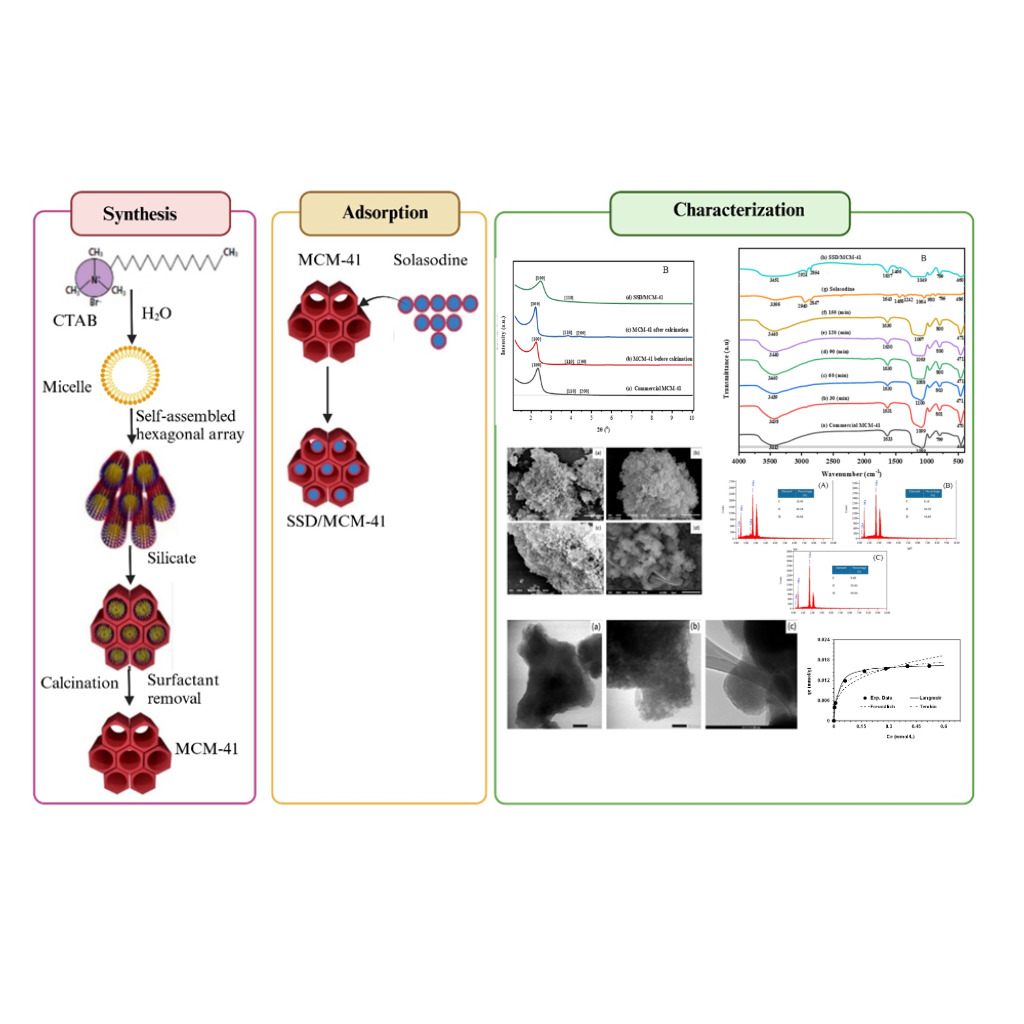
Downloads
References
H Guo, X Zhao, Y Duan and J Shi. Hollow mesoporous silica nanoparticles for drug formulation and delivery: Opportunities for cancer therapy. Colloids and Surfaces B: Biointerfaces 2025; 249, 114534.
J Liu, J Liu, Y Wang, F Chen, Y He, X Xie, Y Zhong and C Yang. Bioactive mesoporous silica materials-assisted cancer immunotherapy. Biomaterials 2025; 315, 122919.
AK Singh, S Singh, T Minocha, SK Yadav, R Narayan, UY Nayak, SK Singh and R Awasthi. In vitro profiling and molecular dynamics simulation studies of berberine-loaded MCM-41 mesoporous silica nanoparticles to prevent neuronal apoptosis. Nanoscale Advances 2024; 6(9), 246-2486.
S Batool, S Sohail, FU Din, AH Alamri, AS Alqahtani, MA Alshahrani, MA Alshehri and HG Choi. A detailed insight of the tumor targeting using nanocarrier drug delivery system. Drug Delivery 2023; 30(1), 2183815.
P Kolimi, S Narala, AAA Youssef, D Nyavanandi and N Dudhipala. A systematic review on development of mesoporous nanoparticles as a vehicle for transdermal drug delivery. Nanotheranostics 2023; 7, 70-89.
Z Li, L Liu, Z Wang, P Gao and GK Li. Synthesis and application of mesoporous materials: Process status, technical problems and development prospects: A mini-review. Energy & Fuels 2023; 37(5), 3413-3427.
R Foulady-Dehaghi, S Sohrabnezhad and M Hadavi. Drug delivery with solvent-free synthesized polyimide-COF/amino-functionalized MCM-41 nanohybrid. Journal of Drug Delivery Science and Technology 2023; 81, 104283.
R Narayan, S Gadag, S Garg and UY Nayak. Understanding the effect of functionalization on loading capacity and release of drug from mesoporous silica nanoparticles: A computationally driven study. ACS Omega 2022; 7(10), 8229-8245.
K Djayanti, P Maharjan, KH Cho, S Jeong, MS Kim, MC Shin and KA Min. Mesoporous silica nanoparticles as a potential nanoplatform: Therapeutic applications and considerations. International Journal of Molecular Sciences 2023; 24(7), 6349.
A Ojha, S Jaiswal, P Bharti and SK Mishra. Nanoparticles and nanomaterials-based recent approaches in upgraded targeting and management of cancer: A review. Cancers 2023; 15(1), 162.
M Deinavizadeh, A Kiasat, N Hooshmand, M Shafiei, M Sabaeian, R Mirzajani, SM Zahraei, HI Labouta and MA El-Sayed. Smart NIR-light and pH-responsive doxorubicin-loaded GNRs@SBA-15-SH nanocomposite for chemo-photothermal therapy of cancer. Nanophotonics 2021; 10(12), 3303-3319.
ZH Mahmoud, UAR Hussein, AM Dhiaa, AF Al-Hussainy, N Aljbory, MH Shuhata, MJ Alnajar, DK Aljaberi, ASOK Khawaf, DK Mahapatra, E Kianfar, TM Joseph and S Thomas. Nano-based drug delivery in cancer: Tumor tissue characteristics and targeting. Trends in Sciences 2025; 22(2), 9078.
L Sun. Smart nanoparticles for cancer therapy. Signal Transduction and Targeted Therapy 2023; 8, 418.
S Swami. Nanomaterial catalyzed green synthesis of tetrazoles and its derivatives: A review on recent. RSC Advances 2021; 11, 39058-39086.
YW Lin, WH Lee, CY Chen, YJ Liu, WQ Zhang, MY Lin and KL Lin. Synthesis of aluminum-mesoporous MCM-41 humidity control material from thin-film transistor liquid crystal display waste glass and sandblasting waste and its application. Boletín de la Sociedad Española de Cerámica y Vidrio 2023; 62(4), 357-367.
A Corma, P Botella and E Rivero-Buceta. Silica-based stimuli-responsive systems for antitumor drug delivery and controlled release. Pharmaceutics 2022; 14(1), 110.
M Hachemaoui, CB Molina, C Belver, J Bedia, A Mokhtar, R Hamacha and B Boukoussa. Metal-loaded mesoporous MCM-41 for the catalytic wet peroxide oxidation (CWPO) of acetaminophen. Catalysts 2021; 11(2), 219.
K Abouaitah and W Lojkowski. Delivery of natural agents by means of mesoporous silica nanospheres as a promising anticancer strategy. Pharmaceutics 2021; 13(2), 143.
Z Shariatinia, N Pourzadi and SMR Darvishi. Tert-butylamine functionalized MCM-41 mesoporous nanoparticles as drug carriers for the controlled release of cyclophosphamide anticancer drug. Surfaces and Interfaces 2021; 22, 100842.
GD Aquino, MS Moreno, CM Piqueras, GP Benedictto and AM Pereyra. Alternative synthesis of MCM-41 using inexpensive precursors for CO2 capture. Inorganics 2023; 11(12), 480.
C de la Torre, R Gavara, A García-Fernández, M Mikhaylov, MN Sokolov, JF Miravet, F Sancenón, R Martínez-Máñez and F Galindo. Enhancement of photoactivity and cellular uptake of (Bu4N)2[Mo6I8(CH3COO)6] complex by loading on porous MCM-41 support. Photodynamic studies as an anticancer agent. Biomaterials Advances 2022; 140, 213057.
C Voycheva, T Popova, M Slavkova, V Tzankova, D Stefanova, D Tzankova, I Spassova, D Kovacheva and B Tzankov. Doxorubicin and quercetin double loading in modified MCM-41 lowered cardiotoxicity in H9c2 cardioblast cells in vitro. Bioengineering 2023; 10, 637.
B Tahmasbi, M Nikoorazm, P Moradi and YA Tyula. A Schiff base complex of lanthanum on modified MCM-41 as a reusable nanocatalyst in the homoselective synthesis of 5-substituted 1H-tetrazoles. RSC Advances 2022; 12, 34303-34317.
V Tzankova, D Aluani, Y Yordanov, M Valoti, M Frosini, I Spassova, D Kovacheva and B Tzankov. In vitro toxicity evaluation of lomefloxacin-loaded MCM-41 mesoporous silica nanoparticles. Drug and Chemical Toxicology 2021; 44(3), 238-249.
T Popova. Mesoporous silica MCM-41 and HMS as advanced drug delivery carriers for bicalutamide. Journal of Drug Delivery Science and Technology 2021; 62, 102340.
BTT Luyen. New solasodine-type glycoalkaloids isolated from solanum nigrum and their cytotoxic activity. Chemical & Biodiversity 2024; 21(7), e202400872.
Y Yang. A combined treatment with Ursolic acid and Solasodine inhibits colorectal cancer progression through the AKT1/ERK1/2-GSK-3β-β-catenin axis. Phytomedicine 2024; 135, 156068.
D Arumuganainar. Exploring the therapeutic role of Solasodine in oral cancer management. Natural Product Research 2024. https://doi.org/10.1080/14786419.2024.2408656
Y Alyassin, EG Sayed, P Mehta, K Ruparelia, MS Arshad, M Rasekh, J Shepherd, I Kucuk, PB Wilson, N Singh, MW Chang, DG Fatouros and Z Ahmad. Application of mesoporous silica nanoparticles as drug delivery carriers for chemotherapeutic agents. Drug Discovery Today 2020; 25(8), 1513-1520.
N Atiyah, M Atiya and T Albayati. Curcumin Loaded onto Magnetic Mesoporous Material MCM-41 for Controlled and Release in Drug Delivery System. Engineering and Technology Journal 2022; 40(3), 472-483.
NA Atiyah. Functionalization of mesoporous MCM-41 for the delivery of curcumin as an anti-inflammatory therapy. Advanced Powder Technology 2022; 33(2), 103417.
Y Chen, Y Lu and RJ Lee. Nano encapsulated curcumin: And its potential for biomedical applications. International Journal of Nanomedicine 2020; 15, 3099-3120.
S Bhattacharya and BG Prajapati. Mesoporous silica-based nanoparticles in pharmaceutical sciences: A mini-review. International Journal of Pharmaceutical Sciences and Nanotechnology 2020; 13(4), 4964-4969.
TAN Dau, VMH Le, TKH Pham, VH Le, SK Cho, TNU Nguyen, TKH Ta and TTV Tran. Surface functionalization of doxorubicin-loaded MCM-41 mesoporous silica nanoparticles by 3-aminopropyltriethoxysilane for selective anticancer effect on A549 and A549/DOX Cells. Journal of Electronic Materials 2021; 50(5), 2932-2939.
J Chen. Solasodine suppresses MCF7 breast cancer stem-like cells via targeting Hedgehog/Gli1. Phytomedicine 2022; 107, 154448.
S Lagergren. Zur theorie der sogenannten adsorption gelöster stoffe. Kungliga Svenska Vetenskapsakademiens Handlingar 1898; 24, 1-39.
YS Ho. Pseudo-second order model for sorption processes. Process Biochemistry 1999; 34, 451-465.
SJ Santosa, M Hadi, FN Aisyah and Nuryono. A novel utilization of sugarcane bagasse-derived ash to reductively remove gold (III) to gold metal: Energetics, kinetics and mechanism studies. Case Studies in Chemical and Environmental Engineering 2024; 10, 100802.
E Amdeha, RS Mohamed and AS Dhmees. Sonochemical-assisted preparation of ZnS-ZnO/MCM-41 based on blast furnace slag and electric arc furnace dust for Cr (VI) photoreduction. Ceramics International 2021; 47(16), 23014-23027.
A Putz, M Ciopec, A Negrea and O Grad. Comparison of Structure and adsorption properties of mesoporous silica functionalized with aminopropyl groups by the co-condensation and the post-grafting methods. Materials 2021; 14, 628.
M Kurniasih, NH Aprilita, R Roto and M Mudasir. Modification of coal fly ash for high-capacity adsorption of methylene blue. Case Studies in Chemical and Environmental Engineering 2025; 11, 101101.
SK Khandani, M Mehrabani, F Sharififar, A Pardakhty, M Pournamdari and M Pakravanan. Development and validation of an RP-HPLC method for determination of solasodine, a steroidal alkaloid. Journal of Young Pharmacists 2018; 11(1), 21-25.
H Budi, AF Arsyada, H Saptono, K Soerja and K Azlan. Synthesis and characterization of chitosan-alginate hydrogel adsorbent for paracetamol removal from wastewater. Trends in Sciences 2025; 22(12), 10767.
J Wang and X Guo. Adsorption isotherm models: Classification, physical meaning, application and solving method. Chemosphere 2020; 258, 127279.
SJ Santosa, ES Kunarti, NH Aprilita, B Wulandari and DN Bawani. Sorption mechanism and performance of peat soil humin for Methylene blue and p-Nitrophenol. Indonesian Journal of Chemistry 2019; 19(1), 198-210.
Published
How to Cite
Issue
Section
License
Copyright (c) 2025 Walailak University

This work is licensed under a Creative Commons Attribution-NonCommercial-NoDerivatives 4.0 International License.





