
SGLT2 Downregulation Mediates the Antidiabetic and Renoprotective Effects of Swietenia Macrophylla King in A Neonatal Streptozotocin-Induced Rat Model
DOI:
https://doi.org/10.48048/tis.2025.11224Keywords:
Diabetes mellitus, Swietenia macrophylla King, Renoprotective, SGLT2, Blood glucose, Tubular injury, Urine glucose, Diabetes mellitus, Swietenia macrophylla King, Renoprotective, SGLT2, Blood glucose, Tubular injury, Urine glucoseAbstract
Swietenia macrophylla King (SMK) has been reported to exhibit hypoglycemic activity by lowering blood glucose levels, which may aid the management of diabetes mellitus. Elevated blood glucose leads to increased glucose reabsorption in the kidneys and potentially serious kidney complications. In this study, 24 neonatal Wistar rats were induced with 90 mg/kgBW Streptozotocin (STZ) on the 2nd day of birth and divided into 6 groups: Normal control, negative control, positive control, and 3 groups were given Swietenia macrophylla King extract at doses of 25, 50 and 100 mg/kgBW for 21 days. Blood glucose, urine glucose, and Sodium Glucose Cotransporter 2 (SGLT2) expression were examined as biomarkers of glucose reabsorption, and histopathology of the kidney was assessed to evaluate tubular injury in this study. Blood glucose levels and SGLT2 expression in the group receiving extract were lower than the negative control group (p ≤ 0.005). The histopathological picture of the tubular injury in the group that received the extract showed less damage than the negative control group (p ≤ 0.001). The urine glucose levels in the groups that received the extract decreased compared to the first measurements (p < 0.05). The findings indicate that Swietenia macrophylla King extract possesses significant antidiabetic and renoprotective properties, as evidenced by reduced blood and urinary glucose levels, decreased SGLT2 expression, and improved renal histology. These results suggest its potential as a promising natural therapeutic agent for diabetes management, warranting further investigation to explore its underlying mechanisms and clinical applicability.
HIGHLIGHTS
- Swietenia macrophylla King extract significantly lowers blood and urinary glucose levels in a neonatal streptozotocin-induced diabetic rat model.
- The extract downregulates renal SGLT2 expression, suggesting a novel mechanism for its antidiabetic and renoprotective effects.
- This study provides new pharmacological insight into the potential of Swietenia macrophylla as a natural therapeutic agent targeting renal glucose reabsorption in diabetes.
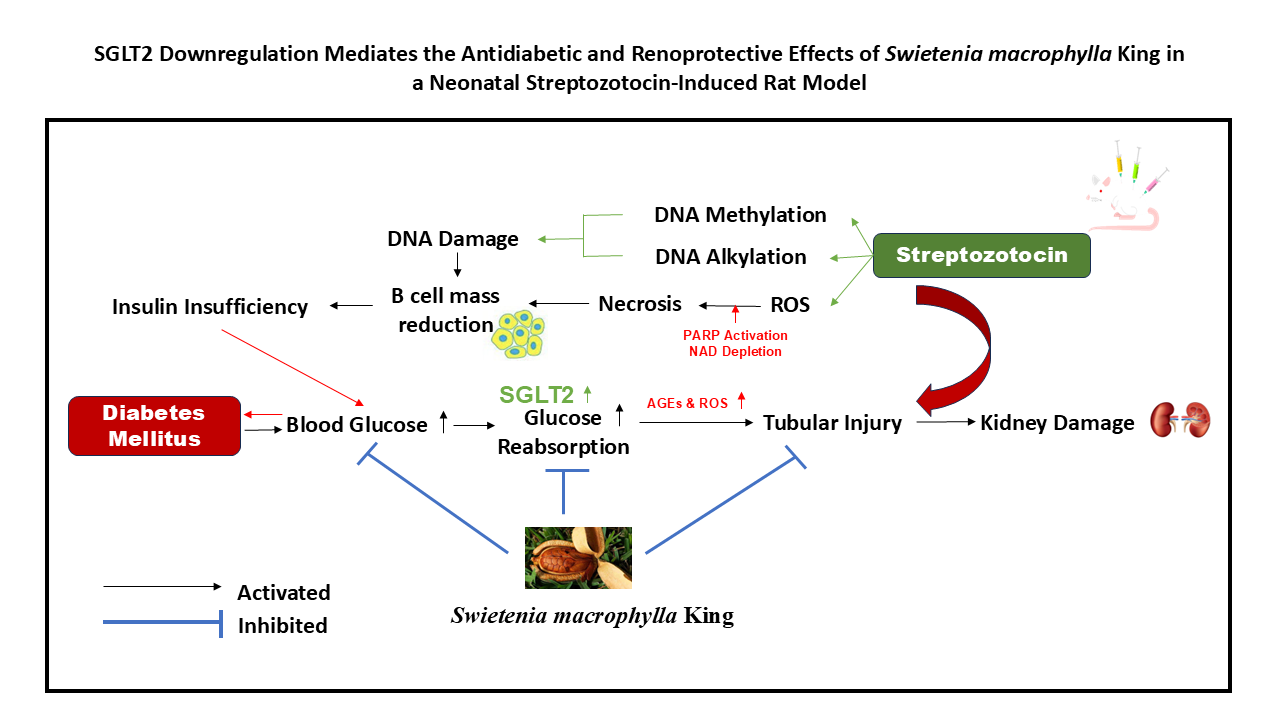
GRAPHICAL ABSTRACT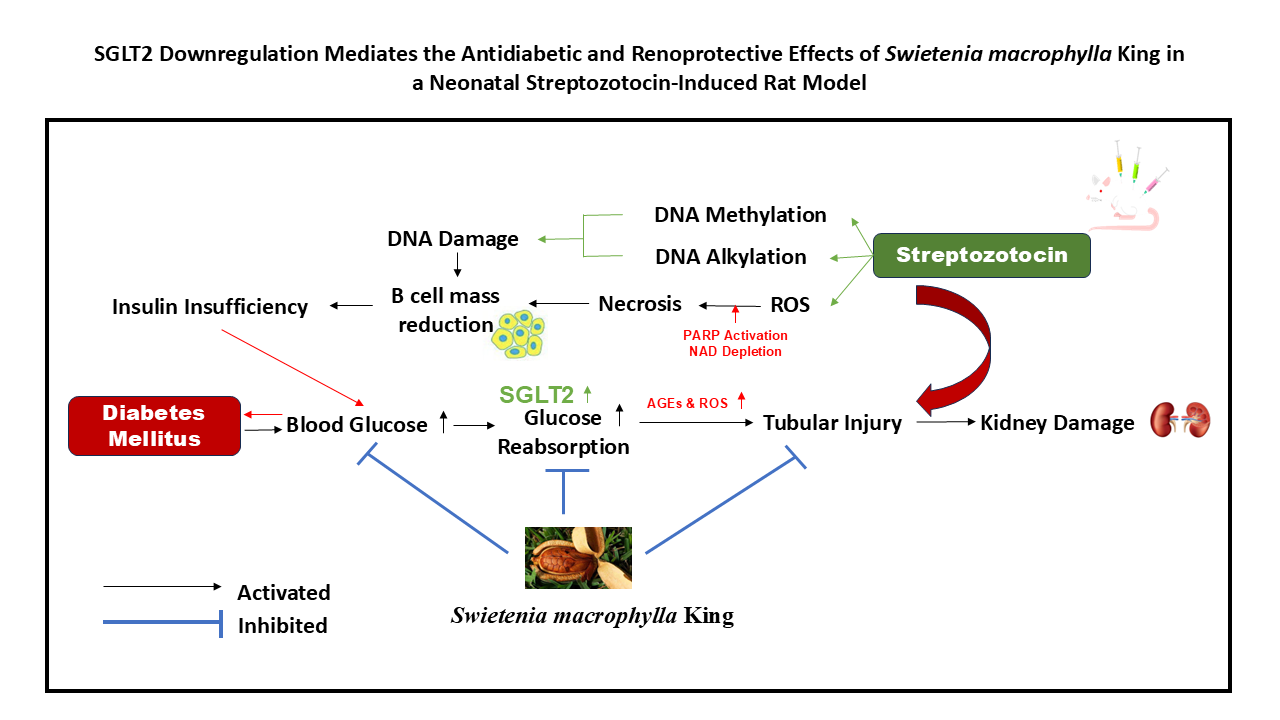
Downloads
References
DGA Budiyasa, NK Noviantari and NKAT Hapsari. Diabetes support system in efforts to improve therapeutic adherence and blood glucose control in type 2 diabetes mellitus patients. Waarmadewa Minesterium Medical Journal 2024; 3(1), 28-32.
International Diabetes Federation. Diabetes basic facts & figures, Available at: https://idf.org/about-diabetes/facts-figures/, accessed July 2026.
NT Saputra, IN Suartha and AAGO Dharmayudha. Diabetogenic agent streptozotocin to make male white rats diabetes mellitus. Buletin Veteriner Udayana 2018; 10(2), 116.
RH Unger and DW Foster. Diabetes mellitus. In: JD Wilson and DW Foster (Eds.). Williams Textbook of Endocrinology. WB Saunders, Philadelphia, 1992.
P Auliya, F Oenzil and ZDD Rofinda. Overview of blood glucose levels in overweight and obese students of the faculty of medicine, Andalas University. Jurnal Kesehatan Andalas 2016; 5(3), 528-533.
K Alipin, EP Sari, M Madihah, T Setiawati, N Ratningsih and DM Malini. Kidney histology in streptozotocin-induced diabetic male Wistar rats treated with combined extract of Temulawak Rhizome and Belimbing Wuluh fruit. Nusantara Bioscience 2017; 9(3), 312-317.
H Osorio, R Bautista, A Rios, M Franco, A Arellano, H Vargas-Robles, E Romo and B Escalante. Effect of phlorizin on SGLT2 expression in the kidney of diabetic rats. Journal of Nephrology 2010; 23(5), 541-546.
P Made and PS Dharma. Diabetes therapy with SGLT-2 inhibitors. Cermin Dunia Kedokteran 2019; 46(6), 452-456.
Kurniawan and PI Suryajaya. Dapagliflozin: A new therapy for diabetes mellitus. Continuing Professional Development 2015; 42(11), 817-822.
A Hendrajaya. Terapi penghambat sodium glucose co-transporters-2 (SGLT-2) dalam pengobatan diabetes melitus tipe-2 (DM-2): Tinjauan pustaka. Intisari Sains Medis 2021; 12(1), 131-136.
D Cheta. Animal models of type I (insulin-dependent) diabetes mellitus. Journal of Pediatric Endocrinology & Metabolism 1998; 11(1), 11-19.
Yulianta, NM Rina, KTP Gelgel and IM Kardena. Toxicity effect of red betel leaf extract on the microscopic picture of alloxan-induced diabetic white rat kidney. Buletin Veteriner Udayana 2013; 5(2), 114-121.
AE Nugroho. Review: Animal models of diabetes mellitus: Pathology and mechanism of some diabetogenics. Biodiversitas Journal of Biological Diversity 2006; 7(4), 378-382.
N Nursakinah, AD Djalil and W Utaminingrum. 2017, Antidiabetic effectiveness test of ethyl acetate fraction of Swietenia macrophylla king leaf (Swietenia macrophylla King) on glucose-induced male rats. Master Thesis. Universitas Muhammadiyah Purwokerto, Jawa Tengah, Indonesia.
M Muthmainah, I Nurwati, S Handayani, B Saptiwi and S Marufah. Swietenia macrophylla king (Swietenia macrophylla king) seed isolate improves histopathological features of hepar of type 2 DM model rats. Smart Medical Journal 2021; 4(2), 73-82.
Directorate of Drug Safety. Quality and import-export supervision, N. food and drug administration of the republic of Indonesia. Directorate of Drug Safety, Indonesia, 2022.
Z Shiming, KK Mak, MK Balijepalli, S Chakravarthi and MR Pichika. Swietenine potentiates the antihyperglycemic and antioxidant activity of Metformin in Streptozotocin induced diabetic rats. Biomed Pharmacother. 2021; 139, 111576.
R Kurnijasanti, G Wardani, MR Mustafa and SA Sudjarwo. Protective mechanism pathway of Swietenia macrophylla extract nanoparticles against cardiac cell damage in diabetic rats. Pharmaceuticals 2023; 16(7), 973.
N Fratiwi, S Sarani, G Agastia and M Isrum. Aktivitas antiinflamasi ekstrak etanol daun kirinyuh (Chromolaena odorata L.) dan pengaruhnya terhadap kadar interleukin 6 (IL-6) pada tikus jantan galur wistar. Jurnal Pharmacia Mandala Waluya 2022; 1(2), 54-67.
DJ Cada, TL Levien and DE Baker. Dapagliflozin. Hospital pharmacy 2014; 49(7), 647-662.
S Bonner-Weir, DF Trent, CJ Zmachinski, ET Clore and GC Weir. Limited B cell regeneration in a B cell-deficient rat model: Studies with dexamethasone. Metabolism 1981; 30(9), 914-918.
LL Basy, S Lestari and S Kadarsih. The effects of the ethanolic extract of Swietenia macrophylla King seeds (Swietenia macrophylla King) on the renal function of streptozotocin-induced diabetic rats. Journal of the Medical Sciences 2015; 47(2), 51-58.
G Sahgal, S Ramanathan, S Sasidharan, MN Mordi, S Ismail and SM Mansor. Phytochemical and antimicrobial activity of Swietenia mahagoni crude methanolic seed extract. Tropical Biomedicine 2009; 26(3), 274-279.
DW Sumekar and S Fauzia. The effectiveness of Swietenia macrophylla king seed (Swietenia Mahagoni) as a treatment of diabetes mellitus. Medical Journal of Lampung University 2016; 5, 1-10.
B Joseph and D Jini. Antidiabetic effects of Momordica charantia (bitter melon) and its medicinal potency. Asian Pacific Journal of Tropical Disease 2013; 3(2), 93-102.
WA Saka, OS Oyekunle, TM Akhigbe, OO Oladipo, MB Ajayi, AT Adekola, AI Omole and RE Akhigbe. Andrographis paniculata improves glucose regulation by enhancing insulin sensitivity and upregulating GLUT 4 expression in Wistar rats. Frontiers in Nutrition 2024; 11, 1416641.
LV Vigneshwaran and KG Lalitha. In silico evaluation of antidiabetic molecules of the seeds of Swietenia mahagoni Jacq. International Journal of Pharmaceutical and Phytopharmacological Research 2017; 6(1), 41.
B Kiberd. The chronic kidney disease epidemic: Stepping back and looking forward. Journal of the American Society of Nephrology 2006; 17(11), 2967-2973.
H Tae-sun, C Ji-Young, P Hye-Young and L Jin-Seok. Gingseng total saponin improves podocyte hyperpermeability induced by high glucose and advanced glycosylation endproducts. Journal of Korean Medical Science 2011; 26(10), 1316-1321.
Published
How to Cite
Issue
Section
License
Copyright (c) 2025 Walailak University

This work is licensed under a Creative Commons Attribution-NonCommercial-NoDerivatives 4.0 International License.





