
Co-Sputtering Ti-Ag-N Films: Structure, Wettability, and Antibacterial Properties
DOI:
https://doi.org/10.48048/tis.2026.11900Keywords:
Antibacterial coatings, Biomedical applications, Contact angle, DC sputtering, Structural properties, Surface wettability, Ti–Ag–N thin filmsAbstract
Incorporating silver (Ag) into titanium nitride (TiN) coatings is an effective strategy to enhance their structural integrity, mechanical strength, surface characteristics, and antibacterial activity. In this study, Ti–Ag–N coatings were deposited via DC magnetron sputtering using Ag plates with diameters of 0, 4, 6, and 8 mm. The resulting films were analyzed using XRD, SEM/EDS, hardness tests, and water contact angle measurements, while their antibacterial performance was tested against Staphylococcus aureus. Moderate Ag incorporation (Ag-6) yielded the best overall properties, improving crystallinity, producing a uniform Ag distribution, and increasing surface energy. This composition also demonstrated the highest hardness (179.24 VHN) and excellent wettability. Antibacterial tests confirmed that Ag-containing coatings - particularly Ag-6 - suppressed bacterial growth by up to 99.99%, mainly due to controlled Ag ion release and enhanced surface energy. These results indicate that optimizing Ag content effectively balances durability, functionality, and antibacterial performance, making Ti–Ag–N coatings promising candidates for biomedical and advanced engineering applications.
HIGHLIGHTS
- Ti-Ag-N thin films were prepared by DC sputtering.
- Varying Ag content modified the crystallographic structure and surface energy.
- Increased Ag incorporation enhanced surface hydrophilicity.
- Antibacterial tests showed up to 99.99% inhibition against S. aureus.
- A strong link was found between structure, wettability, and antibacterial performance.
GRAPHICAL ABSTRACT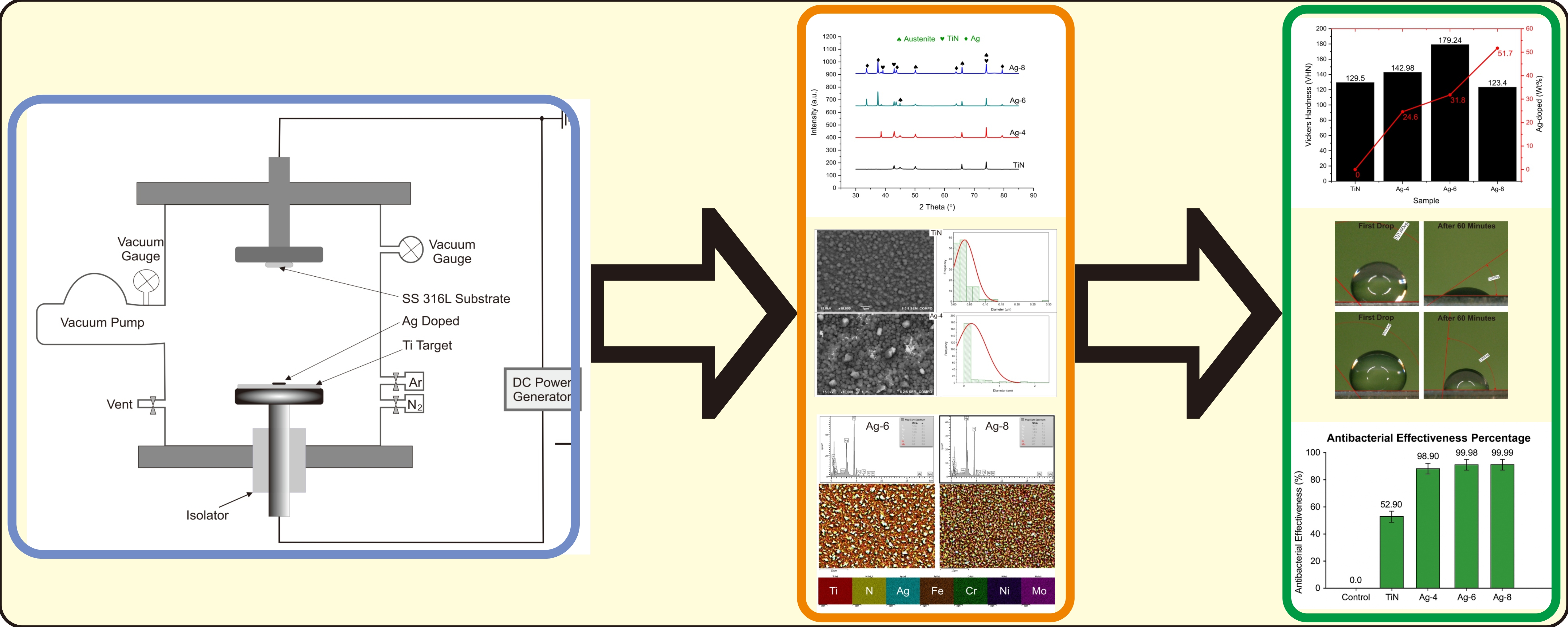
Downloads
References
G Shineh, M Mobaraki, MJP Bappy and DK Mills. Biofilm formation, and related impacts on healthcare, food processing and packaging, industrial manufacturing, marine industries and sanitation - A review. Applied Microbiology 2023; 3(3), 629-665.
Z Li, Q Li, D Ren, X Wu and D Xu. Superhydrophobic surfaces: A promising strategy for addressing food industry challenges. Innovative Food Science & Emerging Technologies 2025; 100, 103899.
RV Wagh, R Priyadarshi, A Khan, Z Riahi, JS Packialakshmi, P Kumar, SN Rindhe and JW Rhim. The role of active packaging in the defense against foodborne pathogens with particular attention to bacteriophages. Microorganisms 2025; 13(2), 401.
CV Garcia, GH Shin and JT Kim. Metal oxide-based nanocomposites in food packaging: Applications, migration, and regulations. Trends in Sciences 2018; 82, 21-31.
C Echeverria, MDT Torres, M Fernández-García, C de la Fuente-Nunez and A Muñoz-Bonilla. Physical methods for controlling bacterial colonization on polymer surfaces. Biotechnology Advances 2020; 43, 107586.
MA Alsuwat, AA Shah, S Ullah, RU Khan, M Alissa and MS Khan. Microbial biofilm formation to mitigate foodborne pathogens: Strategies and control measures. Indian Journal of Microbiology 2025. https://doi.org/10.1007/s12088-025-01461-4
S Zheng, M Bawazir, A Dhall, HE Kim, L He, J Heo and G Hwang. Implication of surface properties, bacterial motility, and hydrodynamic conditions on bacterial surface sensing and their initial adhesion. Frontiers in Bioengineering and Biotechnology 2021; 9(1), 643722.
M Mu, S Liu, W DeFlorio, L Hao, X Wang, KS Salazar, M Taylor, A Castillo, L Cisneros-Zevallos, JK Oh, Y Min and M Akbulut. Influence of surface roughness, nanostructure, and wetting on bacterial adhesion. Langmuir 2023; 39, 5426-5439.
S Mahmoudi-Qashqay, MR Zamani-Meymian and SJ Sadati. Improving antibacterial ability of Ti-Cu thin films with co-sputtering method. Scientific Reports 2023; 13(1), 16593.
R Sarvari, B Naghili, S Agbolaghi, S Abbaspoor, H Bannazadeh Baghi, V Poortahmasebi, M Sadrmohammadi and M Hosseini. Organic/polymeric antibiofilm coatings for surface modification of medical devices. International Journal of Polymeric Materials and Polymeric Biomaterials 2023; 72, 867-908.
R Alvarez, S Muñoz-Piña, MU González, I Izquierdo-Barba, I Fernández-Martínez, V Rico, D Arcos, A García-Valenzuela, A Palmero, M Vallet-Regi, AR González-Elipe and JM García-Martín. Antibacterial nanostructured Ti coatings by magnetron sputtering: From laboratory scales to industrial reactors. Nanomaterials 2019; 9(9), 1217.
L Bai, R Hang, A Gao, X Zhang, X Huang, Y Wang, B Tang, L Zhao and PK Chu. Nanostructured titanium-silver coatings with good antibacterial activity and cytocompatibility fabricated by one-step magnetron sputtering. Applied Surface Science 2015; 355, 32-44.
A Forte-Castro, JM Pérez, MA Domene, K Ovejero-Paredes, M Filice and I Fernández. Design and characterization of a multifunctional Ag/Ag(I)-coated olive stone material for enhanced preservation and antibacterial protection. Trends in Sciences 2025; 49, 101526.
SM Marques, I Carvalho, TR Leite, M Henriques and S Carvalho. Antimicrobial TiN-Ag coatings in leather insole for diabetic foot. Materials 2022; 15(6), 2009.
ACS de Arruda, RD Mansano, N Ordonez, R Ruas and SF Durrant. Ag behavior on TiN thin films for decorative coatings. Coatings 2024; 14(3), 322.
B Petrović, D Mitić, M Miličić Lazić, M Lazarević, A Trajkovska Petkoska, I Nasov, S Živković and V Jokanović. TiN-Ag multilayer protective coatings for surface modification of AISI 316 stainless steel medical implants. Trends in Sciences 2025; 15(7), 820.
BL Ouay and F Stellacci. Antibacterial activity of silver nanoparticles: A surface science insight. Nano Today 2015; 10(3), 339-354.
E Nayman, MF Gozukizil, B Armutci, S Temel and FO Gokmen. Structural and gas sensing properties of NiO thin films deposited by a novel spin coating technique. Journal of Sol-Gel Science and Technology 2025; 114(2), 386-398.
M Yaseen, MAK Khattak, A Khan, S Bibi, M Bououdina, M Usman, NA Khan, AAA Pirzado, RA Abumousa and M Humayun. State-of-the-art electrochromic thin films devices, fabrication techniques and applications: A review. Nanocomposites 2023; 10(1), 1-40.
SK Mondal, S Chakraborty, S Manna and SM Mandal. Antimicrobial nanoparticles: Current landscape and future challenges. RSC Pharmaceutics 2024; 1(3), 388-402.
H Zhang, F Li and Q Jia. Preparation of titanium nitride ultrafine powders by sol-gel and microwave carbothermal reduction nitridation methods. Ceramics International 2009; 35, 1071-1075.
SV Kumar, SP Kumar, D Rupesh and K Nitin. Journal of chemical and pharmaceutical research preparations. International Journal of Current Research in Chemistry and Pharmaceutical Sciences 2011; 2(3), 89-98.
T Elangovan, A Balasankar, S Arokiyaraj, R Rajagopalan, RP George, TH Oh, P Kuppusami and S Ramasundaram. Highly durable antimicrobial tantalum nitride/copper coatings on stainless steel deposited by pulsed magnetron sputtering. Micromachines 2022; 13(5), 824.
M Truchlý, M Haršáni, A Frkáň, T Fiantok, M Sahul, T Roch, P Kúš and M Mikula. First approach to doping silver into CrB2 thin films deposited by DC/HiPIMS technology in terms of mechanical and tribological properties. Coatings 2023; 13(5), 824.
S Hojda, M Biegun-Żurowska, A Skórkowska, K Klesiewicz and M Ziąbka. A weapon against implant-associated infections: Antibacterial and antibiofilm potential of biomaterials with titanium nitride and titanium nitride-silver nanoparticle electrophoretic deposition coatings. International Journal of Molecular Sciences 2025; 26(4), 1646.
UZM Zaidi, AR Bushroa, RR Ghahnavyeh and R Mahmoodian. Crystallite size and microstrain: XRD line broadening analysis of AgSiN thin films. Pigment & Resin Technology 2019; 48, 473-480.
BH Baby and DB Mohan. Structural, optical and electrical studies of DC-RF magnetron co-sputtered Cu, In & Ag doped SnS thin films for photovoltaic applications. Solar Energy 2019; 194, 61-73.
AM Alsaad, AA Ahmad, QM Al-Bataineh, AA Bani-Salameh, HS Abdullah, IA Qattan, ZM Albataineh and AD Telfah. Optical, structural, and crystal defects characterizations of dip synthesized (Fe-Ni) co-doped ZnO thin films. Materials 2020; 13(7), 1737.
O Kamoun, A Akkari, B Alhalaili, R Vidu and N Turki-Kamoun. Investigations on the synthesis and characterization of silver-doped MoO3 thin films for photocatalytic applications. Scientific Reports 2025; 15(1), 998.
JP Molina-Jiménez, SD Horta-Piñeres, SJ Castillo, JL Izquierdo and DA Avila. Ultra-thin films of CdS doped with silver: Synthesis and modification of optical, structural, and morphological properties by the doping concentration effect. Coatings 2025; 15(4), 431.
W Tillmann, D Grisales, AM Echavarría, JA Calderón and GB Gaitan. Effect of Ag doping on the microstructure and electrochemical response of TiAlN coatings deposited by DCMS/HiPIMS magnetron sputtering. Journal of Materials Engineering and Performance 2022; 31(5), 3811-3825.
H Ju, L Yu, D Yu, I Asempah and J Xu. Microstructure, mechanical and tribological properties of TiN-Ag films deposited by reactive magnetron sputtering. Vacuum 2017; 141, 82-88.
I Braceras, M Brizuela, N Álvarez, M Martínez Van Geeteruyen and I Azkona. TiN-Ag as an antimicrobial and wear resistant coating. Biotribology 2021; 28, 100192.
Published
How to Cite
Issue
Section
License
Copyright (c) 2025 Walailak University

This work is licensed under a Creative Commons Attribution-NonCommercial-NoDerivatives 4.0 International License.





