
Synthesis, Characterization, and Biogas Storage Performance of CO2-Doped Petung Bamboo Activated Carbon
DOI:
https://doi.org/10.48048/tis.2026.11834Keywords:
Activated carbon, Biogas, Carbonization temperature, Bamboo, Pore structure, Functional groups, EfficiencyAbstract
The declining availability of fossil fuels requires the exploration of alternative renewable energy sources, such as biogas. The primary challenge associated with biogas utilization is storage. Traditional methods, such as compressed natural gas (CNG) and liquefied petroleum gas (LPG), require high pressures and very low temperatures, respectively, which reduce their overall efficiency. However, adsorbed natural gas (ANG) technology offers a better storage solution at low pressures by using adsorbent materials, including activated carbon. According to the results, there is limited research on using bamboo as a raw material for activated carbon in biogas storage. There is also limited information about how carbonization temperature affects pore structure, functional groups, and storage performance. Therefore, this research focuses on producing activated carbon from petung bamboo, characterizing the properties, and testing the effectiveness for biogas storage. Activated carbon is produced by carbonizing the bamboo at a temperature of 600 to 750 °C and activating it using CO2. The results show that carbonization temperature influences pore structure, functional groups, and biogas storage capacity. Activated carbon carbonized at 750 °C (AC-750) shows the best performance based on proximate analysis, pore distribution, surface area, pore volume, and biogas adsorption capacity. AC-750 contains a strong C=C aromatic functional group and has a pore distribution that includes micro, meso, and macro pores. It has a surface area of 192.8 m2/g, pore volume of 0.39 cc/g, and can store biogas up to 1.0 g/g at a pressure of 100 psi. Biogas release efficiency reached 92.9%, highlighting the potential of activated carbon made from petung bamboo for ANG applications. This result is significant as it highlights the potential of using abundant biomass resources as eco-friendly energy storage materials, thereby supporting sustainable energy security and facilitating the transition toward renewable energy.
HIGHLIGHTS
- Increasing the temperature from 600 to 750 °C changes the structure and functional group of activated carbon.
- The surface area and pore volume both increase as the carbonization temperature rises.
- Activated carbon carbonized at 750 °C (AC-750) has expanded pore distribution, high surface area, and the largest cumulative pore volume.
- AC-750 is the best choice for biogas storage with the highest biogas storage capacity (1.011 g/g) and release (0.940 g/g) based on the gravimetric method.
GRAPHICAL ABSTRACT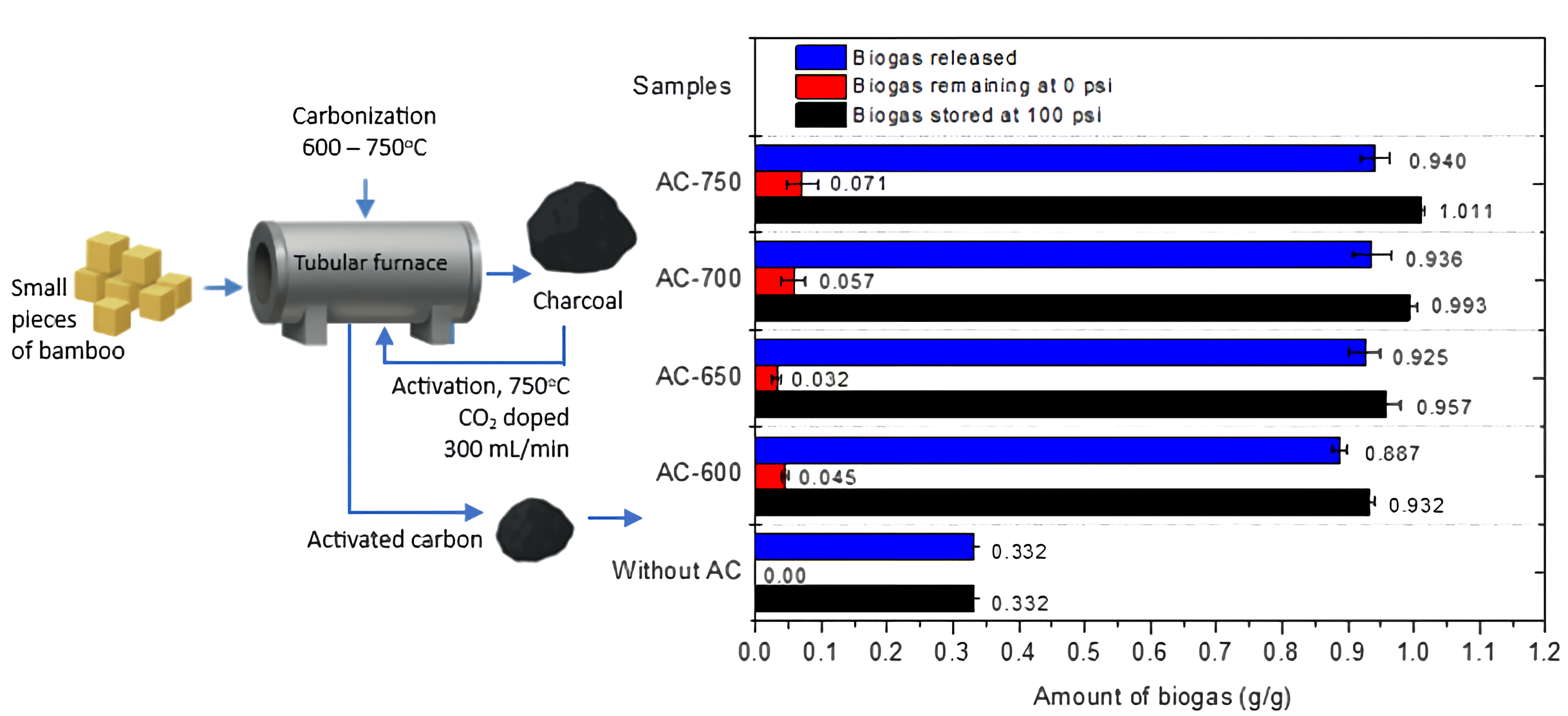
Downloads
References
L Cozzi and T Gould. World energy outlook 2023, International Energy Agency. Available at: https://www.iea.org/reports/world-energy-outlook-2023, accessed May 2025.
H Lee, K Calvin, D Dasgupta, G Krinner, A Mukherji, P Thorne, C Trisos, J Romero, P Aldunce, K Barrett, G Blanco, WWL Cheung, SL Connors, F Denton, A Diongue-Niang, D Dodman, M Garschagen, O Geden, B Hayward, C Jones, F Jotzo, T Krug, R Lasco, JY Lee, V Masson-Delmotte , M Meinshausen, K Mintenbeck, A Mokssit, FEL Otto, M Pathak, A Pirani, E Poloczanska, HO Pörtner, A Revi, DC Roberts , J Roy , AC. Ruane , J Skea, PR Shukla , R Slade , A Slangen , Y Sokona , AA Sörensson , M Tignor, DV Vuuren, YM Wei, H Winkler, P Zhai, and Z Zommers. Climate Change 2023. AR6 Synthesis Report, DOI:10.59327/IPCC/AR6-9789291691647.001. Accessed May 2025.
S Wolf, R Bullard, JJ Buonocore, N Donley, T Farrelly, J Fleming, DJX González, N Oreskes, W Ripple, R Saha and MD Willis. Scientists’ warning on fossil fuels. Oxford Open Climate Change 2025; 5(1), 1-26.
W Saadi, B Ruiz, S Najar-souissi, A Ouederni and E Fuente. High-pressure gas adsorption on activated carbons from pomegranate peels biochar: A promising approach for biogas purification. Biomass and Bioenergy 2024; 186, 107258.
E Surra, RPPL Ribeiro, T Santos, M Bernardo, JPB Mota, N Lapa and IAAC Esteves. Evaluation of activated carbons produced from maize cob waste for adsorption-based CO2 separation and biogas upgrading. Journal of Environmental Chemical Engineering 2022; 10(1), 107065.
A Alengebawy, Y Ran, AI Osman, K Jin, M Samer and P Ai. Anaerobic digestion of agricultural waste for biogas production and sustainable bioenergy recovery: A review. Environmental Chemistry Letters 2024; 22(6), 2641-2668.
AH Ulukardesler. Anaerobic co‑digestion of grass and cow manure: kinetic and GHG calculations. Scientific Reports 2023; 13(1), 6320.
R Bruno, V Ferraro, A Cristaudo and P Bevilacqua. A novel system based on a series of ORCs to recover cryogenic energy from the LNG regasification process for power and freshwater production. Journal of Cleaner Production 2024; 469, 14317.
Y Ali, A Younus, A Ullah and AH Alrefai. Compressed Natural Gas (CNG) as a fuel and the associated risks: A quantitative analysis in the scenario of a developing country. Journal of Safety Science and Resilience 2024; 5(3), 306-316.
AV Shkolin, EM Strizhenov, SS Chugaev, IE Men’shchikov, VV Gaidamavichute, AE Grinchenko and AA Zherdev. Natural gas storage filled with peat-derived carbon adsorbent : Influence of nonisothermal effects and ethane impurities on the storage cycle. Nanomaterials 2022; 12(22), 4066.
IE Men, AV Shkolin, EM Strizhenov and AA Zherdev. Thermodynamic behaviors of adsorbed methane storage systems based on nanoporous carbon adsorbents prepared from coconut shells. Nanomaterials 2020; 10(11), 2243.
EM Strizhenov, SS Chugaev, IE Men and AV Shkolin. Heat and mass transfer in an adsorbed natural gas storage system filled with monolithic carbon adsorbent during circulating gas charging. Nanomaterials 2021; 11(12), 3274.
J Serafin, Ba Dziejarski, P Rodríguez-Estupiñán, VB Fernández, L Giraldo, J Sreńscek-Nazzal, B Michalkiewicz and JC Moreno-Piraján. Effective synthesis route of renewable activated biocarbons adsorbent for high CO2, CH4, H2, N2, C2H4 gas storage and CO2/N2, CO2/CH4, CO2/H2, C2H4/CH4 selectivity. Fuel 2024; 374, 132462.
S Mirzaei, L Lotfikatooli, A Ahmadpour, M Niknam, M Reza and A Arami-niya. Enhancing energy carrier gas storage: Novel MOF-decorated carbons with high affinity toward methane and hydrogen. Chemical Engineering Research and Design 2024; 203, 419-430.
JH Lee, J Lee, D Kim, S Lee and S Park. Unveiling pore size contributions and host-guest interactions in methane adsorption under varying pressure conditions: A semi-empirical adsorption model. NPG Asia Materials 2025; 17(1), 30.
MO Azeez and SA Ganiyu. Review of biomass derived-activated carbon for production of clean fuels by adsorptive desulfurization: Insights into processes, modifications, properties, and performances. Arabian Journal of Chemistry 2023; 16(10), 105182.
DNKP Negara, TGT Nindhia, IM Widiyarta, IGK Dwijana, DGA Dinata, G Prasetiyo, IDMPH Wardana and IW RA Wibawa. Characteristics evaluation of 3 Balinese as precursor of activated carbon. In: Proceedings of the 7th International Conference on Materials Engineering and Nanotechnology 2023 (ICMEN 2023), Kuala Lumpur, Malaysia. 2023, p. 44-53.
G Hyeon, GB Lee, DJ Kang, SE Lee, KM Seong and J Park. Optimization of activated carbon synthesis from spent coffee grounds for enhanced adsorption performance. Molecules 2025; 30(12), 2557.
M Kwiatkowski. An analysis of textural properties of activated carbons obtained from biomass via the LBET, NLDFT and QSDFT methods. Scientific Reports 2024; 14(1), 26472.
Q Wang, B Luo, Z Wang, Y Hu and M Du. Pore engineering in biogas-derived activated carbon materials for enhance energy, catalysis, and environmental applications. Molecules 2024; 29(21), 5172.
H Feng, T Zhou, L Ge, Q Li, C Zhao, J Huang and Y Wang. Study on the preparation of high value-added activated carbon from petroleum coke: Comparison between 1-and 2-step methods for carbonization and activation. Energy 2024; 292, 130570.
C Quan, H Wang, X Jia and N Gao. Effect of carbonization temperature on CO2 adsorption behavior of activated coal char. Journal of the Energy Institute 2021; 97, 92-99.
G Liu, C Zhang, D Dou and Y Wei. Modeling and optimization of activated carbon carbonization process based on support vector machine. Physicochemical Problems of Mineral Processing 2021; 57(2), 131-143.
I Karume, S Bbumba, S Tewolde, IZT Mukasa and M Ntale. Impact of carbonization conditions and adsorbate nature on the performance of activated carbon in water treatment. BMC Chemistry 2023; 17(1), 1162.
MS Hafizuddin, CL Lee, KL Chin, PS H’ng, PS Khoo and U Rashid. Fabrication of highly microporous structure activated carbon via surface modification with sodium hydroxide. Polymer 2021; 13(22), 3954.
W Chi, G Wang, Z Qiu, Q Li, Z Xu, Z Li, B Qi, K Cao, C Chi, T Wei and Z Fan. Secondary high-temperature treatment of porous carbons for high-performance supercapacitors. Batteries 2024; 10(5), 1-12.
A Pimsawat, A Tangtrakarn, N Pimsawat, A Khamkongkaeo and S Daengsakul. Microwave assisted activation of silkworm excrement for fast adsorption of methylene blue and high performance supercapacitor. Scientific Reports 2024; 14(1), 26868.
TM Budnyak, IV Pylypchuk, ME Lindström and O Sevastyanova. Kraft lignin-derived microporous nitrogen-doped carbon adsorbent for air and water purification. ACS Applied Materials & Interfaces 2024; 16(3), 3427-3441.
M Lotfinezhad, M Tahmasebpoor and C Pevida. Exploring the structural characteristics and adsorption capabilities of cost-effective N-doped activated carbon derived from waste biomass for CO2 adsorption. Environmental Research 2024; 263, 120017.
Y Ye, W Chen, C Tsai and W Tsai. The combination of nitrogen (N2) pyrolysis and carbon dioxide (CO2) Activation for regenerating spent activated carbon. Applied Sciences 2025; 15(10), 5336.
DNKP Negara, TGT Nindhia, IM Widiyarta, IMG Karohika, IMG Suarda and IGK Dwijana. Characteristics and performance analysis of activated carbons derived from different precursors and activators for waste water adsorption. EUREKA: Physics and Engineering 2023; 6, 160-172.
D Peredo-Mancilla, I Ghouma, C Hort, CM Ghimbeu, M Jeguirim and D Bessieres. CO2 and CH4 adsorption behavior of biomass-based activated carbons. Energies 2018; 11(11), 3136.
DNKP Negara, TGT Nindhia, CIPK Kencanawati, IGAK Suriadi, IM Widiyarta, IP Lokantara and IN Budiarsa. The effect of carbonisation heating rates on the properties of N-doped teak sawdust waste activated carbon. Journal of Physical Science 2023; 34(3), 1-20.
W Zhao, L Luo, H Wang and M Fan. Synthesis of bamboo-based activated carbons with super-high specific surface area for hydrogen storage. BioResources 2017; 12(1), 1246-1262.
N Jarawi and I Jusoh. Charcoal properties of Malaysian bamboo charcoal carbonized at 750 °C. Bioresources 2023; 18(3), 4413-4429.
IG Agung, DNKP Negara, TGT Nindhia, IKA Atmika, IMDB Penindra and IMG Karohika. The impact of activation heating rate on pore structure in teak sawdust-derived activated carbon and its application in methylene blue adsorption. Trends in Sciences 2024; 21(9), 8110.
PAS Cavazos, E Hunter-sellars, P Iacomi, SR Mcintyre, D Danaci and DR Williams. Evaluating solid sorbents for CO2 capture: Linking material properties and process efficiency via adsorption performance. Frontiers in Energy Research 2023; 11, 1167043.
D Obracaj, M Korzec and M Korzec. Comparison of gravimetric determination of methane sorption capacities of coals for using their results in assessing. Energies 2024; 17(17), 4372.
R Kumar, B Singh and B Acharya. A comprehensive review on activated carbon from pyrolysis of lignocellulosic biomass: An application for energy and the environment. Carbon Resources Conversion 2024; 7(4), 100228.
J Pramana, G Sutapa, G Lukmandaru and S Sunarta. Conversion of shoot waste of fast-growing teak into activated carbon and its adsorption properties. Journal of the Korean Wood Science and Technology 2024; 52(5), 488-503.
C Quan, Y Zhou, J Wang, C Wu and N Gao. Biomass-based carbon materials for CO2 capture: A review. Journal of CO2 Utilization 2023; 68, 102373.
M Burachevskaya, T Minkina, T Bauer, I Lobzenko, A Fedorenko, M Mazarji, S Sushkova, S Mandzhieva, A Nazarenko, V Butova, MH Wong and VD Rajput. Fabrication of biochar derived from different types of feedstocks as an efficient adsorbent for soil heavy metal removal. Scientific Reports 2023; 13, 2020.
NK Achmelwar, SB Sollapur, YA Kharche and SGG Devakant. Processing and characterization of germanium-based borate bioglass for biological applications. Engineering Reports 2025, 7(7), e70253.
J Serafin, B Dziejarski, ÓJ Fonseca-Bermúdez, L Giraldo, R Sierra-Ramírez, MG Bonillo, G Farid and JC Moreno-Piraján. Bioorganic activated carbon from cashew nut shells for H2 adsorption and industrial applications. International Journal of Hydrogen Energy 2024; 86, 662-676.
N Chaiammart, V Vignesh, MM Thu, A Eiad-ua, T Maiyalagan and G Panomsuwan. Chemically activated carbons derived from cashew nut shells as potential electrode materials for electrochemical supercapacitors. Carbon Resources Conversion 2025; 8(2), 100267.
SY Yang, BC Bai and YR Kim. Effective surface structure changes and characteristics of activated carbon with the simple introduction of oxygen functional groups by using radiation energy. Surfaces 2024; 7(1), 12-25.
X Song, J Gong, X Zhan and Y Zeng. Exploring a new method to study the effects of surface functional groups on adsorption of CO2 and CH4 on activated carbons. Langmuir 2020; 36(14), 3862-3870.
D Shrestha. Structural and electrochemical evaluation of renewable carbons and their composites on different carbonization temperatures for supercapacitor applications. Heliyon 2024; 10, e25628.
N Czerwinska, C Giosu, I Matos, S Sabbatini, L Ruello and M Bernardo. Development of activated carbons derived from wastes: coffee grounds and olive stones as potential porous materials for air depollution. Science of the Total Environment 2024; 914, 169898.
M. Thommes. Physical adsorption characterization of nanoporous materials. Chemie Ingenieur Technik 2010; 82(7), 1059-1073.
S Ha, SG Jeong, S Myeong, C Lim and Y Lee. High-performance CO2 adsorption of jellyfish-based activated carbon with many micropores and various heteroatoms. Journal of CO2 Utilization 2023; 76, 102589.
B Sun, Q Yang, J Zhu, T Shao, Y Yang, C Hou and G Li. Pore size distributions and pore multifractal characteristics of medium and low‑rank coals. Scientific Reports 2020; 10(1), 22353.
D Peredo-Mancilla, A Bermudez, C Hort and D Bessieres. Surface-modified activated carbon with a superior CH4 /CO2 adsorption selectivity for the biogas upgrading process. Industrial & Engineering Chemistry Research 2022; 61, 12710-12727.
D Peredo-Mancilla, A Bermudez, C Hort and D Bessieres. Exploring activated carbons for sustainable biogas upgrading: A Comprehensive Review. Energies 2025; 18, 4010.
C Quan, H Wang, X Jia and N Gao. Effect of carbonization temperature on CO2 adsorption behavior of activated coal char. Journal of the Energy Institute 2021; 97, 92-99.
M Vashishtha, S Gadipelli and KV Kuma. Deliverable capacity of methane: Required material property levels for the ideal ‘Holy Grail’ adsorbent. Chem & Bio Engineering 2025; 2(1), 64-67.
Published
How to Cite
Issue
Section
License
Copyright (c) 2025 Walailak University

This work is licensed under a Creative Commons Attribution-NonCommercial-NoDerivatives 4.0 International License.





