
The Impact of Activation Heating Rate on Pore Structure in Teak Sawdust-Derived Activated Carbon and Its Application in Methylene Blue Adsorption
DOI:
https://doi.org/10.48048/tis.2024.8110Keywords:
Activation heating rate, Activated carbon, Adsorption, Teak sawdust waste, Methylene blueAbstract
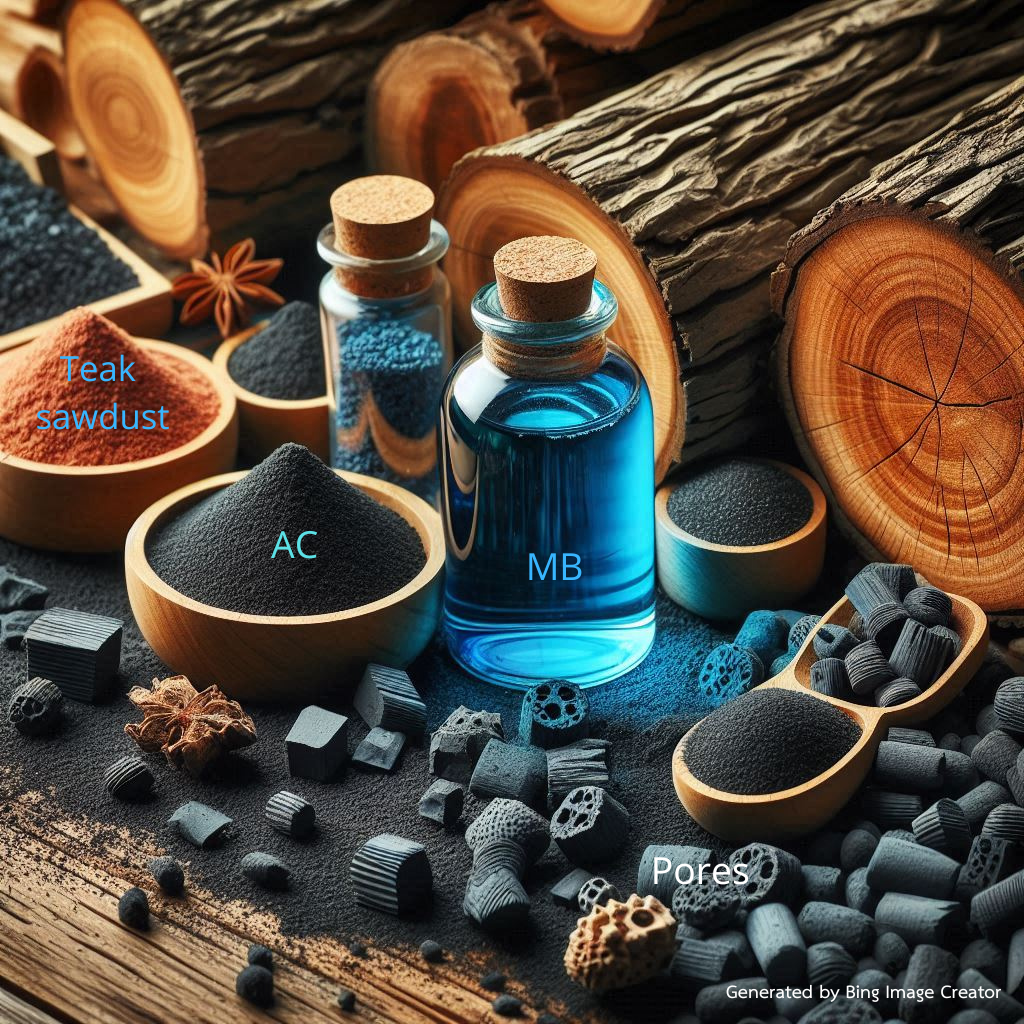
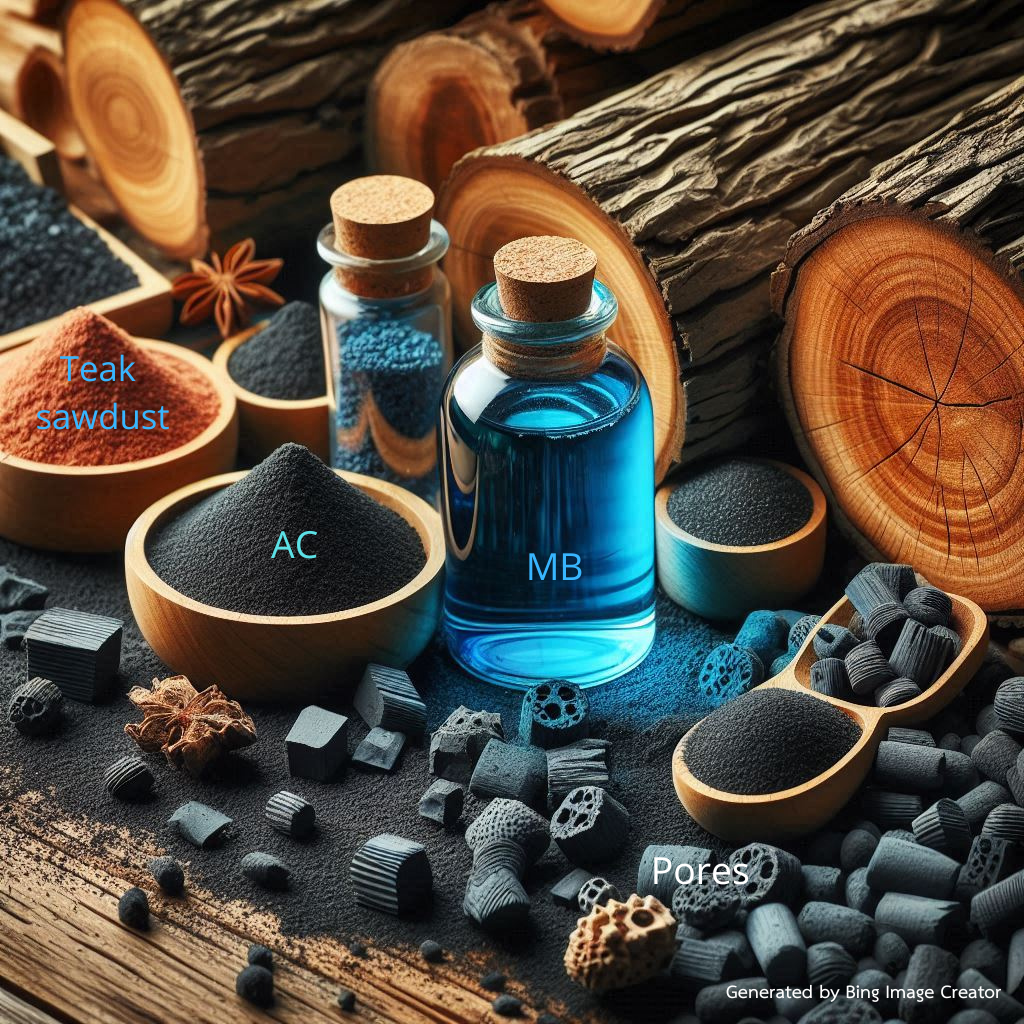
Activated carbon (AC) is a multifunctional adsorbent with a high adsorption capacity because of its pore structure comprising a large pore volume and surface area. However, its pore structure properties are largely influenced by the chemical composition and manufacturing conditions of the raw material. This study examined the effect of activation heating rate parameter on pore structure and methylene blue adsorption in teak sawdust AC. The adsorbent was dehydrated, carbonized and activated at 105, 750 and 700 °C for 2 h, 50 min, and 6 to 14 °C/min, with a nitrogen flow rate of 200 mL/min for 50 min. Several characterizations were carried out to identify pore structure, proximate substance, functional groups, surface morphology, and methylene blue-adsorption capacity of AC. The results showed that activation heating rate with the best properties and capacity of MB adsorption were adsorbed at a peak of 10 °C/min. AC obtained has a C-C aromatic rings functional group, an amorphous crystal structure, an interplanar length of 3.03 Å, 75.74 % fixed carbon, pore surface area of 126.279 m2/g, pore volume of 0.235 cc/g, and a multimodal micropore-mesopore size distribution. This is in addition to adsorption capability of 13.48 mg/g for methylene blue.
HIGHLIGHTS
- The teak sawdust waste was successfully converted into activated carbon with different activation heating rate.
- A parabolic pattern of methylene blue adsorption was produced by applying different activation heating rates of 6, 8, 10, 12, and 14 °C /min, with adsorption peak of 13.46 mg/g occurring at 10 °C/min.
- Activated carbon with activation heating rate of 10 °C/min produces the best characteristics (75.74 % fix carbon, surface area of 126.279 m2/g, pore volume of 0.235 cc/g), and maximum methylene blue adsorption capacity (13.46 mg/g).
- The interplanar lengths of activated carbon range between 3.03 Å and 3.04 Å.
GRAPHICAL ABSTRACT
Downloads
References
R Mustafa and E Asmatulu. Preparation of activated carbon using fruit, paper and clothing wastes for wastewater treatment. J. Water Process Eng. 2020; 35, 101239.
PR Sera, PN Diagboya, SO Akpotu, FM Mtunzi, and TB Chokwe. Potential of valourized moringa oleifera seed waste modified with activated carbon for toxic metals decontamination in conventional water treatment. Bioresour. Tech. Rep. 2021; 16, 100881.
DNKP Negara, TGT Nindhia, M Sucipta, IW Surata, KS Astrawan and IPH Wangsa. Simultaneous adsorption of motorcycle emissions through bamboo-activated carbon. Int. J. Glob. Energ. Issues 2021; 43, 199-210.
Y Mochizuki, J Bud, E Byambajav and N Tsubouchi. Influence of ammonia treatment on the CO2 adsorption of activated carbon. J. Environ. Chem. Eng. 2022; 10, 107273.
DNKP Negara, IM Widiyarta, IGAK Suriadi, IGK Dwijana, IMDB Penindra, IGNP Tenaya, IGK Sukadana and AS Ferdinand. Development of mesoporous activated carbons derived from brewed coffee waste for CO2 adsorption. Eureka Phys. Eng. 2023; 2, 107273.
X Ma, Y Wu, M Fang, B Liu, R Chen, R Shi, Q Wu, Z Zeng and L Li. In-situ activated ultramicroporous carbon materials derived from waste biomass for CO2 capture and benzene adsorption. Biomass Bioenerg. 2022; 158, 106353.
L Spessato, VA Duarte, JM Fonseca, PA Arroyo and VC Almeida. Nitrogen-doped activated carbons with high performances for CO2 adsorption. J. CO2 Utilization 2022; 61, 102013.
DNKP Negara, TGT Nindhia, IM Widiyarta, IMG Karohika, M Suarda and IGK Dwijana. Characteristics and performance analysis of activated carbons derived from different precursors and activators for waste water adsorption. Eureka Phys. Eng. 2023; 6, 160-72.
AA Nuhu, ICP Omali and CO Clifford. Equilibrium adsorption studies of methylene blue onto caesalpinia pulcherrima husk-based activated carbon. Chem. Sci. Int. J. 2019; 2, CSIJ.39673.
DNKP Negara, IM Widiyarta, IMG Karohika, IGAK Suriadi, IGK Dwijana, IP Lokantara, IM Parwata and IK Suarsana. Preparation and characterization of pelleted and powdered activated carbons derived from used brewed coffee. Trends Sci. 2023; 20, 7136.
P Arjunan, M Kouthaman, K Kannan, K Diwakar, V Priyanka, R Subadevi and M Sivakumar. Study on Efficient Electrode from Electronic waste renewed carbon material for sodium battery applications. J. Environ. Chem. Eng. 2021; 9, 105024.
H Long, H Lin, M Yan, Y Bai, X Tong, X Kong and S Li. Adsorption and diffusion characteristics of CH4, CO2, and N2 in micropores and mesopores of bituminous coal: Molecular dynamics. Fuel 2021; 292, 120268.
E Elaiyappillai, R Srinivasan, Y Johnbosco, P Devakumar, K Murugesan, K Kesavan and PM Johnson. Lowcost activated carbon derived from Cucumis melo fruit peel for electrochemical supercapacitor application. Appl. Surf. Sci. 2019; 486, 527-38.
E Taer, A Apriwandi, R Taslim, A Agutino and DA Yusra. Conversion Syzygium oleana leaves biomass waste to porous activated carbon nanosheet for boosting supercapacitor performances. J. Mater. Res. Tech. 2020; 9, 13332-40.
MJ Mostazo-López, R Ruiz-Rosas, T Tagaya, Y Hatakeyama, S Shiraishi, E Morallón and D Cazorla-Amorós. Nitrogen doped superactivated carbons prepared at mild conditions as electrodes for supercapacitors in organic electrolyte. J. Carbon Res. 2020; 6, 56.
JH Hassen, AA Baqer, NK Kareem and AY Zaeen. Biochemical study on the removal of water impurities using modified activated carbon. Res. J. Pharm. Tech. 2020; 13, 1790-4.
JH Hassen, MS Ferhan and AH Ayfan. Fexofenadine adsorption by activated charcoal impregnated with hydrogen peroxide. Iraqi J. Sci. 2020; 61, 1245-52.
JH Hassen, YM Farhan and AH Ayfan. Comparative study of levocetirizine elimination by pristine and potassium permanganate modified activated charcoal. Int. J. Pharm. Sci. Res. 2018; 9, 5155-60.
JH Hassen, AH Ayfan and YM Farhan. Spectroscopic evaluation of activated charcoal as a poison antidote for gliclazide drug. Asian J. Pharm. Clin. Res. 2018; 11, 140-3.
GJ Mcdougall. The physical nature and manufacture of activated carbon. J. S. Afr. Inst. Min. Metall. 1991; 91, 109-20.
IM Astika, DNKP Negara, CIPK Kencanawati, TGT Nindhia and F Hidajat. Proximate and morphology properties of swat bamboo activated carbon carburized under different carbonization temperature. IOP Conf. Ser. Mater. Sci. Eng. 2019; 539, 012010.
DNKP Negara, TGT Nindhia, Lusiana, IM Astika and CIPK Kencanawati. Development and characterization of activated carbons derived from lignocellulosic material. Mater. Sci. Forum 2020; 988, 80-6.
EH Sujiono, D Zabrian, Zurnansyah, Mulyati, V Zharvan, Samnur and NA Humairah. Fabrication and characterization of coconut shell activated carbon using variation chemical activation for wastewater treatment application. Results Chem. 2022; 4, 100291.
M Deng, J Wang and Q Zhang. Effect of freezing pretreatment on the performance of activated carbon from coconut shell for supercapacitor application. Mater. Lett. 2022; 306, 130934.
S Wang, Y Lee, Y Won, H Kim, S Jeong, BW Hwang, AR Cho, J Kim, YC Park, H Nam, D Lee, H Kim and S Jo. Development of high-performance adsorbent using KOH-impregnated rice husk-based activated carbon for indoor CO2 adsorption. Chem. Eng. J. 2022; 437, 135378.
A Mukherjee, JA Okolie, C Niu, and AK Dalai. Techno - Economic analysis of activated carbon production from spent coffee grounds: Comparative evaluation of different production routes. Energ. Convers. Manag. X 2022; 14, 100218.
R Hossain, RK Nekouei, I Mansuri and V Sahajwalla. In-situ O/N-heteroatom enriched activated carbon by sustainable thermal transformation of waste coffee grounds for supercapacitor material. J. Energ. Storage 2022; 33, 102113.
E Taer, A Apriwandi, DR Andani and R Taslim. Solid coin-like design activated carbon nanospheres derived from shallot peel precursor for boosting supercapacitor performance. J. Mater. Res. Tech. 2021; 15, 1732-41.
DNKP Negara, TGT Nindhia, CIPK Kencanawati, IGAK Suriadi, IM Widiyarta, IP Lokantara and IN Budiarsa. The effect of carbonisation heating rates on the properties of N-doped teak sawdust waste activated carbon. J. Phys. Sci. 2023; 34, 1-20.
LCDD Medeiros, AS Pimenta, RM Braga, TKDA Carnaval, PNM Neto and DMDA Melo. Effect of pyrolysis heating rate on the chemical composition of wood vinegar from Eucalyptus urograndis and Mimosa tenuiflora. Revista Árvore 2019; 43, e430408.
S Lee, J Kim, W Kim and J Roh. The efffect of the heating rate during carbonization on the porosity, strength, and electrical resistivity of graphite blocks using phenolic resin as a binder. Materials 2022; 15, 3259.
Z Liao, Y Zhu, G Sun, L Qiu and M Zhu. Micromorphology control of the lignin-based activated carbon and the study on the pyrolysis and adsorption kinetics. Ind. Crops Prod. 2021; 175, 114266.
AA Shagali, S Hu, Y Wang, H Li, Y Wang, S Su and J Xiang. Comparative study on one-step pyrolysis activation of walnut shells to biochar at different heating rates. Energ. Rep. 2021; 7, 388-96.
GK Gupta, PK Gupta and MK Mondal. Experimental process parameters optimization and in-depth product characterizations for teak sawdust pyrolysis. Waste Manag. 2019; 87, 499-511.
NFSM Azani, CTH Chuin, NS Abdullah, SS Sharifuddin and MH Hussin. Characterisation and kinetic studies on activated carbon derived from rubber seed shell for the removal of methylene blue in aqueous solutions. J. Phys. Sci. 2019; 30, 1-20
U Im, J Kim, SH Lee, S Lee, B Lee, D Peck and D Jung. Preparation of activated carbon from needle coke via two-stage steam activation process. Mater. Lett. 2019; 237, 22-5.
B Kaur, RK Gupta, and H Bhunia. Chemically activated nanoporous carbon adsorbents from waste plastic for CO2 capture: Breakthrough adsorption study. Micropor. Mesopor. Mater. 2019; 282, 146-58.
M Li and R Xiao. Preparation of a dual pore structure activated carbon from rice husk char as an adsorbent for CO2 capture. Fuel Process. Tech. 2019; 186, 35-9.
J Shao, C Ma, J Zhao, L Wang and X Hu. Effective nitrogen and sulfur co-doped porous carbonaceous CO2 adsorbents derived from amino acid. Colloids Surf. A Physicochem. Eng. Asp. 2021; 632, 127750.
Downloads
Published
How to Cite
Issue
Section
License
Copyright (c) 2024 Walailak University

This work is licensed under a Creative Commons Attribution-NonCommercial-NoDerivatives 4.0 International License.





