
Harnessing Metal-Loaded Zeolites for Superior Antibacterial Activity
DOI:
https://doi.org/10.48048/tis.2026.11684Keywords:
Zeolite, Antibacterial activity, Metal ion loading, Escherichia coli, Staphylococcus aureusAbstract
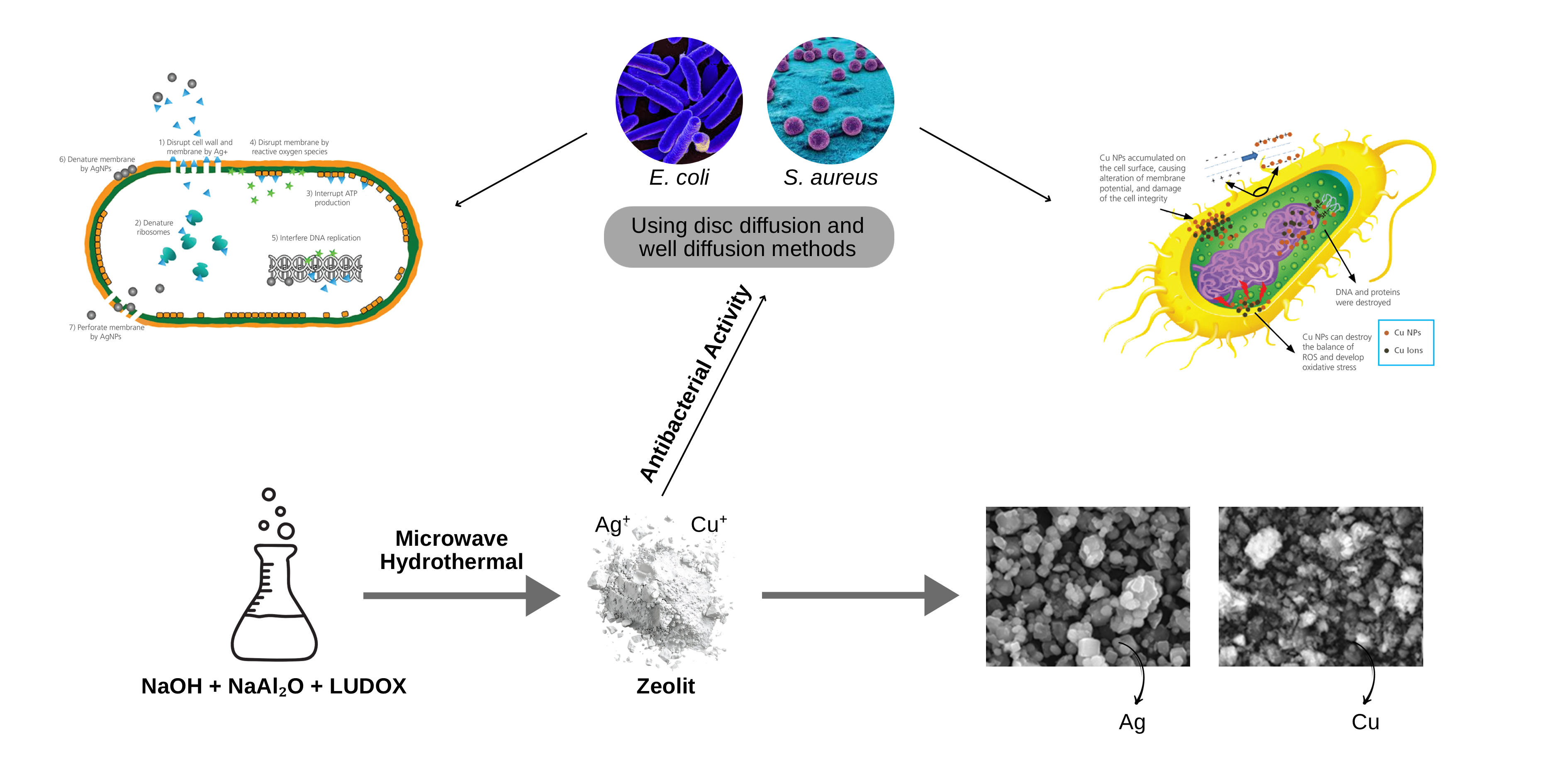
Metal-loaded zeolites has gained significant interest for their antibacterial properties and potential applications in biomedical and environmental fields. In this study, silver- and copper-loaded zeolites were successfully synthesized using ion exchange and impregnation methods. Characterization techniques confirmed the successful incorporation of Ag⁺ and Cu²⁺ ions into the zeolite framework. X-ray diffraction (XRD) analysis demonstrated reduction in peak intensities at 2θ ≈ 26°, 34° and 42° for Ag-zeolite and 2θ = 19.59°, 32.22° and 37.97° for Cu-zeolite, indicating successful metal loading. Scanning Electron Microscopy-Energy Dispersive X-ray Spectroscopy (SEM-EDX) verified the presence of 3.98% Ag and 3.79% Cu in the modified zeolites. The antibacterial performance of Ag- and Cu-loaded zeolites was evaluated against Escherichia coli and Staphylococcus aureus using disk diffusion and well diffusion methods. Ag-zeolite (0.05 M, 9 h) exhibited inhibition zones of 12.23 mm and 11.35 mm for E. coli and S. aureus, respectively. Cu-zeolite showed even stronger antibacterial activity, with inhibition zones of 15.3 mm and 18.1 mm. These findings highlight the potential of Ag- and Cu-loaded zeolites as effective antimicrobial agents. This research demonstrates a simple and efficient approach for synthesizing antibacterial zeolites, offering promising applications in water treatment, wound healing and antibacterial coatings. This research can serve as a reference for further studies, including the evaluation of long-term stability and the exploration of practical applications for large-scale implementation.
HIGHLIGHTS
- Low Si/Al ratio of zeolite were synthesized through microwave-assisted.
- Zeolite with Ag+ and Cu2+ loading were synthesized through impregnation and ion exchange.
- Cu2+-zeolite exhibited highest performance against coli and S. Aureus.
- Increased metal loadings concentration caused decline in antibacterial performance.
- Increase metal loadings time showed diminishing returns in antibacterial performance.
GRAPHICAL ABSTRACT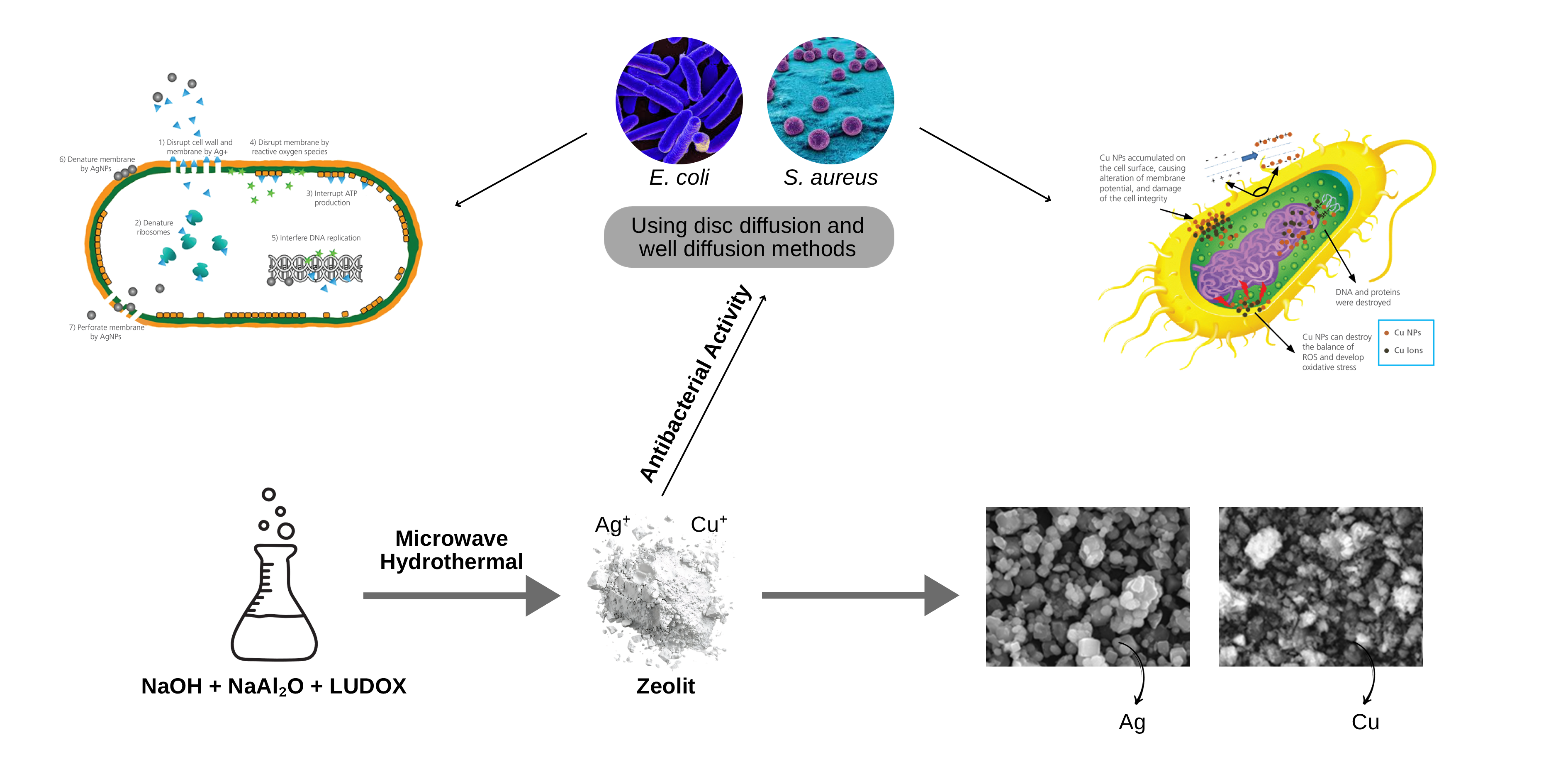
Downloads
References
L Serwecińska. Antimicrobials and antibiotic-resistant bacteria: A risk to the environment and to public health. Water 2020; 12(12), 3313.
Y Verma, G Sharma, A Kumar, T Wang, P Dhiman and GT Mola. Zeolites and their composites as novel remediation agent for antibiotics: A review. Environmental Engineering Research: EER 2025; 30(1), 240062.
J Matusiak, A Przekora and W Franus. Zeolites and zeolite imidazolate frameworks on a quest to obtain the ideal biomaterial for biomedical applications: A review. Materials Today 2023; 67, 495-517.
S Dabagh, SA Haris, BK Isfahani, N Ashammakhi and YN Ertas. Zeolite-copper ferrite nanocomposites with improved antibacterial activity and reusability for biomedical applications. ACS Applied Nano Materials 2023; 6(22), 21412-21423.
X Fan, LH Yahia and E Sacher. Antimicrobial properties of the Ag, Cu nanoparticle system. Biology 2021; 10(2), 137.
M Awais, A Aizaz, A Nazneen, QA Bhatti, M Akhtar, A Wadood and MAU Rehman. A review on the recent advancements on therapeutic effects of ions in the physiological environments. Prosthesis 2022; 4(2), 263-316.
X Ma, S Zhou, X Xu and Q Du. Copper-containing nanoparticles: Mechanism of antimicrobial effect and application in dentistry-a narrative review. Frontiers in Surgery 2022; 9, 905892.
G Yao, J Lei, W Zhang, C Yu, Z Sun, S Zheng and S Komarneni. Antimicrobial activity of X zeolite exchanged with Cu(2+) and Zn(2+) on escherichia coli and staphylococcus aureus. Environmental Science and Pollution Research International 2019; 26(3), 2782-2793.
J Milenkovic, J Hrenovic, D Matijasevic, M Niksic and N Rajic. Bactericidal activity of Cu-, Zn- and Ag-containing zeolites toward escherichia coli isolates. Environmental Science and Pollution Research International 2017; 24(25), 20273-20281.
S Ishak, NANN Malek, Z Yusop, CD Williams, S Suhartono and A Syafiuddin. Evaluation of phase transformation behaviors of zeolite and antibacterial properties against Gram‐positive and ‐negative bacteria. Journal of the Chinese Chemical Society 2020; 67(11), 2042-2049.
N Mintcheva, M Panayotova, G Gicheva, O Gemishev and G Tyuliev. Effect of exchangeable ions in natural and modified zeolites on Ag content, Ag nanoparticle formation and their antibacterial activity. Materials 2021; 14(15), 4153.
J Hrenović and N Rajić. Application of modified natural zeolite—clinoptilolite for bacterial control in the environment. Materials 2025; 18(10), 2411.
X Yang, Q Yu, W Gao, X Tang, H Yi and X Tang. The mechanism of metal-based antibacterial materials and the progress of food packaging applications: A review. Ceramics International 2022; 48(23A), 34148-34168.
P Peixoto, JF Guedes, E Rombi, AM Fonseca, CA Aguiar and IC Neves. Metal Ion–Zeolite materials against resistant bacteria, MRSA. Industrial & Engineering Chemistry Research 2021; 60(35), 12883-12892.
C Septommy, SA Nikmatus and B Muarofah. The effect of natural Zeolite (Ag-Zeolite) modified with silver against the inhibition of Candida albicans. Journal of Syiah Kuala Dentistry Society 2020; 5(2), 56-60.
A Ali, YW Chiang and RM Santos. X-ray diffraction techniques for mineral characterization: A review for engineers of the fundamentals, applications, and research directions. Minerals 2022; 12(2), 205.
SH Vreeswijk and BM Weckhuysen. Emerging analytical methods to characterize zeolite-based materials. National Science Review 2022; 9(9), nwac047.
C Koop-Santa, RI Yocupicio-Gaxiola, FN Murrieta-Rico, M Avalos-Borja, M Xiao, V Petranovskii and A Reyes-Serrato. Additive-free synthesis of layer-like Faujasite-type zeolite X. Journal of Materials Science 2024; 59, 10169-10181.
D Liang, Y Liu, R Zhang, Q Xie and L Zhang. A review on the influence factors in the synthesis of zeolites and the transformation behavior of silicon and aluminum during the process. Comments on Inorganic Chemistry 2024; 44(6), 461-497.
CT Chen, K Iyoki, P Hu, H Yamada, K Ohara, S Sukenaga, M Ando, H Shibata, T Okubo and T Wakihara. Reaction kinetics regulated formation of short-range order in an amorphous matrix during zeolite crystallization. Journal of the American Chemical Society 2021; 143(29), 10986-10997.
N Salahudeen. A review on zeolite: Application, synthesis and effect of synthesis parameters on product properties. Chemistry Africa 2022; 5, 1889-1906.
C Han, J Yang, S Dong, L Ma, Q Dai and J Guo. Zeolite preparation from industrial solid waste: Current status, applications and prospects. Separation and Purification Technology 2025; 354(P3), 128957.
S Wang, J Vaughan, F Xia, B Etschmann, J Brugger, H Brand and H Peng. Revealing the effect of anions on the formation and transformation of zeolite LTA in caustic solutions: An in situ synchrotron PXRD study. Crystal Growth & Design 2023; 23(5), 3660-3670.
ÁJ Ruíz-Baltazar, SY Reyes-López, N Méndez-Lozano, NA Medellín-Castillo and R Pérez. Sustainable zeolite–silver nanocomposites via green methods for water contaminant mitigation and modeling approaches. Nanomaterials 2024; 14(3), 258.
HI Hamoud, F Douma, M Lafjah, F Djafri, O Lebedev, V Valtchev and M El-Roz. Size-dependent photocatalytic activity of silver nanoparticles embedded in ZX-Bi zeolite supports. ACS Applied Nano Materials 2022; 5(3), 3866-3877.
CQWang, JP Yang, R Huang and YJ Cao. Mechanical activation of natural chalcopyrite for improving heterogeneous Fenton degradation of tetracycline. Journal of Central South University 2022; 29, 3884-3895.
SAF Romeeh, SA Younis, MM Ghobashy, YM Moustafa, MY Abdelaal and MA Deyab. Design a variety of cation exchange hydrogel resins using gamma irradiation to remove hard/scale metal cations from saline water under different circumstances. Scientific Reports 2024; 14, 30512.
S Li, J Li, M Dong, S Fan, T Zhao, J Wang and W Fan. Strategies to control zeolite particle morphology. Chemical Society Reviews 2019; 48(3), 885-907.
M Liu, Y Ren, J Wu, Y Wang, J Chen, X Lei and X Zhu. Effect of cations on the structure, physico-chemical properties and photocatalytic behaviors of silver-doped zeolite Y. Microporous and Mesoporous Materials 2020; 293, 109800.
S Silviana, GJ Sanyoto and A Darmawan. Preparation of geothermal silica glass coating film through multi-factor optimization. Jurnal Teknologi (Sciences & Engineering) 2021; 83(4), 41-49.
APMP Alcantara, MLMD Oliveira, JCSD Araújo, RDS Araújo, RKCD Lima, AV Bueno, MEV Silva, PAC Rocha and E Rodríguez-Castellón. Reduction of typical diesel NOx emissions by SCR-NH3 using metal-exchanged natural zeolite and SBA-15 catalysts. Air 2023; 1(3), 159-174.
A Darmawan, L Karlina, Y Astuti, Sriatun, DK Wang, J Motuzas and JCD Costa. Interlayer free – nickel doped silica membranes for desalination. IOP Conference Series: Materials Science and Engineering 2017; 172, 012001.
FT Fanta, AA Dubale, DF Bebizuh and M Atlabachew. Copper doped zeolite composite for antimicrobial activity and heavy metal removal from waste water. BMC Chemistry 2019; 13, 44.
N Mammari, E Lamouroux, A Boudier and RE Duval. Current knowledge on the oxidative-stress-mediated antimicrobial properties of metal-based nanoparticles. Microorganism 2022; 10(2), 437.
A Javid, M Kumar, S Yoon, JH Lee and JG Han. Size-controlled growth and antibacterial mechanism for Cu:C nanocomposite thin films. Physical Chemistry Chemical Physics 2017; 19(1), 237-244.
S Agnihotri and NK Dhiman. Development of Nano-Antimicrobial Biomaterials for Biomedical Applications. In: A. Tripathi and JS Melo (Eds.). Advances in biomaterials for biomedical applications. Springer, Singapore, 2017, p. 479-545.
YN Slavin, J Asnis, UO Häfeli and H Bach. Metal nanoparticles: understanding the mechanisms behind antibacterial activity. Journal of Nanobiotechnology 2017; 15, 65.
KJ Thomas and CV Rice. Equilibrium binding behavior of magnesium to wall teichoic acid. Biochimica et Biophysica Acta (BBA) - Biomembranes 2015; 1848(10A), 1981-1987.
Published
How to Cite
Issue
Section
License
Copyright (c) 2025 Walailak University

This work is licensed under a Creative Commons Attribution-NonCommercial-NoDerivatives 4.0 International License.





