
Enhanced Conductive Polymer Sulfonated Polyeugenol-Graphene Oxide Composite for Eco-Friendly Supercapacitor Electrodes
DOI:
https://doi.org/10.48048/tis.2026.11471Keywords:
Polyeugenol, Sulfonation, Graphene oxide, Electrode, SupercapacitorAbstract
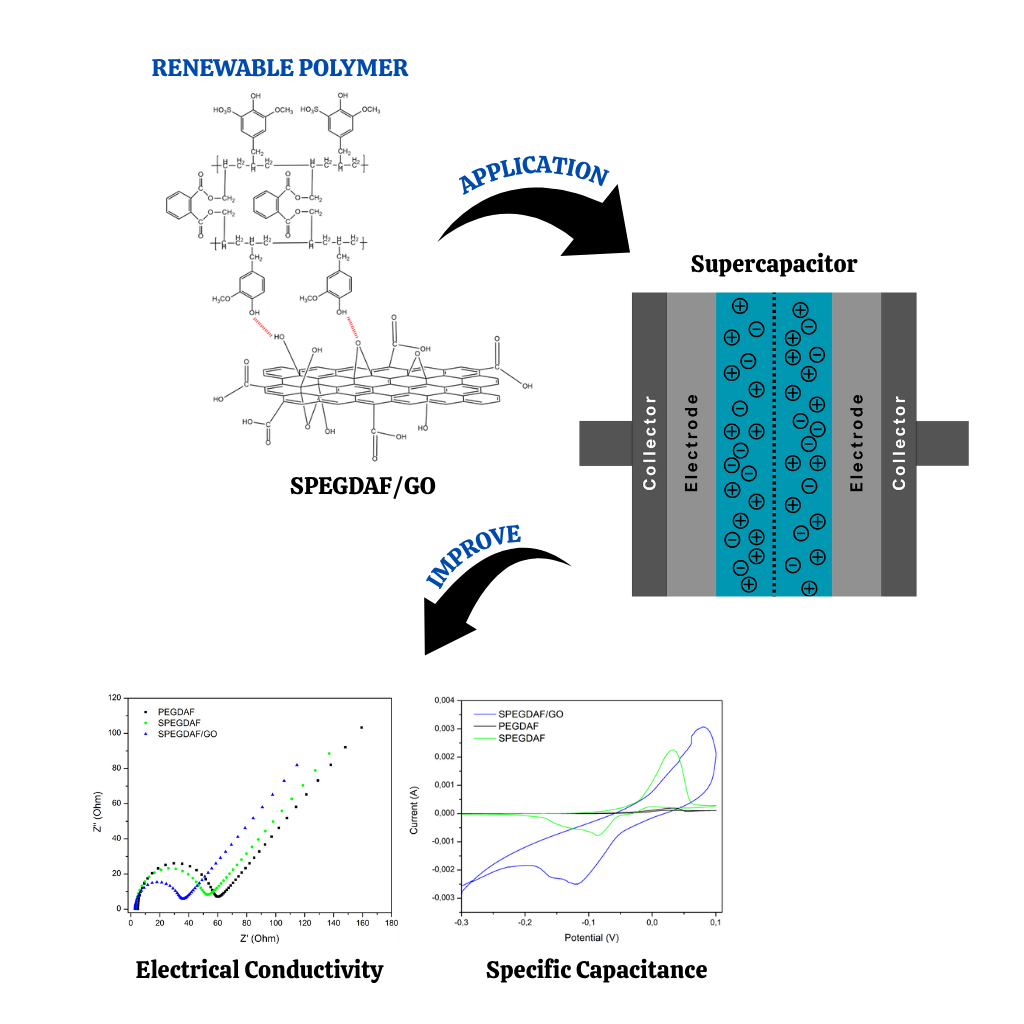
Conductive polymers derived from renewable resources have attracted increasing attention as environmentally friendly alternatives-based polymers such as polyaniline (PANI), polypyrrole (PPy), and polystyrene (PST) for supercapacitor electrode materials. Among them, polyeugenol represents a promising candidate due to its renewable origin and versatile functional groups. In this study, a composite of sulfonated eugenol–diallyl phthalate copolymer (SPEGDAF) and graphene oxide (GO) was synthesized and evaluated as a supercapacitor electrode material. The research encompassed several stages: Synthesis of the eugenol–diallyl phthalate copolymer (PEGDAF), sulfonation to yield SPEGDAF, synthesis of graphene oxide, fabrication of the SPEGDAF/GO composite, and subsequent electrochemical performance testing. Structural and thermal characterizations of PEGDAF and SPEGDAF were conducted using FTIR spectroscopy, TGA-DTG, and molecular weight analysis. Sulfonation introduced sulfonate groups, which raised the melting point from 84 - 110 °C and increased the molecular weight from 7,611.06 Da to 13,674.54 Da. The sulfonation degree was determined to be 31.16%, corresponding to a cation exchange capacity of 3.856 meq/g. FTIR and XRD analyses of the synthesized graphene oxide confirmed the presence of oxygen-containing functional groups and crystalline features. The incorporation of GO into SPEGDAF resulted in distinct FTIR spectral enhancements and notable improvements in electrochemical behavior. Cyclic voltammetry revealed a specific capacitance of 2.47 F/g, while electrochemical impedance spectroscopy indicated an ionic conductivity of 4.02×10‒4 S/cm. These findings demonstrate that the integration of GO into SPEGDAF effectively enhances the charge storage and ionic transport properties of the composite. Overall, this study highlights the potential of polyeugenol-derived composites as sustainable for supercapacitor applications, underscoring their promise as renewable and environmentally responsible alternatives for future energy storage technologies.
HIGHLIGHTS
- Polyeugenol was modified by crosslinking with diallyl phthalate followed by sulfonation
- Graphene oxide was synthesized using a modified Hummers method without NaNO3
- The SPEGDAF/GO composite was synthesized via a physical dispersion method
- The composite exhibited a specific capacitance of 2.47 F/g and an electrical conductivity of 4.02×10‒4 S/cm
GRAPHICAL ABSTRACT
Downloads
References
YM Volfkovich. Electrochemical supercapacitors (a review). Russian Journal of Electrochemistry 2021; 57(4), 311-347.
AG Olabi, Q Abbas, AA Makky and MA Abdelkareem. Supercapacitors as next generation energy storage devices: Properties and applications. Energy 2022; 248, 123617.
P Lamba, P Singh, P Singh, P Singh, Bharti, A Kumar, M Gupta and Y Kumar. Recent advancements in supercapacitors based on different electrode materials: Classifications, synthesis methods and comparative performance. Journal of Energy Storage 2022; 48, 103871.
G Sumdani, MR Islam, ANA Yahaya and S Safie. Recent advancements in synthesis, properties, and applications of conductive polymers for electrochemical energy storage devices: A review. Polymer Engineering & Science 2021; 62(2), 269-303.
RA Sheldon. Green carbon and the chemical industry of the future. Philosophical Transactions of the Royal Society A 2024; 382(2282), 20230259.
NBA Prasetya, MR Putri, Ngadiwiyana and Gunawan. Polyeugenol-gum arabic/graphene oxide composite coating for high performance anticorrosion material. Case Studies in Chemical and Environmental Engineering 2024; 9, 100658.
VJV Vinayak, K Deshmukh, VRK Murthy and SKK Pasha. Conducting polymer based nanocomposites for supercapacitor applications: A review of recent advances, challenges and future prospects. Journal of Energy Storage 2024; 100, 113551.
Z Zhai, X Du, Y Long and H Zheng. Biodegradable polymeric materials for flexible and degradable electronics. Frontiers in Electronics 2022; 3, 985681.
Ngadiwiyana, Gunawan, NBA Prasetya, TD Kusworo and H Susanto. Synthesis and characterization of sulfonated poly (eugenol-co-allyleugenol) membranes for proton exchange membrane fuel cells. Heliyon 2022; 8(12), 12401.
A Kausar. Poly (ether ether ketone) nanocomposites with graphene and derivative nanoreinforcements - contemporary scientific paragon and prospering breakthroughs. Polymer-Plastics Technology and Materials 2025; 64(7), 973-997.
A Darmawan, AFN Sabarina, DN Bima, H Muhtar, CW Kartikowati and TE Saraswati. New design of graphene oxide on macroporous nylon assisted polyvinyl alcohol with Zn (II) cross-linker for pervaporation desalination. Chemical Engineering Research and Design 2023; 195, 54-64.
A Darmawan, H Muhtar, DN Pratiwi, DN Bima, C Panatarani, NL Hamidah and EC Prima. Thin-Film Nanofiltration membrane of polyaniline Decorated graphene oxide via In-Situ polymerization for ion separation. Separation and Purification Technology 2025; 356, 129975.
S Singh, TSSK Naik, N Shehata, L Aguilar-Marcelino, K Dhokne, S Lonare, V Chauhan, A Kumar, J Singh, PC Ramamurthy, AH Khan, NA Khan and MH Dehghani. Novel insights into graphene oxide-based adsorbents for remediation of hazardous pollutants from aqueous solutions: A comprehensive review. Journal of Molecular Liquids 2023; 369, 120821.
S Tamang, S Rai, R Bhujel, NK Bhattacharyya, BP Swain and J Biswas. A concise review on GO, rGO and metal oxide/rGO composites: Fabrication and their supercapacitor and catalytic applications. Journal of Alloys and Compounds 2023; 947, 169588.
H Chaudhuri and Y-S Yun. A critical review on the properties and energy storage applications of graphene oxide/layered double hydroxides and graphene oxide/MXenes. Journal of Power Sources 2023; 564, 232870.
R Kumar and R Thangappan. Electrode material based on reduced graphene oxide (rGO)/transition metal oxide composites for supercapacitor applications: A review. Emergent Materials 2022; 5, 1881-1897.
Ngadiwiyana, CN Nabila, Ismiyarto and M Christwardana. Sulfonation of eugenol-diallyl phthalate copolymer as base material of supercapacitor electrode material Jurnal Kimia Sains dan Aplikasi 2024; 27(11), 523-530.
B Li, W Tang, D Sun, B Li, Y Ge, X Ye and W Fang. Electrochemical manufacture of graphene oxide/polyaniline conductive membrane for antibacterial application and electrically enhanced water permeability. Journal of Membrane Science 2021; 640, 119844.
E Kianfar. Advances in nanoelectronics: Carbon nanotubes, graphene, and smart polymers: A review. Trends in Sciences 2025; 22(7), 9843.
S Rattanaveeranon and K Jiamwattanapong. Enhancing supercapacitor performance with multilayered tungsten (VI) Oxide Nanoparticles/Reduced graphene oxide and activated carbon. Trends in Sciences 2025; 22(9), 10377.
Ngadiwiyana, NBA Prasetya, Gunawan, TD Kusworo and H Susanto. Synthesis, characterization, and study of proton exchange polymer membrane properties of sulfonated copolymer eugenol-diallyl Phthalate. Indonesian Journal of Chemistry 2021; 21(1), 168-178.
N Mendez-Lozano, F Peerez-Reynoso and C Gonzaalez-Gutieerrez. Eco-friendly approach for graphene oxide synthesis by Modified Hummers method. Materials 2022; 15(20), 7228.
S Suriyakumar, P Bhardwaj, AN Grace and AM Stephan. Role of polymers in enhancing the performance of electrochemical supercapacitors: A review. Batteries & Supercaps 2021; 4(4), 571-584.
L Francisco-Vieira, R Benavides, LD Silva, E Cuara-Diaz and D Morales-Acosta. Effect of sulfonating agent in the properties of styrene copolymers for PEMFC membranes. International Journal of Hydrogen Energy 2022; 47(70), 30303-30314.
S Yadav, APS Raman, H Meena, AG Goswami, Bhawna, V Kumar, P Jain, G Kumar, M Sagar, DK Rana, I Bahadur and P Singh. An update on graphene oxide: Applications and toxicity. ACS omega 2022; 7(40), 35387-35445.
Y Wang, K Zheng, H Guo, L Tian, Y He, X Wang, T Zhu, P Sun and Y Liu. Potassium permanganate-based advanced oxidation processes for wastewater decontamination and sludge treatment: A review. Chemical Engineering Journal 2023; 452, 139529.
MG Sumdani, MR Islam, ANA Yahaya and SI Safie. Recent advances of the graphite exfoliation processes and structural modification of graphene: A review. Journal of Nanoparticle Research 2021; 23, 253.
S Ghosh, A Kuttasseri, S Akhila, S Khamaru, NPB Aetukuri, A Mahata and SK Martha. Understanding critical bottlenecks of anion intercalation into graphite: Operando gas evolution, host fluorination, site blocking, and structural issues. Chemical Engineering Journal 2025; 519, 164880.
S Bhadr and D Khastgir. Determination of crystal structure of polyaniline and substituted polyanilines through powder X-ray diffraction analysis. Polymer Testing 2008; 27(7), 851-857.
N Tohluebaji, N Muensit, C Putson, GA Ashraf, P Channuie, P Porrawatkul, U Wanthong and J Yuennan. Multi-functional enhancement of P(VDF-HFP) nanocomposites through MWCNTs loading for piezoelectric sensing. Journal of Materials Research and Technology 2025; 36, 8475-8491.
RS Rajaura, S Srivastava, V Sharma, PK Sharma, C Lal, M Singh, HS Palsania and YK Vijay. Role of interlayer spacing and functional group on the hydrogen storage properties of graphene oxide and reduced graphene oxide. International Journal of Hydrogen Energy 2016; 41(22), 9454-9461.
L Shen, L Zhang, K Wang, L Miao, Q Lan, K Jiang, H Lu, M Li, Y Li, B Shen and W Zheng. Analysis of oxidation degree of graphite oxide and chemical structure of corresponding reduced graphite oxide by selecting different-sized original graphite. RSC advances 2018; 8(31), 17209-17217.
SR Yekkaluri, S Konda, D Velpula, RK Thida, SC Chidurala, BN Tumma, NR Nama and R Deshmukh. Comparative analysis of ZnO nanoparticleʼs specific capacitance in supercapacitors: The role of surfactant and stabilizing agent. Applied Surface Science Advances 2022; 12, 100326.
H Yang and N Wu. Ionic conductivity and ion transport mechanisms of solid‐state lithium‐ion battery electrolytes: A review. Energy Science & Engineering 2022; 10(5), 1567-1789.
TKN Tran, HL Ho, HV Nguyen, BT Tran, TT Nguyen, PQT Bui and LG Bach. Photocatalytic degradation of Rhodamine B in aqueous phase by bimetallic metal-organic framework M/Fe-MOF (M= Co, Cu, and Mg). Open Chemistry 2022; 20(1), 52-60.
A SI, GZ Kyzas, K Pal and FG de Souza Jr. Graphene functionalized hybrid nanomaterials for industrial-scale applications: A systematic review. Journal of Molecular Structure 2021; 1239, 130518.
AA Nada, AO Siskova, A Kleinova, AE Andicsova, Erik Simon and J Mosnacek. Ionic conductive cellulose-based hydrogels for Al-air batteries: Influence of the charged-functional groups on the electrochemical properties. Journal of Power Sources 2023; 572, 233089.
J Yuennan, N Muensit, N Tohluebaji, W Chailad, L Yang, N Sukhawipat, GA Ashraf and P Channuie. Tailoring dielectric properties and crystallinity in poly(vinylidene fluoride-co-hexafluoropropylene) nanocomposites via iron (III) chloride hexahydrate incorporation. Scientific Reports 2025; 15, 17810.
Published
How to Cite
Issue
Section
License
Copyright (c) 2025 Walailak University

This work is licensed under a Creative Commons Attribution-NonCommercial-NoDerivatives 4.0 International License.





