
Facile Synthesis of Thin Film Cobalt-doped Zinc Oxide Nanorods Photoanode for Efficient Methylene Blue Degradation
DOI:
https://doi.org/10.48048/tis.2025.8697Keywords:
ZnO, Thin film, Photoelectrocatalyst, Methylene Blue, Nanorods, Chemical bath deposition, ITO, ZnO, Thin film,Photoelectrocatalyst, Methylene blue, Nanorods, Chemical bath depositionAbstract
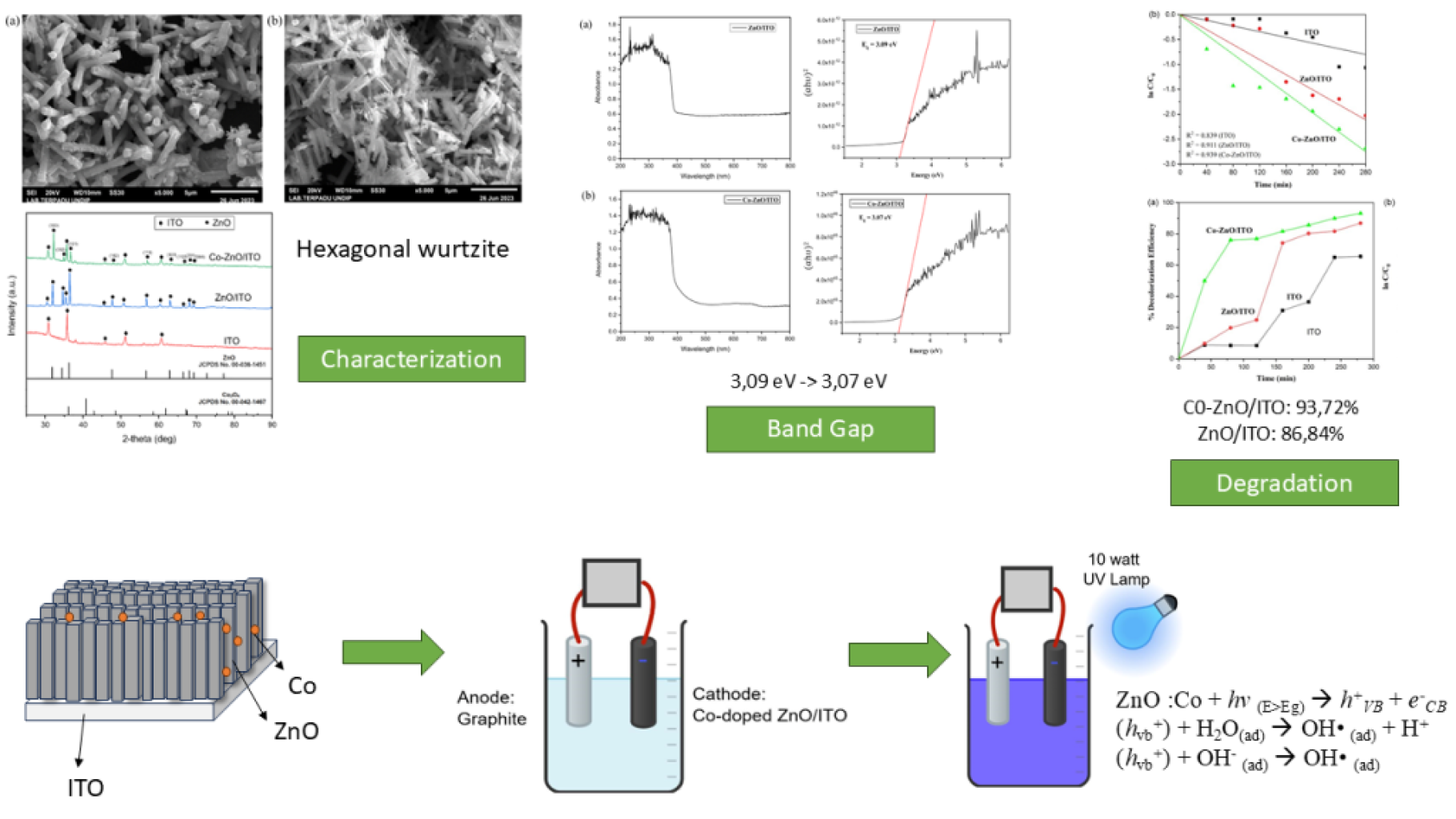
ZnO nanorod thin films doped with cobalt were successfully synthesized on Indium Thin Oxide (ITO) glass substrates using the chemical bath deposition method to assess their characteristics and methylene blue degradation capabilities. ZnO nanorod thin films doped with cobalt were successfully synthesized on Indium ThinOxide (ITO) glass substrates using the chemical bath deposition method to evaluate their characteristics and methylene blue degradation capabilities. This study compared undoped and Co-doped ZnO on ITO glass substrates for photoelectrocatalytic (PEC) applications. XRD analysis confirmed that all samples exhibited a crystalline hexagonal wurtzite structure, with no additional phases detected in films with 5 % Co doping. The formation of nanorod structures in both undoped and Co-doped ZnO was revealed by SEM images where the presence of Co in the doped ZnO was confirmed through EDX analysis UV-DRS analysis indicated changes in band gap values with the addition of 5 % Co doping, decreasing from 3.09 to 3.07 eV for the ZnO/ITO and Co-ZnO/ITO photoanode. Evaluation of the PEC performance of the photoanodes toward methylene blue in an aqueous solution showed that Co doping enhanced the PEC efficiency of the ZnO/ITO photoanode. The decolourization efficiency of methylene blue reached 93.72 % using Co-ZnO/ITO, which is higher than that of ZnO/ITO at 86.84 %. Furthermore, the kinetic study showed that Co-ZnO/ITO photoanode follows a first-order reaction kinetics model with a reaction rate constant of 0.0085 min−1. The result of our study suggests the potential of Co-ZnO/ITO photoanode in addressing dyecontamination issues effectively.
HIGHLIGHTS
- Co-doped ZnO thin films synthesized via chemical bath deposition method.
- Hexagonal structure retained; band gap reduced from 3.09 to 3.07 eV.
- Co-doped ZnO showed 93.72 % methylene blue degradation vs. 86.84 % for ZnO.
- First-order kinetics with a rate constant of 0.0085 min⁻¹ for Co-ZnO/ITO.
- Co-ZnO/ITO thin films show promise for dye-contaminated water treatment.
GRAPHICAL ABSTRACT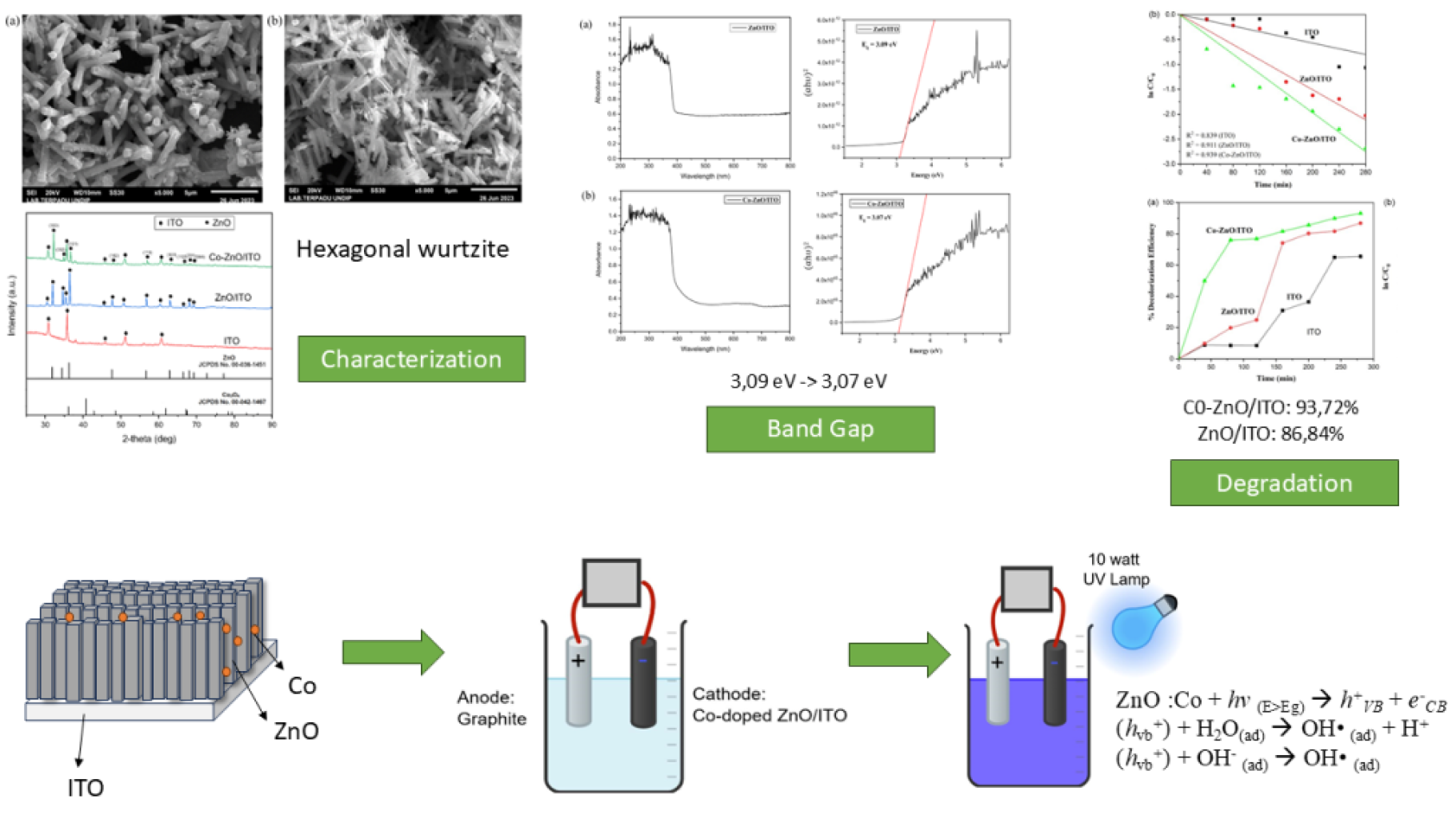
Downloads
References
NT Son, J Noh and S Park. Role of ZnO thin film in the vertically aligned growth of ZnO nanorods by chemical bath deposition. Applied Surface Science 2016; 379, 440-445.
W Wang, F Zhang, X Wang, S Zhang, J Yan, W Zhang and W Zhang. Magnetic and optical properties of Co-doped ZnO nanorod arrays. The European Physical Journal Plus 2020; 135, 40.
M Figueredo, EM Rodriguez, J Rivas and FJ Beltran. Photocatalytic ozonation in water treatment: Is there really a synergy between systems? Water Research 2021; 206, 117727.
X Zhang, Y Chen, S Zhang and C Qiu. High photocatalytic performance of high concentration Al-doped ZnO nanoparticles. Separation and Purification Technology 2017; 172, 236-241.
RB Rajput, R Shaikh, J Sawant and RB Kale. Recent developments in ZnO-based heterostructures as photoelectrocatalysts for wastewater treatment: A review. Environmental Advances 2022; 9, 100264.
RT Sapkal, SS Shinde, MA Mahadik, VS Mohite, TR Waghmode, SP Govindwar, KY Rajpure and CH Bhosale. Photoelectrocatalytic decolorization and degradation of textile effluent using ZnO thin films. Journal of Photochemistry and Photobiology B: Biology 2012; 114, 102-107.
KM Lee, CW Lai, KS Ngai and JC Juan. Recent developments of zinc oxide based photocatalyst in water treatment technology: A review. Water Research 2016; 88, 428-448.
E Amaterz, A Tara, A Bouddouch, A Taoufyq, B Bakiz, A Benlhachemi and O Jbara. Photo-electrochemical degradation of wastewaters containing organics catalysed by phosphate-based materials: A review. Reviews in Environmental Science and Bio/Technology 020; 19, 843-872.
W Mantele and E Deniz. UV-VIS absorption spectroscopy: Lambert-beer reloaded. Spectrochim. Spectrochimica Acta Part A: Molecular and Biomolecular Spectroscopy 2017; 173, 965-968.
KA Isai and VS Shrivastava. Photocatalytic degradation of methylene blue using ZnO and 2 % Fe-ZnO semiconductor nanomaterials synthesized by sol-gel method: A comparative study. SN Applied Sciences 2019; 1, 1247.
C Lausecker, B Salem, X Baillin and V Consonni. Effects of zinc nitrate and HMTA on the formation mechanisms of ZnO nanowires on Au seed layers. Crystal Growth & Design 2023; 23, 2941-2950.
LK Gaur, P Gairola, SP Gairola, MC Mathpal, P Kumar, S Kumar, D Kushavah, V Agrahari, FFH Aragon, MAG Soler and HC Swart. Cobalt doping induced shape transformation and its effect on luminescence in zinc oxide rod-like nanostructures. Journal of Alloys and Compounds 2021; 868, 159189.
S Kaassamani, W Kassem and M Tabbal. X-ray diffraction lineshape analysis of pulsed laser deposited ZnO nano-structured thin films. Applied Surface Science 2019; 473, 298-302.
A Kaphle, T Reed, A Apblett and P Hari. Doping efficiency in cobalt-doped ZnO nanostructured materials. Journal of Nanomaterials 2019; 2019, 7034620.
MS Nadeem, T Munawar, F Mukhtar, MNU Rahman, M Riaz, A Hussain and F Iqbal. Hydrothermally derived co, Ni co-doped ZnO nanorods; structural, optical, and morphological study. Optical Materials 2021; 111, 110606.
Y Pan, X Li, K Fu, H Deng and J Shi. Degradation of metronidazole by UV/chlorine treatment: Efficiency, mechanism, pathways and DBPs formation. Chemosphere 2019; 224, 228-236.
GAM Amin and NM Spyrou. Study of gamma-radiation-induced optical effects in Ge-Se-Cd for possible industrial dosimetric applications. Radiation Physics and Chemistry 2005; 72(4), 419-422.
M Abdelfatah, HY Salah, MI El-Henawey, AH Oraby, A El-Shaer and W Ismail. Insight into Co concentrations effect on the structural, optical, and photoelectrochemical properties of ZnO rod arrays for optoelectronic applications. Journal of Alloys and Compounds 2021; 873, 159875.
LK Jangir, Y Kumari, A Kumar, M Kumar and K Awasthi. Investigation of luminescence and structural properties of ZnO nanoparticles, synthesized with different precursors. Materials Chemistry Frontiers 2017; 1, 1413-1421.
J Cai, M Zhou, Y Pan, X Du and X Lu. Extremely efficient electrochemical degradation of organic pollutants with co-generation of hydroxyl and sulfate radicals on Blue-TiO2 nanotubes anode. Applied Catalysis B: Environmental 2019; 257, 117902.
RS Pedanekar, SV Mohite, SB Madake, Y Kim, JL Gunjakar and KY Rajpure. Photoelectrocatalytic activity of methylene blue using chemically sprayed Bi2WO6 photoanode under natural sunlight. Journal of Alloys and Compounds 2023; 942, 168866.
A Darmawan, S Sulaksono, MS Arifin, H Muhtar and S Sriyanti. Highly efficient TiO2-pillared smectite clay with Ni and Co doping for Rhodamine B removal: Kinetics of adsorption and photodegradation. Clays and Clay Minerals 2024; 72, e7.
IA Saleh, N Zouari and MA Al-Ghouti. Removal of pesticides from water and wastewater: Chemical, physical and biological treatment approaches. Environmental Technology & Innovation 2020; 19, 101026.
NG Asenjo, R Santamaria, C Blanco, M Granda, P Alvarez and R Menendez. Correct use of the Langmuir-Hinshelwood equation for proving the absence of a synergy effect in the photocatalytic degradation of phenol on a suspended mixture of titania and activated carbon. Carbon 2013; 55, 62-69.
F Poorsajadi, MH Sayadi, M Hajiani and MR Rezaei. Synthesis of CuO/Bi2O3 nanocomposite for efficient and recycling photodegradation of methylene blue dye. International Journal of Environmental Analytical Chemistry 2022; 102(18), 7165-7178.
S Garcia-Segura and E Brillas. Applied photoelectrocatalysis on the degradation of organic pollutants in wastewaters. Journal of Photochemistry and Photobiology C: Photochemistry Reviews 2017; 31, 1-35.
ZZ Vasiljevic, MP Dojcinovic, JD Vujancevic, I Jankovic-Castvan, M Ognjanovic, NB Tadic, S Stojadinovic, GO Brankovic and MV Nikolic. Photocatalytic degradation of methylene blue under natural sunlight using iron titanate nanoparticles prepared by a modified sol-gel method. Royal Society Open Science 2020; 7(9), 200708.
RS Dariani, A Esmaeili, A Mortezaali and S Dehghanpour. Photocatalytic reaction and degradation of methylene blue on TiO2 nano-sized particles. Optik 2016; 127(18), 7143-7154.
Downloads
Published
How to Cite
Issue
Section
License
Copyright (c) 2024 Walailak University

This work is licensed under a Creative Commons Attribution-NonCommercial-NoDerivatives 4.0 International License.





