
Antibacterial and pH-Responsive Chitosan/Glutaraldehyde Film with Red Cabbage Anthocyanins for Meat Freshness Detection
DOI:
https://doi.org/10.48048/tis.2025.10254Keywords:
pH sensitive, Glutaraldehyde, Biodegradability, Chicken freshness, Smart packaging film, Antibacterial activityAbstract
This study presents the development of a biodegradable chitosan-based film responsive to pH changes, utilizing anthocyanins from red cabbage extract as a natural pH indicator. Chitosan films were prepared with varying volumes of glutaraldehyde (GA) as a cross-linking agent through a casting method, followed by coating with red cabbage extract. The chitosan/GA films exhibited color transitions within a pH range of 2 - 13, changing from purple during the initial storage to green as chicken meat spoiled, effectively indicating freshness. FE-SEM analysis revealed that GA cross-linking resulted in a denser film structure, with a reducing porosity from 10.0% (pure chitosan) to 6.7% (chitosan/GA). The incorporation of glutaraldehyde significantly enhanced the films’ tensile strength, with the optimal strength achieved at 0.5 mL GA, representing a threefold increase compared to pure chitosan. The films also demonstrated improved mechanical stability, defined as an improved resistance to deformation under applied stress, which is crucial for packaging integrity. Additionally, glutaraldehyde modified films exhibited greater hydrophilicity, as indicated by changes in contact angle, and displayed antibacterial activity, with CG0.5 exhibiting the largest inhibition zone against S. aureus (4.9 mm). Although GA incorporation slightly reduced the biodegradation rate, the films still displayed acceptable biodegradability, defined as the ability to degrade by least 60% within 5 days sufficient for short-term food packaging applications. The red cabbage extract-coated chitosan-GA films effectively monitored meat spoilage through visible color changes and demonstrated eco-friendly degradation behavior, positioning them as promising smart packaging materials for chicken meat freshness monitoring.
HIGHLIGHTS
- A novel biodegradable chitosan-based film with pH-responsive color changes for real-time chicken freshness monitoring.
- First report on the integration of glutaraldehyde cross-linking and anthocyanin-based sensing in a single film system.
- Significant enhancement in mechanical properties, with tensile strength increased threefold due to optimized cross-linking.
- Improved antibacterial performance, with CG0.5 exhibiting a 4.9 mm inhibition zone against aureus, enhancing food safety.
GRAPHICAL ABSTRACT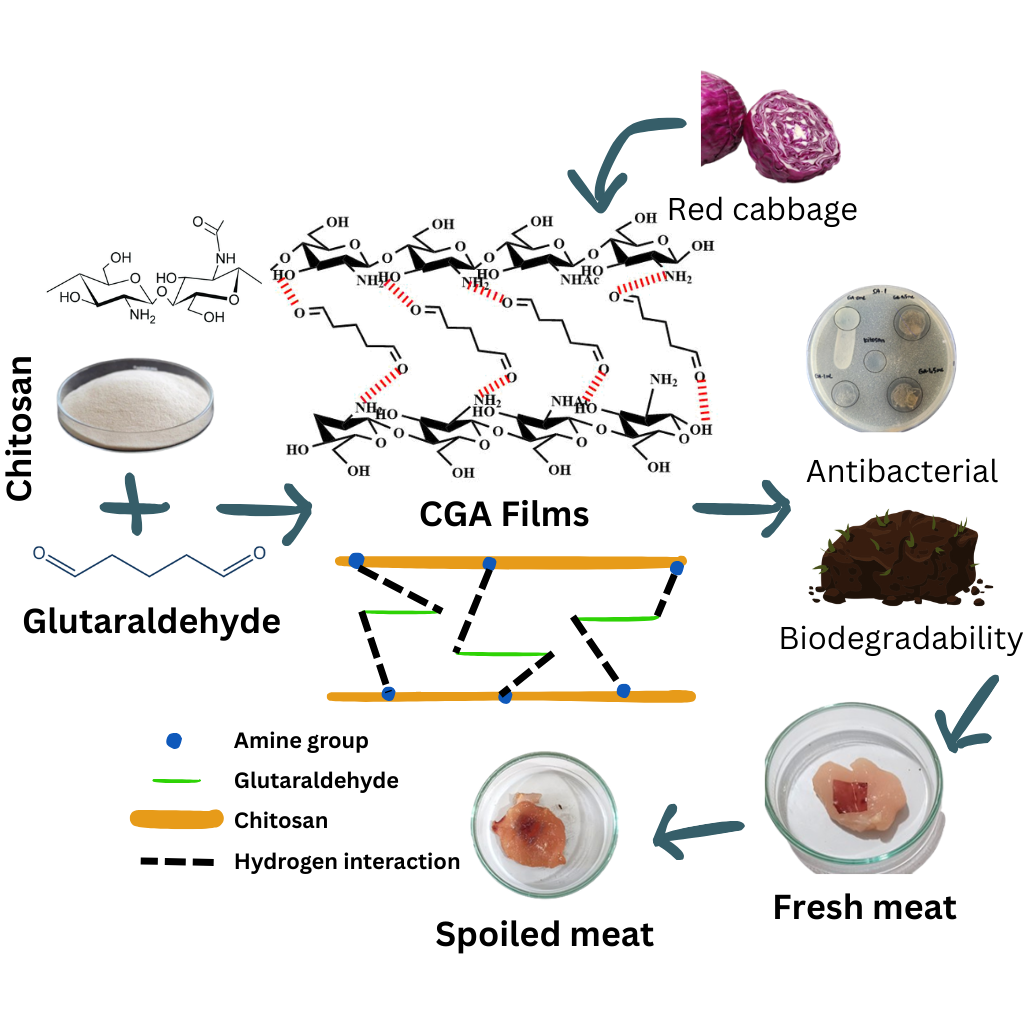
Downloads
References
M Alizadeh-Sani, E Mohammadian, J-W Rhim and SM Jafari. pH-sensitive (halochromic) smart packaging films based on natural food colorants for the monitoring of food quality and safety. Trends in Food Science & Technology 2020; 105, 93-144.
A Bahrami, R Delshadi, E Assadpour, SM Jafari and L Wiliams. Antimicrobial-loaded nanocarriers for food packaging applications. Advances in Colloid and Interface Science 2020; 278, 102140.
J Liu, F Xie, R Li and T Li. TiO2-x/Ag3PO4 photocatalyst: Oxygen vacancy dependent visible light photocatalytic performance and BPA degradative pathway. Materials Science in Semiconductor Processing 2019; 97, 1-10.
T Vo, T Dang and B Chen. Synthesis of intelligent pH indicative films from chitosan/poly (vinyl alcohol)/anthocyanin extracted from red cabbage. Polymers 2019; 11(7), 1088.
M Chen, T Yan, J Huang and Y Zhou. Fabrication of halochromic smart films by immobilizing red cabbage anthocyanins into chitosan/oxidized-chitin nanocrystals composites for real-time hairtail and shrimp freshness monitoring. International Journal of Biological Macromolecules 2021; 179, 90-100.
X Li, J S del Río Saez, S Du, RS Diaz, X Ao and D Wang. Bio-based chitosan-based film as a bifunctional fire-warning and humidity sensor. International Journal of Biological Macromolecules 2023; 253(3), 126466.
Y Liu, G Chen, Y Yang, R Wu, L Zhang, W Mu and S Wang. Fabrication of chitosan-based smart film by the O/W emulsion containing curcumin for monitoring pork freshness. Journal of Food Engineering 2024; 379, 112115.
L Prietto, TC Mirapalhete, VZ Pinto, JF Hoffmann, NL Vanier, L Lim, ARG Dias and EDR Zavareze. pH-sensitive films containing anthocyanins extracted from black bean seed coat and red cabbage. Lwt 2017; 80, 492-500.
M Shahid, Shahid-ul-Islam, F Mohammad. Recent advancements in natural dye applications: A review. Journal of Cleaner Production 2013; 53, 310-331.
S Roy and J Rhim. Anthocyanin food colorant and its application in pH-responsive color change indicator films. Critical Reviews in Food Science and Nutrition 2021; 61(14), 2297-2325.
L Cao, G Sun, C Zhang, W Liu, J Li and L Wang. An intelligent film based on cassia gum containing bromothymol blue-anchored cellulose fibers for real-time detection of meat freshness. Journal of Agricultural and Food Chemistry 2019; 67(7), 2066-2074.
L Ding, X Li, L Hu, Y Zhang, Y Jiang, Z Mao, H Xu, B Wang, X Feng and X Sui. A naked-eye detection polyvinyl alcohol/cellulose-based pH sensor for intelligent packaging. Carbohydrate Polymers 2020; 233, 115859.
Y Zhao, J Du, H Zhou, S Zhou, Y Lv, Y Cheng, Y Tao, J Lu and H Wang. Biodegradable intelligent film for food preservation and real-time visual detection of food freshness. Food Hydrocolloids 2022; 129, 107665.
YS Musso, PR Salgado and AN Mauri. Smart gelatin films prepared using red cabbage (Brassica oleracea L.) extracts as solvent. Food Hydrocolloids 2019; 89, 674-681.
T Gasti, S Dixit, OJ D'souza, VD Hiremani, SK Vootla, SP Masti, RB Chougale and RB Malabadi. Smart biodegradable films based on chitosan/methylcellulose containing Phyllanthus reticulatus anthocyanin for monitoring the freshness of fish fillet. International Journal of Biological Macromolecules 2021; 187, 451-461.
J Liang and R Chen. Impact of cross-linking mode on the physical properties of zein/PVA composite films. Food Packaging and Shelf Life 2018; 18, 101-106.
H Deng, W Zhang, Y Ramezan, Z Riahi, A Khan and Z Huang. Antibacterial and antioxidant plant‐derived aldehydes: A new role as cross‐linking agents in biopolymer‐based food packaging films. Comprehensive Reviews in Food Science and Food Safety 2025; 24(1), e70089.
T Hasanvand, M Mohammadi, F Abdollahpour, B Kamarehie, A Jafari, A Ghaderpoori and MA Karami. A comparative study on antibacterial activity of carvacrol and glutaraldehyde on Pseudomonas aeruginosa and Staphylococcus aureus isolates: An in vitro study. Journal of Environmental Health Science and Engineering 2021; 19, 475-482.
B Li, C Shan, Q Zhou, Y Fang, Y Wang, F Xu, L Han, M Ibrahim, L Guo, G Xie and G Sun. Synthesis, characterization, and antibacterial activity of cross-linked chitosan-glutaraldehyde. Marine Drugs 2013; 11(5), 1534-1552.
ACD Araujo, JP Gomes, FBD Silva, JS Nunes, FSD Santos, WPD Silva, JPDL Ferreira, AJDM Queiroz, RMFD Figueiredo, GSD Lima, LADA Soares, APT Rocha and AGBD Lima. Optimization of extraction method of anthocyanins from red cabbage. Molecules 2023; 28(8), 3549.
AB Das, VV Goud and C Das. Extraction of phenolic compounds and anthocyanin from black and purple rice bran (Oryza sativa L.) using ultrasound: A comparative analysis and phytochemical profiling. Industrial Crops and Products 2017; 95, 332-341.
LMD Oliveira, and F Antelo. Thermostability of the visual color and anthocyanins from Rio-Grande-Cherry (Eugenia involucrata DC). Brazilian Journal of Food Technology 2020; 23, e2019140.
HE Khoo, A Azlan, ST Tang and SM Lim. Anthocyanidins and anthocyanins: Colored pigments as food, pharmaceutical ingredients, and the potential health benefits. Food & Nutrition Research 2017; 61, 1361779.
M Cheng, X Yan, Y Cui, M Han, X Wang, J Wang and R Zhang. An eco-friendly film of pH-responsive indicators for smart packaging. Journal of Food Engineering 2022; 321, 110943.
SR Kanatt. Development of active/intelligent food packaging film containing Amaranthus leaf extract for shelf life extension of chicken/fish during chilled storage. Food Packaging and Shelf Life 2020; 24, 100506.
T Liang, G Sun, L Cao, J Li and W Wang. A pH and NH3 sensing intelligent film based on Artemisia sphaerocephala Krasch. gum and red cabbage anthocyanins anchored by carboxymethyl cellulose sodium added as a host complex. Food Hydrocolloids 2019; 87, 858-868.
Y Liu, Z Cai, L Sheng, M Ma, Q Xu and Y Jin. Structure-property of crosslinked chitosan/silica composite films modified by genipin and glutaraldehyde under alkaline conditions. Carbohydrate Polymers 2019; 215, 348-357.
F Doustdar, A Olad and M Ghorbani. Effect of glutaraldehyde and calcium chloride as different crosslinking agents on the characteristics of chitosan/cellulose nanocrystals scaffold. International Journal of Biological Macromolecules 2022; 208, 912-924.
EC Stroparo, KC Mollinari and KVD Souza. Use of chitosan in the remediation of water from purification of biodiesel. Polimeros 2018; 28(5), 400-405.
FF Illiana and HD Ariyanto. Development of chitosan/glutaraldehyde cross-linked film with silica addition as membrane material for SLS rejection in detergent wastewater. Journal of Vocational Studies on Applied Research 2024; 6(1), 1-6.
JM Frick, A Ambrosi, LD Pollo and IC Tessaro. Influence of glutaraldehyde crosslinking and alkaline post-treatment on the properties of chitosan-based films. Journal of Polymers and the Environment 2018; 26, 2748-2757.
NR Kildeeva, PA Perminov, LV Vladimirov, VV Novikov and SN Mikhailov. About mechanism of chitosan cross-linking with glutaraldehyde. Russian Journal of Bioorganic Chemistry 2009; 35, 360-369.
HD Rahmayanti, A Zulfi, JC Ginting, TR Kartika, S Ardiani, N Akmalia and M Dioktyanto. Physicomechanical properties of edible film-based nata de coco, acetic acid, and Chitosan. KnE Engineering 2024; 2024, 668-674.
A Arianita, Cahyaningtyas, B Amalia, W Pudjiastuti, S Melanie, V Fauzia and C Imawan. Effect of glutaraldehyde to the mechanical properties of chitosan/nanocellulose. Journal of Physics: Conference Series 2019; 1317, 012045.
K Wegrzynowska-Drzymalska, P Grebicka, DT Mlynarczyk, D Chelminiak-Dudkiewicz, H Kaczmarek, T Goslinski and M Ziegler-Borowska. Crosslinking of chitosan with dialdehyde chitosan as a new approach for biomedical applications. Materials 2020; 13(15), 3413.
JMF Pavoni, NZD Santos, IC May, LD Pollo and IC Tessaro. Impact of acid type and glutaraldehyde crosslinking in the physicochemical and mechanical properties and biodegradability of chitosan films. Polymer Bulletin 2021; 78, 981-1000.
J Galan, J Trilleras, PA Zapata, VA Arana and CD Grande-Tovar. Optimization of chitosan glutaraldehyde-crosslinked beads for reactive blue 4 anionic dye removal using a surface response methodology. Life 2021; 11(2), 85.
RV Pinto, PS Gomes, MH Fernandes, MEV Costa and MM Almeida. Glutaraldehyde-crosslinking chitosan scaffolds reinforced with calcium phosphate spray-dried granules for bone tissue applications. Materials Science and Engineering: C 2020; 109, 110557.
REK Billah, M Ahrouch, L Bahsis, N Aflak, Z Azoubi, H Majdoubi, M Achak, Y Abdellaoui and MA Khan. Biological activity assessment and water deflouridation application of glutaraldehyde crosslinked chitosan-TiO2 composite: A conjugated experimental and theoretical insights. Separation and Purification Technology 2025; 368, 132984.
L Poon, LD Wilson, and JV Headley. Chitosan-glutaraldehyde copolymers and their sorption properties. Carbohydrate Polymers 2014; 109, 92-101.
W Sun, S Kothari and CC Sun. The relationship among tensile strength, Young's modulus, and indentation hardness of pharmaceutical compacts. Powder Technology 2018; 331, 1-6.
S Valizadeh, M Naseri, S Babaei, SMH Hosseini and A Imani. Development of bioactive composite films from chitosan and carboxymethyl cellulose using glutaraldehyde, cinnamon essential oil and oleic acid. International Journal of Biological Macromolecules 2019; 134, 604-612.
M Jufri, RA Lusiana and NBA Prasetya. Effects of additional polyvinyl alcohol (PVA) on the physiochemical properties of chitosan-glutaraldehyde-gelatine bioplastic. Jurnal Kimia Sains dan Aplikasi 2022; 25(3), 130-136.
SD Carolis, C Putignano, L Soria and G Carbone. Effect of porosity and pore size distribution on elastic modulus of foams. International Journal of Mechanical Sciences 2024; 261, 108661.
Y Gao, K Peng and S Mitragotri. Covalently crosslinked hydrogels via step‐growth reactions: Crosslinking chemistries, polymers, and clinical impact. Advanced Materials 2021; 33(25), 2006362.
D Kim, INMD Chan, TMS Manalastas, RSC II, JRHS Agueda and RKB Bitangcor. Optimization of glutaraldehyde concentration in relation to swelling behavior of PVA-PEG-BTB film using hybrid genetic metaheuristic algorithm. Scientific Reports 2025; 15, 12582.
IS Bayer and CM Megaridis. Contact angle dynamics in droplets impacting on flat surfaces with different wetting characteristics. Journal of Fluid Mechanics 2006; 558, 415-449.
FS Jebel and H Almasi. Morphological, physical, antimicrobial and release properties of ZnO nanoparticles-loaded bacterial cellulose films. Carbohydrate Polymers 2016; 149, 8-19.
G Vikhoreva, N Kil'deeva, MY Ustinov, and YN Nochevkina. Fabrication and study of the degradability of chitosan films. Fibre Chemistry 2002; 34, 407-411.
A Oberlintner, M Bajic, G Kalcikova, B Likozar, B Likozar and U Novak. Biodegradability study of active chitosan biopolymer films enriched with Quercus polyphenol extract in different soil types. Environmental Technology & Innovation 2021; 21, 101318.
S Nizamuddin, AJ Baloch, C Chen, M Arif and NM Mubarak. Bio-based plastics, biodegradable plastics, and compostable plastics: Biodegradation mechanism, biodegradability standards and environmental stratagem. International Biodeterioration & Biodegradation 2024; 195, 105887.
M Alizadeh-Sani, M Tavassoli, DJ McClements and H Hamishehkar. Multifunctional halochromic packaging materials: Saffron petal anthocyanin loaded-chitosan nanofiber/methyl cellulose matrices. Food Hydrocolloids 2021; 111, 106237.
MA Sani, M Tavassoli, H Hamishehkar and DJ McClements. Carbohydrate-based films containing pH-sensitive red barberry anthocyanins: Application as biodegradable smart food packaging materials. Carbohydrate Polymers 2021; 255, 117488.
P Ezati and J Rhim. pH-responsive chitosan-based film incorporated with alizarin for intelligent packaging applications. Food Hydrocolloids 2020; 102, 105629.
M Nami, M Taheri, J Siddiqui, IA Deen, M Packirisamy and MJ Deen. Recent progress in intelligent packaging for seafood and meat quality monitoring. Advanced Materials Technologies 2024; 9(12), 2301347.
D Komodromos, D Sergelidis, I Amvrosiadis and MG Kontominas. Combined effect of an active agIon® absorbent pad and a chitosan coating on the preservation of fresh beef. Foods 2024; 13(9), 1387.
M Nadi, SMA Razavi and D Shahrampour. Fabrication of green colorimetric smart packaging based on basil seed gum/chitosan/red cabbage anthocyanin for real‐time monitoring of fish freshness. Food Science & Nutrition 2023; 11(10), 6360-6375.
KP Chaithra, TP Vinod and P Nagarajan. Smartphone application-based colorimetric fish freshness monitoring using an indicator prepared by rub-coating of red cabbage on paper substrates. Colloids and Surfaces A: Physicochemical and Engineering Aspects 2023; 679, 132553.
S Fang, Z Guan, C Su, W Zhang, J Zhu, Y Zheng, H Li, P Zhao and X Liu. Accurate fish-freshness prediction label based on red cabbage anthocyanins. Food Control 2022; 138, 109018.

Published
How to Cite
Issue
Section
License
Copyright (c) 2025 Walailak University

This work is licensed under a Creative Commons Attribution-NonCommercial-NoDerivatives 4.0 International License.





