
Phytochemical Profiling and Bactericidal Mechanism of Crinum wattii Extracts
DOI:
https://doi.org/10.48048/tis.2025.10540Keywords:
Bactericidal activity, Crinum wattii extracts, Lycorine alkaloid, Material characterization, Mechanism action, Phytochemical profiling, Bactericidal activity, Crinum wattii extracts, Ethanolic extract, Lycorine alkaloid, Material characterization, Mechanism action, Phytochemical profilingAbstract
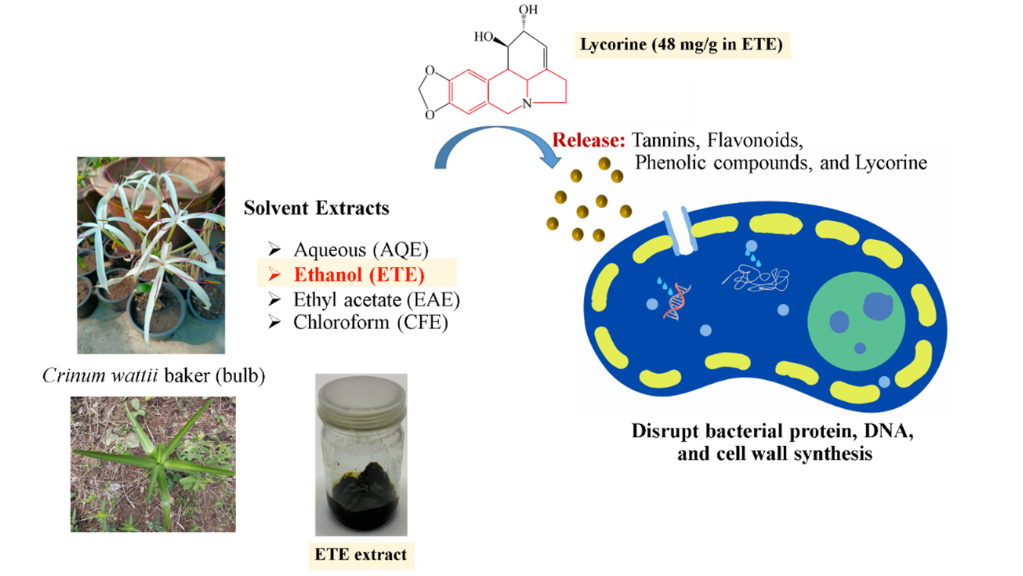
Crinum wattii Baker, a perennial herb from the Amaryllidaceae family, was studied for its phytochemical content and antibacterial activity. Aqueous (AQE), ethanol (ETE), ethyl acetate (EAE), and chloroform (CFE) extracts from bulb samples were analyzed using colorimetric assays and high-performance liquid chromatography (HPLC). The ETE contained 47.93 mg/g of lycorine, suggesting its use as a quality control marker. AQE, EAE, and ETE showed high levels of tannins, flavonoids, and phenolics, respectively. Antibacterial activity was evaluated via disc diffusion method, revealing ETE as the most potent, especially against Bacillus cereus and Bacillus subtilis. Transmission electron microscopy (TEM) and scanning electron microscopy (SEM) revealed ETE-induced bacterial lysis and abnormal elongation, while Fourier Transform Infrared (FT-IR) spectroscopy indicated reductions in protein amides, polysaccharides, ester lipids, and nucleic acids, alongside an increase in phospholipids. These findings suggest that ETE disrupts bacterial protein, DNA, and cell wall synthesis in Bacillus subtilis, as evidenced by FT-IR analysis and ultrastructural changes. However, further molecular-level studies are required to identify the specific targets and mechanisms involved. In summary, C. wattii ETE, rich in lycorine and phenolics, exerts bactericidal effects through a lysis-based mechanism.
HIGHLIGHTS
- Crinum wattii extracts demonstrate strong potential as natural antibacterial agents against resistant bacterial strains.
- The ethanolic extract (ETE) contained 47.93 mg/g of lycorine, supporting its use as a quality control marker.
- ETE exhibited the highest antibacterial activity, notably against Bacillus cereus and Bacillus subtilis.
- SEM and TEM analyses confirmed ETE-induced bacterial lysis and abnormal elongation of bacterial cells.
- FT-IR analysis revealed that ETE disrupts bacterial proteins, DNA, cell wall integrity, and membrane components.
GRAPHICAL ABSTRACT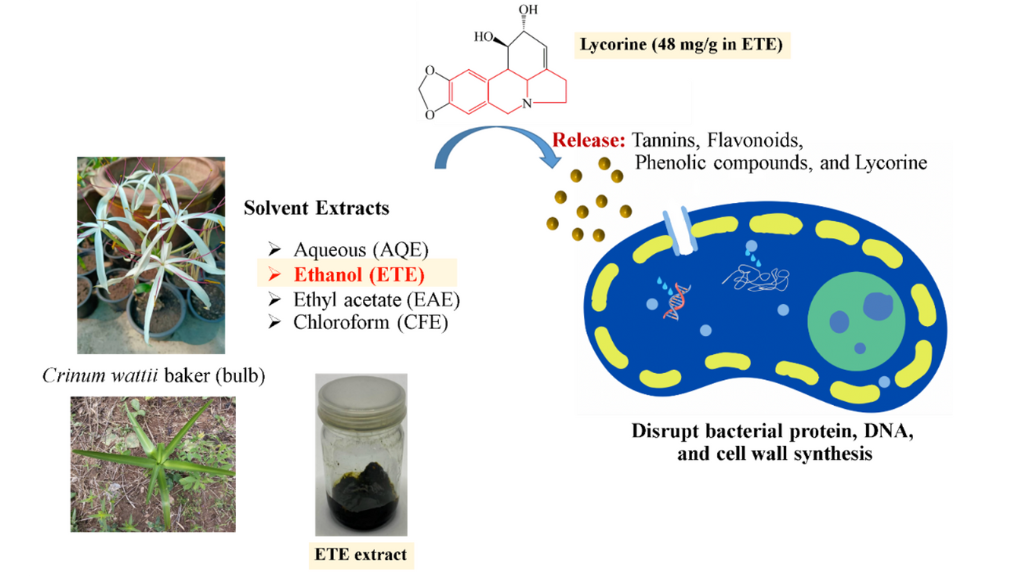
Downloads
References
N Kumar, M Kumar Mishra and OP Agrawal. In-vitro antioxidant activity of hydroalcoholic extract of Crinum latifolium using different method. International Journal of Health Sciences 2022; 6(S3), 9475-9481.
M Salihu, GE Batiha, KI Kasozi, GD Zouganelis, SMZ Sharkawi, EI Ahmed, IM Usman, H Nalugo, JJ Ochieng, I Ssengendo, OS Okeniran, T Pius, KR Kimanje, ES Kegoye, R Kenganzi and F Ssempijja. Crinum jagus (J. Thomps. Dandy): Antioxidant and protective properties as a medicinal plant on toluene-induced oxidative stress damages in liver and kidney of rats. Toxicology Reports 2022; 9(31), 699-712.
LC Silva, AF Correia, JV Gomes, W Romão, LC Motta, CW Fagg, PO Magalhães, D Silveira, YM Fonseca-Bazzo. Lycorine Alkaloid and Crinum americanum L. (Amaryllidaceae) extracts display antifungal activity on clinically relevant Candida species. Molecules 2022; 27(9), 2976.
BY Kianfé, J Kühlborn, RT Tchuenguem, BT Tchegnitegni, BK Ponou, J Groß, RB Teponno, JP Dzoyem, T Opatz and LA Tapondjou. Antimicrobial secondary metabolites from the medicinal plant Crinum glaucum A. Chev. (Amaryllidaceae). South African Journal of Botany 2020; 133(10), 161-166.
B Georgiev, B Sidjimova and S Berkov. Phytochemical and cytotoxic aspects of Amaryllidaceae alkaloids in Galanthus species: A review. Plants 2024; 13(24), 3577.
MJM Paiva, GNL Nascimento, IAM Damasceno, TT Santos and D Silveira. Pharmacological and toxicological effects of Amaryllidaceae. Brazilian Journal of Biology 2023; 83(2), e277092.
J Zhou, IA Stringlis, J Wen, Y Liu, S Xu and R Wang. Interplay between Amaryllidaceae alkaloids, the bacteriome and phytopathogens in Lycoris radiata. New Phytologist 2024; 241(5), 2258-2274.
N Barghout, N Chebata, S Moumene, S Khennouf, A Harbi and EH Di. Antioxidant and antimicrobial effect of alkaloid bulbs extract of Polianthes tuberosa L. (Amaryllidaceae) cultivated in Algeria. Journal of Drug Delivery and Therapeutics 2020; 10(4), 44-8.
TT Alawode, L Lajide, BJ Owolabi and MT Olaleye. Investigation of bulb extracts of Crinum jagus for antibacterial and antifungal activities. Journal of Applied Sciences and Environmental Management 2021; 25(1), 113-117.
A Di Sotto, M Valipour, A Azari, S Di Giacomo and H Irannejad. Benzoindolizidine alkaloids tylophorine and lycorine and their analogues with antiviral, anti-Inflammatory, and anticancer properties: Promises and challenges. Biomedicines 2023; 11(10), 2619.
S Kamonwannasit, B Prajanban, A Kamcharoen. Modulatory effect of Plab Plueng Khao (Crinum wattii) bulb extract on antioxidant activity and pro-inflammatory mediators. Huachiew Chalermprakiet Science and Technology Journal 2023; 9(1), 28-43.
N Nasim, IS Sandeep and S Mohanty. Plant-derived natural products for drug discovery: Current approaches and prospects. The Nucleus 2022; 65(5), 399-411.
N Chaachouay and L Zidane. Plant-derived natural products: A source for drug discovery and development. Drugs Drug Candidates 2024; 3(1), 184-207.
M Ahmad, M Tahir, Z Hong, MA Zia, H Rafeeq, MS Ahmad, S Rehman and J Sun. Plant and marine-derived natural products: sustainable pathways for future drug discovery and therapeutic development. Frontiers in Pharmacology 2025; 15, 1497668.
K Sawangjaroen and K Keereevong. Spasmolytic effect of papaya (Carica papaya L.) leave alkaloid on isolated rat myometrial contraction in vitro. Trends in Sciences 2022; 19(4), 2684.
ZH Pu, D Min, X Liang and C Peng. Total alkaloids from the rhizomes of Ligusticum striatum: A review of chemical analysis and pharmacological activities. Natural Product Research 2022; 36(13), 3489-3506.
GN Pham and H Nguyen-Ngoc. Fissistigma genus – a review on phytochemistry and pharmacological activities. Natural Product Research 2021; 35(23), 5209-5223.
S Tan, MG Banwell, WC Ye, P Lan and LV White. The inhibition of RNA viruses by amaryllidaceae alkaloids: Opportunities for the development of broad-spectrum anti-coronavirus drugs. Chemistry: An Asian Journal 2022; 17(4), e202101215.
TE Sebola, NC Uche-Okereafor, L Mekuto, MM Makatini, E Green and V Mavumengwana. Antibacterial and anticancer activity and untargeted secondary metabolite profiling of crude bacterial endophyte extracts from crinum macowanii baker leaves. International Journal of Microbiology 2020; 2020(1), 8839490.
ZU Zango, A Garba, FB Shittu, SS Imam, A Haruna, MU Zango, IA Wadi, U Bello, H Adamu, BE Keshta, DO Bokov, O Baigenzhenov and A Hosseini-Bandegharaei. A state-of-the-art review on green synthesis and modifications of ZnO nanoparticles for organic pollutants decomposition and CO2 conversion. Journal of Hazardous Materials Advances 2025; 17, 100588.
MA Uddin, X Yuan, L Wang, H Yu, H Wang, X Yuan, BE Keshta, A Basit, C Ouyang, Y Yuan, Y Zheng, J Hu and J Feng. Biomass-derived organonanomaterials as contrast agents for efficient magnetic resonance imaging. ACS Applied Bio Materials 2024; 7(12), 8479-8488.
S Palaniyappan, A Sridhar, Z Abdul Kari, G Tellez-Isaias and T Ramasamy. Evaluation of phytochemical screening, pigment content, in vitro antioxidant, antibacterial potential and GC-MS metabolite profiling of green seaweed Caulerpa racemosa. Marine drugs 2023; 21, 278.
I Ivanov, S Berkov and A Pavlov. Improved HPLC metod for the determination of amaryllidaceae alkaloids. Biotechnol. Biotechnology & Biotechnological Equipment 2009; 23(S1), 809-813.
W Tafroji, NI Margyaningsih, MM Khoeri, WT Paramaiswari, Y Winarti, K Salsabila, HFM Putri, NC Siregar, A Soebandrio and D Safari. Antibacterial activity of medicinal plants in Indonesia on Streptococcus pneumoniae. PLoS One 2022; 17(9), e0274174.
HM Alkreathy and A Esmat. Lycorine ameliorates thioacetamide-induced hepatic fibrosis in rats: Emphasis on antioxidant, anti-inflammatory, and STAT3 inhibition effects. Pharmaceuticals 2022; 15(3), 369.
C Cylke, F Si and S Banerjee. Effects of antibiotics on bacterial cell morphology and their physiological origins. Biochemical Society Transactions 2022; 50(5), 1269-1279.
A Penesyan, IT Paulsen, MR Gillings, S Kjelleberg and MJ Manefield. Secondary effects of antibiotics on microbial biofilms. Frontiers in Microbiology 2020; 11, 2109.
T Stachurová, K Malachová, J Semerád, M Sterniša, Z Rybková and SS Možina. Tetracycline induces the formation of biofilm of bacteria from different phases of wastewater treatment. Processes 2020; 8(8), 989.
N Ojkic, D Serbanescu and S Banerjee. Antibiotic resistance via bacterial cell shape-shifting. mBio 2022; 13(3), e00659-22.
N Ojkic and S Banerjee. Bacterial cell shape control by nutrient-dependent synthesis of cell division inhibitors. Biophysical Journal 2021; 120(11), 2079-2084.
S Ansari, CW James, LB Amy, GD Iain, C Burke and JH Elizabeth. A newly identified prophage gene, ymfM, causes SOS-inducible filamentation in Escherichia coli. Journal of Bacteriology 2021; 203(11), e00646-20.
N Ojkic, E Lilja, S Direito, A Dawson, RJ Allen and B Waclaw. A roadblock-and-kill mechanism of action model for the DNA-targeting antibiotic ciprofloxacin. Antimicrobial Agents and Chemotherapy 2020; 64(9), e02487-19.
Z Yu, ECA Goodall, IR Henderson and J Guo. Plasmids can shift bacterial morphological response against antibiotic stress. Advanced Science 2023; 10(2), 2203260.
S Banerjee, K Lo, N Ojkic, R Stephens, NF Scherer and AR Dinner. Mechanical feedback promotes bacterial adaptation to antibiotics. Nature Physics volume 2021; 17(3), 403-409.
Published
How to Cite
Issue
Section
License
Copyright (c) 2025 Walailak University

This work is licensed under a Creative Commons Attribution-NonCommercial-NoDerivatives 4.0 International License.





