
Antibacterial Hydrogel Films Embedded with Cu–Ag Oxide Nanoparticles Based on Basil Seed Mucilage for Advanced Wound Dressing Applications
DOI:
https://doi.org/10.48048/tis.2025.10418Keywords:
Alginate, Antibacterial activity, Basil seed mucilage, Composite material, Copper-silver oxide, Gelatin, Hydrogel film, Alginate, Antibacterial activity, Basil seed mucilage, Composite material, Copper-silver oxide, Gelatin, Hydrogel filmAbstract
Hydrogel films with antibacterial properties, swelling capability, and mechanical strength show promise as wound dressings. This study investigates the fabrication of Cu1.0-xAgₓO (x = 0.0, 0.1, 0.5, 0.9, and 1.0) antibacterial nanoparticles loaded into basil seed mucilage (BSM)/hydrogel (BSM/HG) films via a casting method. The crystal phases, surface chemical composition, and antimicrobial efficacy of Cu1.0-xAgₓO particles were characterized using X-ray diffraction (XRD), X-ray photoemission spectroscopy (XPS), and agar well diffusion assays. XRD analysis confirmed that
Cu1.0-xAgₓO (x = 0.1 – 0.7) samples formed composites containing CuO, Ag, and Ag2O phases. Among them, Cu0.7Ag0.3O exhibited superior antibacterial activity, achieving inhibition zone diameters of 8 - 13 mm against Bacillus cereus, Staphylococcus aureus, Streptococcus thermophilus, and Escherichia coli. The hydrogel demonstrated good swelling capacity and mechanical strength suitable for wound dressing applications. The incorporation of Cu0.7Ag0.3O nanoparticles into BSM/HG films reduced both swelling capacity and tensile strength due to particle agglomeration, although the antibacterial properties were significantly enhanced. This research highlights the potential of Cu1.0-xAgₓO-loaded BSM/HG films for advanced wound dressing applications.
HIGHLIGHTS
- Formation of various phases on Cu0.7Ag0.3O composite including CuO, metallic Ag and Ag2O improved antibacterial activity.
- Cu0.7Ag0.3O loaded BSM/HG film showed excellent antibacterial activity against Gram-positive and Gram-negative bacteria.
- Cu0.7Ag0.3O loaded BSM/HG film has the suitability as an antibacterial material in biomedical applications.
GRAPHICAL ABSTRACT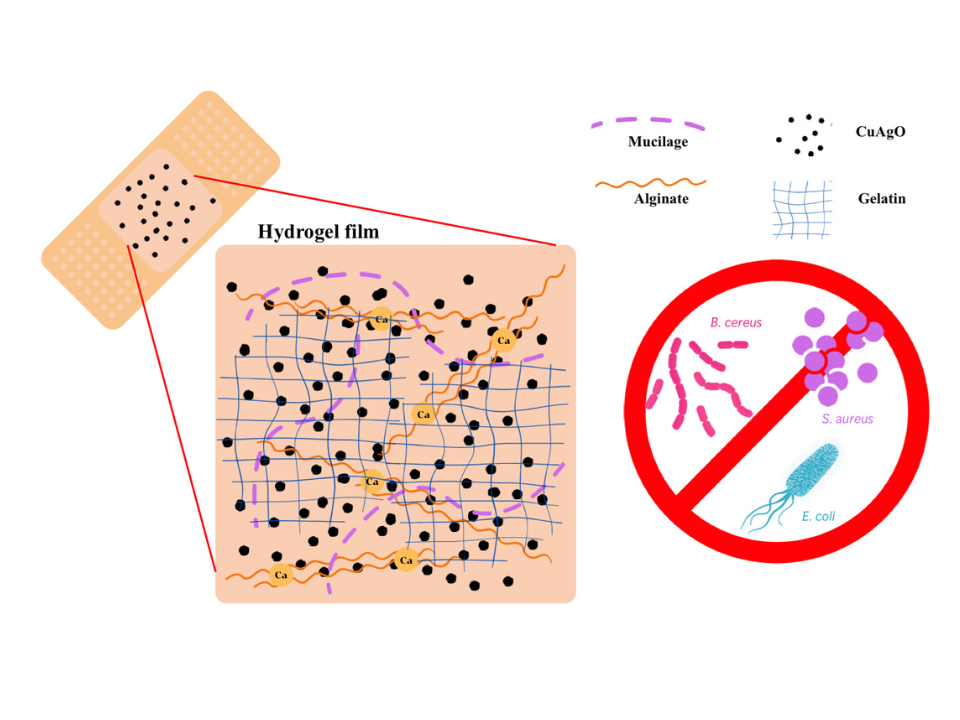
Downloads
References
V Brumberg, T Astrelina, T Malivanova and A Samoilov. Modern wound dressings: Hydrogel dressings. Biomedicines 2021; 9(9),1235.
MB Labowska, K Cierluk, AM Jankowska, J Kulbacka, J Detyna and I Michalak. A review on the adaption of alginate-gelatin hydrogels for 3D cultures and bioprinting. Materials 2021; 14(4), 858.
S Yue, H He, B Li and T Hou. Hydrogel as a biomaterial for bone tissue engineering: A review. Nanomaterials 2020; 10(8), 1511.
H Zhang, Q Song, Z Deng, J Ren and X Xiang. Sodium alginate hydrogel toughened by guar gum for strain sensors. Polymer Bulletin 2024; 81, 8045-8056.
ME Batouti, W Sadik, AG Eldemerdash, E Hanafy and HA Fetouh. New and innovative microwave-assisted technology for synthesis of guar gum-grafted acrylamide hydrogel superabsorbent for the removal of acid red 8 dye from industrial wastewater. Polymer Bulletin 2023; 80(5), 4965-4989.
M Moradi, A Barati, S Moradi and E Zarinabadi. Synthesis and characterization of starch-based hydrogels containing myrtus oil nanoemulsion for wound dressings. Polymer Bulletin 2023; 80, 3043-3062.
KGD Oznur and TDA Pınar. Statistical evaluation of biocompatibility and biodegradability of chitosan/gelatin hydrogels for wound-dressing applications. Polymer Bulletin 2024; 81, 1563-1596.
G Nifontova, S Safaryan, Y Khristidis, O Smirnova, M Vosough, A Shpichka and P Timashev. Advancing wound healing by hydrogel-based dressings loaded with cell-conditioned medium: A systematic review. Stem Cell Research & Therapy 2024; 15(1), 371.
R Jaiswal and AP Sherje. Recent advances in biopolymer-based smart hydrogel for wound healing. Journal of Drug Delivery Science and Technology 2024; 99, 105990.
S Bashir, M Hina, J Iqbal, AH Rajpar, MA Mujtaba, NA Alghamdi, S Wageh, K Ramesh and S Ramesh. Fundamental concepts of hydrogels: Synthesis, properties, and their applications. Polymers 2020; 12(11), 2702.
NP Esfahani, N Koupaei and H Bahreini. Fabrication and characterization of a novel hydrogel network composed of polyvinyl alcohol/polyvinylpyrrolidone/nano-rGO as wound dressing application. Journal of Polymer Research 2023; 30, 56.
X Lin, X Zhao, C Xu, L Wang and Y Xia. Progress in the mechanical enhancement of hydrogels: Fabrication strategies and underlying mechanisms. Journal of Polymer Science 2022; 60(17), 2525-2542.
Q Chen, H Chen, L Zhu and J Zheng. Fundamentals of double network hydrogels. Journal of Materials Chemistry B 2015; 3(18), 3654-3676.
KO Rojek, M Cwiklinska, J Kuczak and J Guzowski. Microfluidic formulation of topological hydrogels for microtissue engineering. Chemical Reviews 2021; 122(22), 16839-16909.
S Cometa, C Licini, MA Bonifacio, P Mastrorilli, M Mattioli-Belmonte and ED Giglio. Carboxymethyl cellulose-based hydrogel film combined with berberine as an innovative tool for chronic wound management. Carbohydrate Polymers 2022; 283, 119145.
A Saarai, V Kasparkova, T Sedlacek and P Saha. On the development and characterisation of crosslinked sodium alginate/gelatine hydrogels. Journal of the Mechanical Behavior of Biomedical Materials 2013; 18, 152-166.
K Yari, I Akbari and SAV Yazdi. Development and evaluation of sodium alginate-basil seeds mucilage beads as a suitable carrier for controlled release of metformin International Journal of Biological Macromolecules 2020; 159, 1-10.
F Kurd, M Fathi and H Shekarchizadeh. Basil seed mucilage as a new source for electrospinning: Production and physicochemical characterization. International Journal of Biological Macromolecules 2017; 95, 689-695.
N Srikhao, K Chirochrapas, N Kwansanei, P Kasemsiri, A Ounkaew, M Okhawilai, C Likitaporn, S Theerakulpisut and H Uyama. Multi-responsive optimization of novel pH-sensitive hydrogel beads based on basil seed mucilage, alginate, and magnetic particles. Gels 2022; 8(5), 274.
S Nazir and IA Wani. Functional characterization of basil (Ocimum basilicum L.) seed mucilage. Bioactive Carbohydrates and Dietary Fibre 2021; 25, 100261.
X Jing, H Mi, BN Napiwocki, X Peng and L Turng. Mussel-inspired electroactive chitosan/graphene oxide composite hydrogel with rapid self-healing and recovery behavior for tissue engineering. Carbon 2017; 125, 557-570.
AA Mohammed, S Li, T Sang, JR Jones and A Pinna. Nanocomposite hydrogels with polymer grafted silica nanoparticles using glucose oxidase. Gels 2023; 9(6), 486.
Y Kaptan, O Karal-Yilmaz, B Izbudak, B Giray, B Yilmaz and A Bal-Ozturk. Preparation of tetracycline hydrochloride loaded chitosan/silk fibroin/ZnO antibacterial biocomposite hydrogel sponges for wound healing application. Journal of Polymer Research 2023; 30, 49.
A Martinez-Higuera, C Rodriguez-Beas, JMA Villalobos-Noriega, A Arizmendi-Grijalva, C Ochoa-Sanchez, E Larios-Rodriguez, JM Martinez-Soto, E Rodriguez-Leon, C Ibarra-Zazueta, R Mora-Monroy, HA Borbon-Nunez, A Garcia-Galaz, MDC Candia-Plata, LF Lopez-Soto and R Iniguez-Palomares. Hydrogel with silver nanoparticles synthesized by Mimosa tenuiflora for second-degree burns treatment. Scientific Reports 2021; 11, 11312.
P Phatai and CM Futalan. Characteristics of cerium-aluminum-manganese mixed oxides and their performance in adsorbing methyl violet dye from an aqueous solution. Desalination and Water Treatment 2017; 62, 257-266.
S Kamonwannasit, CM Futalan, P Khemthong, T Butburee, A Karaphun and P Phatai. Synthesis of copper-silver doped hydroxyapatite via ultrasonic coupled sol-gel techniques: structural and antibacterial studies. Journal of Sol-Gel Science and Technology 2020; 96(2), 452-463.
FA Akgul, G Akgul, N Yildirim, HE Unalan and R Turan. Influence of thermal annealing on microstructural, morphological, optical properties and surface electronic structure of copper oxide thin films. Materials Chemistry and Physics 2014; 147(3), 987-995
F Arshad, A Munir, QQ Kashif, TU Haq, J Iqbal, F Sher and I Hussain. Controlled development of higher-dimensional nanostructured copper oxide thin films as binder free electrocatalysts for oxygen evolution reaction, International Journal of Hydrogen Energy 2020; 45(33), 16583-16590.
VDCG Videira, BN Harada, VG Vital, RAGD Silva, SPD Vasconcellos and DS Pellosi. Structural and antibacterial evaluation of copper, silver, and bimetallic silver/copper nanoalloys synthesized in chitosan biopolymer. Next Materials 2024; 3, 100071.
V Sudha, G Murugadoss and R Thangamuthu. Structural and morphological tuning of Cu-based metal oxide nanoparticles by a facile chemical method and highly electrochemical sensing of sulphite. Scientific Reports 2021; 11, 3413.
TC Kaspar, T Droubay, SA Chambers and PS Bagus. Spectroscopic evidence for Ag(III) in highly oxidized silver films by x-ray photoelectron spectroscopy. The Journal of Physical Chemistry C 2010; 114(49), 21562-21571.
P Prieto, V Nistor, K Nouneh, M Oyama, M Abd-Lefdil and R Diaz. XPS study of silver, nickel and bimetallic silver–nickel nanoparticles prepared by seed-mediated growth. Applied Surface Science 2012; 258(22), 8807-8813.
K Bialik-Was, KN Raftopoulos and K Pielichowski. Alginate hydrogels with aloe vera: The effects of reaction temperature on morphology and thermal properties. Materials 2022; 15(3), 748.
H Wang, J Liu, X Fan, J Ren, Q Liu and B Kong. Fabrication, characterisation, and application of green crosslinked sodium alginate hydrogel films by natural crab-shell powders to achieve drug sustained release. LWT 2022; 171, 114147.
Y Dong, D Sang, C He, X Sheng and L Lei. Mxene/alginate composites for lead and copper ion removal from aqueous solutions. RSC Advances 2019; 9(50), 29015-29022.
W Lee and K Tsao. Effect of silver nanoparticles content on the various properties of nanocomposite hydrogels by in situ polymerization. Journal of Materials Science 2010; 45(1), 89-97.
GR Deen and V Chua. Synthesis and properties of new “Stimuli” responsive nanocomposite hydrogels containing silver nanoparticles. Gels 2015; 1(1), 117-134.
HA Ali and NJ Hameed. The study of the particle size effect on the physical properties of TiO2/cellulose acetate composite films. Journal of the Mechanical Behavior of Materials 2022; 31(1), 150-159.
SA Alobaid, S Shrestha, M Tasseff, B Wang, MLV Hoek and PK Dutta. Activity of silver-zinc nanozeolite-based antibiofilm wound dressings in an in vitro biofilm model and comparison with commercial dressings. Discover Nano 2025; 20(1), 26.

Published
How to Cite
Issue
Section
License
Copyright (c) 2025 Walailak University

This work is licensed under a Creative Commons Attribution-NonCommercial-NoDerivatives 4.0 International License.





