
Improving Nham Hed Quality and Safety through Co-Starter Fermentation with Lactiplantibacillus plantarum NH48/12 and Saccharomyces cerevisiae TISTR 5110
DOI:
https://doi.org/10.48048/tis.2025.10206Keywords:
Lactiplantibacillus plantarum NH48/12, Saccharomyces cerevisiae TISTR 5110, Nham Hed, Co-starter fermentation, Microbial safety, Volatile compounds, Sensory qualityAbstract
This study evaluated the effects of Lactiplantibacillus plantarum NH48/12 and Saccharomyces cerevisiae TISTR 5110 as co-starter cultures in Nham Hed fermentation, focusing on fermentation dynamics, microbial stability, biochemical composition, and sensory characteristics. The addition of L. plantarum NH48/12 at 4% (w/w) significantly enhanced acidification, rapidly reducing pH within 24 hours and promoting lactic acid bacteria (LAB) proliferation. Co-starter fermentation with S. cerevisiae TISTR 5110 accelerated yeast establishment, reaching 8 log CFU/g within 2 days but did not significantly affect pH, acidity, or LAB populations. Free amino acid (FAA) analysis revealed increased levels of key flavor-enhancing amino acids, while volatile organic compound (VOC) profiling identified 2 unique compounds—butanoic acid, ethyl ester, and benzeneacetaldehyde—exclusively in co-starter fermented samples, contributing to improved aroma and taste. Microbiological safety assessment confirmed the absence of Escherichia coli, Staphylococcus aureus, Clostridium perfringens, Bacillus cereus, and Salmonella spp., indicating the effectiveness of fermentation conditions in controlling pathogens. Sensory evaluation showed that co-starter fermentation significantly improved odor, taste, and overall consumer acceptance. These findings support the application of co-starter cultures to enhance fermentation efficiency, product quality, and safety in Nham Hed production. Future studies should investigate the biochemical pathways involved in flavor development to further optimize fermentation conditions.
HIGHLIGHTS
- L. plantarum NH48/12 at 4 % w/w significantly accelerated acidification, reducing pH within 24 h and promoting LAB proliferation.
- Co-starter fermentation with S. cerevisiae TISTR 5110 facilitated rapid yeast growth (8 log CFU/g in 2 days) without significantly affecting pH, acidity, or LAB populations.
- Free amino acid (FAA) analysis showed an increase in key flavor-enhancing amino acids while volatile organic compound (VOC) profiling identified butanoic acid, ethyl ester, and benzeneacetaldehyde contributing to superior aroma and taste.
- Fermentation effectively inhibited foodborne pathogens including E. coli, S. aureus, C. perfringens, B. cereus, and Salmonella sp., ensuring product safety.
- Sensory evaluation confirmed significant improvements in odor, taste, and overall acceptance supporting co-starter cultures as a promising approach to improving fermentation efficiency, product quality, and safety in Nham Hed production.
GRAPHICAL ABSTRACT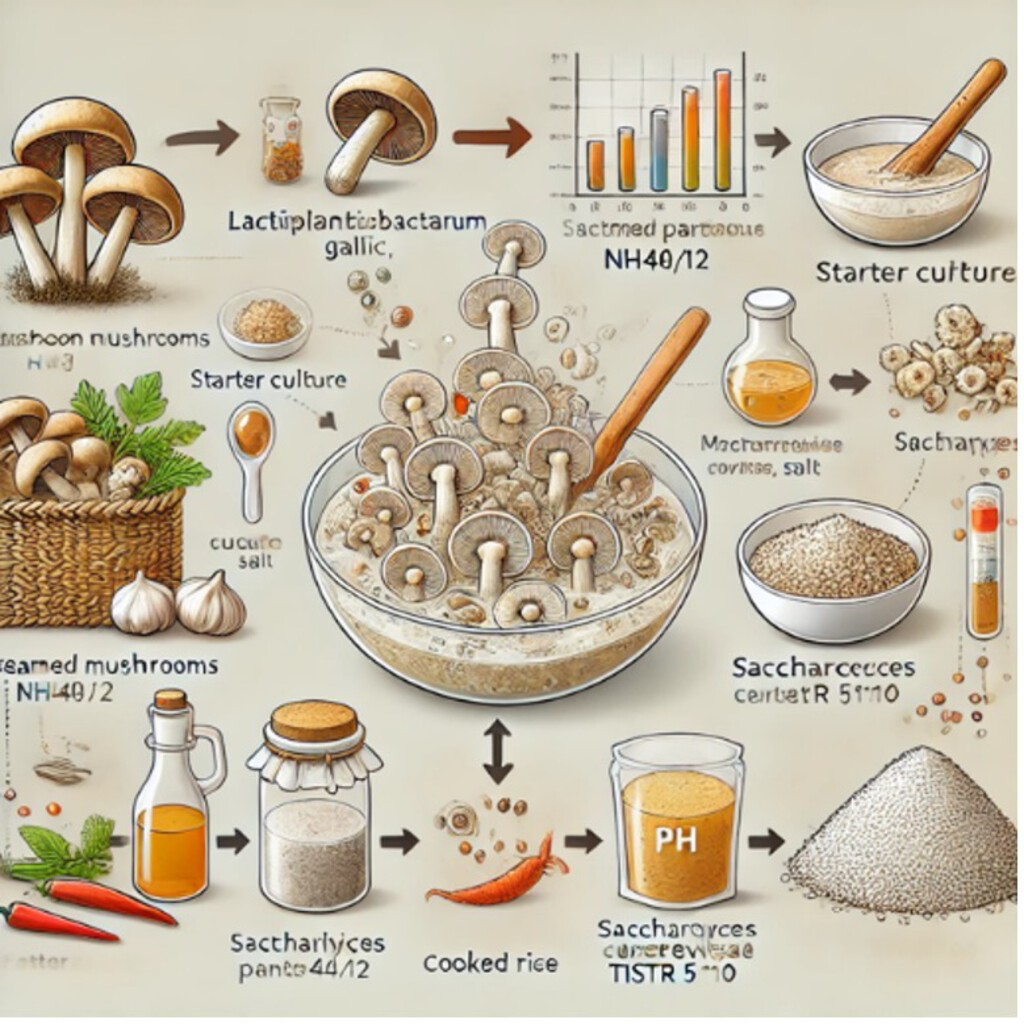
Downloads
References
D Bao, S Kinugasa and Y Kitamoto. The biological species of oyster mushrooms (Pleurotus spp.) from Asia based on mating compatibility tests. Journal of Wood Science 2004; 50, 162-168.
J Raman, KY Jang, YL Oh, M Oh, JH Im, H Lakshmanan and V Sabaratnam. Cultivation and nutritional value of prominent Pleurotus spp.: An overview. Mycobiology 2021; 49(1), 1-14.
P Rangsinth, R Sharika, N Pattarachotanant, C Duangjan, C Wongwan, C Sillapachaiyaporn, S Nilkhet, N Wongsirojkul, A Prasansuklab, T Tencomnao, GP Leung and S Chuchawankul. Potential beneficial effects and pharmacological properties of ergosterol, a common bioactive compound in edible mushrooms. Foods 2023; 12(13), 2529.
EI Eze, UM Ishiwu, CU Agbo, UP Chukwudi and JO Odo. Substrate effects on the yield, proximate, phytochemical and vitamin attributes of Pleurotus pulmonarius mushroom. Tropical Journal of Natural Product Research 2024; 8(10), 8819-8825.
K Castellanos-Reyes, R Villalobos-Carvajal and T Beldarrain-Iznaga. Fresh mushroom preservation techniques. Foods 2021; 10(9), 2126.
P Saithong, W Panthavee, M Boonyaratanakornkit and C Sikkhamondhol. Use of a starter culture of lactic acid bacteria in plaa-som, a Thai fermented fish. Journal of Bioscience and Bioengineering 2010; 110(5), 553-557.
J García-Díez and C Saraiva. Use of starter cultures in foods from animal origin to improve their safety. International Journal of Environmental Research and Public Health 2021; 18(5), 2544.
N Makhamrueang, S Sirilun, J Sirithunyalug, W Chaiyana, W Wangcharoen, S Peerajan and C Chaiyasut. Lactobacillus plantarum SK15 as a starter culture for prevention of biogenic amine accumulation in fermented beverage containing Hericium erinaceus mushroom. Applied Sciences 2021; 11(15), 6680.
J Xu, S Peng, Y Xiong, Z Zheng, M Liu, J Xu, W Chen, M Liu, J Kong, C Wang, Y Wang, L Rao, L Zhoa and X Liao. A review on fermented vegetables: Microbial community and potential upgrading strategy via inoculated fermentation. Comprehensive Reviews in Food Science and Food Safety 2024; 23(3), e13362.
Q Hua, Y Sun, Y Xu, P Gao and W Xia. Contribution of mixed commercial starter cultures to the quality improvement of fish-chili paste, a Chinese traditional fermented condiment. Food Bioscience 2022; 46, 101559.
Y Liu, XX Xie, SA Ibrahim, SG Khaskheli, H Yang, YF Wang and W Huang. Characterization of Lactobacillus pentosus as a starter culture for the fermentation of edible oyster mushrooms (Pleurotus spp.). LWT - Food Science and Technology 2016; 68, 21-26.
J Zheng, S Wittouck, E Salvetti, CM Franz, HM Harris, P Mattarelli, PW O’Toole, B Pot, P Vandemme, J Walter, K Watanabe, S Wuyts, GE Felis, MG Ganzle and S Lebeer. A taxonomic note on the genus Lactobacillus: Description of 23 novel genera, emended description of the genus Lactobacillus Beijerinck 1901, and union of Lactobacillaceae and Leuconostocaceae. International Journal of Systematic and Evolutionary Microbiology 2020; 70, 2782-2858.
N Garcia-Gonzalez, N Battista, R Prete and A Corsetti. Health-promoting role of Lactiplantibacillus plantarum isolated from fermented foods. Microorganisms 2021; 9(2), 349.
S Nitipan, K Boonloy, H Da-oh, J Permpool and P Saithong. In vitro assessment of probiotic properties in Lactobacillus strains isolated from traditionally fermented Thai foods. Naresuan University Journal: Science and Technology 2022; 30(2), 11-23.
B Yilmaz, SP Bangar, N Echegaray, S Suri, I Tomasevic, JM Lorenzo, E Melekoglu, JM Rocha and F Ozogul. The impacts of Lactiplantibacillus plantarum on the functional properties of fermented foods: A review of current knowledge. Microorganisms 2022; 10(4), 826.
Y Liu, M Danial, L Liu, FA Sadiq, X Wei and G Zhang. Effects of co-fermentation of Lactiplantibacillus plantarum and Saccharomyces cerevisiae on digestive and quality properties of steamed bread. Foods 2023; 12(18), 3333.
Z Que, S Wang, M Wei, Y Fang, T Ma, X Wang and X Sun. The powerful function of Saccharomyces cerevisiae in food science and other fields: A critical review. Food Innovation and Advances 2024; 3(2), 167-180.
M Carpena, M Fraga-Corral, P Otero, RA Nogueira, P Garcia-Oliveira, MA Prieto and J Simal-Gandara. Secondary aroma: Influence of wine microorganisms in their aroma profile. Foods 2020; 10(1), 51.
F Melini and V Melini. Role of microbial fermentation in the bio-production of food aroma compounds from vegetable waste. Fermentation 2024; 10(3), 132.
R Abdulgani, CC Lau, N Abdullah and S Vikineswary. Morphological and molecular characterization of Pleurotus pulmonarius hybrids with improved sporophore features and higher biological efficacy. International Journal of Agriculture and Biology 2017; 19(4), 707-712.
X Jin, W Chen, H Chen, W Chen and Q Zhong. Combination of Lactobacillus plantarum and Saccharomyces cerevisiae DV10 as starter culture to produce mango slurry: Microbiological, chemical parameters and antioxidant activity. Molecules 2019; 24(23), 4349.
H Wenkang, L Jingui, D Xuelu, R Yanjie, L Mingzhu, S Tingting, T Fuyao and Z Xuefeng. Saccharomyces cerevisiae strains L7 contribute to flavor and deacidification in Suanyu, a Chinese traditional fermented fish. NPJ Science of Food 2024; 8, 92.
M Zhang, L Wang, G Wu, X Wang, H Lv, J Chen, Y Liu, H Pang and Z Tan. Effects of Lactobacillus plantarum on the fermentation profile and microbiological composition of wheat fermented silage under the freezing and thawing low temperatures. Frontiers in Microbiology 2021; 12, 671287.
A Dysvik, SLL Rosa, KH Liland, KS Myhrer, HM Østlie, GD Rouck, EO Rakke, B Wasteren and T Wicklund. Co-fermentation involving Saccharomyces cerevisiae and Lactobacillus species tolerant to brewing-related stress factors for controlled and rapid production of sour beer. Frontiers in Microbiology 2020; 11, 279.
YN Li, Y Luo, ZM Lu, YL Dong, LJ Chai, JS Shi, XJ Zhang and ZH Xu. Metabolomic analysis of the effects of a mixed culture of Saccharomyces cerevisiae and Lactiplantibacillus plantarum on the physicochemical and quality characteristics of apple cider vinegar. Frontiers in Nutrition 2023; 10, 1142517.
S Tomita, J Watanabe, T Kuribayashi, S Tanaka and T Kawahara. Metabolomic evaluation of different starter culture effects on water-soluble and volatile compound profiles in nozawana pickle fermentation. Food Chemistry: Molecular Sciences 2021; 2, 100019.
J Luo, S Xiao, J Wang, B Wang, Y Cai and W Hu. The metabolite profiling and microbial community dynamics during pineapple by-product fermentation using co-inoculation of lactic acid bacteria and yeast. Fermentation 2023; 9(2), 79.
Z Tian, Q Zhu, Y Chen, Y Zhou, K Hu, H Li, K Lu, J Zhou, Y Liu and X Chen. Studies on flavor compounds and free amino acid dynamic characteristics of fermented pork loin ham with a complex starter. Foods 2022; 11(10), 1501.
M Gobbetti, MD Angelis, RD Cagno, M Calasso, G Archetti and CG Rizzello. Novel insights on the functional/nutritional features of the sourdough fermentation. International Journal of Food Microbiology 2019; 302, 103-113.
LD Vuyst and F Leroy. Functional role of yeasts, lactic acid bacteria and acetic acid bacteria in cocoa fermentation processes. FEMS Microbiology Reviews 2020; 44(4), 432-453.
O Ponomarova and KR Patil. Metabolic interactions in microbial communities: Untangling the Gordian knot. Current Opinion in Microbiology 2015; 27, 37-44.
Y Xu, KAHM Minhazul and X Li. The occurrence, enzymatic production, and application of ethyl butanoate, an important flavor constituent. Flavour and Fragrance Journal 2020; 35(6), 601-615.
H Yu, Q Li, W Guo, L Ai, C Chen and H Tian. Unraveling the difference in flavor characteristics of Huangjiu fermented with different rice varieties using dynamic sensory evaluation and comprehensive two-dimensional gas chromatography-quadrupole mass spectrometry. Frontiers in Nutrition 2023; 10, 1160954.
S Wang, Y Lu, X Fu, M Wang, W Wang, J Wang, H Wang and Y Liu. Sequential fermentation with Torulapora delbrueckii and selected Saccharomyces cerevisiae for aroma enhancement of longyan dry white wine. International Journal of Food Science and Technology 2022; 57(1), 576-589.
C Zeng, Y Mu, J Yuan, H Zhang, J Song and S Kang. Effects of Torulaspora delbrueckii and Saccharomyces cerevisiae co-fermentation on the physicochemical and flavor compounds of Huaniu apple cider. Molecules 2024; 29(8), 1750.
Y Xiao, S Zhang, X Wang, X Zhao, Z Liu, C Chu, Y Wang, X Hu and J Yi. Characterization of key aroma-active compounds in fermented chili pepper (Capsicum frutescens L.) using instrumental and sensory techniques. Food Chemistry: X 2024; 23, 101581.
Z Shi, W Li, Z Chen, Z Peng, M Ma, J Zhang, D Wu, G Xie and J Lu. Exploring the impact of different Saccharomyces cerevisiae strains on the flavor profile of greengage alcoholic beverage using GC-E-Nose, HS-GC-IMS, and HS-SPME-GC-MS. Foods 2024; 13(24), 3984.
D Zare, H Aryaee, S Mirdamadi and F Shirkhan. The benefits and applications of Lactobacillus plantarum in food and health: A narrative review. Iranian Journal of Public Health 2024; 53(10), 2201-2213.
R Elsabagh, SM Nada and EM Abd-Elaaty. Controlling food poisoning bacteria in fermented chicken sausage using Lactobacillus plantarum. World's Veterinary Journal 2021; 11(3), 462-468.
KY Park, JK Jeong, YE Lee and JW Daily. Health benefits of kimchi (Korean fermented vegetables) as a probiotic food. Journal of Medical Food 2014; 17(1), 6-20.
Published
How to Cite
Issue
Section
License
Copyright (c) 2025 Walailak University

This work is licensed under a Creative Commons Attribution-NonCommercial-NoDerivatives 4.0 International License.





