
Unlocking the Power of Capsaicin: A Comprehensive Review of Its Mechanisms and Applications
DOI:
https://doi.org/10.48048/tis.2025.10202Keywords:
Capsaicin, Clinical use, Good health and wellbeing, Pharmacology, TRPV1Abstract
Capsaicin is the main bioactive compound in chili peppers (Capsicum sp.) that has attracted widespread attention in pharmacology and health. This substance functions by stimulating the Transient Receptor Potential Vanilloid 1 (TRPV1) receptor, which is involved in the sense of pain, the control of body temperature, and inflammatory reactions. This study reviews the mechanism of action of capsaicin and its applications in various fields of health and clinical therapy. Capsaicin has diverse pharmacological effects, including as an analgesic, antioxidant, cardioprotective, anti-cancer, and metabolic regulator agent in the management of obesity. In addition, this compound shows potential in neurodegenerative therapy, such as Alzheimer’s and Parkinson’s diseases, by reducing oxidative stress and neuroinflammation. Capsaicin also has gastroprotective, dermatoprotective, antimicrobial, and anti-inflammatory effects, making it a potential ingredient in various medical applications. However, side effects such as gastrointestinal irritation, burning sensation, and possible long-term toxicity need to be considered in its use. Therefore, further research is needed to develop safer and more effective formulations. In addition to its medical applications, capsaicin is also used in the food and biotechnology industries. With a deeper understanding of its mechanisms of action such as affecting the nervous system, body fat profiles, and controlling hunger and other mechanisms described in this paper, capsaicin has the potential to be an important component in the development of molecular-based therapies. Further studies are needed to optimize its therapeutic benefits and explore its safety in broader clinical applications.
HIGHLIGHTS
- Capsaicin exerts its biological effects primarily through activation of the TRPV1 receptor, inducing calcium influx and neuropeptide release that mediate pain perception, thermoregulation, and inflammatory responses.
- Capsaicin demonstrates a broad spectrum of pharmacological properties, including antioxidant, anti-obesity, cardioprotective, anticancer, and antimicrobial activities via multiple cellular pathways.
- Capsaicin shows therapeutic potential in the management of neurodegenerative and metabolic disorders such as Alzheimer’s disease, Parkinson’s disease, and obesity by modulating oxidative stress and metabolic signaling mechanisms.
- Capsaicin’s clinical applications are limited by adverse effects, such as local irritation and gastrointestinal discomfort, thereby necessitating the development of safer and better-tolerated analogs.
- The discovery of endogenous and synthetic TRPV1 ligands reinforces capsaicin’s therapeutic relevance beyond nociception, extending to cardiovascular, dermatological, and gastrointestinal health.
GRAPHICAL ABSTRACT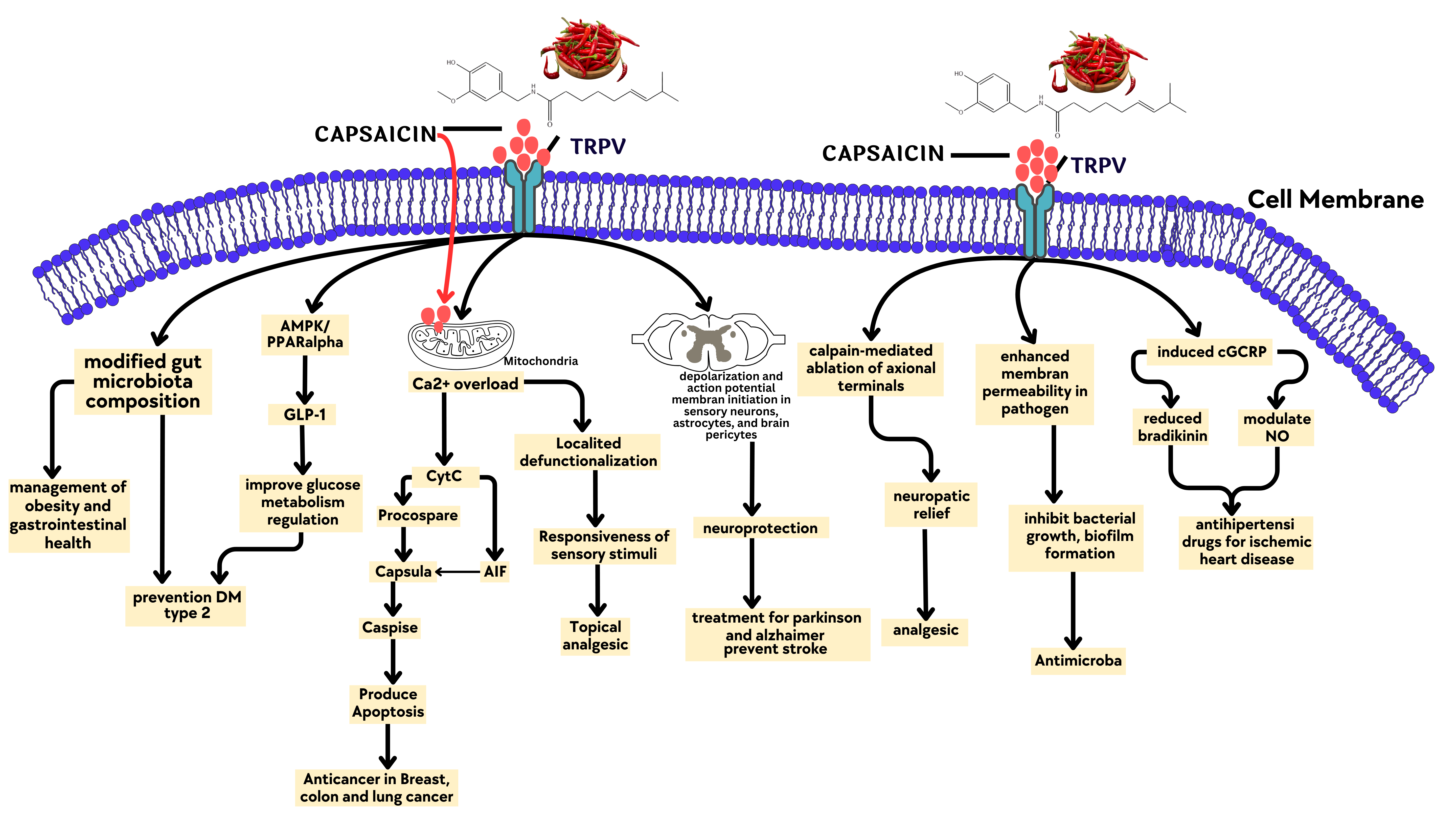
Downloads
References
GE Barboza, CC Garcia, LB Bianchetti, MV Romero and M Scaldaferro. Monograph of wild and cultivated chili peppers (Capsicum L., Solanaceae). PhytoKeys 2022; 200(4), 1-423.
BK Saleh, A Omer and B Teweldemedhin. Medicinal uses and health benefits of chili pepper (Capsicum spp.): A review. MOJ Food Processing & Technology 2018; 6(4), 325-328.
E Siebert, S Lee and MP Prescott. Chili pepper preference development and its impact on dietary intake: A narrative review. Frontiers in Nutrition 2022; 9, 1039207.
A Maharjan, BMK Vasamsetti and J Park. A comprehensive review of capsaicin: Biosynthesis, industrial productions, processing to applications, and clinical uses. Heliyon 2024; 10(21), e39721.
V Fattori, MSN Hohmann, AC Rossaneis, FA Pinho-Ribeiro and WA Verri. Capsaicin: Current understanding of its mechanisms and therapy of pain and other pre-clinical and clinical uses. Molecules 2016; 21(7), 844.
F Cervantes-Hernandez, P Alcala-Gonzalez, O Martinez and JJ Ordaz-Ortiz. Placenta, pericarp, and seeds of tabasco chili pepper fruits show a contrasting diversity of bioactive metabolites. Metabolites 2019; 9(10), 206.
MDL Reyes-Escogido, EG Gonzalez-Mondragon and E Vazquez-Tzompantzi. Chemical and pharmacological aspects of capsaicin. Molecules 2011; 16(2), 1253-1270.
R Milde, A Schnabel, T Ditfe, W Hoehenwarter, C Proksch, B Westermann and T Vogt. Chemical synthesis of trans 8-methyl-6-nonenoyl-coa and functional expression unravel capsaicin synthase activity encoded by the pun1 locus. Molecules 2022; 27(20), 6878.
BP Pratama, Y Pranoto, Supriyadi and RT Swasono. The identification of β-ocimene biosynthetic pathway through mevalonate acid (MVA) and 1-Deoxy-D-Xylulose 5-Phosphate (DXP) pathways using crude enzyme extracts in indonesian bay leaf/salam leaf (Syzygium polyanthum). Tropical Life Sciences Research 2022; 33(2), 1-18.
ADP Papoiu and G Yosipovitch. Topical capsaicin. The fire of a ‘hot’ medicine is reignited. Expert Opinion on Pharmacotherapy 2010; 11(8), 1359-1371.
F Wang, Y Xue, L Fu, Y Wang, M He, L Zhao and X Liao. Extraction, purification, bioactivity and pharmacological effects of capsaicin: A review. Critical Reviews in Food Science and Nutrition 2022; 62(19), 5322-5348.
V Rastogi, M Porwal, MS Sikarwar, B Singh, P Choudhary and BC Mohanta. A review on phytochemical and pharmacological potential of Bhut Jolokia (a cultivar of Capsicum chinense Jacq.). Journal of Applied Pharmaceutical Science 2024; 14(5), 079-090.
K Sahin, O Kucuk, C Orhan, E Sahin, K Fowler, T White, S Durkee and A Bellamine. Bioavailability of a Capsaicin Lipid Multi-particulate Formulation in Rats. European Journal of Drug Metabolism and Pharmacokinetics 2021; 46(5), 645-650.
A Hudita, B Galateanu, M Costache, C Negrei, RM Ion, L Iancu and O Ginghina. In vitro cytotoxic protective effect of alginate-encapsulated capsaicin might improve skin side effects associated with the topical application of capsaicin. Molecules 2021; 26(5), 1455.
W Zhang, Y Zhang, J Fan, Z Feng and X Song. Pharmacological activity of capsaicin: Mechanisms and controversies (Review). Molecular Medicine Reports 2024; 29(3), 38.
I Devesa, R Planells-Cases, G Fernandez-Ballester, JM Gonzalez-Ros, A Ferrer-Montiel and A Fernandez-Carvajal. Role of the transient receptor potential vanilloid 1 in inflammation and sepsis. Journal of Inflammation Research 2011; 4, 67-81.
S Munjuluri, DA Wilkerson, G Sooch, X Chen, FA White and AG Obukhov. Capsaicin and TRPV1 channels in the cardiovascular system: The role of inflammation. Cells 2021; 11(1), 18.
Q Du, Q Liao, C Chen, X Yang, R Xie and J Xu. The role of transient receptor potential vanilloid 1 in common diseases of the digestive tract and the cardiovascular and respiratory system. Frontiers in Physiology 2019; 10, 1064.
M Rhyu, MH Ozdener and V Lyall. Differential effect of TRPV1 modulators on neural and behavioral responses to taste stimuli. Nutrients 2024; 16(22), 3858.
EN Aroke, KL Powell-Roach, RB Jaime-Lara, M Tesfaye, A Roy, P Jackson and PV Joseph. Taste the pain: The role of TRP channels in pain and taste perception. International Journal of Molecular Sciences 2020; 21(16), 5929.
B Liu, C Zhang and F Qin. Functional recovery from desensitization of vanilloid receptor TRPV1 requires resynthesis of phosphatidylinositol 4,5-bisphosphate. Journal of Neuroscience 2005; 25(19), 4835-4843.
A Szallasi. Capsaicin and cancer: Guilty as charged or innocent until proven guilty? Temperature 2022; 10(1), 35-49.
K Bley, G Boorman, B Mohammad, D McKenzie and S Babbar. A comprehensive review of the carcinogenic and anticarcinogenic potential of capsaicin. Toxicologic Pathology 2012; 40(6), 847-873.
S Bal, AB Sharangi, TK Upadhyay, F Khan, P Pandey, S Siddiqui, M Saeed, H Lee and DK Yadav. Biomedical and antioxidant potentialities in chilli: Perspectives and way forward. Molecules 2022; 27(19), 6380.
Q Xiang, X Tang, S Cui, Q Zhang, X Liu, J Zhao, H Zhang, B Mao and W Chen. Capsaicin, the spicy ingredient of chili peppers: Effects on gastrointestinal tract and composition of gut microbiota at various dosages. Foods 2022; 11(5), 686.
S Basith, M Cui, S Hong and S Choi. Harnessing the therapeutic potential of capsaicin and its analogues in pain and other diseases. Molecules 2016; 21(8), 966.
N Tamburini, G Bollini, CA Volta, G Cavallesco, P Maniscalco, S Spadaro, F Qurantotto and R Ragazzi. Capsaicin patch for persistent postoperative pain after thoracoscopic surgery, report of two cases. Journal of Visualized Surgery 2018; 4, 51.
SR Georgescu, MI Sârbu, C Matei, MA Ilie, C Caruntu, C Constantin, M Neagu and M Tampa. Capsaicin: Friend or foe in skin cancer and other related malignancies? Nutrients 2017; 9(12), 1365.
H Yan, Z Wang and J Wang. Correlation of solubility and prediction of the mixing properties of capsaicin in different pure solvents. Industrial & Engineering Chemistry Research 2012; 51(6), 2808-2813.
N Wang, X Zhou, T Zhang, W Jian, Z Sun, P Qi, Y Feng, H Liu, L Liu and S Yang. Capsaicin from chili peppers and its analogues and their valued applications: An updated literature review. Food Research International 2025; 208(1), 116034.
K Elokely, P Velisetty, L Delemotte, E Palovcak, ML Klein, T Rohacs and V Carnevale. Understanding TRPV1 activation by ligands: Insights from the binding modes of capsaicin and resiniferatoxin. Biophysics and Computational Biology 2016; 113(2), E137-E145.
M Hayman and PCA Kam. Capsaicin: A review of its pharmacology and clinical applications. Current Anaesthesia & Critical Care 2008; 19(5-6), 338-343.
B Frias and A Merighi. Capsaicin, nociception and pain. Molecules 2016; 21(6), 797.
V Arora, JN Campbell and MK Chung. Fight fire with fire: Neurobiology of capsaicin-induced analgesia for chronic pain. Pharmacology & Therapeutics 2021; 220(1), 107743.
C Azmi, F Manik, A Rahayu, IR Saadah, RC Br Hutabarat, S Barus, BB Karo, R Tarigan, R Kirana, R Gaswanto and Harmanto. The potential and the quality of several open pollinated chili varieties seed production. IOP Conference Series: Earth and Environmental Science 2023; 1230, 012186.
SM Hanson, S Newstead, KJ Swartz and MSP Sansom. Capsaicin interaction with TRPV1 channels in a lipid bilayer: Molecular dynamics simulation. Biophysical Journal 2015; 108(6), 1425-1434.
M Manchanda, E Leishman, K Sangani, A Alamri and HB Bradshaw. Activation of TRPV1 by capsaicin or heat drives changes in 2-acyl glycerols and N-Acyl ethanolamines in a time, dose, and temperature dependent manner. Frontiers in Cell and Developmental Biology 2021; 9, 611952.
Y Takayama, D Uta, H Furue and M Tominaga. Pain-enhancing mechanism through interaction between TRPV1 and anoctamin 1 in sensory neurons. Pnas 2015; 112(16), 5213-5218.
E Pinter, Z Helyes, E Szoke, K Bolcskei, A Kecskes and G Petho. The triple function of the capsaicin-sensitive sensory neurons: In memoriam Janos Szolcsanyi. Temperature 2022; 10(1), 13-34.
P Sahbaie, X Shi, T Guo, Y Qiao, DC Yeomans, WS Kingery and JD Clark. Role of substance P signaling in enhanced nociceptive sensitization and local cytokine production after incision. Pain 2009; 145(3), 341-349.
P Baral, S Udit and IM Chiu. Pain and immunity: implications for host defence. Nature Reviews Immunology 2019; 19(7), 433-447.
MJ Caterina and Z Pang. TRP channels in skin biology and pathophysiology. Pharmaceuticals 2016; 9(4), 77.
A Latremoliere and CJ Woolf. Central sensitization: A generator of pain hypersensitivity by central neural plasticity. The Journal of Pain 2009; 10(9), 895-926.
YM Shuba. Beyond neuronal heat sensing: Diversity of TRPV1 heat-capsaicin receptor-channel functions. Frontiers in Cellular Neuroscience 2021; 14, 612480.
J Zheng. Molecular mechanism of TRP channels. Comprehensive Physiology 2013; 3(1), 221-242.
SS Abdalla, AA Harb, IM Almasri and YK Bustanji. The interaction of TRPV1 and lipids: Insights into lipid metabolism. Frontiers in Physiology 2022; 13(1), 1066023.
K Mitchell, EE Lebovitz, JM Keller, AJ Mannes, MI Nemenov and MJ Iadarola. Nociception and inflammatory hyperalgesia evaluated in rodents using infrared laser stimulation after Trpv1 gene knockout or resiniferatoxin lesion. Pain 2014; 155(4), 733-745.
HE Gibson, JG Edwards, RS Page, MJ Van Hook and JA Kauer. TRPV1 channels mediate long-term depression at synapses on hippocampal interneurons. Neuron 2008; 57(5), 746-759.
F Yang and J Zheng. Understand spiciness: Mechanism of TRPV1 channel activation by capsaicin. Protein & Cell 2017; 8(3), 169-177.
MJ Caterina, MA Schumacher, M Tominaga, TA Rosen, JD Levine and D Julius. The capsaicin receptor: A heat-activated ion channel in the pain pathway. Nature 1997; 389(6653), 816-824.
JK Bujak, D Kosmala, IM Szopa, K Majchrzak and P Bednarczyk. Inflammation, cancer and immunity-implication of TRPV1 channel. Frontiers in Oncology 2019; 9, 1087.
AD Mickle, AJ Shepherd and DP Mohapatra. Sensory TRP channels: The key transducers of nociception and pain. Progress in Molecular Biology and Translational Science 2015; 131, 73-118.
A Fernandez-Carvajal, G Fernández-Ballester and A Ferrer-Montiel. TRPV1 in chronic pruritus and pain: Soft modulation as a therapeutic strategy. Frontiers in Molecular Neuroscience 2022; 15, 930964.
N Tessier, M Ducrozet, M Dia, S Badawi, C Chouabe, CCD Silva, M Ovize, G Bidaux, FV Coppenolle and S Ducreux. TRPV1 channels are new players in the reticulum-mitochondria Ca2+ coupling in a rat cardiomyoblast cell line. Cells 2023; 12(18), 2322.
KC Thomas, AS Sabnis, ME Johansen, DL Lanza, PJ Moos, GS Yost and CA Reilly. Transient receptor potential vanilloid 1 agonists cause endoplasmic reticulum stress and cell death in human lung cells. The Journal of Pharmacology and Experimental Therapeutics 2007; 321(3), 830-838.
M Benitez-Angeles, SL Morales-Lazaro, E Juarez-Gonzalez and T Rosenbaum. TRPV1: Structure, endogenous agonists, and mechanisms. International Journal of Molecular Sciences 2020; 21(10), 3421.
GD Maio, I Villano, CR Ilardi, A Messina, V Monda, AC Iodice, C Porro, MA Panaro, S Chieffi, G Messina, M Monda and ML Marra. Mechanisms of transmission and processing of pain: A narrative review. International Journal of Environmental Research and Public Health 2023; 20(4), 3064.
WD Willis. The role of TRPV1 receptors in pain evoked by noxious thermal and chemical stimuli. Experimental Brain Research 2009; 196(1), 5-11.
K Starowicz, S Nigam and VD Marzo. Biochemistry and pharmacology of endovanilloids. Pharmacology & Therapeutics 2007; 114(1), 13-33.
L Menendez, A Lastra, A Hidalgo and A Baamonde. The analgesic effect induced by capsaicin is enhanced in inflammatory states. Life Sciences 2004; 74(26), 3235-3244.
J Huang, X Zhang and PA McNaughton. Inflammatory pain: The cellular basis of heat hyperalgesia. Current Neuropharmacology 2006; 4(3), 197-206.
GP Ahern, IM Brooks, RL Miyares and XB Wang. Extracellular cations sensitize and gate capsaicin receptor TRPV1 modulating pain signaling. Journal of Neuroscience 2005; 25(21), 5109-5116.
E Cao, JF Cordero-Morales, B Liu, F Qin and D Julius. TRPV1 channels are intrinsically heat sensitive and negatively regulated by phosphoinositide lipids. Neuron 2013; 77(4), 667-679.
T Hagenacker, F Splettstoesser, W Greffrath, RD Treede and D Busselberg. Capsaicin differentially modulates voltage-activated calcium channel currents in dorsal root ganglion neurones of rats. Brain Research 2005; 1062(1-2), 74-85.
MJ Iadarola and AJ Mannes. The vanilloid agonist resiniferatoxin for interventional-based pain control. Current Topics in Medicinal Chemistry 2011; 11(17), 2171-2179.
L Karai, DC Brown, AJ Mannes, ST Connelly, J Brown, M Gandal, OM Wellisch, JK Neubert, Z Olah and MJ Iadarola. Deletion of vanilloid receptor 1-expressing primary afferent neurons for pain control. Journal of Clinical Investigation 2004; 113(9), 1344-1352.
SK Mandal, SK Rath, R Logesh, SK Mishra, HP Devkota and N Das. Capsicum annuum L. and its bioactive constituents: A critical review of a traditional culinary spice in terms of its modern pharmacological potentials with toxicological issues. Phytotherapy Research 2023; 37(3), 965-1002
P Ansari, AD Reberio, NJ Ansari, S Kumar, JT Khan, S Chowdhury, FM Abd El-Mordy, JMA Hannan, PR Flatt, YHA Abdel-Wahab and V Seidel. Therapeutic potential of medicinal plants and their phytoconstituents in diabetes, cancer, infections, cardiovascular diseases, inflammation, and gastrointestinal disorders. Biomedicines 2025; 13(2), 454.
SK Panchal, E Bliss and L Brown. Capsaicin in metabolic syndrome. Nutrients 2018; 10(5), 630.
C Kang, Y Zhang, X Zhu, K Liu, X Wang, M Chen, J Wang, H Chen, S Hui, L Huang, Q Zhang, J Zhu, B Wang and M Mi. Healthy subjects differentially respond to dietary capsaicin correlating with specific gut enterotypes. The Journal of Clinical Endocrinology and Metabolism 2016; 101(12), 4681-4689.
A Tremblay, H Arguin and S Panahi. Capsaicinoids: A spicy solution to the management of obesity? International Journal of Obesity 2016; 40(8), 1198-1204.
A Szallasi. Capsaicin for weight control: “exercise in a pill” (or just another fad)? Pharmaceuticals 2022; 15(7), 851.
J Zheng, S Zheng, Q Feng, Q Zhang and X Xiao. Dietary capsaicin and its anti-obesity potency: From mechanism to clinical implications. Bioscience Reports 2017; 37(3), BSR20170286.
Q Zhang, P Luo, F Xia, H Tang, J Chen, J Zhang, D Liu, Y Zhu, Y Liu, L Gu, L Zheng, Z Li, F Yang, L Dai, F Liao, C Xu and J Wang. Capsaicin ameliorates inflammation in a TRPV1-independent mechanism by inhibiting PKM2-LDHA-mediated Warburg effect in sepsis. Cell Chemical Biology 2022; 29(8), 1248-1259.e6.
OME Abdel-Salam and G Mozsik. Capsaicin, the vanilloid receptor TRPV1 agonist in neuroprotection: mechanisms involved and significance. Neurochemical Research 2023; 48(11), 3296-3315.
M Chache, SS Das, D Choudhury, BJ Sahariah, GJ Ashraf, R Sahu, TK Dua, M Majumder and KN Dutta. GC-MS and HPTLC fingerprinting analysis and evaluation of antimicrobial activity of naga chilli: An in vitro and in silico approach. Biomedical Chromatography 2025; 39(1), e6058.
RDP Menezes, MADS Bessa, CDP Siqueira, SC Teixeira, EAV Ferro, MM Martins, LCS Cunha and CHG Martins. Antimicrobial, antivirulence, and antiparasitic potential of capsicum chinense jacq. extracts and their isolated compound capsaicin. Antibiotics 2022; 11(9), 1154.
BYC Pongajow, CV Simamora, M Sugata and J Jo. The combined antimicrobial activity of cayenne chili pepper (Capsicum frutescens) extract and Bifidobacterium breve BS2-PB3 against methicillin-resistant Staphylococcus aureus. FaST- Jurnal Sains dan Teknologi 2024; 8(2), 129-143.
J Lv, L Qi, C Yu, L Yang, Y Guo, Y Chen, Z Bian, D Sun, J Du, P Ge, Z Tang, W Hou, Y Li, J Chen, Z Chen, L Li and on behalf of the China Kadoorie Biobank collaborative group. Consumption of spicy foods and total and cause specific mortality: Population based cohort study. BMJ 2015; 351, h3942.
M Chopan and B Littenberg. The association of hot red chili pepper consumption and mortality: A large population-based cohort study. Plos One 2017; 12(1), e0169876.
A Szallasi. Dietary capsaicin: A spicy way to improve cardio-metabolic health? Biomolecules 2022; 12(12), 1783.
MR Amini, N Payandeh, F Sheikhhossein, M Alvani, A Talebyan, F Mohtashaminia and A Hekmatdoost. The effects of capsinoids and fermented red pepper paste supplementation on lipid profile: A systematic review and meta-analysis of randomized controlled trials. Clinical Nutrition Research 2022; 11(4), 302-315.
L Jiang, J Wang, L Ma, S Liu, Y Li, S Ding, X Yang, Y Liu, S He and H Yan. Chronic venous disease of lower limbs in young men at high-altitude: A cross-sectional survey. Phlebology 2024; 39(10), 669-675.
JL Silva, EA Santos and JI Alvarez-Leite. Are we ready to recommend capsaicin for disorders other than neuropathic pain? Nutrients 2023; 15(20), 4469.
MF McCarty, JJ DiNicolantonio and JH O’Keefe. Capsaicin may have important potential for promoting vascular and metabolic health. Open Heart 2015; 2(1), e000262.
O SOgut, H Kaya, M Gokdemir and Y Sezen. Acute myocardial infarction and coronary vasospasm associated with the ingestion of cayenne pepper pills in a 25-year-old male. International Journal of Emergency Medicine 2012; 5, 5.
T Szabados, K Gomori, L Palvolgyi, A Gorbe, I Baczko, Z Helyes, G Jancso, P Ferdinandy and P Bencsik. Capsaicin-sensitive sensory nerves and the trpv1 ion channel in cardiac physiology and pathologies. International Journal of Molecular Sciences 2020; 21(12), 4472.
M Nakanishi, K Hata, T Nagayama, T Sakurai, T Nishisho, H Wakabayashi, T Hiraga, S Ebisu and T Yoneda. Acid activation of Trpv1 leads to an up-regulation of calcitonin gene-related peptide expression in dorsal root ganglion neurons via the CaMK-CREB cascade: a potential mechanism of inflammatory pain. Molecular Biology of the Cell 2010; 21(15), 2568-2677.
R Yu, S Liu, Y Li, L Lu, S Huang, X Chen, Y Xue, T Fu, J Liu and Z Li. TRPV1+ sensory nerves suppress conjunctival inflammation via SST-SSTR5 signaling in murine allergic conjunctivitis. Mucosal Immunology 2024; 17(2), 211-225.
H Tang, Y Li, K Miyano and Y Nakata. Phosphorylation of TRPV1 by neurokinin-1 receptor agonist exaggerates the capsaicin-mediated substance P release from cultured rat dorsal root ganglion neurons. Neuropharmacology 2008; 55(8), 1405-1411.
LS Premkumar and P Sikand. TRPV1: A target for next generation analgesics. Current Neuropharmacology 2008; 6(2), 151-163.
T Rohacs. Phosphoinositide regulation of TRPV1 revisited. Pflügers Archiv - European Journal of Physiology 2015; 467(9), 1851-1869.
K Zhai, A Liskova, P Kubatka and D Busselberg. Calcium entry through TRPV1: A potential target for the regulation of proliferation and apoptosis in cancerous and healthy cells. International Journal of Molecular Sciences 2020; 21(11), 4177.
L Sanz-Salvador, A Andres-Borderia, A Ferrer-Montiel and R Planells-Cases. Agonist- and Ca2+-dependent desensitization of TRPV1 channel targets the receptor to lysosomes for degradation. Journal of Biological Chemistry 2012; 287(23), 19462-19471.
DC Rosenberger, U Binzen, R Treede and W Greffrath. The capsaicin receptor TRPV1 is the first line defense protecting from acute non damaging heat: A translational approach. Journal of Translational Medicine 2020; 18, 28.
M Chung and JN Campbell. Use of capsaicin to treat pain: Mechanistic and therapeutic considerations. Pharmaceuticals 2016; 9(4), 66.
M Nolano, DA Simone, G Wendelschafer-Crabb, T Johnson, E Hazen and WR Kennedy. Topical capsaicin in humans: Parallel loss of epidermal nerve fibers and pain sensation. Pain 1999; 81(1-2), 135-145.
P Holzer. The pharmacological challenge to tame the transient receptor potential vanilloid-1 (TRPV1) nocisensor. British Journal of Pharmacology 2008; 155(8), 1145-1162.
I Nagy, P Santha, G Jancso and L Urban. The role of the vanilloid (capsaicin) receptor (TRPV1) in physiology and pathology. European Journal of Pharmacology 2004; 500(1-3), 351-369.
S Choi, JY Lim, S Yoo, H Kim and SW Hwang. Emerging role of spinal cord TRPV1 in pain exacerbation. Neural Plasticity 2016; 2016(1), 5954890.
N Garcia-Sanz, A Fernandez-Carvajal, C Morenilla-Palao, R Planells-Cases, E Fajardo-Sanchez, G Fernandez-Ballester and A Ferrer-Montiel. Identification of a tetramerization domain in the C terminus of the vanilloid receptor. Journal of Neuroscience 2004; 24(23), 5307-5314.
M Tominaga and T Tominaga. Structure and function of TRPV1. Pflügers Archiv 2005; 451(1), 143-150.
J Chen, W Sun, Y Zhu, F Zhao, S Deng, M Tian, Y Wang and Y Gong. TRPV1: The key bridge in neuroimmune interactions. Journal of Intensive Medicine 2024; 4(4), 442-452.
MJ Gunthorpe and A Szallasi. Peripheral TRPV1 receptors as targets for drug development: New molecules and mechanisms. Current Pharmaceutical Design 2008; 14(1), 32-41.
MM Rahman, Y Jo, YH Kim and C Park. Current insights and therapeutic strategies for targeting TRPV1 in neuropathic pain management. Life Sciences 2024; 355, 122954.
CH Pratt, LE King, AG Messenger, AM Christiano and JP Sundberg. Alopecia areata. Nature Reviews Disease Primers 2017; 3, 17011.
AH Ehsani, S Toosi, H Seirafi, M Akhyani, M Hosseini, R Azadi, P Noormohamadpour and A Ghanadan. Capsaicin vs. clobetasol for the treatment of localized alopecia areata. Journal of the European Academy of Dermatology and Venereology 2009; 23(12), 1451-1453.
F Siebenhaar, AA Sharov, EMJ Peters, TY Sharova, W Syska, AN Mardaryev, P Freyschmidt-Paul, JP Sundberg, M Maurer and VA Botchkarev. Substance P as an immunomodulatory neuropeptide in a mouse model for autoimmune hair loss (alopecia areata). Journal of Investigative Dermatology 2007; 127(6), 1489-1497.
A Koivisto, MG Belvisi, R Gaudet and A Szallasi. Advances in TRP channel drug discovery: From target validation to clinical studies. Nature Reviews Drug Discovery 2022; 21(1), 41-59.
K Andersson, D Behr-Roussel, P Denys and F Giuliano. Acute intravesical capsaicin for the study of TRPV1 in the lower urinary tract: clinical relevance and potential for innovation. Medical Sciences 2022; 10(3), 50.
Y Qu, Y Fu, Y Liu, C Liu, B Xu, Q Zhang and P Jiang. The role of TRPV1 in RA pathogenesis: Worthy of attention. Frontiers in Immunology 2023; 14, 1232013.
R Brito, S Sheth, D Mukherjea, LP Rybak and V Ramkumar. TRPV1: A potential drug target for treating various diseases. Cells 2014; 3(2), 517-545.
S Derry, A Sven-Rice, P Cole, T Tan and RA Moore. Topical capsaicin (high concentration) for chronic neuropathic pain in adults. Cochrane Database of Systematic Reviews 2013; 1(1), CD007393.
BG Green and JE Hayes. Capsaicin as a probe of the relationship between bitter taste and chemesthesis. Physiology & Behavior 2003; 79(4-5), 811-821.
A Szallasi. Resiniferatoxin: nature’s precision medicine to silence TRPV1-Positive afferents. International Journal of Molecular Sciences 2023; 24(20), 15042.
A Giannantoni, SMD Stasi, RL Stephen, P Navarra, G Scivoletto, E Mearini and M Porena. Intravesical capsaicin versus resiniferatoxin in patients with detrusor hyperreflexia: a prospective randomized study. Journal of Urology 2002; 167(4), 1710-1714.
J Sheu. Pharmacological Effects of Rutaecarpine, an Alkaloid Isolated from Evodia rutaecarpa. Cardiovascular Drug Reviews 1999; 17(3), 237-245.
FA Russell, R King, S Smillie, X Kodji and SD Brain. Calcitonin gene-related peptide: Physiology and pathophysiology. Physiological Reviews 2014; 94(4), 1099-1142.
T Nguyen, Y Nam, S Lee, H Kim and C Jang. Effects of capsazepine, a transient receptor potential vanilloid type 1 antagonist, on morphine-induced antinociception, tolerance, and dependence in mice. British Journal of Anaesthesia 2010; 105(5), 668-674.
N Üçeyler and C Sommer. High-Dose Capsaicin for the Treatment of Neuropathic Pain: What We Know and What We Need to Know. Pain and Therapy 2014; 3(1), 73-84.
J O’Neill, C Brock, AE Olesen, T Andresen, M Nilsson and AH Dickenson. Unravelling the mystery of capsaicin: A tool to understand and treat pain. Pharmacological Reviews 2012; 64(4), 939-971.
WD Rollyson, CA Stover, KC Brown, HE Perry, CD Stevenson, CA McNees, JG Ball, MA Valentovic and P Dasgupta. Bioavailability of capsaicin and its implications for drug delivery. Journal of Controlled Release 2014; 196, 96-105.
CA Reilly, WJ Ehlhardt, DA Jackson, P Kulanthaivel, AE Mutlib, RJ Espina, DE Moody, DJ Crouch and GS Yost. Metabolism of capsaicin by cytochrome P450 produces novel dehydrogenated metabolites and decreases cytotoxicity to lung and liver cells. Chemical Research in Toxicology 2003; 16(3), 336-349.
S Thongin, T Den-Udom, K Uppakara, T Sriwantana, N Sibmooh, T Laolob, C Boonthip, U Wichai, K Muta and P Ketsawatsomkron. Beneficial effects of capsaicin and dihydrocapsaicin on endothelial inflammation, nitric oxide production and antioxidant activity. Biomedicine & Pharmacotherapy 2022; 154, 113521.
S Derry and RA Moore. Topical capsaicin (low concentration) for chronic neuropathic pain in adults. Cochrane Database of Systematic Reviews 2012; 2012(9), CD010111.
M Haddad, F Cherchi, M Alsalem, YM Al-Saraireh and S Madae’en. Adenosine receptors as potential therapeutic analgesic targets. International Journal of Molecular Sciences 2023; 24(17), 13160.
SE Thomas and H Laycock. The use of high dose topical capsaicin in the management of peripheral neuropathy: Narrative review and local experience. British Journal of Pain 2020; 14(2), 133-140.
V Guedes, JP Castro and I Brito. Topical capsaicin for pain in osteoarthritis: A literature review. Reumatología Clínica 2018; 14(1), 40-45.
V Vachiramon, P Tanratana, T Anuntrangsee, P Palakornkitti, N Yeesibsean, P Kungvalpivat and S Fabi. The role of topical capsaicin gel in pain management during microfocused ultrasound treatment for neck laxity. Skin Research and Technology 2023; 29(1), e13240.
S Derry, R Lloyd, RA Moore and HJ McQuay. Topical capsaicin for chronic neuropathic pain in adults. Cochrane Database of Systematic Reviews 2009; 1(4), CD007393.
KJ Holt, J Belcher and JA Smith. Novel capsaicin cough endpoints effectively discriminate between healthy controls and patients with refractory chronic cough. Respiratory Medicine 2023; 208, 107142.
JJ Adcock. TRPV1 receptors in sensitisation of cough and pain reflexes. Pulmonary Pharmacology & Therapeutics 2009; 22(2), 65-70.
I Satia, N Tsamandouras, K Holt, H Badri, M Woodhead, K Ogungbenro, TW Felton, PM O’Byrne, SJ Fowler and JA Smith. Capsaicin-evoked cough responses in asthmatic patients: Evidence for airway neuronal dysfunction. Journal of Allergy and Clinical Immunology 2017; 139(3), 771-779.e10.
S Manti, A Gambadauro, F Galletta, P Ruggeri and G Piedimonte. Update on the role of β2AR and TRPV1 in respiratory diseases. International Journal of Molecular Sciences 2024; 25(19), 10234.
O Spicer and JR Almirall. Extraction of capsaicins in aerosol defense sprays from fabrics. Talanta 2005; 67(2), 377-382.
H Krishnatreyya, H Hazarika, A Saha and P Chattopadhyay. Fundamental pharmacological expressions on ocular exposure to capsaicin, the principal constituent in pepper sprays. Scientific Reports 2018; 8, 12153.
A Grigorian, MYC Lin and CD Virgilio. Severe epigastric pain with nausea and vomiting. Springer Nature, Cham, Switzerland, 2019.
R Sandu and V Pandy. Capsaicin: A review of its pharmacology in gastrointestinal health and disorders. Pharmacological Research - Natural Products 2024; 5, 100103.
H Sumano-Lopez, L Gutierrez-Olvera, R Aguilera-Jimenez, C Gutierrez-Olvera and F Jimenez‐Gomez. Administration of ciprofloxacin and capsaicin in rats to achieve higher maximal serum concentrations. Arzneimittelforschung 2011; 57(5), 286-290.
N Akwaras, J Ibu, C Onahinon and E Eru. Aqueous extract of capsicum frutescens exhibits saturation phenomenon in gastric acid secretion. International Journal of Innovative Research and Development 2018; 7(4), 1-13.
JR Friedman, NA Nolan, KC Brown, SL Miles, AT Akers, KW Colclough, JM Seidler, JM Rimoldi, MA Valentovic and D Piyali. Anticancer activity of natural and synthetic capsaicin analogs. Journal of Pharmacology and Experimental Therapeutics 2018; 364(3), 462-473.
EJ Mendivil, A Sandoval-Rodriguez, A Meza-Ríos, L Zuñiga-Ramos, A Dominguez-Rosales, M Vazquez-Del Mercado, L Sanchez-Orozco, A Santos-Garcia and J Armendariz-Borunda. Capsaicin induces a protective effect on gastric mucosa along with decreased expression of inflammatory molecules in a gastritis model. Journal of Functional Foods 2019; 59(1), 345-351.
S Ahmed, A Ansari, S Bishwanathan, MA Siddiqui, S Tailor, PK Gupta, DS Negi and P Ranjan. Electronic tongue based on zno/ito@glass for electrochemical monitoring of spiciness levels. Langmuir 2024; 40(8), 4434-4446.
Q Fang, L Yu, F Tian, W Chen, Q Zhai and H Zhang. Randomized controlled trials of the effects of capsaicin or menthol on irritable bowel syndrome: A systematic review and meta-analysis. Food & Function 2024; 15(24), 11865-11874.
X Zhang, H Hu, Y Zhang, S Hu, J Lu, W Peng and D Luo. Dietary capsaicin exacerbates gut microbiota dysbiosis and mental disorders in type 1 diabetes mice. Nutrients 2025; 17(3), 593.
C Yi, W Lei, J Hung, T Liu, C Chen and F Pace. Influence of capsaicin infusion on secondary peristalsis in patients with gastroesophageal reflux disease. World Journal of Gastroenterology 2016; 22(45), 10045-10052.
F Aziz, M Xin, Y Gao, A Chakroborty, I Khan, J Monts, K Monson, AM Bode and Z Dong. Induction and prevention of gastric cancer with combined helicobacter pylori and capsaicin administration and dfmo treatment, respectively. Cancers 2020; 12(4), 816.
TL Adetunji, F Olawale, C Olisah, AE Adetunji and AO Aremu. Capsaicin: A two-decade systematic review of global research output and recent advances against human cancer. Frontiers in Oncology 2022; 12, 908487.
L Yue, L Ma, S Cui, F Liu, M Yi and Y Wan. Brain-derived neurotrophic factor in the infralimbic cortex alleviates inflammatory pain. Neuroscience Letters 2017; 655, 7-13.
Y Chu, BE Cohen and H Chuang. A single TRPV1 amino acid controls species sensitivity to capsaicin. Scientific Reports 2020; 10, 8038.
MV Storozhuk, OF Moroz and AV Zholos. Multifunctional TRPV1 Ion channels in physiology and pathology with focus on the brain, vasculature, and some visceral systems. BioMed Research International 2019; 2019(1), 5806321.
N Wikan, J Tocharus, S Sivasinprasasn, A Kongkaew, W Chaichompoo, A Suksamrarn and C Tocharus. Capsaicinoid nonivamide improves nonalcoholic fatty liver disease in rats fed a high-fat diet. Journal of Pharmacological Sciences 2020; 143(3), 188-198.
A Rosa, M Deiana, V Casu, S Paccagnini, G Appendino, M Ballero and MA Dessi. Antioxidant activity of capsinoids. Journal of Agricultural and Food Chemistry 2002; 50(25), 7396-7401.
TL Olatunji and AJ Afolayan. Comparison of nutritional, antioxidant vitamins and capsaicin contents in Capsicum annuum and C. frutescens. International Journal of Vegetable Science 2019; 26(2), 1-18.
DH Kwon, H Cha, H Lee, S Hong, C Park, S Park, G Kim, S Kim, H Kim, H Hwang and YH Choi. Protective effect of glutathione against oxidative stress-induced cytotoxicity in RAW 264.7 macrophages through activating the nuclear factor erythroid 2-related factor-2/heme oxygenase-1 pathway. Antioxidants 2019; 8(4), 82.
K Kogure, S Goto, M Nishimura, M Yasumoto, K Abe, C Ohiwa, H Sassa, T Kusumi and H Terada. Mechanism of potent antiperoxidative effect of capsaicin. Biochimica et Biophysica Acta (BBA) - General Subjects 2002; 1573(1), 84-92.
T Ochi, Y Takaishi, K Kogure and I Yamauti. Antioxidant activity of a new capsaicin derivative from Capsicum annuum. Journal of Natural Products 2003; 66(8), 1094-1096.
J Chen, J Yang, L Ma, J Li, N Shahzad and CK Kim. Structure-antioxidant activity relationship of methoxy, phenolic hydroxyl, and carboxylic acid groups of phenolic acids. Scientific Reports 2020; 10, 2611.
BP Pratama, Y Pranoto, S Supriyadi and RT Swasono. Effect of drying time and temperature to the chemical properties and enzymatic activities related to the β-ocimene production in Syzygium polyanthum Leaves. Trends in Sciences 2022; 19(23), 1526.
BP Pratama, Y Pranoto, Supriyadi and RT Swasono. The properties of salam leaf extract (syzygium polyanthum) with different solvent ratio and processing time using ultrasonication-assisted extraction method. Journal of Applied Science and Engineering 2023; 26(4), 581-587.
Y Qin, L Ran, J Wang, L Yu, H Lang, X Wang, M Mi and J Zhu. Capsaicin supplementation improved risk factors of coronary heart disease in individuals with low HDL-C levels. Nutrients 2017; 9(9), 1037.
PK Randhawa and AS Jaggi. A review on potential involvement of TRPV1 channels in ischemia-reperfusion injury. Journal of Cardiovascular Pharmacology and Therapeutics 2018; 23(1), 38-45.
C Xie and DH Wang. Inhibition of renin release by arachidonic acid metabolites, 12(s)-HPETE and 12-HETE: Role of TRPV1 channels. Endocrinology 2011; 152(10), 3811-3819.
U Sadat. Signaling pathways of cardioprotective ischemic preconditioning. International Journal of Surgery 2009; 7(6), 490-498.
RA Liddle. The role of Transient Receptor Potential Vanilloid 1 (TRPV1) channels in pancreatitis. Biochimica et Biophysica Acta (BBA) - Molecular Basis of Disease 2007; 1772(8), 869-878.
D Yang, Z Luo, S Ma, WT Wong, L Ma, J Zhong, H He, Z Zhao, T Cao, Z Yan, D Liu, WJ Arendshorst, Y Huang, M Tepel and Z Zhu. Activation of TRPV1 by dietary capsaicin improves endothelium-dependent vasorelaxation and prevents hypertension. Cell Metabolism 2010; 12(2), 130-141.
N Sharma, HTT Phan, T Yoda, N Shimokawa, MC Vestergaard and M Takagi. Effects of capsaicin on biomimetic membranes. Biomimetics 2019; 4(1), 17.
ME Mahmoud, Y Shimizu, T Shiina, H Nikami, RM Dosoky, MM Ahmed and T Takewaki. Involvement of a capsaicin-sensitive TRPV1-independent mechanism in lipopolysaccharide-induced fever in chickens. Comparative Biochemistry and Physiology Part A: Physiology 2007; 148(3), 578-583.
AGS Harper, SL Brownlow and SO Sage. A role for TRPV1 in agonist-evoked activation of human platelets. Journal of Thrombosis and Haemostasis 2009; 7(2), 330-338.
S Chanda, G Erexson, D Frost, S Babbar, J Burlew and K Bley. 26-Week dermal oncogenicity study evaluating pure trans-capsaicin in Tg.AC hemizygous mice (FBV/N). International Journal of Toxicology 2007; 26(2), 123-133.
N Liu, P Hsieh, M Hsieh, Z Zeng, H Cheng, J Liao and P Chueh. Capsaicin-mediated tNOX (ENOX2) up-regulation enhances cell proliferation and migration in vitro and in vivo. Journal of Agricultural and Food Chemistry 2012; 60(10), 2758-2765.
GDA Popescu, C Scheau, IA Badarau, MD Dumitrache, A Caruntu, AE Scheau, DO Costache, RS Costache, C Constantin, M Neagu and C Caruntu. The effects of capsaicin on gastrointestinal cancers. Molecules 2020; 26(1), 94.
MY Kim, LJ Trudel and GN Wogan. Apoptosis induced by capsaicin and resveratrol in colon carcinoma cells requires nitric oxide production and caspase activation. Anticancer Research 2009; 29(10), 3733-3740.
A Mondal, S Banerjee, W Terang, A Bishayee, J Zhang, L Ren, MND Silva and A Bishayee. Capsaicin: A chili pepper bioactive phytocompound with a potential role in suppressing cancer development and progression. Phytotherapy Research 2024; 38(3), 1191-1223.
R Clark, J Lee and S Lee. Synergistic anticancer activity of capsaicin and 3,3’-diindolylmethane in human colorectal cancer. Journal of Agricultural and Food Chemistry 2015; 63(17), 4297-4304.
D Wu, H Jia, Z Zhang and S Li. Capsaicin suppresses breast cancer cell viability by regulating the CDK8/PI3K/Akt/Wnt/β‑catenin signaling pathway. Molecular Medicine Reports 2020; 22(6), 4868-4876.
C Scheau, IA Badarau, C Caruntu, GL Mihai, AC Didilescu, C Constantin and M Neagu. Capsaicin: Effects on the pathogenesis of hepatocellular carcinoma. Molecules 2019; 24(13), 2350.
T Liu, G Wang, H Tao, Z Yang, Y Wang, Z Meng, R Cao, Y Xiao, X Wang and J Zhou. Capsaicin mediates caspases activation and induces apoptosis through P38 and JNK MAPK pathways in human renal carcinoma. BMC Cancer 2016; 16, 790.
SR Chinreddy, NT Mashozhera, B Rashrash, G Flores-Iga, P Nimmakayala, GR Hankins, RT Harris and UK Reddy. Unraveling TRPV1’s role in cancer: Expression, modulation, and therapeutic opportunities with capsaicin. Molecules 2024; 29(19), 4729.
Misgiati, I Winarni, T Murniasih, E Novriyanti, K Tarman, M Safithri, I Setyaningsih, D Cahyati, BP Pratama and I Wirawati. The anticancer and antioxidant potential of local sea cucumber Holothuria edulis, an ecology balancer of Labuan Bajo marine ecosystem. Case Studies in Chemical and Environmental Engineering 2024; 9, 100625.
FD Agrippina, M Ismayati, S Hidayati and BP Pratama. Utilization of tannins with various polymers for green-based active packaging: A review. Jurnal Sylva Lestari 2024; 12(3), 648-683.
H Liu, S Wang, J Wang, X Guo, Y Song, K Fu, Z Gao, D Liu, W He and L Yang. Energy metabolism in health and diseases. Signal Transduction and Targeted Therapy 2025; 10, 69.
Y Wang, C Tang, Y Tang, H Yin and X Liu. Capsaicin has an anti-obesity effect through alterations in gut microbiota populations and short-chain fatty acid concentrations. Food & Nutrition Research 2020; 64, 3615.
Y Xiang, X Xu, T Zhang, X Wu, D Fan, Y Hu, J Ding, X Yang, J Lou, Q Du, J Xu and R Xie. Beneficial effects of dietary capsaicin in gastrointestinal health and disease. Experimental Cell Research 2022; 417(2), 113227.
AG Dulloo and S Samec. Uncoupling proteins: Their roles in adaptive thermogenesis and substrate metabolism reconsidered. British Journal of Nutrition 2001; 86(2), 123-139.
D Moseti, A Regassa and WK Kim. Molecular regulation of adipogenesis and potential anti-adipogenic bioactive molecules. International Journal of Molecular Sciences 2016; 17(1), 124.
P Baskaran, V Krishnan, J Ren and B Thyagarajan. Capsaicin induces browning of white adipose tissue and counters obesity by activating TRPV1 channel-dependent mechanisms. British Journal of Pharmacology 2016; 173(15), 2369-2389.
M Ludy, GE Moore and RD Mattes. The effects of capsaicin and capsiate on energy balance: Critical review and meta-analyses of studies in humans. Chemical Senses 2012; 37(2), 103-121.
PLHR Janssens, R Hursel, E Martens and MS Westerterp‐Plantenga. Acute effects of capsaicin on energy expenditure and fat oxidation in negative energy balance. Plos One 2013; 8(7), e67786.
RJ Bloomer, RE Canale, S Shastri and S Suvarnapathki. Effect of oral intake of capsaicinoid beadlets on catecholamine secretion and blood markers of lipolysis in healthy adults: A randomized, placebo controlled, double-blind, cross-over study. Lipids in Health and Disease 2010; 9, 72.
PN Onuoha, NC Oganezi, CU Okoronkwo, UL Nkiruka and PA Onwualu. Comparison of antioxidant activities of silver nanoparticles and methanol extracts of three indigenous nigeria herbal seeds. Food and Nutrition Sciences 2022; 13(7), 702-719.
J Yang, W Li and Y Wang. Capsaicin reduces obesity by reducing chronic low-grade inflammation. International Journal of Molecular Sciences 2024; 25(16), 8979.
T Thornton, D Mills and E Bliss. Capsaicin: A potential treatment to improve cerebrovascular function and cognition in obesity and ageing. Nutrients 2023; 15(6), 1537.
J Chen, L Li, Y Li, X Liang, Q Sun, H Yu, J Zhong, Y Ni, J Chen, Z Zhao, P Gao, B Wang, D Liu, Z Zhu and Z Yan. Activation of TRPV1 channel by dietary capsaicin improves visceral fat remodeling through connexin43-mediated Ca2+ influx. Cardiovascular Diabetology 2015; 14, 22.
S Hui, L Huang, X Wang, X Zhu, M Zhou, M Chen, L Yi and M Mi. Capsaicin improves glucose homeostasis by enhancing glucagon-like peptide-1 secretion through the regulation of bile acid metabolism via the remodeling of the gut microbiota in male mice. The FASEB Journal 2020; 34(6), 8558-8573.
JI Joo, DH Kim, JW Choi and JW Yun. Proteomic analysis for antiobesity potential of capsaicin on white adipose tissue in rats fed with a high fat diet. Journal of Proteome Research 2010; 9(6), 2977-2987.
C Zsiboras, R Matics, P Hegyi, M Balasko, E Petervari, I Szabo, P Sarlos, A Miko, J Tenk, I Rostas, D Pecsi, A Garami, Z Rumbus, O Huszar and M Solymar. Capsaicin and capsiate could be appropriate agents for treatment of obesity: A meta-analysis of human studies. Critical Reviews in Food Science and Nutrition 2018; 58(9), 1419-1427.
M Larauche, PM Anton, G Peiro, H Eutamene, L Bueno and J Fioramonti. Role of capsaicin-sensitive afferent nerves in different models of gastric inflammation in rats. Autonomic Neuroscience 2004; 110(2), 89-97.
MN Satyanarayana. Capsaicin and gastric ulcers. Critical Reviews in Food Science and Nutrition 2006; 46(4), 275-328.
G Mozsik, J Szolcsanyi and I Racz. Gastroprotection induced by capsaicin in healthy human subjects. World Journal of Gastroenterology 2005; 11(33), 5180-5184.
WH Li, YM Lee, JY Kim, S Kang, S Kim, KH Kim, C Park and JH Chung. Transient receptor potential vanilloid-1 mediates heat-shock-induced matrix metalloproteinase-1 expression in human epidermal keratinocytes. Journal of Investigative Dermatology 2007; 127(10), 2328-2335.
C Yu. Study on HIF-1α gene translation in psoriatic epidermis with the topical treatment of capsaicin ointment. International Scholarly Research Notices 2011; 2011(1), 821874.
E Weisshaar, N Dunker and H Gollnick. Topical capsaicin therapy in humans with hemodialysis-related pruritus. Neuroscience Letters 2003; 345(3), 192-194.
H Siiskonen and I Harvima. Mast cells and sensory nerves contribute to neurogenic inflammation and pruritus in chronic skin inflammation. Frontiers in Cellular Neuroscience 2019; 13, 422.
S Soetarno, Sukrasno, E Yulinah and Sylvia. antimicrobial activities of the ethanol extracts of capsicum fruits with different levels of pungency. Journal on Material Science 1997; 2(2), 57-63.
A Periferakis, A Periferakis, K Periferakis, A Caruntu, IA Badarau, I Savulescu-Fiedler, C Scheau and C Caruntu. Antimicrobial properties of capsaicin: Available data and future research perspectives. Nutrients 2023; 15(19), 4097.
HE Romero-Luna, J Colina, L Guzman-Rodriguez, CG Sierra-Carmona, AM Farias-Campomanes, S Garcia-Pinilla, MM Gonzalez-Tijera, KO Malagon-Alvira and A Peredo-Lovillo. Capsicum fruits as functional ingredients with antimicrobial activity: An emphasis on mechanisms of action. Journal of Food Science and Technology 2022; 60(11), 2725-2735.
E Marini, G Magi, M Mingoia, A Pugnaloni and B Facinelli. Antimicrobial and anti-virulence activity of capsaicin against erythromycin-resistant, cell-invasive group a streptococci. Frontiers in Microbiology 2015; 6, 1281.
JF Peppin and M Pappagallo. Capsaicinoids in the treatment of neuropathic pain: A review. Therapeutic Advances in Neurological Disorders 2014; 7(1), 22-32.
K Alawi and J Keeble. The paradoxical role of the transient receptor potential vanilloid 1 receptor in inflammation. Pharmacology & Therapeutics 2010; 125(2), 181-195.
YI Asiri, SS Moni, M Ramar and K Chidambaram. Advancing pain understanding and drug discovery: Insights from preclinical models and recent research findings. Pharmaceuticals 2024; 17(11), 1439.
MR Brandt, CE Beyer and SM Stahl. TRPV1 antagonists and chronic pain: Beyond thermal perception. Pharmaceuticals 2012; 5(2), 114-132.
G Smutzer and RK Devassy. Integrating TRPV1 receptor function with capsaicin psychophysics. Advances in Pharmacological Sciences 2016; 2016(1), 1512457.
J Wang, W Tian, S Wang, W Wei, D Wu, H Wang, L Wang, R Yang, A Ji and Y Li. Anti-inflammatory and retinal protective effects of capsaicin on ischaemia-induced injuries through the release of endogenous somatostatin. Clinical and Experimental Pharmacology and Physiology 2017; 44(7), 803-814.
D Inyang, T Saumtally, CN Nnadi, S Devi and PW So. A Systematic Review of the Effects of Capsaicin on Alzheimer's Disease. International Journal of Molecular Sciences 2023; 24(12), 10176.
MA Velazquez-Flores, G Sanchez-Chavez, SL Morales-Lazaro, RR Esparza-Garrido, A Canizales-Ontiveros and R Salceda. Streptozotocin-induced diabetic rats showed a differential glycine receptor expression in the spinal cord: A GlyR role in diabetic neuropathy. Neurochemical Research 2024; 49(3), 684-691.
E Bok, YC Chung, KS Kim, HH Baik, WH Shin and BK Jin. Modulation of M1/M2 polarization by capsaicin contributes to the survival of dopaminergic neurons in the lipopolysaccharide-lesioned substantia nigra in vivo. Experimental & Molecular Medicine 2018; 50(7), 1-14.
YL Yong, LT Tan, LC Ming, K Chan, L Lee, B Goh and TM Khan. The effectiveness and safety of topical capsaicin in postherpetic neuralgia: A systematic review and meta-analysis. Frontiers in Pharmacology 2017; 7, 538.
L Mason, RA Moore, S Derry, JE Edwards and HJ McQuay. Systematic review of topical capsaicin for the treatment of chronic pain. BMJ 2004; 328(7446), 991.
B Goodwin, M Chiplunkar, R Salerno, K Coombs, U Sannoh, V Shah, N Averell, U Al-Shebab and D Janora. Topical capsaicin for the management of painful diabetic neuropathy: A narrative systematic review. Pain Management 2023; 13(5), 309-316.
W Zhang, Q Zhang, L Wang, Q Zhou, P Wang, Y Qing and C Sun. The effects of capsaicin intake on weight loss among overweight and obese subjects: a systematic review and meta-analysis of randomised controlled trials. British Journal of Nutrition 2023; 130(9), 1645-1656.
N Pabalan, H Jarjanazi and H Ozcelik. The impact of capsaicin intake on risk of developing gastric cancers: A meta-analysis. Journal of Gastrointestinal Cancer 2014; 45(3), 334-341.
A Mosqueda-Solis, ILD Mendoza, J Aguirre-Urizar and A Mosqueda-Taylor. Capsaicin intake and oral carcinogenesis: A systematic review. Medicina Oral Patologia Oral y Cirugia Bucal 2021; 26(2), e261-e268.
Published
How to Cite
Issue
Section
License
Copyright (c) 2025 Walailak University

This work is licensed under a Creative Commons Attribution-NonCommercial-NoDerivatives 4.0 International License.





