
Photocatalytic Degradation of Congo Red Dye using ZnFe2O4/SnO2 Composite with Response Surface Methodology (RSM) Optimization
DOI:
https://doi.org/10.48048/tis.2025.9988Keywords:
ZnFe2O4/SnO2 composite, Degradation photocatalytic, Congo red dye, Optimization by RSMAbstract
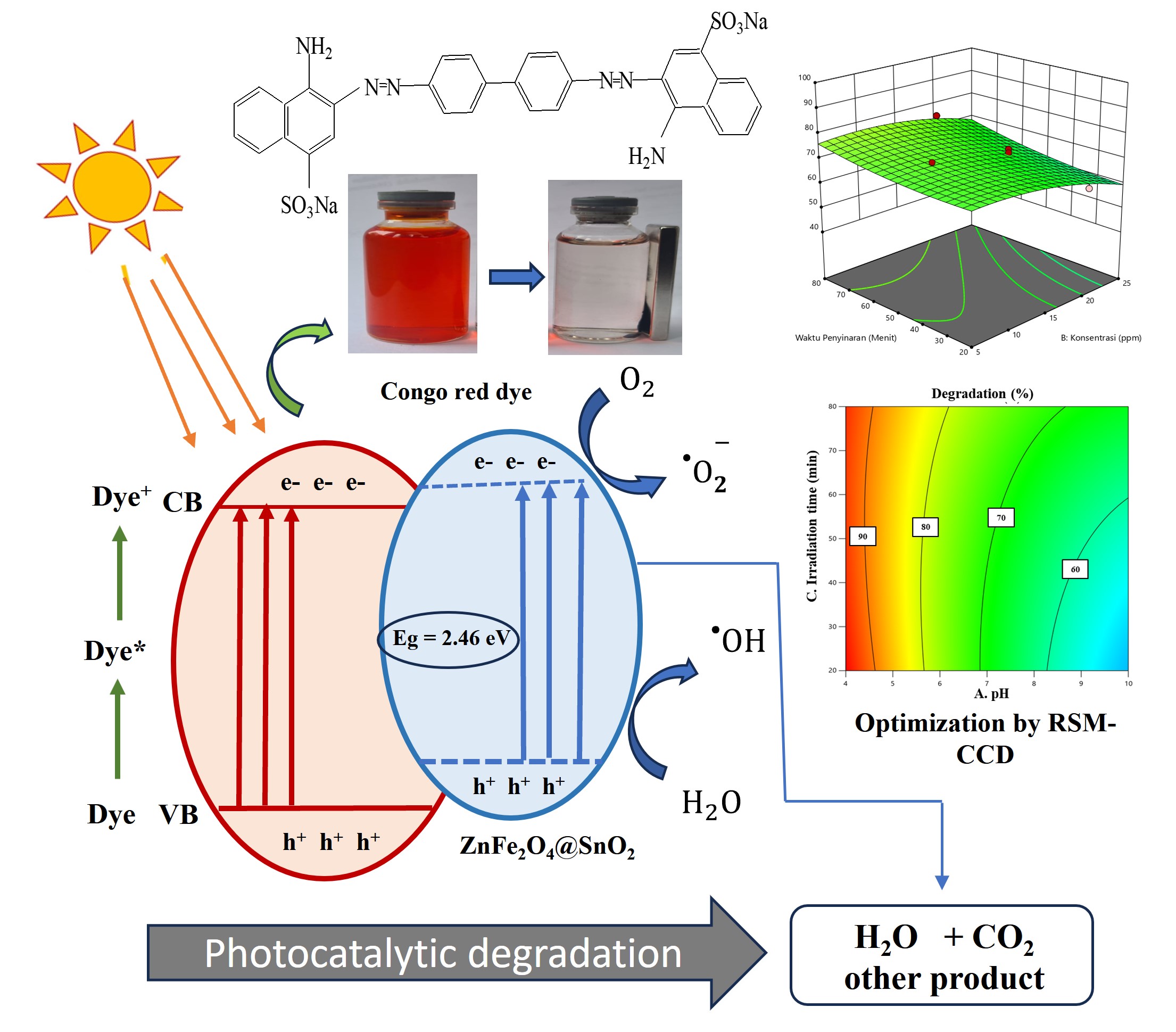
In this investigation, the synthesized ZnFe2O4/SnO2 composites for the photocatalytic degradation of Congo red dye. Doping SnO₂ onto ZnFe2O4 optimized the energy gap, promoting light absorption in the visible spectrum. The ZnFe2O4/SnO2 composites were analyzed using XRD, UV-DRS, SEM-EDS, VSM, and pHpzc. Photocatalytic degradation is optimized using Central Composite Design (CCD), which is based on response surface methodology (RSM). The XRD characterization results of the ZnFe2O4/SnO2 composites demonstrate the success of the synthesis method. The composite has a combined 2θ of ZnFe2O4 and SnO2, with a crystallite size of 17.50 nm. A band gap value of 2.46 eV indicates that the material can absorb most of the visible light spectrum. The EDS mapping results verify the presence of SnO2 on the surface of ZnFe2O4, and the saturation magnetization value of 12.80 emu/g confirmed the composite’s magnetic properties. Degradation optimization using RSM indicated that the quadratic model effectively characterizes the photocatalytic degradation of Congo red dye. The RSM model’s high accuracy in predicting experimental outcomes is evidenced by the minor difference in efficiency degradation between experimental and predicted values, with an R2 of 0.9851 and a p-value < 0.05. The optimum degradation efficiency was achieved at a solution pH of 4, a Congo red dye concentration of 10 mg/L, and an irradiation time of 80 min. The composite exhibits great stability, efficiency, and reliability; the reuse evaluation after 5 cycles indicated a deterioration reduction of less than 5 %.
HIGHLIGHTS
- Doping SnO₂ into ZnFe₂O₄ reduces the band gap energy, thereby enhancing its absorption capability within the visible light spectrum.
- Degradation optimization using RSM indicated that the quadratic model where solution pH, dye concentration and irradiation time affect degradation efficiency.
- The ZnFe₂O₄/SnO₂ composite demonstrated the ability to degrade over 90% of Congo red dye
- The deterioration efficiency diminished by less than 5% after after five consecutive cycles, signifying exceptional material stability.
GRAPHICAL ABSTRACT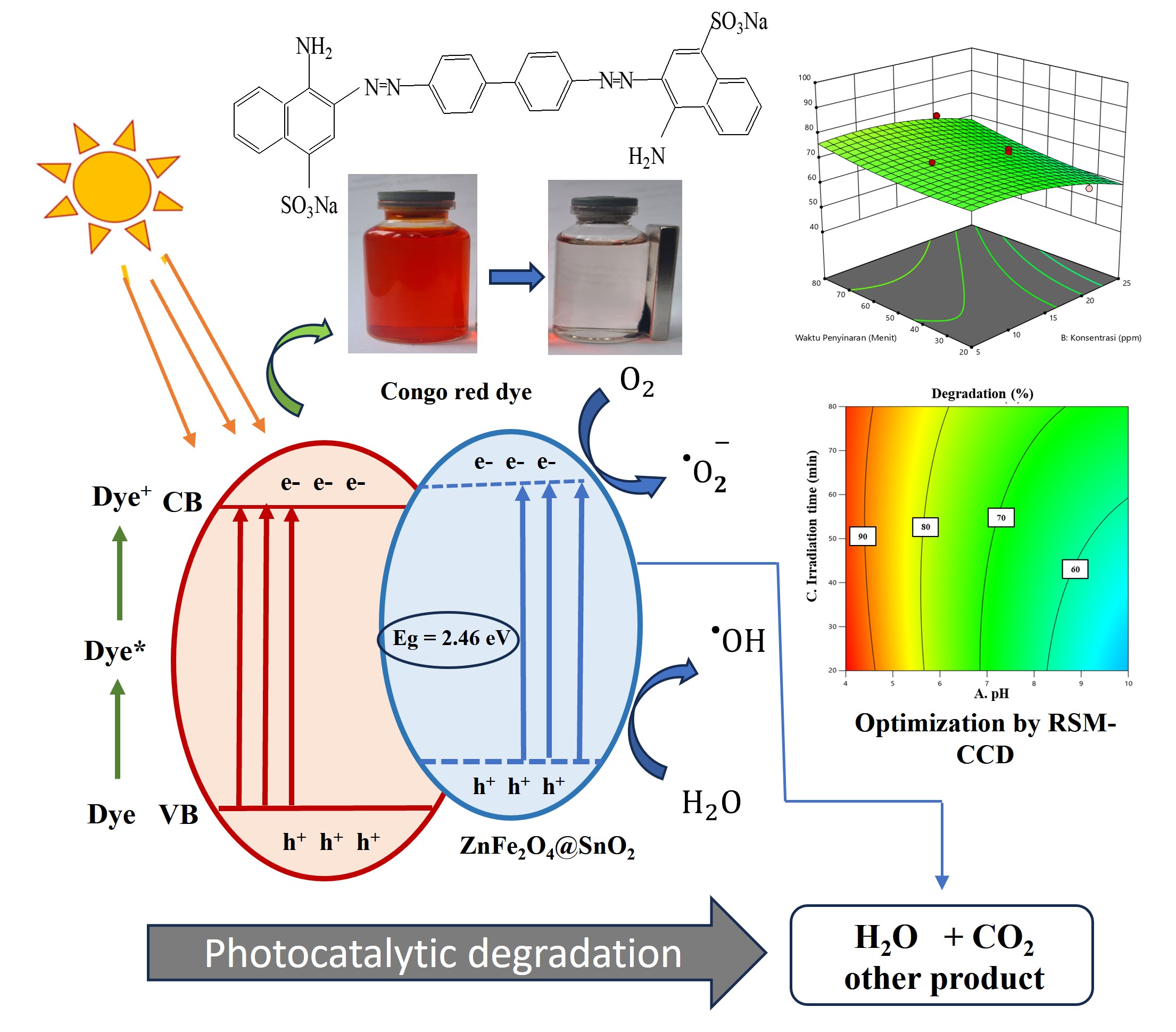
Downloads
References
T Zobeidi, J Yaghoubi and M Yazdanpanah. Developing a paradigm model for the analysis of farmers’ adaptation to water scarcity. Environment, Development and Sustainability 2022; 24(4), 5400-5425.
A Dehghani, S Baradaran and S Movahedirad. Synergistic degradation of Congo Red by hybrid advanced oxidation via ultraviolet light, persulfate, and hydrodynamic cavitation. Ecotoxicology and Environmental Safety 2024; 272, 116042.
SE Bourachdi, F Moussaoui, AR Ayub, AE Amri, FE Ouadrhiri, A Adachi, A Bendaoud, AM Idrissi and A Lahkimi. DFT theoretical analysis, experimental approach, and RSM process to understand the congo red adsorption mechanism on Chitosan@Graphene oxide beads. Journal of Molecular Structure 2025; 1321(4), 140090.
Y Yang, N Ali, A Khan, S Khan, S Khan, H Khan, S Xiaoqi, W Ahmad, S Uddin, N Ali and M Bilal. Chitosan-capped ternary metal selenide nanocatalysts for efficient degradation of Congo red dye in sunlight irradiation. International Journal of Biological Macromolecules 2021; 167, 169-181.
AJ Sayyed, DV Pinjari, SH Sonawane, BA Bhanvase, J Sheikh and M Sillanpää. Cellulose-based nanomaterials for water and wastewater treatments: A review. Journal of Environmental Chemical Engineering 2021; 9(6), 106626.
D Gautam, S Kumari, B Ram, GS Chauhan and K Chauhan. A new hemicellulose-based adsorbent for malachite green. Journal of Environmental Chemical Engineering 2018; 6(4), 3889-3897.
N Yahya, F Aziz, NA Jamaludin, MA Mutalib, AF Ismail, WNW Salleh, J Jaafar, N Yusof and NA Ludin. A review of integrated photocatalyst adsorbents for wastewater treatment. Journal of Environmental Chemical Engineering 2018; 6(6), 7411-7425.
R Javaid and UY Qazi. Catalytic oxidation process for the degradation of synthetic dyes: An overview. International Journal of Environmental Research and Public Health 2019; 16(11), 2066.
AYL Tang, CKY Lo and C Kan. Textile dyes and human health: A systematic and citation network analysis review. Coloration Technology 2018; 134(4), 245-257.
K Balapure, N Bhatt and D Madamwar. Mineralization of reactive azo dyes present in simulated textile waste water using down flow microaerophilic fixed film bioreactor. Bioresource Technology 2015; 175(1), 1-7.
BL Alderete, JD Silva, R Godoi, FRD Silva, SR Taffarel, LPD Silva, ALH Garcia HM Júnior, HLND Amorim and JN Picada. Evaluation of toxicity and mutagenicity of a synthetic effluent containing azo dye after Advanced Oxidation Process treatment. Chemosphere 2021; 263, 128291.
A Farhan, J Arshad, EU Rashid, H Ahmad, S Nawaz, J Munawar, J Zdarta, T Jesionowski and M Bilal. Metal ferrites-based nanocomposites and nanohybrids for photocatalytic water treatment and electrocatalytic water splitting. Chemosphere 2023; 310, 136835.
OMA Halim, NH Mustapha, SNM Fudzi, R Azhar, NIN Zanal, NF Nazua, AH Nordin, MSM Azami, MAM Ishak, WINW Ismail and Z Ahmad. A review on modified ZnO for the effective degradation of methylene blue and rhodamine B. Results in Surfaces and Interfaces 2025; 18, 100408.
C Sun, J Yang, M Xu, Y Cui, W Ren, J Zhang, H Zhao and B Liang. Recent intensification strategies of SnO2-based photocatalysts: A review. Chemical Engineering Journal 2022; 427, 131564.
Q Li, T Zhao, M Li, W Li, B Yang, D Qin, K Lv, X Wang, L Wu, X Wu and J Sun. One-step construction of Pickering emulsion via commercial TiO2 nanoparticles for photocatalytic dye degradation. Applied Catalysis B: Environment and Energy 2019; 249, 1-8.
S Yao, F Qu, G Wang and X Wu. Facile hydrothermal synthesis of WO3 nanorods for photocatalysts and supercapacitors. Journal of Alloys and Compounds 2017; 724, 695-702.
AB Siddique, MA Shaheen, A Abbas, Y Zaman, MA Bratty, A Najmi, A Hanbashi, M Mustaqeem, HA Alhazmi, ZU Rehman, K Zoghebi and HMA Amin. Thermodynamic and kinetic insights into azo dyes photocatalytic degradation on biogenically synthesized ZnO nanoparticles and their antibacterial potential. Heliyon 2024; 10(23), e40679.
SB Sharafudheen, C Vijayakumar, R Rajakrishnan, A Alfarhan, S Arokiyaraj and MR Bindhu. Biogenic synthesis of porous CuO nanoparticles: Synergistic effects in photocatalytic dye degradation and electrochemical energy storage applications. Journal of Crystal Growth 2025; 649, 127917.
M Khatri, A Gupta, K Gyawali, A Adhikari, AR Koirala and N Parajuli. Photocatalytic degradation of dyes using synthesized δ-MnO2 nanostructures. Chemical Data Collections 2022; 39, 100854.
AM Al-Hamdi, U Rinner and MSillanpa. Tin dioxide as a photocatalyst for water treatment: A review. Process Safety and Environmental Protection 2017; 107, 190-205.
V Perumal, A Sabarinathan, M Chandrasekar, M Suvabsh, C Inmozhi, R Uthrakumar, AB Isaev, A Raja, MS Elshikh, SM Almutairia and K Kaviyarasu. Hierarchical nanorods of graphene oxide decorated SnO2 with high photocatalytic performance for energy conversion applications. Fuel 2022; 324, 124599.
Z Yang, L Lv, Y Dai, Z Xv and D Qian. Synthesis of ZnO-SnO2 composite oxides by CTAB-assisted co-precipitation and photocatalytic properties. Applied Surface Science 2010; 256(9), 2898-2902.
FGE Desouky, MM Saadeldin, MA Mahdy and IKE Zawawi. Tuning the structure, morphological variations, optical and magnetic properties of SnO2/NiFe2O4 nanocomposites for promising applications. Vacuum 2021; 185, 110003.
M Arif, MZU Shah, SA Ahmad, MS Shah, Z Ali, A Ullah, M Idrees, J Zeb, P Song, T Huang and J Yi. High photocatalytic performance of copper-doped SnO2 nanoparticles in degradation of Rhodamine B dye. Optical Materials 2022; 134, 113135.
MHDS Ribeiro, GN Marques, AJ Moreira, MM Oliveira, RC Oliveira, RTD Silva, AC Krohling, WAA Macedo, MIB Bernardi, LH Mascaro, JHG Rangel and HBD Carvalho. Green-assisted synthesis of highly defective nanostructured Fe-doped SnO2: Magnetic and photocatalytic properties evaluation. Acta Materialia 2024; 277, 120194.
BS Shagolsem and NM Singh. Ternary photocatalyst of Fe3O4/Ag-SnO2 with Parkia speciosa extract improves visible-light-driven photocatalytic degradation of dye. Inorganic Chemistry Communications 2024; 162, 112245.
TP Oliveira, GN Marques, MAM Castro, RCV Costa, JHG Rangel, SF Rodrigues, CCD Santos and MM Oliveira. Synthesis and photocatalytic investigation of ZnFe2O4 in the degradation of organic dyes under visible light. Journal of Materials Research Technology 2020; 9(6), 15001-15015.
CG Anchieta, EC Severo, C Rigo, MA Mazutti, RC Kuhn, EI Muller, EMM Flores, RFPM Moreira and EL Foletto. Rapid and facile preparation of zinc ferrite (ZnFe2O4) oxide by microwave-solvothermal technique and its catalytic activity in heterogeneous photo-Fenton reaction. Materials Chemistry and Physics 2015; 160, 141-147.
R Moeinzadeh, N Azizi, M Hekmati, M Qomi and D Esmaeili. ZnONPs/covalent triazine frameworks nanocomposite as high-performance photocatalysts for degradation of Congo red under visible light. Materials Chemistry and Physics 2023; 307, 128122.
N Kumar, MR Ansari, S Khaladkar, O Maurya, KR Peta, A Kalekar, MK Singha and JK Dash. NiFe2O4 nanoparticles as highly efficient catalyst for oxygen reduction reaction and energy storage in supercapacitor. Materials Chemistry and Physics 2024; 316, 129072.
R Li, H Hu, Y Ma, X Liu, L Zhang, S Zhou, B Deng, H Lin and H Zhang. Persulfate enhanced photocatalytic degradation of bisphenol A over wasted batteries-derived ZnFe2O4 under visible light. Journal of Cleaner Production 2020; 276, 124246.
FU Zaman, A Kumar, G Yasin, FO Boakye, F Muhammad, S Iqbal, KM Alotaibi, L Hou and C Yuan. Enhanced photocatalytic degradation of organic dyes by carbon quantum dots-ZnFe2O4 composites. Journal of Alloys and Compounds 2024; 983, 173860.
JS Duque, BM Madrigal, H Riascos and YP Avila. Colloidal metal oxide nanoparticles prepared by laser ablation technique and their antibacterial test. Colloids and Interfaces 2019; 3(1), 25.
FS Volkov, MA Kamenskii, LA Voskanyan, NP Bobrysheva, OM Osmolovskaya and SN Eliseeva. Impact of ZnFe2O4 nanoparticles parameters on magnetic and electrochemical performance. Materialia 2024; 34, 102046.
PA Vinosha, LA Mely, JE Jeronsia, S Krishnan and SJ Das. Synthesis and properties of spinel ZnFe2O4 nanoparticles by facile co-precipitation route. Optik 2017; 134, 99-108.
R Chen, S Ding, B Wang and X Ren. Preparation of ZnFe2O4@TiO2 novel core-shell photocatalyst by ultrasonic method and its photocatalytic degradation activity. Coatings 2022; 12(10), 1407.
M Afaq, A Sajid, Q Manzoor, F Imtiaz, A Sajid, R Javed, A Ahmad, N Alwadai, W Mnif and M Iqbal. Sonochemical synthesis of CoO-ZnO nanocomposite and optimizing the degradation of toxic anionic dye using RSM-BBD. Materials Science and Engineering: B 2025; 312, 117847.
L Aeindartehran and SSA Talesh. Enhanced photocatalytic degradation of Acid Blue 1 using Ni-Decorated ZnO NPs synthesized by sol-gel method: RSM optimization approach. Ceramics International 2021; 47(19), 27294-27304.
S Hmamouchi, AE Yacoubi, ME Hezzat, B Sallek and BCE Idrissi. Optimization of photocatalytic parameters for MB degradation by g-C3N4 nanoparticles using Response Surface Methodology (RSM). Diamond and Related Materials 2023; 136, 109986.
H Gomaa, C An, Q Deng, HA Altaleb, SM Gomha, TZ Abolibda, MA Shenashen and N Hu. A hybrid mesoporous sheet-like NiCo2O4@P,S,N-doped carbon nano-photocatalyst for efficient synergistic degradation of Congo red: Statistical, DFT and mechanism studies. Journal of Industrial and Engineering Chemistry 2025; 141, 130-144.
F Riyanti, PL Hariani, H Hasanudin, A Rachmat and W Purwaningrum. Optimization photodegradation of methylene blue dye using bentonite/PDA/Fe3O4@CuO composite by response surface methodology. Bulletin of Chemical Reaction Engineering and Catalysis 2024; 19(2), 252-264.
M Shaban, MR Abukhadra, A Hamd, RR Amin and AA Khalek. Photocatalytic removal of Congo red dye using MCM-48/Ni2O3 composite synthesized based on silica gel extracted from rice husk ash; fabrication and application. Journal of Environmental Management 2017; 204(1), 189-199.
MR Dustgeer, A Jilani, MO Ansari, MB Shakoor, S Ali, A Imtiaz, HS Zakria and MHD Othman. Reduced graphene oxide supported polyaniline/ copper (II) oxide nanostructures for enhanced photocatalytic degradation of Congo red and hydrogen production from water. Journal of Water Process Engineering 2024; 5, 105053.
N Kousar, S Rasheed, K Yasmeen, AR Umar, MH Laiche, M Masood, H Muhammad and M Hanif. Efficient synergistic degradation of Congo red and omeprazole in wastewater using rGO/Ag@ZnO nanocomposite. Journal of Water Process Engineering 2024; 58, 104775.
V Arumugaperumal and K Sadaiyandi. Solar light driven photocatalytic degradation of methylene blue dye over Cu doped α-MnO2 nanoparticles. Chemical Physics Impact 2024; 8, 100434.
MN Aditya, T Chellapandi, GK Prasad, MJP Venkatesh, MMR Khan, G Madhumitha and SM Roopan. Biosynthesis of rod shaped Gd2O3 on g-C3N4 as nanocomposite for visible light mediated photocatalytic degradation of pollutants and RSM optimization. Diamond and Related Materials 2022; 121, 108790.
S Moosavi, RYM Li, CW Lai, Y Yusof, S Gan, O Akbarzadeh, ZZ Chowhury, XG Yue and MRB Johan. Methylene blue dye photocatalytic degradation over synthesised Fe3O4/AC/TiO2 nano-catalyst: Degradation and reusability studies. Nanomaterials 2020; 10(12), 2360.
Published
How to Cite
Issue
Section
License
Copyright (c) 2025 Walailak University

This work is licensed under a Creative Commons Attribution-NonCommercial-NoDerivatives 4.0 International License.





