
Synthesis of Ternary Chitosan–Al₂O₃–Graphene Oxide Composite via Sol-Gel Method for Enhanced Adsorptive Removal of Methylene Blue: Characterization, Kinetics, and Isotherm Studies
DOI:
https://doi.org/10.48048/tis.2027.14436Keywords:
Chitosan, Aluminium oxide (Al₂O₃), Graphene oxide, Sol–gel, Ternary composite, Methylene blue adsorption, Kinetics model adsorption, Chitosan, Aluminium oxide (Al₂O₃), Graphene oxide, Sol-gel, Ternary composite, Methylene blue adsorption, Kinetics model adsorption, Isotherm model adsorptionAbstract
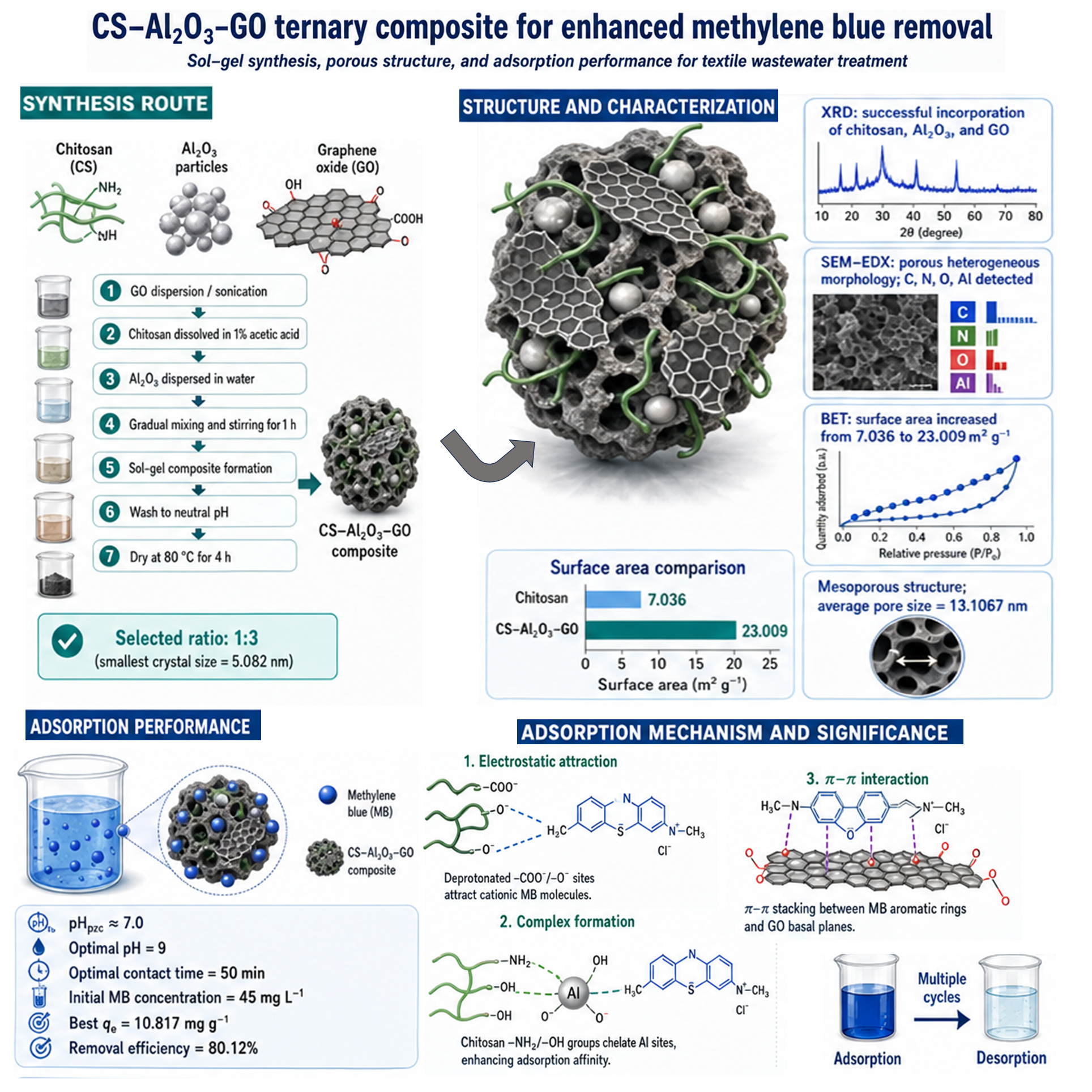
The rapid growth of the textile industry has worsened water pollution with the release of synthetic dyes, especially methylene blue, which presents significant environmental and health risks due to its persistence against natural degradation. Graphene oxide (GO) has been proposed as a promising adsorbent. However, its practical application is constrained by post-treatment separation and secondary pollution, which can impede the overall effectiveness of employing GO in water treatment processes. The aim of this research was to synthesize a ternary composite of chitosan–Al₂O₃–graphene oxide (CS–AO–GO) via the sol-gel method for enhanced adsorptive removal of methylene blue and improved separation. The composite was prepared by adding GO and Al₂O₃ into the chitosan matrix with various mass ratios, and the ratio 1:3 (CS–AO–GO 1:3) was selected for detailed investigation due to its smaller crystal size. XRD characterization confirmed the successful incorporation of all 3 components. SEM-EDX revealed a porous heterogeneous surface morphology with elemental verification of carbon, nitrogen, oxygen and aluminum. BET analysis showed a significant enhancement in the specific surface area from 7.036 m²/g for pure chitosan to 23.009 m²/g for the composite, which had a mesoporous structure with an average pore size of 13.106 nm. Based on the batch adsorption study, the optimum conditions for methylene blue were obtained at pH 9, contact time 50 min and initial concentration 45 mg/L with an adsorption capacity of 10.817 mg/g and removal efficiency of 80.12%. The Langmuir isotherm model provided a good fit to the adsorption equilibrium data (R² = 0.998), indicating monolayer adsorption on a homogeneous surface with a maximum adsorption capacity of 11.600 mg/g. Kinetic studies showed that the adsorption process was found to follow a pseudo-second-order model (R² = 0.982), indicating that the rate-limiting step was controlled by chemisorption mechanisms such as electrostatic interaction, complex formation and π-π interaction. Results showed that the incorporation of Al₂O₃ and GO into the chitosan matrix significantly improved the surface area and adsorption efficiency, reaching almost six times as compared to pure chitosan. The synthesized CS–AO–GO composite is a promising and cost-effective and easily separable biopolymer-based adsorbent for the remediation of cationic dye-contaminated textile wastewater.
HIGHLIGHTS
- A novel ternary composite made up of chitosan, Al₂O₃, and graphene oxide was successfully synthesized using a straightforward sol-gel method
- The incorporation of Al₂O₃ and graphene oxide significantly enhanced the thermal stability and surface properties of chitosan
- The composite exhibited high adsorption capacity for methylene blue, outperforming pristine chitosan and binary composites
GRAPHICAL ABSTRACT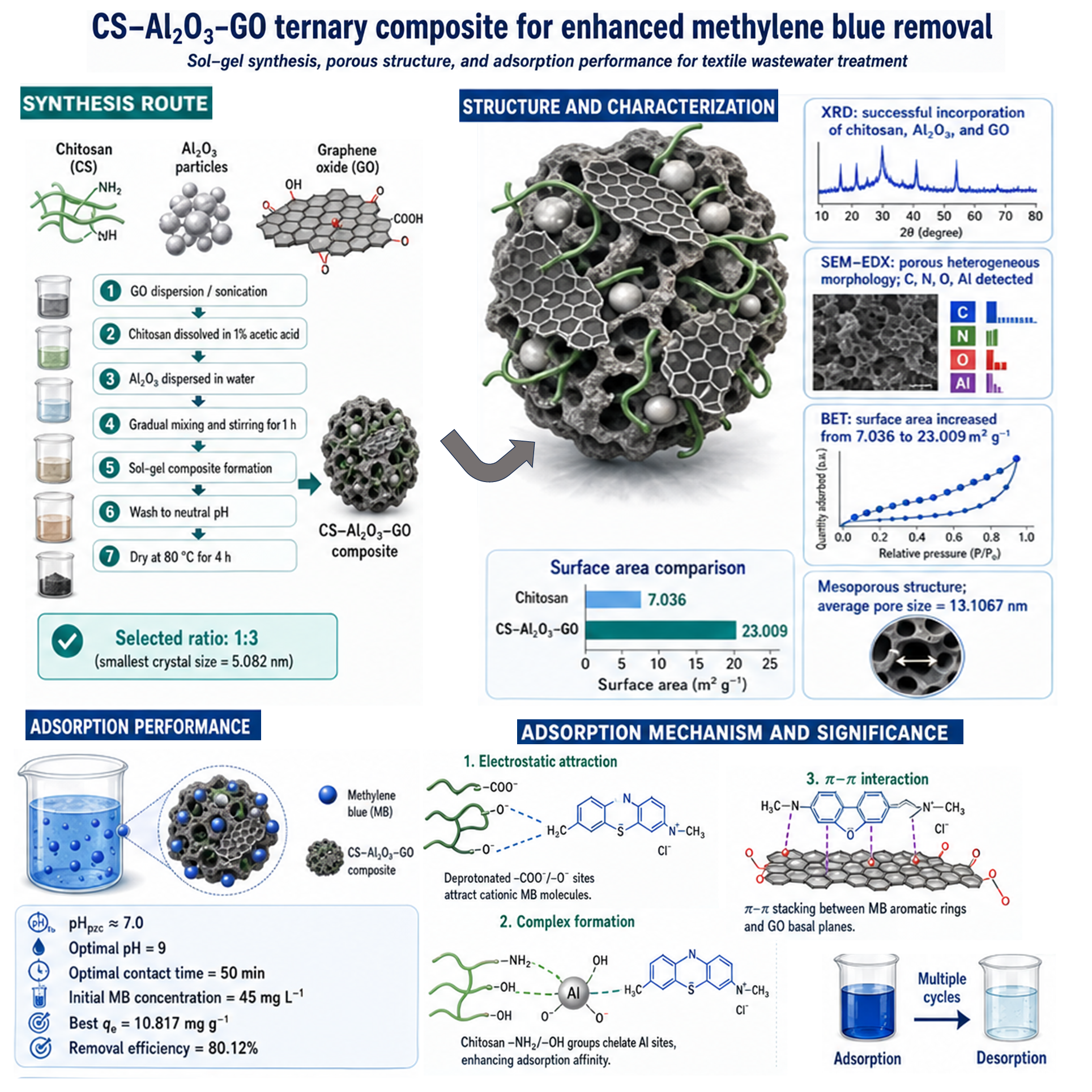
Downloads
References
Y Lyu, Y Liu, Y Guo, J Tian and L Chen. Managing water sustainability in textile industry through adaptive multiple stakeholder collaboration. Water Research 2021; 205, 117655.
MM Islam, AR Aidid, JN Mohshin, H Mondal, S Ganguli and AK Chakraborty. A critical review on textile dye-containing wastewater: Ecotoxicity, health risks, and remediation strategies for environmental safety. Cleaner Chemical Engineering 2025; 11, 100165.
ZM Xiong, X Mao, M Trappio, C Arya, JE Kordi and K Cao. Ultraviolet radiation protection potentials of Methylene Blue for human skin and coral reef health. Scientific Reports 2021; 11(1), 10871.
B Anegbe, IH Ifijen, M Maliki, IE Uwidia and AI Aigbodion. Graphene oxide synthesis and applications in emerging contaminant removal: A comprehensive review. Environmental Sciences Europe 2024; 36, 15.
N Bellier, P Baipaywad, N Ryu, JY Lee and H Park. Recent biomedical advancements in graphene oxide- and reduced graphene oxide-based nanocomposite nanocarriers. Biomaterials Research 2022; 26(1), 65.
E Adotey, A Kurbanova, A Ospanova, A Ardakkyzy, Z Toktarbay, N Kydyrbay, M Zhazitov, N Nuraje and O Toktarbaiuly. Development of superhydrophobic reduced graphene oxide (rGO) for potential applications in advanced materials. Nanomaterials 2025; 15(5), 363.
HVT Luong, TP Le, TLT Le, HG Dang and TBQ Tran. A graphene oxide based composite granule for methylene blue separation from aqueous solution: Adsorption, kinetics and thermodynamic studies. Heliyon 2024; 10(7), e28648.
B Liu, YN Xin, J Zou, FM Khoso, YP Liu, XY Jiang, S Peng and JG Yu. Removal of chromium species by adsorption: Fundamental principles, newly developed adsorbents and future perspectives. Molecules 2023; 28(2), 639.
A Ali, MI Vohra, A Nadeem, BS Al-Anzi, M Iqbal, AA Memon, AH Jatoi, J Akhtar, J Yang and KH Thebo. Ultrafast graphene oxide-lignin biopolymer nanocomposite membranes for separation of biomolecules, dyes, and salts. ACS Applied Polymer Materials 2024; 6(8), 4747-4755.
MA Shehab, M Al-lami, MA Taher, HH Mohammed, AA AbdulRazak, KT Rashid, A Mahmood, MF Abd Al-Ogaili and S Alsarayefi. Recent progress in adsorptive removal of different contaminants by chitosan-based aerogel. RSC Advances 2025; 15(36), 29727-29742.
H Rajabi and SM Jafari. Synthesis and characterization of 3-dimensional graphene oxide-chitosan/glutaraldehyde nanocomposites: Towards adsorption of crocin from saffron. International Journal of Biological Macromolecules 2024; 281(4), 136672.
TS Vo. Progresses and expansions of chitosan-graphene oxide hybrid networks utilizing as adsorbents and their organic dye removal performances: A short review. Journal of the Turkish Chemical Society Section A: Chemistry 2021; 8(4), 1121-1136.
D Desnelli, S Safitri, E Musifa, A Hamidah, M Said, S Suheryanto and A Mara. Study of Congo Red adsorption by chitosan-graphene oxide (ChitosanGO) composite synthesize with hydrothermal synthetic method: Optimization and determination condition. Indonesian Journal of Fundamental and Applied Chemistry 2025; 10(2), 101-111.
MS Akhtar, S Ali and W Zaman. Innovative adsorbents for pollutant removal: Exploring the latest research and applications. Molecules 2024; 29(18), 4317.
MR Farani, I Zare, M Mirshafiei, A Gholami, M Zhang, E Pishbin, JE Ahn, A Mohammadi, M Imani, M Lak, J Shen, H Kang and YS Huh. Graphene oxide-engineered chitosan nanoparticles: Synthesis, properties, and antibacterial activity for tissue engineering and regenerative medicine. Chemical Engineering Journal 2025; 509, 160852.
D Desnelli, IH Padillah, M Ulfa, E Eliza, A Mara and F Fatma. Synthesis of chitosan-Al2O3 composite using the sol-gel method and its application in photodegradation of Methylene Blue. Indonesian Journal of Fundamental and Applied Chemistry 2023; 8(1), 40-47.
N Anuwongsa, T Yawai and W Ananpreechakorn. A simple preparation of graphene oxide with a modified Hummer’s method. Indochina Applied Sciences 2023; 12(3), 251664.
HP Buwono, S Adiwidodo, H Wicaksono and HI Firmansyah. Hydrothermal synthesis and characterization of nano-particles γ-Al2O3. IOP Conference Series: Materials Science and Engineering 2021; 1073, 012011.
M Sabzevari, DE Cree and LD Wilson. Gas and solution uptake properties of graphene oxide-based composite materials: Organic vs. inorganic cross-linkers. Journal of Composites Science 2019; 3(3), 80.
D Desnelli, K Ramadhina, D Alfarado, F Fatma, A Mara and M Said. Methylene blue degradation using chitosan-Fe2O3 composite and photo-Fenton. Revista Colombiana de Química 2023; 52(2), 36-42.
D Desnelli, D Rizkiani, D Alfarado, F Ferlinahayati, H Yohandini, F Fatma, A Mara, S Suheryanto, E Nurnawati, A Hamidah and M Said. Adsorption study on phenol from bentonite doped with zinc oxide: Synthesis, characterization, equilibrium, kinetics, and thermodynamic. Indonesian Journal of Fundamental and Applied Chemistry 2024; 9(2), 82-95.
AD Meretoudi, I Kalampogias, I Koumentakou, IK Kalavrouziotis, AK Tolkou and GZ Kyzas. Chitosan/montmorillonite/graphene oxide composites for the adsorption of dyes from single-component solutions, binary mixtures, and real textile wastewaters: On understanding the adsorption interactions. Langmuir 2025; 41(34), 23198-23213.
MA Saraswati, WH Saputera, E Lafina and D Sasongko. Development of MnO2/γ-Al2O3 catalysts for catalytic ozonation of phenolic wastewater. South African Journal of Chemical Engineering 2026; 55, 417-427.
I Aranaz, AR Alcántara, MC Civera, C Arias, B Elorza, A Heras Caballero and N Acosta. Chitosan: An overview of its properties and applications. Polymers 2021; 13(19), 3256.
S Saisa, Z Sartika, Erdiwansyah, Elvitriana and R Mamat. Application of alumina-chitosan modified monolithic activated carbon derived from empty fruit bunches for acid mine drainage treatment. Kuwait Journal of Science 2026; 53(2), 100559.
AMA Saputra, N Agustina, Amran, Zurnansyah, Samnur and EH Sujiono. Synthesis and characterisation of graphene oxide/chitosan composite membranes from natural waste. Journal of Physical Science 2022; 33(3), 63-79.
Y Wang, F Yang, T Wu and G Huang. Systematic overview of the preparation, interface characteristics, strengthening mechanisms, and challenges of graphene-reinforced Al matrix composites. Journal of Materials Research and Technology 2024; 33, 7709-7739.
J Chen, AM Chandler, I Külaots, Q Zhang and VL Colvin. Size effects in magnetic separation for rapid and efficient bacteria removal. Nanoscale 2026; 18(3), 1433-1444.
M Lehocký. Environmental applications of chitosan derivatives and chitosan composites. Polymers 2025; 17(19), 2583.
I Roato, T Genova, D Duraccio, FA Ruffinatti, DZ Venturini, M Di Maro, A Mosca Balma, R Pedraza, S Petrillo, G Chinigò, L Munaron, G Malucelli, MG Faga and F Mussano. Mechanical and biological characterization of PMMA/Al2O3 composites for dental implant abutments. Polymers 2023; 15(15), 3186.
C Santillo, Y Wang, GG Buonocore, G Gentile, L Verdolotti, S Kaciulis, H Xia and M Lavorgna. Hybrid graphene oxide/cellulose nanofillers to enhance mechanical and barrier properties of chitosan-based composites. Frontiers in Chemistry 2022; 10, 926364.
BA Al-Mur and MT Jamal. Eco-friendly dye removal using chitosan: Characterization and kinetic modeling of Methylene Blue and Methyl Orange adsorption. Polymers 2026; 18(5), 546.
MA Kamal, S Bibi, SW Bokhari, AH Siddique and T Yasin. Synthesis and adsorptive characteristics of novel chitosan/graphene oxide nanocomposite for dye uptake. Reactive and Functional Polymers 2017; 110, 21-29.
MM Hasan, MA Shenashen, MN Hasan, H Znad, MS Salman and MR Awual. Natural biodegradable polymeric bioadsorbents for efficient cationic dye encapsulation from wastewater. Journal of Molecular Liquids 2021; 323, 114587.
MV Reyes-Peces, A Pérez-Moreno, DM de-los-Santos, MdM Mesa-Díaz, G Pinaglia-Tobaruela, JI Vilches-Pérez, R Fernández-Montesinos, M Salido, N de la Rosa-Fox and M Piñero. Chitosan-GPTMS-silica hybrid mesoporous aerogels for bone tissue engineering. Polymers 2020; 12(11), 2723.
M Ulfa, RF Hanif and NA Sholeha. Surface chemistry and adsorption behavior of Methylene Blue on functionalized carbon materials: A comprehensive study. Communications in Science and Technology 2025; 10(2), 276-291.
X Yang, H Zhang, S Cheng and B Zhou. Optimization of the adsorption and removal of Sb(III) by MIL-53(Fe)/GO using response surface methodology. RSC Advances 2022; 12, 4101-4112.
CE Flores-Chaparro, CJ Castilho, I Külaots, R Hurt and J Rangel-Méndez. Pillared graphene oxide composite as an adsorbent of soluble hydrocarbons in water: pH and organic matter effects. Journal of Environmental Management 2020; 259, 110044.
L Seimukhanova, U Zhantikeyev, I Sapargali, M Kunarbekova, K Kudaibergenov, E Skwarek and S Azat. Surface and structural characterization of buckwheat husk-derived activated carbons: Correlation of SEM, elemental, FTIR, Raman, and porous properties with electrokinetic behavior. International Journal of Molecular Sciences 2026; 27(4), 1803.
JQ Huang, K Liu, X Song, G Zheng, Q Chen, J Sun, H Jin, L Jiang, Y Jiang, Y Zhang, P Jiang and W Wu. Incorporation of Al2O3, GO, and Al2O3@GO nanoparticles into water-borne epoxy coatings: Abrasion and corrosion resistance. RSC Advances 2022; 12(38), 24804-24820.
A Rahmatpour, N Alijani and AH Alizadeh. Preparation of chitosan-based ternary nanocomposite hydrogel film by loading graphene oxide nanosheets as adsorbent for enhanced Methylene Blue dye removal. International Journal of Biological Macromolecules 2023; 253(1), 126585.
R Maceiras, J Feijoo, L Perez-Rial, MA Alvarez-Feijoo and N Eslami. Influence of activated carbon granulometry on H2 purification in glycerol reforming syngas: Adsorption and kinetic analysis. Energies 2024; 17(23), 6011.
A Ouzani, Y Zouambia, H Maachou, M Krea, AA Assadi, L Khezami, Y Benguerba, J Zhang, A Amrane, W Elfalleh and H Tahraoui. Sustainable removal of Basic Fuchsine and Methylene Blue dyes using chicken bone biomass: Thermodynamics, kinetics, and insights from experimental studies and decision tree with least squares boosting predictive modeling. Water 2025; 17(7), 1053.
X Zhang, X Zhang and W Xu. Adsorption performance and mechanism of waste Myriophyllum aquaticum biochar for Malachite Green in wastewater: Batch and column studies. Sustainability 2025; 17(7), 2868.
S Ebrahimi, P Zanganeh, S Nouripour-Sisakht, H Javadian, A Babaie, R Khaleghi and A Asfaram. A multifunctional graphene oxide-ZnO nanohybrid for rapid and highly efficient Malachite Green adsorption and strong broad-spectrum antimicrobial activity. Scientific Reports 2026; 16(1), 7316.
AE Eltaweil, EM Abd El-Monaem, AM Omer, RE Khalifa, MM Abd El-Latif and GM El-Subruiti. Efficient removal of toxic Methylene Blue (MB) dye from aqueous solution using a metal-organic framework (MOF) MIL-101(Fe): Isotherms, kinetics, and thermodynamic studies. Desalination and Water Treatment 2020; 189, 395-407.
L Fan, C Luo, M Sun, X Li, F Lu and H Qiu. Preparation of novel magnetic chitosan/graphene oxide composite as effective adsorbents toward Methylene Blue. Bioresource Technology 2012; 114, 703-706.
J Ren, S Zhang, Y Wang and H Yang. Adsorption properties and mechanisms of Methylene Blue by modified Sphagnum moss bio-based adsorbents. Materials 2024; 17(17), 4329.
G Taha, RA Baseer and M Sultan. Chitosan nanocomposites for the removal of pollutants from waste water. Discover Applied Sciences 2025; 7, 1306.
AA Nayl, AI Abd-Elhamid, WAA Arafa, IM Ahmed, AA El-Shanshory, MA Abu-Saied, HMA Soliman, MA Abdelgawad, HM Ali and S Bräse. Chitosan-functionalized-graphene oxide (GO@CS) beads as an effective adsorbent to remove cationic dye from wastewater. Polymers 2022; 14(19), 4236.
F Pinelli, T Nespoli and F Rossi. Graphene oxide-chitosan aerogels: Synthesis, characterization, and use as adsorbent material for water contaminants. Gels 2021; 7(4), 149.
S Stankovich, RD Piner, X Chen, N Wu, ST Nguyen and RS Ruoff. Stable aqueous dispersions of graphitic nanoplatelets via the reduction of exfoliated graphite oxide in the presence of poly(sodium 4-styrenesulfonate). Journal of Materials Chemistry 2006; 16(2), 155-158.
M Sabzevari, DE Cree and LD Wilson. Graphene oxide-chitosan composite material for treatment of a model dye effluent. ACS Omega 2018; 3(10), 13045-13054.
Downloads
Published
How to Cite
Issue
Section
License
Copyright (c) 2026 Walailak University

This work is licensed under a Creative Commons Attribution-NonCommercial-NoDerivatives 4.0 International License.