
A Review of Advancements in Investigating MicroRNA Roles in Breast Cancer Bone Metastasis
DOI:
https://doi.org/10.48048/tis.2025.9604Keywords:
Biomarker, Breast cancer, Bone metastasis, miRNA, miRNA therapyAbstract
Breast cancer is among the most prevalent malignancies affecting women globally. Metastasis is a common clinical issue associated with a poor prognosis for breast cancer patients. Bones are one of the most common target organs for metastasis found in breast cancer patients, with a frequency of 70% in metastatic breast cancer. Dysregulation of microRNA (miRNA) is one of the critical molecular factors that mediates bone metastasis in breast cancer. miRNAs expressed by primary breast cancer tissue are known to shape the pre-metastatic bone microenvironment and cause osteolytic bone metastasis in breast cancer. Further investigation is required into the biological implications of alterations in miRNA expression during bone metastasis. In summary, recent advancements in understanding the role of miRNAs in breast cancer bone metastasis have explained the fundamental mechanisms of this process and introduced novel possibilities for improved diagnostic, prognostic, and therapeutic approaches.
HIGHLIGHTS
- This review article focused comprehensively on critical roles of microRNAs in driving breast cancer bone metastasis.
- The role of various miRNAs in regulating key steps of bone metastasis, including pre-metastatic niche formation, cancer cell migration, and invasion.
- The potential of targeting miRNA pathways as novel therapeutic approaches for the prevention and treatment of bone metastasis in breast cancer.
GRAPHICAL ABSTRACT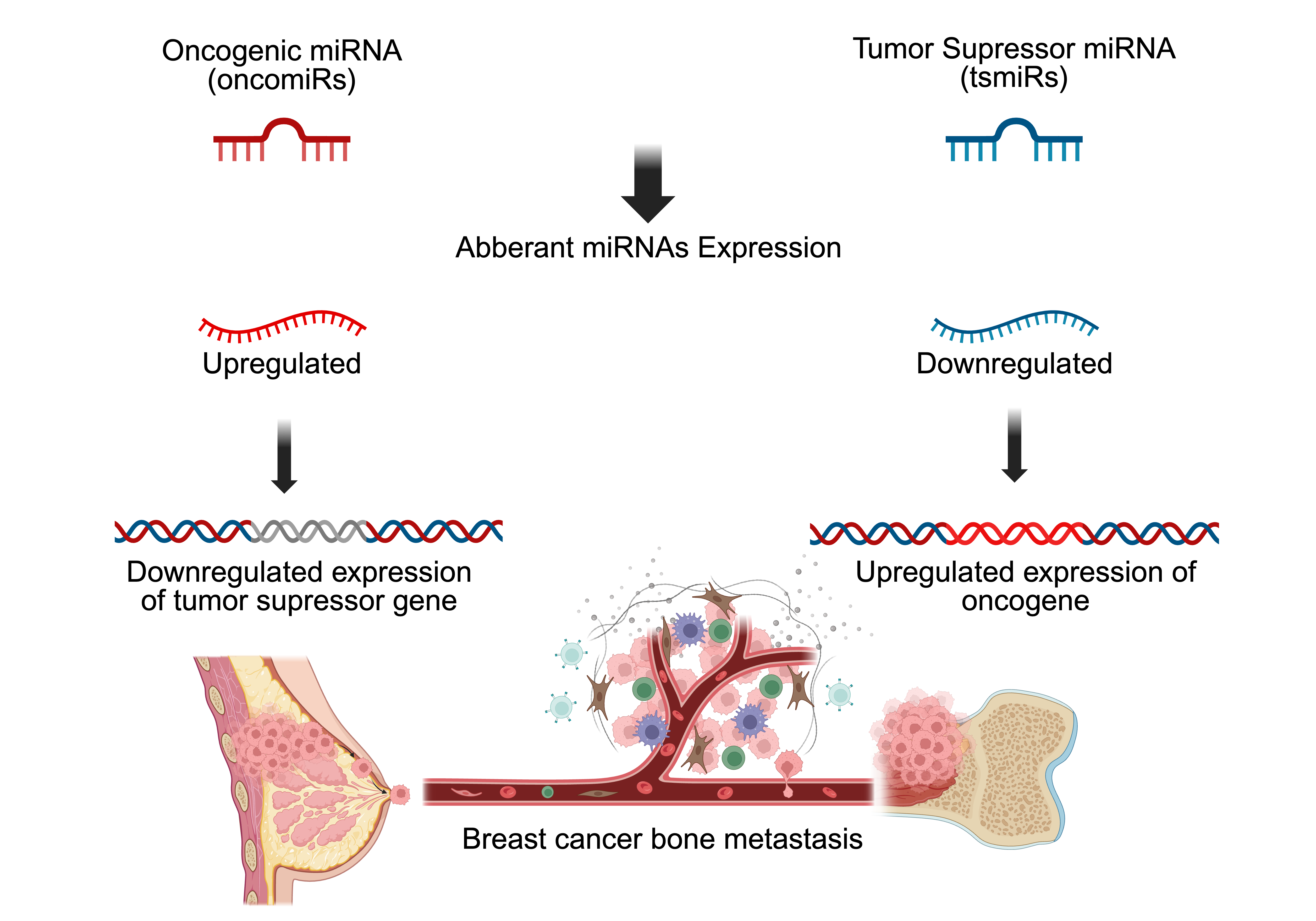
Downloads
References
M Arnold, E Morgan, H Rumgay, A Mafra, D Singh, M Laversanne, J Vignat, JR Gralow, F Cardoso, S Siesling and I Soerjomataram. Current and future burden of breast cancer: Global statistics for 2020 and 2040. The Breast 2022; 66, 20.
S Wang, W Wu, X Lin, KM Zhang, QL Wu, M Luo and J Zhou. Predictive and prognostic biomarkers of bone metastasis in breast cancer: Current status and future directions. Cell & Bioscience 2023; 13(1), 224.
J Fares, MY Fares, HH Khachfe, HA Salhab and Y Fares. Molecular principles of metastasis: A hallmark of cancer revisited. Signal Transduction and Targeted Therapy 2020; 5(1), 28.
D Yang, SK Denny, PG Greenside, AC Chaikovsky, JJ Brady, Y Ouadah, JM Granja, NS Jahchan, JS Lim, S Kwok, CS Kong, AS Berghoff, A Schmitt, HC Reinhardt, KS Park, M Preusser, A Kundaje, WJ Greenleaf, J Sage and MM Winslow. Intertumoral heterogeneity in SCLC is influenced by the cell type of origin. Cancer Discovery 2018; 8(10), 1316-1331.
KB Siregar and MA Anas. Unveiling bone metastasis: Exploring histological subtypes of breast cancer in Indonesia’s tertiary referral hospital. Cancer Treatment and Research Communications 2023; 37, 100764.
C Tulotta and P Ottewell. The role of IL-1B in breast cancer bone metastasis. Endocrine-Related Cancer 2018; 25(7), R421-R434.
X Yuan, N Qian, S Ling, Y Li, W Sun, J Li, R Du, G Zhong, C Liu, G Yu, D Cao, Z Liu, Y Wang, Z Qi, Y Yao, F Wang, J Liu, S Hao, X Jin and Y Zhao. Breast cancer exosomes contribute to pre-metastatic niche formation and promote bone metastasis of tumor cells. Theranostics 2021; 11(3), 1429-1445.
AC Chiang and J Massagué. Molecular basis of metastasis. New England Journal of Medicine 2008; 359(26), 2814-2823.
RR Langley and IJ Fidler. The seed and soil hypothesis revisited-The role of tumor-stroma interactions in metastasis to different organs. International Journal of Cancer 2011; 128(11), 2527-2535.
PI Croucher, MM McDonald and TJ Martin. Bone metastasis: The importance of the neighbourhood. Nature Reviews Cancer 2016; 16(6), 373-386.
AN Guerrieri, M Montesi, S Sprio, R Laranga, L Mercatali, A Tampieri, DM Donati and E Lucarelli. Innovative options for bone metastasis treatment: An extensive analysis on biomaterials-based strategies for orthopedic surgeons. Frontiers in Bioengineering and Biotechnology 2020; 8, 589964.
S Mustafa, S Koran and L AlOmair. Insights into the role of matrix metalloproteinases in cancer and its various therapeutic aspects: A review. Frontiers in Molecular Biosciences 2022; 9, 896099.
X Song, C Wei and X Li. The signaling pathways associated with breast cancer bone metastasis. Frontiers in Oncology 2022; 12, 855609.
N Reymond, BB d’Água and AJ Ridley. Crossing the endothelial barrier during metastasis. Nature Reviews Cancer 2013; 13(12), 858-870.
AD Wong and PC Searson. Mitosis-mediated intravasation in a tissue-engineered tumor-microvessel platform. Cancer Research 2017; 77(22), 6453-6461.
BM Hussen, ST Abdullah, MF Rasul, A Salihi, S Ghafouri-Fard, HJ Hidayat and M Taheri. MicroRNAs: An important player in breast cancer angiogenesis and therapeutic targets. Frontiers in Molecular Biosciences 2021; 8, 764025.
RK Kanchan, JA Siddiqui, S Mahapatra, SK Batra and MW Nasser. microRNAs orchestrate pathophysiology of breast cancer brain metastasis: Advances in therapy. Molecular Cancer 2020; 19, 29.
G Van der Pluijm, C Löwik and S Papapoulos. Tumour progression and angiogenesis in bone metastasis from breast cancer: new approaches to an old problem. Cancer Treatment Reviews 2000; 26(1), 11-27.
M Sereno, M Videira, I Wilhelm, IA Krizbai and MA Brito. miRNAs in health and disease: A focus on the breast cancer metastatic cascade towards the brain. Cells 2020; 9(8), 1790.
B Strilic and S Offermanns. Intravascular survival and extravasation of tumor cells. Cancer Cell 2017; 32(3), 282-293.
C Alix-Panabières and K Pantel. Clinical applications of circulating tumor cells and circulating tumor DNA as liquid biopsy. Cancer Discovery 2016; 6(5), 479-491.
J Massagué and AC Obenauf. Metastatic colonization by circulating tumour cells. Nature 2016; 529(7586), 298-306.
YA Fouad and C Aanei. Revisiting the hallmarks of cancer. American Journal of Cancer Research 2017; 7, 1016-1036.
FG Giancotti. Mechanisms governing metastatic dormancy and reactivation. Cell 2013; 155(4), 750-764.
M Ha and VN Kim. Regulation of microRNA biogenesis. Nature Reviews Molecular Cell Biology 2014; 15(8), 509-524.
JJ Ipsaro and L Joshua-Tor. From guide to target: Molecular insights into eukaryotic RNA-interference machinery. Nature Structural & Molecular Biology 2015; 22(1), 20-28.
W Xu, A San Lucas, Z Wang and Y Liu. Identifying microRNA targets in different gene regions. BMC Bioinformatics 2014; 15(7), S4.
J Zhang, W Zhou, Y Liu, T Liu, C Li and L Wang. Oncogenic role of microRNA-532 5p in human colorectal cancer via targeting of the 5’UTR of RUNX3. Oncology Letters 2018; 15(5), 7215-7220.
J Alles, T Fehlmann, U Fischer, C Backes, V Galata, M Minet, M Hart, M Abu-Halima, FA Grässer, HP Lenhof, A Keller and E Meese. An estimate of the total number of true human miRNAs. Nucleic Acids Research 2019; 47(7), 3353-3364.
Y Shi, Z Liu, Q Lin, Q Luo, Y Cen, J Li, X Fang and C Gong. MiRNAs and cancer: Key link in diagnosis and therapy. Genes 2021; 12(8), 1289.
K Saliminejad, HR Khorram Khorshid, SS Fard and SH Ghaffari. An overview of microRNAs: Biology, functions, therapeutics, and analysis methods. Journal of Cellular Physiology 2019; 234(5), 5451-5465.
Y Peng and CM Croce. The role of MicroRNAs in human cancer. Signal Transduction and Targeted Therapy 2016; 1, 15004.
H Iwakawa and Y Tomari. Life of RISC: Formation, action, and degradation of RNA-induced silencing complex. Molecular Cell 2022; 82(1), 30-43.
AA Yousif, HA Eisa, AM Nawar, MS Abd El-latif and EG Behiry. Study of serum microRNA-99a relative expression as a diagnostic and prognostic noninvasive biomarker of breast cancer in Egyptian females. Gene Reports 2020; 19, 100593.
PMM Ozawa, E Vieira, DS Lemos, ILM Souza, SM Zanata, VC Pankievicz, TR Tuleski, EM Souza, PF Wowk, CA Urban, F Kuroda, RS Lima, RC Almeida, DF Gradia, IJ Cavalli, LR Cavalli, D Malheiros and EMSF Ribeiro. Identification of miRNAs enriched in extracellular vesicles derived from serum samples of breast cancer patients. Biomolecules 2020; 10(1), 150.
RP Arun, HF Cahill and P Marcato. Breast cancer subtype-specific miRNAs: Networks, impacts, and the potential for intervention. Biomedicines 2022; 10(3), 651-651.
M Saikia, S Paul and S Chakraborty. Role of microRNA in forming breast carcinoma. Life Sciences 2020; 259, 118256.
GA Calin, C Sevignani, CD Dumitru, T Hyslop, E Noch, S Yendamuri, M Shimizu, S Rattan, F Bullrich, M Negrini and CM Croce. Human microRNA genes are frequently located at fragile sites and genomic regions involved in cancers. Proceedings of the National Academy of Sciences of the United States of America 2004; 101(9), 2999-3004.
EV Schooneveld, H Wildiers, I Vergote, PB Vermeulen, LY Dirix and SJV Laere. Dysregulation of microRNAs in breast cancer and their potential role as prognostic and predictive biomarkers in patient management. Breast Cancer Research 2015; 17, 21.
AA Svoronos, DM Engelman and FJ Slack. OncomiR or tumor suppressor? The duplicity of microRNAs in cancer. Cancer research 2016; 76(13), 3666-3670.
R Baffa, M Fassan, S Volinia, B O’Hara, CG Liu, JP Palazzo, M Gardiman, M Rugge, LG Gomella, CM Croce and A Rosenberg. MicroRNA expression profiling of human metastatic cancers identifies cancer gene targets. The Journal of Pathology 2009; 219(2), 214-221.
MC Sanmartin, FR Borzone, MB Giorello, N Pacienza, G Yannarelli and NA Chasseing. Bone marrow/bone pre-metastatic niche for breast cancer cells colonization: The role of mesenchymal stromal cells. Critical Reviews in Oncology/Hematology 2021; 164, 103416.
L Sui, J Wang, WG Jiang, X Song and L Ye. Molecular mechanism of bone metastasis in breast cancer. Frontiers in Oncology 2024; 14, 1401113.
HM Nail, CC Chiu, CH Leung, MMM Ahmed and HMD Wang. Exosomal miRNA-mediated intercellular communications and immunomodulatory effects in tumor microenvironments. Journal of Biomedical Science 2023; 30(1), 69.
K Kousar, T Ahmad, MS Abduh, B Kanwal, SS Shah, F Naseer and S Anjum. miRNAs in regulation of tumor microenvironment, chemotherapy resistance, immunotherapy modulation and miRNA therapeutics in cancer. International Journal of Molecular Sciences 2022; 23(22), 13822.
LN Barrera, PM Ridley, C Bermejo-Rodriguez, E Costello and PA Perez-Mancera. The role of microRNAs in the modulation of cancer-associated fibroblasts activity during pancreatic cancer pathogenesis. Journal of Physiology and Biochemistry 2022; 79(1), 193-204.
D Sahay, R Leblanc, TGP Grunewald, A Srikant, J Ribeiro, C Philippe and P Olivier. The LPA1/ZEB1/miR-21-activation pathway regulates metastasis in basal breast cancer. Oncotarget 2015; 6(24), 20604-20620.
K Hashimoto, H Ochi, S Sunamura, N Kosaka, Y Mabuchi, T Fukuda, K Yao, H Kanda, K Ae, A Okawa, C Akazawa, T Ochiya, M Futakuchi, S Takeda and S Sato. Cancer-secreted hsa-miR-940 induces an osteoblastic phenotype in the bone metastatic microenvironment via targeting ARHGAP1 and FAM134A. Proceedings of the National Academy of Sciences 2018; 115(9), 2204-2209.
MT Haider, DJ Smit and H Taipaleenmaeki. MicroRNAs: Emerging regulators of metastatic bone disease in breast cancer. Cancers 2022; 14(3), 729.
K Wu, J Feng, F Lyu, F Xing, S Sharma, Y Liu, SY Wu, D Zhao, A Tyagi, RP Deshpande, X Pei, MG Ruiz, H Takahashi, S Tsuzuki, T Kimura, YY Mo, Y Shiozawa, R Singh and K Watabe. Exosomal miR-19a and IBSP cooperate to induce osteolytic bone metastasis of estrogen receptor-positive breast cancer. Nature Communications 2021; 12(1), 5196.
K Kitayama, T Kawamoto, Y Kawakami, H Hara, T Takemori, S Fujiwara, Y Shunsuke, T Miyamoto, M Yutaka, Y Hoshino, K Kenichiro, T Matsumoto, T Matsushita, N Takahiro, R Kuroda and A Toshihiro. Regulatory roles of miRNAs 16, 133a, and 223 on osteoclastic bone destruction caused by breast cancer metastasis. International Journal of Oncology 2021; 59(5), 97.
B Ell, L Mercatali, T Ibrahim, N Campbell, H Schwarzenbach, K Pantel, D Amadori and Y Kang. Tumor-induced osteoclast miRNA changes as regulators and biomarkers of osteolytic bone metastasis. Cancer Cell 2013; 24(4), 542-556.
H Taipaleenmäki, G Browne, J Akech, J Zustin, AJV Wijnen, JL Stein, E Hesse, GS Stein and JB Lian. Targeting of Runx2 by miR-135 and miR-203 impairs progression of breast cancer and metastatic bone disease. Cancer Research 2015; 75(7), 1433-1444.
MQ Hassan, Y Maeda, H Taipaleenmaki, W Zhang, M Jafferji, JAR Gordon, Z Li, CM Croce, AJV Wijnen, JL Stein, GS Stein and JB Lian. miR-218 directs a Wnt signaling circuit to promote differentiation of osteoblasts and osteomimicry of metastatic cancer cells. Journal of Biological Chemistry 2012; 287(50), 42084-42092.
M Ono, N Kosaka, N Tominaga, Y Yoshioka, F Takeshita, R Takahashi, M Yoshida, H Tsuda, J Tamura and T Ochiya. Exosomes from bone marrow mesenchymal stem cells contain a microRNA that promotes dormancy in metastatic breast cancer cells. Science Signaling 2014; 7(332), ra63.
MH Younis, L Fuentes-Rivera, S Summers and J Pretell-Mazzini. Survival in patients with carcinomas presenting with bone metastasis at diagnosis: A SEER population-based cohort study. Archives of Orthopaedic and Trauma Surgery 2020; 141(3), 367-373.
PK Lim, SA Bliss, SA Patel, M Taborga, MA Dave, LA Gregory, SJ Greco, M Bryan, PS Patel and R Pranela. Gap junction - mediated import of microRNA from bone marrow stromal cells can elicit cell cycle quiescence in breast cancer cells. Cancer Research 2011; 71(5), 1550-1560.
M Puppo, H Taipaleenmäki, E Hesse and P Clézardin. Non‐coding RNAs in bone remodelling and bone metastasis: Mechanisms of action and translational relevance. British Journal of Pharmacology 2019; 178(9), 1936-1954.
Q Tang, H Ouyang, D He, C Yu and G Tang. MicroRNA-based potential diagnostic, prognostic and therapeutic applications in triple-negative breast cancer. Artificial Cells, Nanomedicine, and Biotechnology 2019; 47(1), 2800-2809.
TH Vo, EL Esam, E Jordan, O O'Donovan, EA McNeela, JP Mehta and S Rani. miRNAs as biomarkers of therapeutic response to HER2-targeted treatment in breast cancer: A systematic review. Biochemistry and Biophysics Reports 2024; 37, 101588.
BN Hannafon and WQ Ding. miRNAs as biomarkers for predicting the progression of ductal carcinoma in situ. The American Journal of Pathology 2018; 188(3), 542-549.
B Ortiz‐Quintero. Cell-free microRNAs in blood and other body fluids, as cancer biomarkers. Cell Proliferation 2016; 49(3), 281-303.
X Zhang, X Yu, Z Zhao, Z Yuan, P Ma, Z Ye, L Guo, S Xu, L Xu, T Liu, H Liu and S Yu. MicroRNA-429 inhibits bone metastasis in breast cancer by regulating CrkL and MMP-9. Bone 2020; 130, 115139.
H Estevão-Pereira, J Lobo, S Salta, M Amorim, P Lopes, M Cantante, B Reis, L Antunes, F Castro, S Palma, CS Gonçalves, BM Costa, R Henrique and C Jerónimo. Overexpression of circulating MiR-30b-5p identifies advanced breast cancer. Journal of Translational Medicine 2019; 17, 435.
J Szczepanek, M Skorupa and A Tretyn. MicroRNA as a potential therapeutic molecule in cancer. Cells 2022; 11(6), 1008.
Z Fu, L Wang, S Li, F Chen, KKW Au-Yeung, and C Shi. MicroRNA as an Important Target for Anticancer Drug Development. Frontiers in Pharmacology 2021; 12, 736323.

Published
How to Cite
Issue
Section
License
Copyright (c) 2025 Walailak University

This work is licensed under a Creative Commons Attribution-NonCommercial-NoDerivatives 4.0 International License.





