
miR-15b-5p in Cancers: Expression Patterns and Regulatory Pathways
DOI:
https://doi.org/10.48048/tis.2026.13197Keywords:
miRNA, miR-15b-5p, Profiling, OncomiR, Tumor suppressor miRNA, Pathways, CancersAbstract
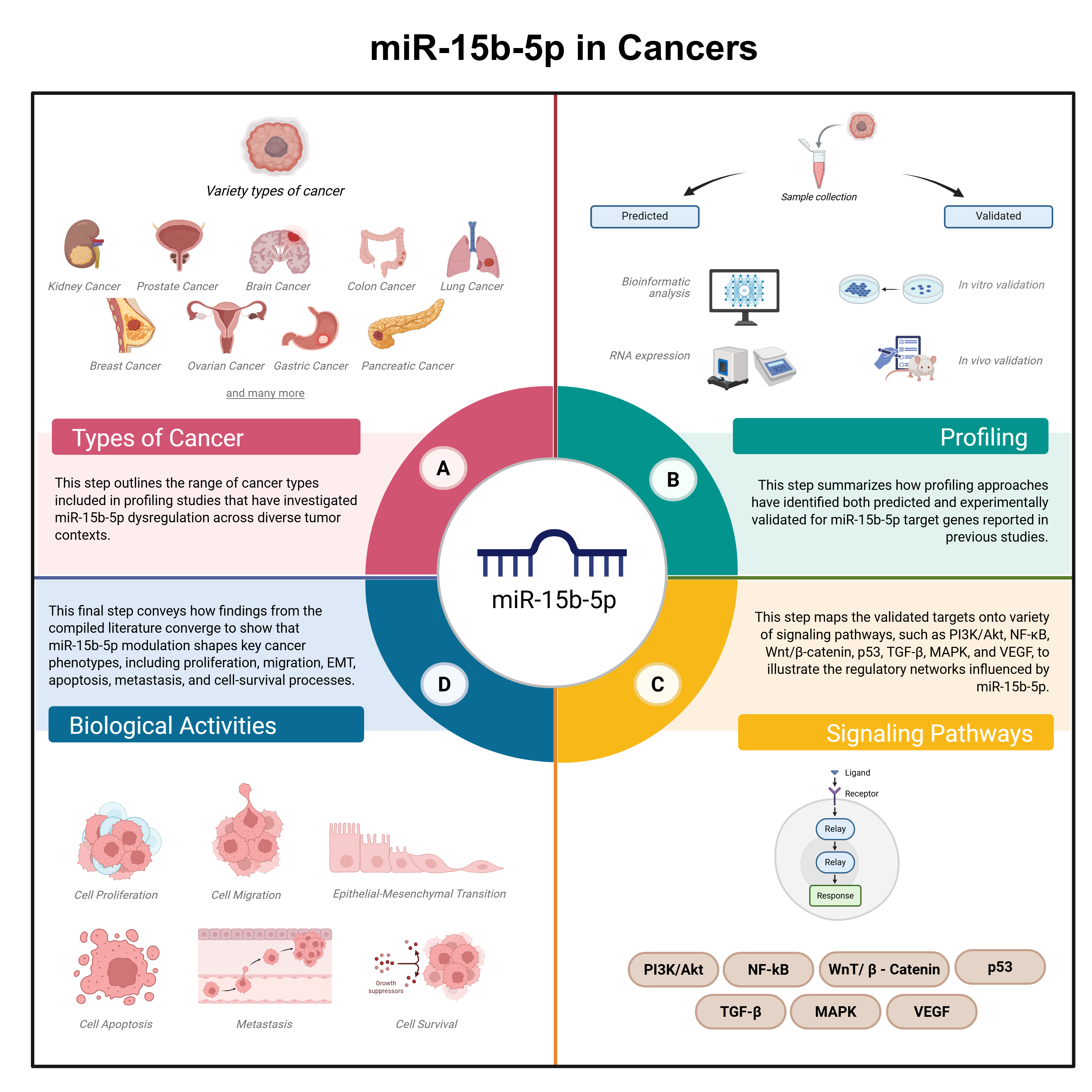
miR-15b-5p is a multifunctional microRNA (miRNA) that is highly context-dependent in cancer, acting as either an oncomiR or a tumor suppressor miRNA (TSM) depending on tumor type, molecular characteristics, and microenvironment. This review synthesizes existing evidence to outline pathway and network integration underlying the context-dependent biological roles of miR-15b-5p across different cancers. Integrated multi-omics cancer profiling demonstrates significant upregulation across several solid tumor types, including non-small cell lung cancer (NSCLC), colorectal cancer (CRC), prostate cancer (PCa), melanoma, and early-stage breast cancer. Conversely, downregulation has been observed in some malignancies, such as Hodgkin’s lymphoma, renal cell carcinoma, and KRAS-mutant CRC. This indicates the dual roles of miR-15b-5p. Upstream, miR-15b-5p is regulated by multiple lncRNA-miRNA-mRNA axes, which affect key targets such as CHRM3, PPM1D, CCND1, CDC42, CA2, and CCNE2, which are involved in oncogenic pathways such as PI3K/Akt, NF-κB, p53, MAPK/ERK, Wnt/β-catenin, TGF-β, and VEGF signaling. In our analysis, the PI3K/Akt network and its interaction with p53 and mTOR appear to be prominently affected signaling pathways, although other regulators such as PAQR3, AXIN2, and ACVR2A may contribute to broader tumor-specific phenotypes. By systematically integrating evidence across diverse malignancies and distinguishing experimentally validated targets from predicted interactions, this study provides a consolidated and mechanistically grounded framework positioning miR-15b-5p as a context-dependent therapeutic, prognostic, and diagnostic candidate. While current evidence remains largely preclinical, our synthesis clarifies inconsistencies in the literature and establishes a structured foundation for future clinical validation.
HIGHLIGHTS
- Dual roles of miR-15b-5p as an oncomiR and tumor suppressor miR in cancer pathogenesis has been described in many studies.
- miR-15b-5p is regulated by multiple lncRNA-miRNA-mRNA axes, which affect key target genes.
- Several key cancer related signaling pathways are regulated by miR-15b-5p, including PI3K/Akt, NF-κB, p53, MAPK/ERK, Wnt/β-catenin, TGF-β, and VEGF signaling.
- mir15b-5p' has potential as a therapeutic target, prognostic, and diagnostic biomarker in human cancers.
GRAPHICAL ABSTRACT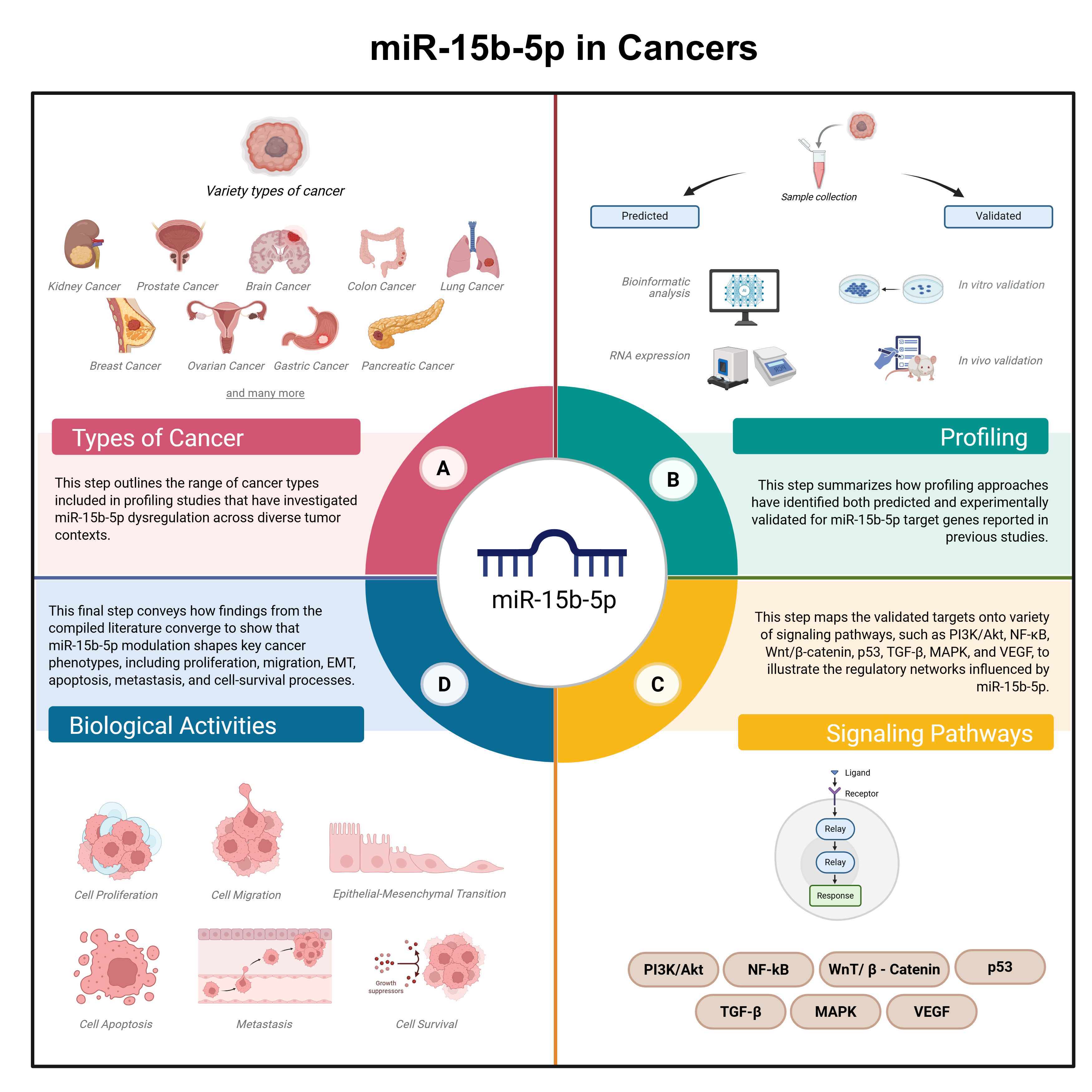
Downloads
References
HH Wu, S Leng, C Sergi and R Leng. How MicroRNAs command the battle against cancer. International Journal of Molecular Sciences 2024; 25(11), 5865.
T Tomankova, M Petrek and E Kriegova. Involvement of microRNAs in physiological and pathological processes in the lung. Respiratory Research 2010; 11(1), 159.
MI Almeida, RM Reis and GA Calin. MicroRNA history: Discovery, recent applications, and next frontiers. Mutation Research/Fundamental and Molecular Mechanisms of Mutagenesis 2011; 717(1-2), 1-8.
Y Peng and CM Croce. The role of MicroRNAs in human cancer. Signal Transduction and Targeted Therapy 2016; 1(1), 15004.
J O’Brien, H Hayder, Y Zayed and C Peng. Overview of microRNA biogenesis, mechanisms of actions, and circulation. Frontiers in Endocrinology 2018; 9, 402.
Z Wang, H Wang, S Zhou, J Mao, Z Zhan and S Duan. miRNA interplay: Mechanisms and therapeutic interventions in cancer. MedComm-Oncology 2024; 3(4), e93.
Y Dong, N Zhang, S Zhao, X Chen, F Li and X Tao. miR-221-3p and miR-15b-5p promote cell proliferation and invasion by targeting Axin2 in liver cancer. Oncology Letters 2019; 18(6), 6491-6500.
R Chen, L Sheng, HJ Zhang, M Ji and WQ Qian. miR-15b-5p facilitates the tumorigenicity by targeting RECK and predicts tumour recurrence in prostate cancer. Journal of Cellular and Molecular Medicine 2018; 22(3), 1855-1863.
LN Sun, Z Zhi, LY Chen, Q Zhou, XM Li, WJ Gan, S Chen, M Yang, Y Liu, T Shen, Y Xu and JM Li. SIRT1 suppresses colorectal cancer metastasis by transcriptional repression of miR-15b-5p. Cancer Letters 2017; 409, 104-115.
GR Chen, YB Zhang, SF Zheng, YW Xu, P Lin, HC Shang-Guan, YX Lin, DZ Kang and PS Yao. Decreased SPTBN2 expression regulated by the ceRNA network is associated with poor prognosis and immune infiltration in low-grade glioma. Experimental and Therapeutic Medicine 2023; 25(6), 253.
MTD Martino, P Tagliaferri and P Tassone. MicroRNA in cancer therapy: Breakthroughs and challenges in early clinical applications. Journal of Experimental & Clinical Cancer Research 2025; 44(1), 126.
MJ Ramaiah. Functions and epigenetic aspects of miR-15/16: Possible future cancer therapeutics. Gene Reports 2018; 12, 149-164.
C Zhao, Y Li, G Chen, F Wang, Z Shen and R Zhou. Overexpression of miR-15b-5p promotes gastric cancer metastasis by regulating PAQR3. Oncology Reports 2017; 38(1), 352-358.
S Ghafouri-Fard, T Khoshbakht, BM Hussen, HH Jamal, M Taheri and M Hajiesmaeili. A comprehensive review on function of miR-15b-5p in malignant and non-malignant disorders. Frontiers in Oncology 2022; 12, 870996.
X Jin, Y Chen, H Chen, S Fei, D Chen, X Cai and C Xie. Evaluation of tumor-derived exosomal miRNA as potential diagnostic biomarkers for early-stage non-small cell lung cancer using next-generation sequencing. Clinical Cancer Research 2017; 23(17), 5311-5319.
X Jin, Y Chen, H Chen, S Fei, D Chen, X Cai, L Liu, B Lin, H Su, L Zhao, M Su, H Pan, L Shen, D Xie and C Xie. Identifying specific miRNAs and associated mRNAs in CD44 and CD90 cancer stem cell subtypes in gastric cancer cell line SNU-5. International Journal of Clinical and Experimental Pathology 2020; 13(6), 1313-1323.
X Li, C Sun, Z Ge, Y Li, H Zhou, Y Wu, S Lin, P Zhang, X Wu and Y Lai. Evaluation of the diagnostic value of a three-miRNA panel in prostate cancer: A discovery and validation study. Discover Oncology 2025; 16(1), 611.
E Milanesi, M Dobre, AI Bucuroiu, V Herlea, TE Manuc, A Salvi, GD Petro, M Manuc and G Becheanu. miRNAs-based molecular signature for KRAS mutated and wild type colorectal cancer: An explorative study. Journal of Immunology Research 2020; 2020, 4927120.
S Paydas, A Acikalin, M Ergin, H Celik, B Yavuz and K Tanriverdi. Micro-RNA (miRNA) profile in Hodgkin lymphoma: Association between clinical and pathological variables. Medical Oncology 2016; 33(4), 34.
L Fan, H Qi, J Teng, B Su, H Chen, C Wang and Q Xia. Identification of serum miRNAs by nano-quantum dots microarray as diagnostic biomarkers for early detection of non-small cell lung cancer. Tumor Biology 2016; 37(6), 7777-7784.
J Xia, M Luo, L Dai, L Wang, L Wang and J Zhu. Serum exosomal microRNAs as predictive markers for EGFR mutations in non-small cell lung cancer. Journal of Clinical Laboratory Analysis 2021; 35(5), e23743.
CO Pintea, M Pricop, E Seclaman, NC Balica, K Guran, DI Horhat and CI Mot. A pilot study on the analysis of circulating miRNA upregulation in laryngeal cancer. Diseases 2025; 13(4), 101.
J Gasparello, C Papi, M Allegretti, E Giordani, F Carboni, S Zazza, E Pescarmona, P Romania, P Giacomini, C Scapoli, R Gambari and A Finotti. A distinctive microRNA (miRNA) signature in the blood of colorectal cancer (CRC) patients at surgery. Cancers 2020; 12(9), 2410.
GB Spychalski, AA Lin, SJ Yang, H Shen, J Rosario, K Tien, K French, M Ghali, S Yee, M Yin, MD Feldman, EF Conant, SP Weinstein, EL Carpenter, D Issadore and A Nayak. miRNA panel from HER2+ and CD24+ plasma extracellular vesicle subpopulations as biomarkers of early-stage breast cancer. Breast Cancer Research 2025; 27(1), 90.
M Sromek, G Rymkiewicz, A Paziewska, LM Szafron, M Kulecka, M Zajdel, M Kulinczak, M Dabrowska, A Balabas, Z Bystydzienski, M Chechlinska and JK Siwicki. A set of 17 microRNAs common for brain and cerebrospinal fluid differentiates primary central nervous system lymphoma from non-malignant brain tumors. Biomolecules 2021; 11(9), 1395.
T Sugai, M Osakabe, T Niinuma, R Sugimoto, M Eizuka, Y Tanaka, N Yanagawa, K Otsuka, A Sasaki, T Matsumoto and H Suzuki. Genome-wide analysis of microRNA and mRNA expression in colorectal intramucosal neoplasia and colorectal cancer with a microsatellite-stable phenotype based on adenoma-carcinoma sequences. Frontiers in Oncology 2022; 12, 831100.
R Weissman, EL Diamond, J Haroche, N Pillar, G Shapira, BH Durham, J Buthorn, F Cohen, M Ki and O Hershkovitz-Rokah. The contribution of microRNAs to the inflammatory and neoplastic characteristics of Erdheim-Chester disease. Cancers 2020; 12(11), 3240.
DA Armstrong, BB Green, JD Seigne, AR Schned and CJ Marsit. MicroRNA molecular profiling from matched tumor and bio-fluids in bladder cancer. Molecular Cancer 2015; 14(1), 194.
A Molfino, M Beltra, MI Amabile, R Belli, G Birolo, E Belloni, S De Lucia, L Garcia-Castillo, F Penna, G Imbimbo, G Nigri, B Pardini, P Costelli and M Muscaritoli. Small non-coding RNA profiling in patients with gastrointestinal cancer. Journal of Cachexia, Sarcopenia and Muscle 2023; 14(6), 2692-2702.
W Xu, S Liu, L Ma, L Cheng, Q Li, L Qing, Y Yang and Z Dong. Identification of miRNA signature in cancer-associated fibroblast to predict recurrent prostate cancer. Computers in Biology and Medicine 2024; 180, 108989.
J Kiraly, E Szabo, P Fodor, A Vass, M Choudhury, R Gesztelyi, C Szasz, T Flasko, N Dobos, B Zsebik, AJ Steli, G Halmos and Z Szabo. Expression of hsa-miRNA-15b,-99b,-181a and their relationship to angiogenesis in renal cell carcinoma. Biomedicines 2024; 12(7), 1441.
M Marcuello, S Duran-Sanchon, L Moreno, JJ Lozano, L Bujanda, A Castells and M Gironella. Analysis of a 6-miRNA signature in serum from colorectal cancer screening participants as non-invasive biomarkers for advanced adenoma and colorectal cancer detection. Cancers 2019; 11(10), 1542.
J Mills, M Capece, E Cocucci, A Tessari and D Palmieri. Cancer-derived extracellular vesicle-associated microRNAs in intercellular communication: one cell's trash is another cell's treasure. International Journal of Molecular Sciences 2019; 20(24), 6109.
M Groot and H Lee. Sorting mechanisms for microRNAs into extracellular vesicles and their associated diseases. Cells 2020; 9(4), 1044.
B Zhang and Q Ye. Linc00662 sponges miR-15b-5p to promote hypopharyngeal squamous cell carcinoma progression by facilitating cancer stem cell-like phenotypes. Journal of Cancer 2024; 15(12), 3781.
Y Ashirbekov, N Khamitova, K Satken, A Abaildayev, I Pinskiy, A Yeleussizov, L Yegenova, A Kairanbayeva, D Kadirshe, G Utegenova, N Jainakbayev and K Sharipov. Circulating microRNAs as biomarkers for the early diagnosis of lung cancer and its differentiation from tuberculosis. Diagnostics 2024; 14(23), 2684.
S Fogli, B Polini, S Carpi, B Pardini, A Naccarati, N Dubbini, M Lanza, MC Breschi, A Romanini and P Nieri. Identification of plasma microRNAs as new potential biomarkers with high diagnostic power in human cutaneous melanoma. Tumor Biology 2017; 39(5), 1-8.
D Hanniford, J Zhong, L Koetz, A Gaziel-Sovran, DJ Lackaye, S Shang, A Pavlick, R Shapiro, R Berman, F Darvishian, Y Shao, I Osman and E Hernando. A miRNA-based signature detected in primary melanoma tissue predicts development of brain metastasis. Clinical Cancer Research 2015; 21(21), 4903-4912.
CY Li, WW Zhang, JL Xiang, XH Wang, J Li and JL Wang. Identification of microRNAs as novel biomarkers for esophageal squamous cell carcinoma: A study based on The Cancer Genome Atlas (TCGA) and bioinformatics. Chinese Medical Journal 2019; 132(18), 2213-2222.
J da Silva, CC da Costa, IF Ramos, AC Laus, L Sussuchi, RM Reis, AS Khayat, LR Cavalli and SR Pereira. Upregulated miRNAs on the TP53 and RB1 binding seedless regions in high-risk HPV-associated penile cancer. Frontiers in Genetics 2022; 13, 875939.
Y Yang, X Xin and X Xu. Identification of potential miRNA-mRNA regulatory network in the development of oral cancer. Disease Markers 2022; 2022, 9376608.
Y Zhao, Y Song, Y Zhang, M Ji, P Hou and F Sui. Screening protective miRNAs and constructing novel lncRNAs/miRNAs/mRNAs networks and prognostic models for triple-negative breast cancer. Molecular and Cellular Probes 2023; 72, 101940.
G Cochetti, L Cari, V Maula, R Cagnani, A Paladini, M Del Zingaro, G Nocentini and E Mearini. Validation in an independent cohort of MiR-122, MiR-1271, and MiR-15b as urinary biomarkers for the potential early diagnosis of clear cell renal cell carcinoma. Cancers 2022; 14(5), 1112.
AA Mohamed, NN Amer, N Osama, W Hafez, AEA Ali, MM Shaheen, AA Alkhalegy, EA Abouahmed, SM Soaida, LA Samy, A El-Kassas, I Cherrez-Ojeda and RR El-Awady. Expression of miR-15b-5p and toll-like receptor4 as potential novel diagnostic biomarkers for hepatitis C virus-induced hepatocellular carcinoma. Non-Coding RNA Research 2025; 10, 262-268.
M Dobre, RC Poenaru, AM Niculae, C Vladut, V Herlea, E Milanesi and ME Hinescu. Increased levels of miR-15b-5p and miR-20b-5p in pancreatic ductal adenocarcinoma with hepatic metastases. Genes 2023; 14(8), 1577.
R Duan, C Pak and P Jin. Single nucleotide polymorphism associated with mature miR-125a alters the processing of pri-miRNA. Human Molecular Genetics 2007; 16(9), 1124-1131.
R Harnprasopwat, D Ha, T Toyoshima, H Lodish, A Tojo and A Kotani. Alteration of processing induced by a single nucleotide polymorphism in pri-miR-126. Biochemical and Biophysical Research Communications 2010; 399(2), 117-122.
W Sun, J Lan, L Chen, J Qiu, Z Luo, M Li, J Wang, J Zhao, T Zhang, X Long, J Chai, Z Yan, Z Guo and S Gun. A mutation in porcine pre-miR-15b alters the biogenesis of miR-15b16-1 cluster and strand selection of miR-15b. PLoS One 2017; 12(5), e0178045.
JS Mattick, PP Amaral, P Carninci, S Carpenter, HY Chang, LL Chen, R Chen, C Dean, ME Dinger, KA Fitzgerald, TR Gingeras, M Guttman, T Hirose, M Huarte, R Johnson, C Kanduri, P Kapranov, JB Lawrence, JT Lee, …, M Wu. Long non-coding RNAs: Definitions, functions, challenges and recommendations. Nature Reviews Molecular Cell Biology 2023; 24(6), 430-447.
J Xu, J Zhang, F Shan, J Wen and Y Wang. SSTR5-AS1 functions as a ceRNA to regulate CA2 by sponging miR-15b-5p for the development and prognosis of HBV-related hepatocellular carcinoma. Molecular Medicine Reports 2019; 20(6), 5021-5031.
F Wang, Y Zu, S Zhu, Y Yang, W Huang, H Xie and Y Zu. Long noncoding RNA MAGI2-AS3 regulates CCDC19 expression by sponging miR-15b-5p and suppresses bladder cancer progression. Biochemical and Biophysical Research Communications 2018; 507, 231-235.
B Ma, S Wang, W Wu, P Shan, Y Chen, J Meng, L Xing, J Yun, L Hao, X Wang, S Li and Y Guo. Mechanisms of circRNA/lncRNA-miRNA interactions and applications in disease and drug research. Biomedicine & Pharmacotherapy 2023; 162, 114672.
S Asai, Y Goto, K Tanigawa, Y Tomioka, M Kato, K Mizuno, S Sakamoto and N Seki. MiR-15b-5p inhibits castration-resistant growth of prostate cancer cells by targeting the muscarinic cholinergic receptor CHRM3. FEBS Letters 2023; 597(8), 1164-1175.
Y Cai, Y Yang, X Zhang, Q Ma and M Li. TRPM2-AS promotes the malignancy of osteosarcoma cells by targeting miR-15b-5p/PPM1D axis. Cell Cycle 2022; 21(8), 835-850.
SY Zhao, Z Wang, XB Wu, S Zhang, Q Chen, DD Wang and QF Tan. CERS6-AS1 contributes to the malignant phenotypes of colorectal cancer cells by interacting with miR-15b-5p to regulate SPTBN2. The Kaohsiung Journal of Medical Sciences 2022; 38(5), 403-414.
Y Zhou, RG Fan, CL Qin, J Jia, XD Wu and WZ Zha. LncRNA-H19 activates CDC42/PAK1 pathway to promote cell proliferation, migration and invasion by targeting miR-15b in hepatocellular carcinoma. Genomics 2019; 111(6), 1862-1872.
Z Li, JM Tian, Y Chu, HY Zhu, JJ Wang and J Huang. Long non-coding RNA PVT1 (PVT1) affects the expression of CCND1 and promotes doxorubicin resistance in osteosarcoma cells. Journal of Bone Oncology 2023; 43, 100512.
A Tolle, L Buckendahl and K Jung. Plasma miR-15b-5p and miR-590-5p for distinguishing patients with bladder cancer from healthy individuals. Oncology Reports 2019; 42(4), 1609-1620.
Y Zhu, X Zhang, L Wang, X Zhu, Z Xia, L Xu and J Xu. FENDRR suppresses cervical cancer proliferation and invasion by targeting miR-15a/b-5p and regulating TUBA1A expression. Cancer Cell International 2020; 20(1), 152.
EC Ottley, HD Nicholson and EJ Gold. Activin A regulates microRNAs and gene expression in LNCaP cells. The Prostate 2016; 76(11), 951-963.
NB Zhang, JJ Jin and XH Ye. Integrated analysis of the potential roles of microRNA-messenger RNA networks in prostate adenocarcinoma. Heliyon 2023; 9(12), e22383.
H Li, J Zhang, MJ Lee, GR Yu, X Han and DG Kim. OIP5, a target of miR-15b-5p, regulates hepatocellular carcinoma growth and metastasis through the AKT/mTORC1 and β-catenin signaling pathways. Oncotarget 2017; 8(11), 18129.
C Zhao, Q Zhao, C Zhang, G Wang, Y Yao, X Huang, F Zhan, Y Zhu, J Shi, J Chen, F Yan and Y Zhang. miR-15b-5p resensitizes colon cancer cells to 5-fluorouracil by promoting apoptosis via the NF-kB/XIAP axis. Scientific Reports 2017; 7(1), 4194.
C Liu, R Liu, B Wang, J Lian, Y Yao, H Sun, C Zhang, L Fang, X Guan, J Shi, S Han, F Zhan, S Luo, Y Yao, T Zheng and Y Zhang. Blocking IL-17A enhances tumor response to anti-PD-1 immunotherapy in microsatellite stable colorectal cancer. Journal for Immunotherapy of Cancer 2021; 9(1), e001895.
AS Pathania, P Prathipati, OA Olwenyi, S Chava, OVS Smith, SC Gupta, NK Chaturvedi, SN Byrareddy, DW Coulter and KB Challagundla. miR-15a and miR-15b modulate natural killer and CD8+T-cell activation and anti-tumor immune response by targeting PD-L1 in neuroblastoma. Molecular Therapy-Oncolytics 2022; 25, 308-329.
S Chava, CP Reynolds, AS Pathania, S Gorantla, LY Poluektova, DW Coulter, SC Gupta, MK Pandey and KB Challagundla. miR-15a-5p, miR-15b-5p, and miR-16-5p inhibit tumor progression by directly targeting MYCN in neuroblastoma. Molecular Oncology 2020; 14(1), 180-196.
XM Zhou, R Sun, DH Luo, J Sun, MY Zhang, MH Wang, Y Yang, HY Wang and SJ Mai. Upregulated TRIM29 promotes proliferation and metastasis of nasopharyngeal carcinoma via PTEN/AKT/mTOR signal pathway. Oncotarget 2016; 7(12), 13634.
GR Chen, YB Zhang, SF Zheng, YW Xu, P Lin, HC Shang-Guan, YX Lin, DZ Kang and PS Yao. Decreased SPTBN2 expression regulated by the ceRNA network is associated with poor prognosis and immune infiltration in low-grade glioma. Experimental and Therapeutic Medicine 2023; 25(6), 253.
H Mao, X Zhao and SC Sun. NF-kB in inflammation and cancer. Cellular & Molecular Immunology 2025; 22(8), 811-839.
Y Zhu, L Yan, W Zhu, X Song, G Yang and S Wang. MMP2/3 promote the growth and migration of laryngeal squamous cell carcinoma via PI3K/Akt-NF-kB-mediated epithelial-mesenchymal transformation. Journal of Cellular Physiology 2019; 234(9), 15847-15855.
Y He, MM Sun, GG Zhang, J Yang, KS Chen, WW Xu and B Li. Targeting PI3K/Akt signal transduction for cancer therapy. Signal Transduction and Targeted Therapy 2021; 6(1), 425.
P Ahmad, J Sana, M Slavik, D Gurin, L Radova, NA Gablo, T Kazda, P Smilek, Z Horakova, B Gal, M Hermanova, P Slampa and O Slaby. MicroRNA-15b-5p predicts locoregional relapse in head and neck carcinoma patients treated with intensity-modulated radiotherapy. Cancer Genomics & Proteomics 2019; 16(2), 139-146.
Q Wu, D Nandi and D Sharma. TRIM-endous functional network of tripartite motif 29 (TRIM29) in cancer progression and beyond. Cancer and Metastasis Reviews 2025; 44(1), 16.
B Han, J Chen, S Chen, X Shen, L Hou, J Fang and M Lian. PPARG and the PTEN-PI3K/AKT signaling axis may cofunction in promoting chemosensitivity in hypopharyngeal squamous cell carcinoma. PPAR Research 2024; 2024(1), 2271214.
XS Jin, LX Chen, TT Ji and RZ Li. SERPINH1 promoted the proliferation and metastasis of colorectal cancer by activating PI3K/Akt/mTOR signaling pathway. World Journal of Gastrointestinal Oncology 2024; 16(5), 1890.
J Zou, J Qian, H Fu, F Yin, W Zhao and L Xu. MicroRNA-15b-5p exerts its tumor repressive role via targeting GDI2: A novel insight into the pathogenesis of thyroid carcinoma. Molecular Medicine Reports 2020; 22(4), 2723-2732.
J Wang, S Yao, Y Diao, Y Geng, Y Bi and G Liu. miR-15b enhances the proliferation and migration of lung adenocarcinoma by targeting BCL2. Thoracic Cancer 2020; 11(6), 1396-1405.
M Gasco, S Shami and T Crook. The p53 pathway in breast cancer. Breast Cancer Research 2002; 4(2), 70.
J Gasparello, C Papi, M Zurlo, L Gambari, A Rozzi, A Manicardi, R Corradini, R Gambari and A Finotti. Treatment of human glioblastoma U251 cells with sulforaphane and a peptide nucleic acid (PNA) targeting miR-15b-5p: Synergistic effects on induction of apoptosis. Molecules 2022; 27(4), 1299.
YJ Guo, WW Pan, SB Liu, ZF Shen, Y Xu and LL Hu. ERK/MAPK signalling pathway and tumorigenesis. Experimental and Therapeutic Medicine 2020; 19(3), 1997-2007.
X Yu, Z Li, MTV Chan and WWK Wu. PAQR3: A novel tumor suppressor gene. American Journal of Cancer Research 2015; 5(9), 2562-2568.
Q Guo, XL Liu, K Zhai, C Chen, XX Ke, J Zhang and G Xu. The emerging roles and mechanisms of PAQR3 in human cancer: Pathophysiology and therapeutic implications. International Journal of General Medicine 2023; 16, 4321-4328.
K He and WJ Gan. Wnt/β-catenin signaling pathway in the development and progression of colorectal cancer. Cancer Management and Research 2023; 15, 435-448.
BD White, AJ Chien and DW Dawson. Dysregulation of Wnt/β-catenin signaling in gastrointestinal cancers. Gastroenterology 2012; 142(2), 219-232.
Y Zhang and X Wang. Targeting the Wnt/β-catenin signaling pathway in cancer. Journal of Hematology & Oncology 2020; 13(1), 165.
E Jho, T Zhang, C Domon, CK Joo, JN Freund and F Costantini. Wnt/β-catenin/Tcf signaling induces the transcription of Axin2, a negative regulator of the signaling pathway. Molecular and Cellular Biology 2002; 22(4), 1172-1183.
DB Bernkopf, M Bruckner, MV Hadjihannas and J Behrens. An aggregon in conductin/axin2 regulates Wnt/β-catenin signaling and holds potential for cancer therapy. Nature Communications 2019; 10(1), 4251.
M Simons, E Gordon and L Claesson-Welsh. Mechanisms and regulation of endothelial VEGF receptor signalling. Nature Reviews Molecular Cell Biology 2016; 17(10), 611-625.
H Mahaki, S Nobari, H Tanzadehpanah, A Babaeizad, G Kazemzadeh, M Mehrabzadeh, A Valipour, N Yazdinezhad, H Manoochehri, P Yang and M Sheykhhasan. Targeting VEGF signaling for tumor microenvironment remodeling and metastasis inhibition: Therapeutic strategies and insights. Biomedicine & Pharmacotherapy 2025; 186, 118023.
Z Shi, M Kuai, B Li, CF Akowuah, Z Wang, Y Pan, M Tang, X Yang and P Lu. The role of VEGF in cancer angiogenesis and tumorigenesis: Insights for anti-VEGF therapy. Cytokine 2025; 189, 156908.
G Liu, T Chen, Z Ding, Y Wang, Y Wei and X Wei. Inhibition of FGF-FGFR and VEGF-VEGFR signalling in cancer treatment. Cell Proliferation 2021; 54(4), e13009.
J Liao, R Chen, B Lin, R Deng, Y Liang, J Zeng, S Ma and X Qiu. Cross-talk between the TGF-β and cell adhesion signaling pathways in cancer. International Journal of Medical Sciences 2024; 21(7), 1307.
R Du, L Wen, M Niu, L Zhao, X Guan, J Yang, C Zhang and H Liu. Activin receptors in human cancer: Functions, mechanisms, and potential clinical applications. Biochemical Pharmacology 2024; 222, 116061.
FA Alabi, IF Okpalanwaka, A Oyegbesan, E Okoyeocha, M Oladejo and SO Imodoye. Transforming growth factor-beta signaling in cancer: Therapeutic implications, challenges, and pathways to progress. MedComm-Oncology 2025; 4(3), e70027.
S Moradi, A Kamal, H Aboulkheyr Es, F Farhadi, M Ebrahimi, H Chitsaz, A Sharifi-Zarchi and H Baharvand. Pan-cancer analysis of microRNA expression profiles highlights microRNAs enriched in normal body cells as effective suppressors of multiple tumor types: A study based on TCGA database. PLoS One 2022; 17(4), e0267291.
JD Gagnon, R Kageyama, HM Shehata, MS Fassett, DJ Mar, EJ Wigton, K Johansson, AJ Litterman, P Odorizzi, D Simeonov, BJ Laidlaw, M Panduro, S Patel, LT Jeker, ME Feeney, MT McManus, A Marson, M Matloubian, S Sanjabi and KM Ansel. miR-15/16 restrain memory T cell differentiation, cell cycle, and survival. Cell Reports 2019; 28(8), 2169-2181.
Published
How to Cite
Issue
Section
License
Copyright (c) 2026 Walailak University

This work is licensed under a Creative Commons Attribution-NonCommercial-NoDerivatives 4.0 International License.





