
Challenges and Strategies to Enhance Drug Efficacy of the Approved Drugs for Chemoresistant Triple-Negative Breast Cancer: A Narrative Review
DOI:
https://doi.org/10.48048/tis.2025.9490Keywords:
Triple negative breast cancer, Chemoresistance, PARP, ADCAbstract
Triple-negative breast cancer (TNBC) has been shown to have a high relapse rate, high incidence of distant metastases, poor overall survival and chemoresistance. Resistance can arise from various factors, including the induction of cancer stem cells (CSCs), activity of ATP-binding cassette (ABC) transporters, hypoxic conditions and evasion of apoptosis. It is necessary to develop biomarker assays to predict chemoresistance (CR). Identification of CR-associated biomarkers will greatly enhance the therapeutic efficacy of drugs, in addition to improving the quality of life of patients. Recently, therapies tailored to specific biomarkers have been introduced for subsets of TNBC, and are now available in clinical practice. These include olaparib and talazoparib for carriers of BRCA1/2 germline mutations; and antibody-drug conjugate therapy targeting trophoblast cell surface antigen 2 (Trop2) for heavily pretreated metastatic TNBC (mTNBC). Additionally, therapies targeting various pathological molecular pathways are currently under investigation. Emerging biomarker-associated therapies, in combination with conventional therapeutic approaches, may overcome/hinder chemoresistance. This review address CR in TNBC while integrating insights into newly approved targeted therapies, biomarker-based patient selection and innovative strategies to overcome resistance mechanisms. This review uniquely combines scientific advances in biomarker-based therapies, clinical translation challenges and practical strategies, making it a valuable resource for guiding precision medicine in TNBC.
HIGHLIGHTS
- This review explores chemoresistance in TNBC, highlighting advancements in targeted therapies, biomarker-driven patient selection, and novel approaches to overcoming resistance mechanisms.
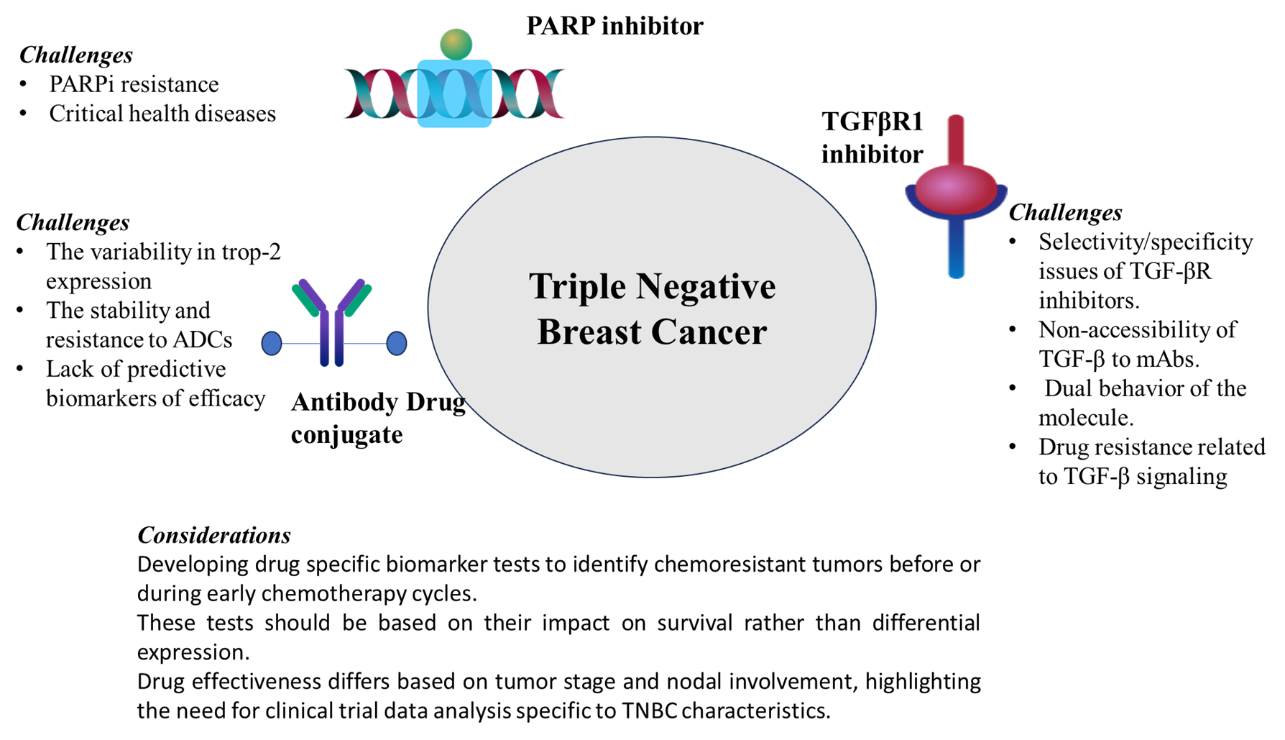
- Targeted therapies for TNBC subtypes have recently been introduced into clinical practice. Olaparib and talazoparib are used for BRCA1/2-mutated cases, while Galunisertib target TGF-β. Additionally, Trop2-targeting antibody-drug conjugates are available for heavily pretreated metastatic TNBC. Nevertheless, these therapies come with several challenges.
- Identifying biomarkers to select patients for personalized treatment will advance therapy effectiveness while minimizing side effects.
- Integrating biomarker-targeted therapies with standard treatments could help overcome chemoresistance.
GRAPHICAL ABSTRACT

Downloads
References
S Gupta, JE Jones and D Smith-Graziani. Disparities in hereditary genetic testing in patients with triple negative breast cancer. Clinical Breast Cancer 2024; 25(1), 12-18.
O Obidiro, G Battogtokh and EO Akala. Triple negative breast cancer treatment options and limitations: Future outlook. Pharmaceutics 2023; 15(7), 1796.
L Yin, JJ Duan, XW Bian and S Yu. Triple-negative breast cancer molecular subtyping and treatment progress. Breast Cancer Research 2020; 22(1), 61.
H Song, D Li, T Wu, D Xie, K Hua, J Hu, X Deng, C Ji, Y Deng and L Fang. MicroRNA-301b promotes cell proliferation and apoptosis resistance in triple-negative breast cancer by targeting CYLD. BMB Reports 2018; 51(11), 602-607.
AS Hamy, L Darrigues, E Laas, D De Croze, L Topciu, GT Lam, C Evrevin, S Rozette, L Laot, F Lerebours, JY Pierga, M Osdoit, M Faron, JG Feron, M Laé and F Reyal. Prognostic value of the residual cancer burden index according to breast cancer subtype: Validation on a cohort of BC patients treated by neoadjuvant chemotherapy. PLoS One 2020; 15(6), e0234191.
P Cortazar, L Zhang, M Untch, K Mehta, JP Costantino, N Wolmark, H Bonnefoi, D Cameron, L Gianni, P Valagussa, SM Swain, T Prowell, S Loibl, L Wickerham, J Bogaerts, J Baselga, C Perou, G Blumenthal, J Blohmer, …, G von Minckwitz. Pathological complete response and long-term clinical benefit in breast cancer: The CTNeoBC pooled analysis. The Lancet 2014; 384(9938), 164-172.
C Liu and X Yu. ADP-ribosyltransferases and poly ADP-ribosylation. Current Protein and Peptide Science 2015; 16(6), 491-501.
J Morales, L Li, FJ Fattah, Y Dong, EA Bey, M Patel, J Gao and DA Boothman. Review of poly (ADP-ribose) polymerase (PARP) mechanisms of action and rationale for targeting in cancer and other diseases. Critical Reviews™ in Eukaryotic Gene Expression 2014; 24(1), 15-28.
SE Caulfield, CC Davis and KF Byers. Olaparib: A novel therapy for metastatic breast cancer in patients with a BRCA1/2 mutation. Journal of the Advanced Practitioner in Oncology 2019; 10(2), 167-174.
PG Pilié, CM Gay, LA Byers, MJ O’Connor and TA Yap. PARP inhibitors: Extending benefit beyond BRCA-mutant cancers. Clinical Cancer Research 2019; 25(13), 3759-3771.
PL Sulkowski, CD Corso, ND Robinson, SE Scanlon, KR Purshouse, H Bai, Y Liu, RK Sundaram, DC Hegan, NR Fons, GA Breuer, Y Song, K Mishra-Gorur, HM De Feyter, RA de Graaf, YV Surovtseva, M Kachman, S Halene, M Günel, PM Glazer and RS Bindra. 2-hydroxyglutarate produced by neomorphic IDH mutations suppresses homologous recombination and induces PARP inhibitor sensitivity. Science Translational Medicine 2017; 9(375), eaal2463.
PL Sulkowski, RK Sundaram, S Oeck, CD Corso, Y Liu, S Noorbakhsh, M Niger, M Boeke, D Ueno, AN Kalathil, X Bao, J Li, B Shuch, RS Bindra and PM Glazer. Krebs-cycle-deficient hereditary cancer syndromes are defined by defects in homologous-recombination DNA repair. Nature Genetics 2018; 50(8), 1086-1092.
IH Ismail, R Davidson, JP Gagné, ZZ Xu, GG Poirier and MJ Hendzel. Germline mutations in BAP1 impair its function in DNA double-strand break repair. Cancer Research 2014; 74(16), 4282-4294.
M Bou Zerdan, T Ghorayeb, F Saliba, S Allam, M Bou Zerdan, M Yaghi, N Bilani, R Jaafar and Z Nahleh. Triple negative breast cancer: Updates on classification and treatment in 2021. Cancers 2022; 14(5), 1253.
Z Tang, B Jiang, Z Shi, W Gong, Y Liu, X Wang, Y Gao, F Yu, C Zhou, L Luo, M Wei and L Wang. BGB-290, a novel PARP inhibitor with unique brain penetration ability, demonstrated strong synergism with temozolomide in subcutaneous and intracranial xenograft models. Cancer Research 2015; 75(15_Supplement), 1651.
EM Stringer-Reasor, JE May, E Olariu, V Caterinicchia, Y Li, D Chen, DL Della Manna, GB Rocque, C Vaklavas, CI Falkson, LM Nabell, EP Acosta, A Forero-Torres and ES Yang. An open-label, pilot study of veliparib and lapatinib in patients with metastatic, triple-negative breast cancer. Breast Cancer Research 2021; 23(1), 30.
HS Han, V Diéras, M Robson, M Palácová, PK Marcom, A Jager, I Bondarenko, D Citrin, M Campone, ML Telli, SM Domchek, M Friedlander, B Kaufman, JE Garber, Y Shparyk, E Chmielowska, EH Jakobsen, V Kaklamani, W Gradishar, …, S Puhalla. Veliparib with temozolomide or carboplatin/paclitaxel versus placebo with carboplatin/paclitaxel in patients with BRCA1/2 locally recurrent/metastatic breast cancer: Randomized phase II study. Annals of Oncology 2018; 29(1), 154-161.
PA Fasching, C Jackisch, K Rhiem, A Schneeweiss, P Klare, C Hanusch, JB Huober, T Link, M Untch, S Schmatloch, C Denkert, A Stefek, C Uleer, G Doering, K Engels, F Seither, JU Blohmer and S Loibl. GeparOLA: A randomized phase II trial to assess the efficacy of paclitaxel and olaparib in comparison to paclitaxel/carboplatin followed by epirubicin/cyclophosphamide as neoadjuvant chemotherapy in patients (pts) with HER2-negative early breast cancer (BC) and homologous recombination deficiency (HRD). Journal of Clinical Oncology 2019; 37(15), 506.
A Moreno-Aspitia, H Liu, DW Hillman, KM Rowland, X Geiger, PJ Stella, P Kourlas, HM Gross, NJ Karlin, MJ Bury, GS Soori, A Nassar and EA Perez. Alliance for clinical trials in oncology, N0937(Alliance): Final clinical results and correlative data from the phase II trial of cisplatin (C) and the novel agent brostallicin (B) in patients with metastatic triple-negative breast cancer (mTNBC). Journal of Clinical Oncology 2013; 31(15), 1059.
HP Eikesdal, S Yndestad, A Elzawahry, A Llop-Guevara, B Gilje, ES Blix, H Espelid, S Lundgren, J Geisler, G Vagstad, A Venizelos, L Minsaas, B Leirvaag, EG Gudlaugsson, OK Vintermyr, HS Aase, T Aas, J Balmaña, V Serra, EAM Janssen, …, PE Lønning. Olaparib monotherapy as primary treatment in unselected triple negative breast cancer. Annals of Oncology 2021; 32(2), 240-249.
A Tutt, C Stephens, P Frewer, A Pierce, J Rhee, S Edgington, L Ottesen, ML Ah-See, SJ Hollingsworth and E Dean. VIOLETTE: A randomized phase II study to assess the DNA damage response inhibitors AZD6738 or AZD1775 in combination with olaparib (Ola) versus Ola monotherapy in patients (pts) with metastatic, triple-negative breast cancer (TNBC). Journal of Clinical Oncology 2019; 37(15), TPS1112.
Z Epigenetics. A study of ZEN003694 and talazoparib in patients with triple negative breast cancer (TNBC). National Library of Medicine, Maryland, 2019.
SM Domchek, S Postel-Vinay, SA Im, YH Park, JP Delord, A Italiano, J Alexandre, B You, S Bastian, MG Krebs, D Wang, SN Waqar, M Lanasa, J Rhee, H Gao, V Rocher-Ros, EV Jones, S Gulati, A Coenen-Stass, …, B Kaufman. Olaparib and durvalumab in patients with germline BRCA-mutated metastatic breast cancer (MEDIOLA): An open-label, multicentre, phase 1/2, basket study. The Lancet Oncology 2020; 21(9), 1155-1164.
ZI Mitri, AL Creason, JM Stommel, D Bottomly, JY Lim, C Corless, S McWeeney and GB Mills. Multi-omic analysis of serial biopsies to inform biomarkers of sensitivity to olaparib and durvalumab in patients with metastatic BRCA-wildtype triple negative breast cancer (mTNBC). Cancer Research 2024; 84(7), CT-203.
S Vinayak, SM Tolaney, L Schwartzberg, M Mita, G McCann, AR Tan, AE Wahner-Hendrickson, A Forero, C Anders, GM Wulf, P Dillon, F Lynce, C Zarwan, JK Erban, Y Zhou, N Buerstatte, JR Graham, S Arora, BJ Dezube and ML Telli. Open-label clinical trial of niraparib combined with pembrolizumab for treatment of advanced or metastatic triple-negative breast cancer. JAMA Oncology 2019; 5(8), 1132-1140.
P Schmid, HS Rugo, S Adams, A Schneeweiss, CH Barrios, H Iwata, V Diéras, V Henschel, L Molinero, SY Chui, V Maiya, A Husain, EP Winer, S Loi and LA Emens. Investigators Atezolizumab plus nab-paclitaxel as first-line treatment for unresectable, locally advanced or metastatic triple-negative breast cancer (IMpassion130): Updated efficacy results from a randomised, double-blind, placebo-controlled, phase 3 trial. The Lancet Oncology 2020; 21(1), 44-59.
LM Jackson and GL Moldovan. Mechanisms of PARP1 inhibitor resistance and their implications for cancer treatment. NAR Cancer 2022; 4(4), zcac042.
A Taglialatela, S Alvarez, G Leuzzi, V Sannino, L Ranjha, JW Huang, C Madubata, R Anand, B Levy, R Rabadan, P Cejka, V Costanzo and A Ciccia. Restoration of replication fork stability in BRCA1- and BRCA2-deficient cells by inactivation of SNF2-family fork remodelers. Molecular Cell 2017; 68(2), 414-430.
DD Singh, A Parveen and DK Yadav. Role of PARP in TNBC: Mechanism of inhibition, clinical applications, and resistance. Biomedicines 2021; 9(11), 1512.
DS Kim, CV Camacho and WL Kraus. Alternate therapeutic pathways for PARP inhibitors and potential mechanisms of resistance. Experimental & Molecular Medicine 2021; 53(1), 42-51.
TK Ricks, HJ Chiu, G Ison, G Kim, AE McKee, P Kluetz and R Pazdur. Successes and challenges of PARP Inhibitors in cancer therapy. Frontiers in Oncology 2015; 5, 222.
MA Smith, CP Reynolds, MH Kang, EA Kolb, R Gorlick, H Carol, RB Lock, ST Keir, JM Maris, CA Billups, D Lyalin, RT Kurmasheva and PJ Houghton. Synergistic activity of PARP inhibition by talazoparib (BMN 673) with temozolomide in pediatric cancer models in the pediatric preclinical testing program. Clinical Cancer Research 2015; 21(4), 819-832.
L Pop, I Suciu, O Ionescu, N Bacalbasa and P Ionescu. The role of novel poly (ADP-ribose) inhibitors in the treatment of locally advanced and metastatic Her-2/neu negative breast cancer with inherited germline BRCA1/2 mutations. A review of the literature. Life 2021; 14(1), 17-20.
Y Wen, D Ouyang, Q Zou, Q Chen, N Luo, H He, M Anwar and W Yi. A literature review of the promising future of TROP2: A potential drug therapy target. Annals of Translational Medicine 2022; 10(24), 1403.
A Shvartsur and B Bonavida. Trop2 and its overexpression in cancers: Regulation and clinical/therapeutic implications. Genes Cancer 2015; 6(3-4), 84-105.
A Kopp and GM Thurber. Severing ties: Quantifying the payload release from antibody drug conjugates. Cell Chemical Biology 2019; 26(12), 1631-1633.
M Shastry, S Jacob, HS Rugo and E Hamilton. Antibody-drug conjugates targeting TROP-2: Clinical development in metastatic breast cancer. Breast 2022; 66, 169-177.
E Mennillo, X Yang, AA Weber, Y Maruo, M Verreault, O Barbier, S Chen and RH Tukey. Intestinal UDP-glucuronosyltransferase 1A1 and protection against irinotecan-induced toxicity in a novel UDP-glucuronosyltransferase 1A1 tissue-specific humanized mouse model. Drug Metabolism and Disposition 2022; 50(1), 33-42.
J Rodon, J Li, J Xue, Y Diao, Y Xu, G Liu, C Rao, B Fan, Y Cheng and J Wang. An open-label, global, first-in-human study of SKB264 in patients with locally advanced or metastatic solid tumors. Annals of Oncology 2021; 32(5), 585.
A Bardia, SM Tolaney, K Punie, D Loirat, M Oliveira, K Kalinsky, A Zelnak, P Aftimos, F Dalenc, S Sardesai, E Hamilton, P Sharma, S Recalde, EC Gil, T Traina, J O’Shaughnessy, J Cortes, M Tsai, L Vahdat, …, SA Hurvitz. Biomarker analyses in the phase III ASCENT study of sacituzumab govitecan versus chemotherapy in patients with metastatic triple-negative breast cancer. Annals of Oncology 2021; 32(9), 1148-1156.
LC Seneviratne, K Harnden, S Blau, MA Danso, D Berz, DC Guaqueta, JF Schwerkoske, J O’Shaughnessy, DA Patt, A Bardia, KE McCann, AP Beelen, J Zhang, JS Yi, SA Hurvitz and MA Mardones. Trilaciclib combined with sacituzumab govitecan (SG) in metastatic triple-negative breast cancer (mTNBC): Updated phase 2 safety and efficacy results. Journal of Clinical Oncology 2024; 42(16), 1091.
A Bardia, IE Krop, T Kogawa, D Juric, AW Tolcher, EP Hamilton, T Mukohara, A Lisberg, T Shimizu, AI Spira, J Tsurutani, S Damodaran, KP Papadopoulos, J Greenberg, F Kobayashi, H Zebger-Gong, R Wong, Y Kawasaki, T Nakamura and F Meric-Bernstam. Datopotamab deruxtecan in advanced or metastatic HR+/HER2- and triple-negative breast cancer: Results from the phase I TROPION-PanTumor01 study. Journal of Clinical Oncology 2024; 42(19), 2281-2294.
RO Abelman, L Spring, A Niemierko, E Abraham, M McNeice, J Goff, A Valenti, SA Wander, SJ Isakoff, B Moy, D Juric, N Vidula, AG Waks, HA Parsons, LW Ellisen, SM Tolaney and A Bardia. Sequential combination of sacituzumab govitecan and talazoparib in metastatic triple negative breast cancer (mTNBC): Results from a phase II study. Journal of Clinical Oncology 2024; 42(16), 1102.
A Bardia, WA Messersmith, EA Kio, JD Berlin, L Vahdat, GA Masters, R Moroose, AD Santin, K Kalinsky, V Picozzi, J O’Shaughnessy, JE Gray, T Komiya, JM Lang, JC Chang, A Starodub, DM Goldenberg, RM Sharkey, P Maliakal, …, AJ Ocean. Sacituzumab govitecan, a Trop-2-directed antibody-drug conjugate, for patients with epithelial cancer: Final safety and efficacy results from the phase I/II IMMU-132-01 basket trial. Annals of Oncology 2021; 32(6), 746-756.
A Bardia, SA Hurvitz, SM Tolaney, D Loirat, K Punie, M Oliveira, A Brufsky, SD Sardesai, K Kalinsky, AB Zelnak, R Weaver, T Traina, F Dalenc, P Aftimos, F Lynce, S Diab, J Cortés, J O’Shaughnessy, V Diéras, …, HS Rugo. Sacituzumab govitecan in metastatic triple-negative breast cancer. New England Journal of Medicine 2021; 384(16), 1529-1541.
T Olivier and V Prasad. Sacituzumab govitecan in metastatic triple negative breast cancer (TNBC): Four design features in the ASCENT trial potentially favored the experimental arm. Translational Oncology 2022; 15(1), 101248.
H Izci, K Punie, L Waumans, A Laenen, H Wildiers, F Verdoodt, C Desmedt, J Ardui, A Smeets, SN Han, I Nevelsteen, P Neven and G Floris. Correlation of TROP-2 expression with clinical-pathological characteristics and outcome in triple-negative breast cancer. Scientific Reports 2022; 12, 22498.
U Hafeez, S Parakh, HK Gan and AM Scott. Antibody-drug conjugates for cancer therapy. Molecules 2020; 25(20), 4764.
DM Lussier, E Alspach, JP Ward, AP Miceli, D Runci, JM White, C Mpoy, CD Arthur, HN Kohlmiller, T Jacks, MN Artyomov, BE Rogers and RD Schreiber. Radiation-induced neoantigens broaden the immunotherapeutic window of cancers with low mutational loads. Proceedings of the National Academy of Sciences 2021; 118(24), e2102611118.
Y Jiang, H Zhou, J Liu, W Ha, X Xia, J Li, T Chao and H Xiong. Progress and innovative combination therapies in trop-2-targeted ADCs. Pharmaceuticals 2024; 17(5), 652.
N Liu, D Qi, J Jiang, J Zhang and C Yu. Significance of combined TGF-beta1 and survivin expression on the prognosis of patients with triple-negative breast cancer. Oncology Letters 2022; 23(6), 193.
S Herbertz, JS Sawyer, AJ Stauber, I Gueorguieva, KE Driscoll, ST Estrem, AL Cleverly, D Desaiah, SC Guba, KA Benhadji, CA Slapak and MM Lahn. Clinical development of galunisertib (LY2157299 monohydrate), a small molecule inhibitor of transforming growth factor-beta signaling pathway. Drug Design, Development and Therapy 2015; 9, 4479-4499.
F Ledys, L Kalfeist, L Galland, E Limagne and S Ladoire. Therapeutic associations comprising anti-PD-1/PD-L1 in breast cancer: Clinical challenges and perspectives. Cancers 2021; 13(23), 5999.
Downloads
Published
How to Cite
Issue
Section
License
Copyright (c) 2024 Walailak University

This work is licensed under a Creative Commons Attribution-NonCommercial-NoDerivatives 4.0 International License.





