
A Comparison of Sonication and Phase Inversion Temperature Methods for Formulating Lavender Essential Oil Nanoemulsions: Stability, Antioxidant Capacity, and Industrial Potential
DOI:
https://doi.org/10.48048/tis.2025.9428Keywords:
Lavender essential oil, Nanoemulsions, Phase inversion temperature, Sonication, Antioxidant capacityAbstract
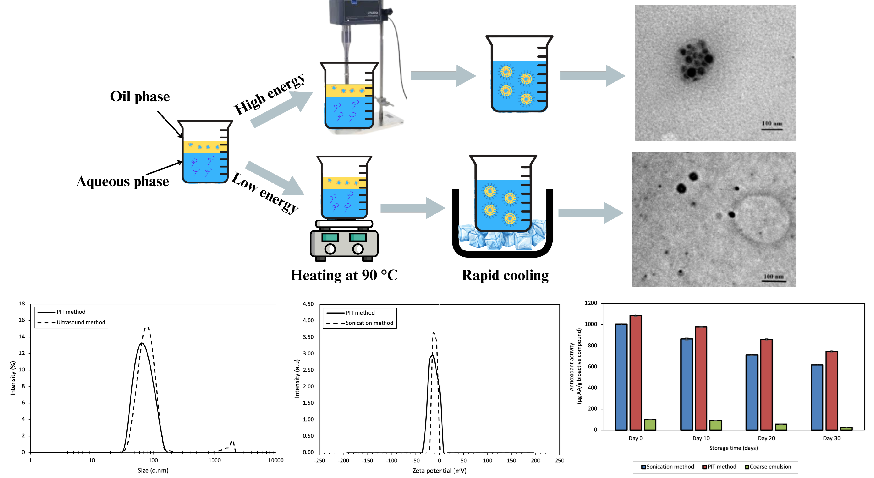
Lavender essential oil (LEO) nanoemulsions are gaining attention for their enhanced stability and antioxidant properties, making them suitable for applications in pharmaceuticals, cosmetics, and the food industry. Despite the widespread use of the high-energy sonication method, the phase inversion temperature (PIT) method has been underexplored in the preparation of LEO-based nanoemulsions. This study aims to address this gap by comparing the efficacy of the low-energy PIT method with the high-energy sonication method in terms of stability and antioxidant capacity. The objectives were to evaluate the physical characteristics (particle size, polydispersity index (PDI), zeta potential, and turbidity) and the antioxidant capacity of nanoemulsions prepared by both methods. The results showed that PIT-prepared nanoemulsions, with slightly larger but more uniform droplet sizes (47.53 ± 0.306 nm, PDI: 0.408 ± 0.005), exhibited superior zeta potential (–14.60 ± 0.436 mV) and enhanced stability compared to those prepared by sonication (47.23 ± 0.252 nm, PDI: 0.466 ± 0.004). Furthermore, PIT-prepared nanoemulsions retained higher antioxidant capacity over a 30-day period. The techno-economic analysis revealed that while sonication is more energy-intensive, the PIT method offers better scalability and lower production costs. These findings suggest that the PIT method holds significant potential for large-scale industrial applications, offering a more cost-effective and sustainable approach for enhancing the stability and antioxidant capacity of LEO nanoemulsions.
HIGHLIGHTS
- Low-energy PIT method enhances stability and antioxidant capacity of LEO nanoemulsions.
- PIT-prepared nanoemulsions show uniform droplet size and superior zeta potential.
- PIT method outperforms sonication in retaining antioxidant capacity over 30 days.
- Both methods create stable LEO nanoemulsions suitable for industrial applications.
- PIT method offers a sustainable alternative to high-energy sonication techniques.
GRAPHICAL ABSTRACT
Downloads
References
FV Romeo, SD Luca, A Piscopo and M Poiana. Antimicrobial effect of some essential oils. Journal of Essential Oil Research 2008; 20(4), 373-379.
HMA Cavanagh and JM Wilkinson. Biological activities of lavender essential oil. Phytotherapy Research 2002; 16(4), 301-308.
AT Peana, PS D’Aquila, F Panin, G Serra, P Pippia and MDL Moretti. Anti-inflammatory activity of linalool and linalyl acetate constituents of essential oils. Phytomedicine 2002; 9(8), 721-726.
M Lis-Balchin and S Hart. Studies on the mode of action of the essential oil of lavender (lavandula angustifolia P. miller). Phytotherapy Research 1999; 13(6), 540-542.
PH Koulivand, MK Ghadiri and A Gorji. Lavender and the nervous system. Evidence-Based Complementary and Alternative Medicine 2013; 2013, 681304.
S Kasper, M Gastpar, WE Muller, H Volz, H Moller, A Dienel and S Schlafke. Efficacy and safety of silexan, a new, orally administered lavender oil preparation, in subthreshold anxiety disorder - evidence from clinical trials. Wiener Medizinische Wochenschrift 2010; 160(21-22), 547-556.
H Vaskova and M Buckova. Thermal degradation of vegetable oils: Spectroscopic measurement and analysis. Procedia Engineering 2015; 100, 630-635.
C Turek and FC Stintzing. Stability of essential oils: A review. Comprehensive Reviews in Food Science and Food Safety 2013; 12(1), 40-53.
C Qian and DJ McClements. Formation of nanoemulsions stabilized by model food-grade emulsifiers using high-pressure homogenization: Factors affecting particle size. Food Hydrocolloids 2011; 25(5), 1000-1008.
M Goutayer, S Dufort, V Josserand, A Royere, E Heinrich, F Vinet, J Bibette, J Coll and I Texier. Tumor targeting of functionalized lipid nanoparticles: Assessment by in vivo fluorescence imaging. European Journal of Pharmaceutics and Biopharmaceutics 2010; 75(2), 137-147.
A Jintapattanakit. Preparation of nanoemulsions by phase inversion temperature (PIT). Pharmaceutical Sciences Asia 2018; 42(1), 1-12.
H Cinar and H Alkan. Crustal s-wave structure around the lake van region (Eastern Turkey) from interstation rayleigh wave phase velocity analyses. Turkish Journal of Earth Sciences 2017; 26(1), 73-90.
M Koroleva and EV Yurtov. Nanoemulsions: The properties, methods of preparation and promising applications. Russian Chemical Reviews 2012; 81(1), 21-43.
N Anton, J Benoit and P Saulnier. Design and production of nanoparticles formulated from nano-emulsion templates - a review. Journal of Controlled Release 2008; 128(3), 185-199.
DJ McClements. Edible nanoemulsions: Fabrication, properties, and functional performance. Soft Matter 2011; 7(6), 2297-2316.
M Safaya and YC Rotliwala. Nanoemulsions: A review on low energy formulation methods, characterization, applications and optimization technique. Materials Today Proceedings 2020; 27(Part 1), 454-459.
A Pratap-Singh, Y Guo, SL Ochoa, F Fathordoobady and Singh A. Optimal ultrasonication process time remains constant for a specific nanoemulsion size reduction system. Scientific Reports 2021; 11(1), 9241.
G Ren, Z Sun, Z Wang, X Zheng, Z Xu, D Sun. Nanoemulsion Formation by the Phase Inversion Temperature Method Using Polyoxypropylene Surfactants. Journal of Colloid and Interface Science 2019; 540, 177-184.
G Lefebvre, J Riou, G Bastiat, E Roger, K Frombach, J Gimel, P Saulnier and B Calvignac. Spontaneous nano-emulsification: Process optimization and modeling for the prediction of the nanoemulsion’s size and polydispersity. International Journal of Pharmaceutics 2017; 534(1-2), 220-228.
AH Saberi, Y Fang and DJ McClements. Thermal reversibility of vitamin e-enriched emulsion-based delivery systems produced using spontaneous emulsification. Food Chemistry 2015; 185, 254-260.
J Rao and DJ McClements. Stabilization of phase inversion temperature nanoemulsions by surfactant displacement. Journal of Agricultural and Food Chemistry 2010; 58(11), 7059-7066.
D Morales, JM Gutierrez, MJ Garcia-Celma and YC Solans. A Study of the relation between bicontinuous microemulsions and oil/water nano-emulsion formation. Langmuir 2003; 19(18), 7196-7200.
J Esquena and J Vilasau. Formulation, characterization, and property control of paraffin emulsions. Emulsion Formation and Stability 2013; (6), 169-197.
N Anton and TF Vandamme. Nano-emulsions and micro-emulsions: Clarifications of the critical differences. Pharmaceutical Research 2011; 28(5), 978-985.
DJ McClements. Nanoemulsions versus microemulsions: Terminology, differences, and similarities. Soft Matter 2012; 8(6), 1719-1729.
C Solans, P Izquierdo, J Nolla, N Azemar and MJ Garcia-Celma. Nano-emulsions. Current Opinion in Colloid & Interface Science 2005; 10(3-4), 102-110.
TG Mason, JN Wilking, K Meleson, CB Chang and SM Graves. Nanoemulsions: Formation, structure, and physical properties. Journal of Physics: Condensed Matter 2007; 18(41), R635-R666.
SM Jafari, Y He and B Bhandari. Nano-emulsion production by sonication and microfluidization - a comparison. International Journal of Food Properties 2006; 9(3), 475-485.
M Jaiswal, R Dudhe and PK Sharma. Nanoemulsion: An advanced mode of drug delivery system. 3 Biotech 2015; 5(2), 123-127.
P Chuesiang, U Siripatrawan, R Sanguandeekul, L McLandsborough and DJ McClements. Optimization of cinnamon oil nanoemulsions using phase inversion temperature method: Impact of oil phase composition and surfactant concentration. Journal of Colloid and Interface Science 2018; 514, 208-216.
MEI Badawy, ASA Saad, EHM Tayeb, SA Mohammed and AD Abd-Elnabi. Optimization and characterization of the formation of oil-in-water diazinon nanoemulsions: Modeling and influence of the oil phase, surfactant and sonication. Journal of Environmental Science and Health, Part B 2017; 52(12), 896-911.
J Stetefeld, SA McKenna, TR Patel. Dynamic Light Scattering: A Practical Guide and Applications in Biomedical Sciences. Biophysical Reviews 2016; 8(4), 409-427.
AH Saberi, Y Fang and DJ McClements. Formation of thermally reversible optically transparent emulsion-based delivery systems using spontaneous emulsification. Soft Matter 2015; 11(48), 9321-9329.
JA Miller, PA Thompson, IA Hakim, H-HS Chow, CA Thomson. D-Limonene: A Bioactive Food Component from Citrus and Evidence for a Potential Role in Breast Cancer Prevention and Treatment. Oncology Reviews 2011; 5(1), 31-42.
SCRD Silva, PM Lopes, MMBD Azevedo, DCM Costa, CS Alviano and DS Alviano. Biological activities of a-pinene and β-pinene enantiomers. Molecules 2012; 17(6), 6305-6316.
F Bakkali, S Averbeck, D Averbeck and M Idaomar. Biological effects of essential oils: A review. Food and Chemical Toxicology 2008; 46(2), 446-475.
J Komaiko and DJ McClements. Low-energy formation of edible nanoemulsions by spontaneous emulsification: Factors influencing particle size. Journal of Food Engineering 2015; 146, 122-128.
M Guttoff, AH Saberi and DJ Mcclements. Formation of vitamin D nanoemulsion-based delivery systems by spontaneous emulsification: Factors affecting particle size and stability. Food Chemistry 2015; 171, 117-122.
M Chouaibi. Preparation of oil-in-water (O/W) clove essential oil nanoemulsion: Characterization and stability. Elsevier Science, Amsterdam, Netherlands, 2022.
VK Rai, N Mishra, KS Yadav and NP Yadav. Nanoemulsion as pharmaceutical carrier for dermal and transdermal drug delivery: Formulation development, stability issues, basic considerations and applications. Journal of Controlled Release 2018; 270, 203-225.
M Hennebelle, P Villeneuve, E Durand, J Lecomte, JV Duynhoven, A Meynier, B Yesiltas, C Jacobsen, C Berton-Carabin. Lipid Oxidation in Emulsions: New Insights from the Past Two Decades. Progress in Lipid Research 2024; 94, 101275.
HR Sharif, HD Goff, H Majeed, F Liu, J Nsor-Atindana, J Haider, R Liang and F Zhong. Physicochemical stability of β-carotene and α-tocopherol enriched nanoemulsions: Influence of carrier oil, emulsifier and antioxidant. Colloids and Surfaces A: Physicochemical and Engineering Aspects 2017; 529, 550-559.
TSH Leong, TJ Wooster, SE Kentish and M Ashokkumar. Minimising oil droplet size using ultrasonic emulsification. Ultrasonics Sonochemistry 2009; 16(6), 721-727.
A Gupta, HB Eral, TA Hatton and PS Doyle. Nanoemulsions: Formation, properties and applications. Soft Matter 2016; 12(11), 2826-2841.
A Perazzo, V Preziosi and S Guido. Phase inversion emulsification: Current understanding and applications. Advances in Colloid and Interface Science 2015; 222, 581-599.
Alexandros Koulouris, Nikiforos Misailidis, Avraam Roussos, Jim Prentzas, Demetri P Petrides. Food Process Simulation and Techno-Economic Assessment in Sustainable Food Manufacturing. Smart Food Industry: The Blockchain for Sustainable Engineering 2024; 23.
NHC Marzuki, RA Wahab and MA Hamid. An overview of nanoemulsion: Concepts of development and cosmeceutical applications. Biotechnology & Biotechnological Equipment 2019; 33(1), 779-797.
SSL Tiang, LE Low, I Ali, L Zhou, B Goh, LT Gew and SY Tang. Recent advances in ultrasonic cavitation technologies for emulsion preparation: A mini review. Current Opinion in Chemical Engineering 2024; 45, 101046.
McClements DJ. Food Emulsions. CRC Press, Florida, 2004.
FBD Carvalho-Guimaraes, KL Correa, TPD Souza, JRR Amado, RM Ribeiro-Costa and JOC Silva-Junior. A review of pickering emulsions: Perspectives and applications. Pharmaceuticals 2022; 15(11), 1413.
Published
How to Cite
Issue
Section
License
Copyright (c) 2025 Walailak University

This work is licensed under a Creative Commons Attribution-NonCommercial-NoDerivatives 4.0 International License.





