
Quercetin: Synthesis Trends, Chemical Reactions, and Its Role as an Estrogen Receptor Alpha Modulator in Breast Cancer Therapy: A Systematic Literature Review
DOI:
https://doi.org/10.48048/tis.2025.9423Keywords:
Quercetin, Quercetin synthesis, Estrogen receptor alpha modulator, Breast cancerAbstract
Quercetin, a flavonoid abundant in fruits and vegetables, has garnered significant attention for its therapeutic potential in breast cancer treatment. Despite its promising bioactivity, clinical applications of quercetin remain limited due to challenges in synthesis, structural stability, and bioavailability. This systematic review examines recent advancements in quercetin synthesis through diverse chemical reactions aimed at improving efficiency and pharmacological properties. Key strategies such as the Algar-Flynn-Oyamada reaction, regioselective esterification, and glycosylation are discussed alongside structural modifications like methylation and glycosylation to enhance chemical reactivity and bioactivity. The reviewed methods demonstrate notable progress in optimizing quercetin production and stability. Structural modifications have shown significant influence on the therapeutic efficacy of quercetin derivatives. However, challenges such as low yield and complex reaction conditions persist. Emerging approaches, including novel catalytic systems and sustainable synthetic methods, offer promising solutions for large-scale production. While substantial progress has been made in quercetin synthesis, further research is essential to refine existing methods and explore innovative strategies for improving reaction selectivity and scalability. Addressing these gaps will expand the application of quercetin in pharmaceutical and biomedical research, particularly in breast cancer therapy, paving the way for more effective treatments and improved patient outcomes.
HIGHLIGHTS
- This review discusses the recent development of synthesis strategies for quercetin and its derivatives aimed at improving pharmacological potential and structural stability.
- The article highlights quercetin’s role as a modulator of Estrogen Receptor Alpha (ERα) and its therapeutic implications in breast cancer treatment.
- Key challenges in quercetin synthesis such as low bioavailability and yield are identified.
- The review introduces opportunities for future research in innovative synthetic methods and sustainable catalytic systems.
- Emphasis is placed on refining synthetic strategies to support the clinical application of quercetin-based therapeutics.
GRAPHICAL ABSTRACT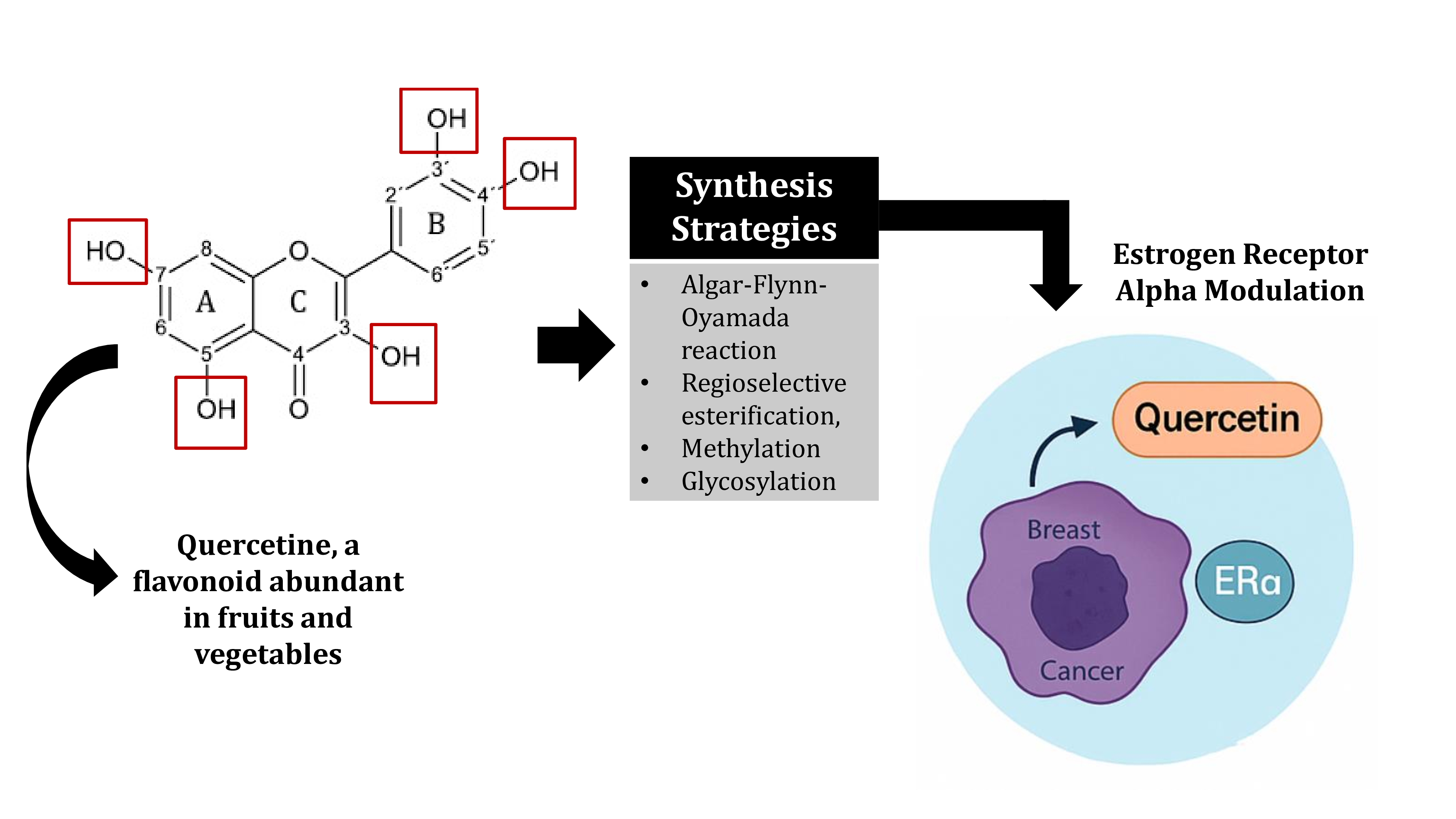
Downloads
References
H Li, L Tan, JW Zhang, H Chen, B Liang, T Qiu, QS Li, M Cai and QH Zhang. Quercetin is the active component of Yang-Yin-Qing-Fei-Tang to induce apoptosis in non-small cell lung cancer. The American Journal of Chinese Medicine 2019; 47(4), 879-893.
Y Kong, L Zhang, Y Huang, T He, L Zhang, X Zhao, X Zhou, D Zhou, Y Yan, J Zhou, H Xie, L Zhou, S Zheng and W Wang. Corrigendum to “Pseudogene PDIA3P1 promotes cell proliferation, migration and invasion, and suppresses apoptosis in hepatocellular carcinoma by regulating the p53 pathway” [Cancer Lett. 407C (2017) 76-83]. Cancer Letters 2018; 414, 311.
H Wang, L Tao, K Qi, H Zhang, D Feng, W Wei, H Kong, T Chen and Q Lin. Quercetin reverses tamoxifen resistance in breast cancer cells. Journal of BUON 2015; 20(3), 707-713.
HG Ulusoy and N Sanlier. A minireview of quercetin: From its metabolism to possible mechanisms of its biological activities. Critical Reviews in Food Science and Nutrition 2020; 60(19), 3290-3303.
K Imai, I Nakanishi, K Ohkubo, Y Ohba, T Arai, M Mizuno, S Fukuzumi, KI Matsumoto and K Fukuhara. Synthesis of methylated quercetin analogues for enhancement of radical-scavenging activity. RSC Advances 2017; 7(29), 17968-17979.
S Ariraman, A Seetharaman, KV Babunagappan and S Sudhakar. Quercetin-loaded nanoarchaeosomes for breast cancer therapy: A ROS mediated cell death mechanism. Materials Advances 2024; 5(17), 6944-6956.
GES Batiha, AM Beshbishy, M Ikram, ZS Mulla, MEA El-Hack, AE Taha, AM Algammal and YHA Elewa. The pharmacological activity, biochemical properties, and pharmacokinetics of the major natural polyphenolic flavonoid: Quercetin. Foods 2020; 9(3), 374.
A Massi, O Bortolini, D Ragno, T Bernardi, G Sacchetti, M Tacchini and CD Risi. Research progress in the modification of quercetin leading to anticancer agents. Molecules 2017; 22(8), 1270.
Y Duan, N Sun, M Xue, X Wang and H Yang. Synthesis of regioselectively acylated quercetin analogues with improved antiplatelet activity. Molecular Medicine Reports 2017; 16(6), 9735-9740.
AYH Saik, YY Lim, J Stanslas and WS Choo. Enzymatic synthesis of quercetin oleate esters using Candida antarctica lipase B. Biotechnology Letters 2017; 39(2), 297-304.
MA Mirza, S Mahmood, AR Hilles, A Ali, MZ Khan, SAA Zaidi, Z Iqbal and Y Ge. Quercetin as a therapeutic product: Evaluation of its pharmacological action and clinical applications—a review. Pharmaceuticals 2023; 16(11), 1631.
DA Mishurov, AA Voronkin and AD Roshal. Synthesis, molecular structure and optical properties of glycidyl derivatives of quercetin. Structural Chemistry 2016; 27, 285-294.
G Carullo and F Aiello. Quercetin-3-oleate. Molbank 2018; 2018(3), M1006.
RA Al-Anssari, RS Elias and SAN Aljadaan. Synthesis, ant proliferative activity and docking study of new quercetin derivatives against MDA-MB231 breast cancer cell lines. American Journal of Applied Sciences 2019; 16(5), 143-161.
D Isika, M Çeşme, FJ Osonga and OA Sadik. Novel quercetin and apigenin-acetamide derivatives: Design, synthesis, characterization, biological evaluation and molecular docking studies. RSC Advances 2020; 10(42), 25046-25058.
MH Choi, SH Yang, DS Kim, ND Kim, HJ Shin and K Liu. Novel quercetin derivative of 3,7-dioleylquercetin shows less toxicity and highly potent tyrosinase inhibition activity. Interational Journal of Molecular Sciences 2021; 22(8), 4264.
D Kirkova, Y Stremski, S Statkova-Abeghe and M Docheva. Quercetin hybrids - synthesis, spectral characterization and radical scavenging potential. Molbank 2022; 2022(1), M1329.
SV Pechinskii, AG Kuregyan and ET Oganesyan. Regioselective synthesis of quercetin and myricetin derivatives. Russian Journal of General Chemistry 2023; 93(2), 245-252.
W Zhang, J Sun, P Zhang, R Yue, Y Zhang, F Niu, H Zhu, C Ma and S Deng. Design, synthesis and antitumor activity of quercetin derivatives containing a quinoline moiety. Molecules 2024; 29(1), 240.
S Nathiya, M Durga and T Devasena. Quercetin, encapsulated quercetin and its application - A review. International Journal of Pharmacy and Pharmaceutical Science 2014; 6(10), 20-26.
TTH Nguyen, SH Yu, J Kim, E An, K Hwang, JS Park and D Kim. Enhancement of quercetin water solubility with steviol glucosides and the studies of biological properties. Functional Foods in Health and Disease 2015; 5(12), 437-449.
P Strugała, T Tronina, E Huszcza and J Gabrielska. Bioactivity in vitro of quercetin glycoside obtained in Beauveria bassiana culture and its interaction with liposome membranes. Molecules 2017; 22(9), 1520.
SR Alizadeh and MA Ebrahimzadeh. O-substituted quercetin derivatives: Structural classification, drug design, development, and biological activities, a review. Journal of Molecular Structure 2022; 1254, 132392.
J Yuan, ILK Wong, T Jiang, SW Wang, T Liu, BJ Wen, LMC Chow and BW Sheng. Synthesis of methylated quercetin derivatives and their reversal activities on P-gp-and BCRP-mediated multidrug resistance tumour cells. European Journal of Medicinal Chemistry 2012; 54, 413-422.
E Rodríguez-Arce and M Saldías. Antioxidant properties of flavonoid metal complexes and their potential inclusion in the development of novel strategies for the treatment against neurodegenerative diseases. Biomedicine and Pharmacotherapy 2021; 143, 112236.
J Zhou, L Wang, J Wang and N Tang. Antioxidative and anti-tumour activities of solid quercetin metal (II) complexes. Transition Metal Chemistry 2001; 26, 57-63.
XR Bao, H Liao, J Qu, Y Sun, X Guo, EX Wang and YH Zhen. Synthesis, characterization and cytotoxicity of alkylated quercetin derivatives. Iranian Journal of Pharmaceutical Research 2016; 15(3), 329-335.
YJ Shi, JW Gao and CF Liu. Facile synthesis of 8-arylated quercetin derivatives and biological activity evaluation. Journal of Molecular Structure 2022; 1268, 133674.
M Veverka, J Gallovič, E Švajdlenka, E Veverková, N Prónayová, I Miláčková and M Štefek. Novel quercetin derivatives: Synthesis and screening for anti-oxidant activity and aldose reductase inhibition. Chemical Papers 2013; 67, 76-83.
RT Magar and JK Sohng. A review on structure, modifications and structure-activity relation of quercetin and its derivatives. Journal of Microbiology and Biotechnology 2020; 30(1), 11-20.
S Warnasih, AH Mulyati, D Widiastuti, AC Zahra, P Sugita, L Ambarsari, H Dianhar and DUC Rahayu. Anticancer potency of methanol extract from terminalia catappa leaves using in vitro and in silico methods. Trends in Sciences 2024; 21(9), 8057.
R Benziane and B Ibrahim. Anti-cancer activity of quercetin via apoptosis induction pathways in human breast cancer cell lines-a systematic review and meta-analysis. Journal of Pharmaceutical Research and Reviews 2022; 6, 23.
M Yoshida, T Sakai, N Hosokawa, N Marui, K Matsumoto, A Fujioka, H Nishino and A Aoike. The effect of quercetin on cell cycle progression and growth of human gastric cancer cells. FEBS Letters 1990; 260(1), 10-13.
S Srivastava, RR Somasagara, M Hegde, M Nishana, SK Tadi, M Srivastava, B Choudhary and SC Raghavan. Quercetin, a natural flavonoid interacts with DNA, arrests cell cycle and causes tumor regression by activating mitochondrial pathway of apoptosis. Scientific Reports 2016; 6, 24049.
F Sheikhnia, A Fazilat, V Rashidi, B Azizzadeh, M Mohammadi, H Maghsoudi and M Majidinia. Exploring the therapeutic potential of quercetin in cancer treatment: Targeting long non-coding RNAs. Pathology, Research and Practice 2024; 260, 155374.
T Xia, J Li, X Ren, C Liu and C Sun. Research progress of phenolic compounds regulating IL‐6 to exert antitumor effects. Phytotherapy Research 2021; 35(12), 6720-6734.
KW Ren, YH Li, G Wu, JZ Ren, HB Lu, ZM Li and XW Han. Quercetin nanoparticles display antitumor activity via proliferation inhibition and apoptosis induction in liver cancer cells. International Journal of Oncology 2017; 50(4), 1299-1311.
M Bhatiya, S Pathak, G Jothimani, AK Duttaroy and A Banerjee. A comprehensive study on the anti-cancer effects of quercetin and its epigenetic modifications in arresting progression of colon cancer cell proliferation. Archivum Immunologiae et Therapiae Experimentalis 2023; 71(1), 6.
S Maenpuen, N Ekaratcharoenchai, R Mongkolrob, T Nualsanit, S Kietinun and A Krajarng. The estrogenic effect of Lysiphyllum strychnifolium (Craib) A. Schmitz water extracts in MCF-7 cells. 2022; 21(6), 2024.
HS Seo, DG DeNardo, Y Jacquot, I Laïos, DS Vidal, CR Zambrana, G Leclercq and PH Brown. Stimulatory effect of genistein and apigenin on the growth of breast cancer cells correlates with their ability to activate ER alpha. Breast Cancer Research and Treatment 2006; 99(2), 121-134.
Y Xu, P Huangyang, Y Wang, L Xue, E Devericks, HG Nguyen, X Yu, JA Oses-Prieto, AL Burlingame, S Miglani, H Goodarzi and D Ruggero. ERα is an RNA-binding protein sustaining tumor cell survival and drug resistance. Cell 2021; 184(20), 5215-5229.e17.
J Jiang, Y Yang, F Wang, W Mao, Z Wang and Z Liu. Quercetin inhibits breast cancer cell proliferation and survival by targeting Akt/mTOR/PTEN signaling pathway. Chemical Biology and Drug Design 2024; 103(6), e14557.
V Barra, RF Chiavetta, S Titoli, IM Provenzano, PS Carollo and AD Leonardo. Specific irreversible cell-cycle arrest and depletion of cancer cells obtained by combining curcumin and the flavonoids quercetin and fisetin. Genes 2022; 13(7), 1125.
S Wang, Y Chen, C Xia, C Yang, J Chen, L Hai, Y Wu and Z Yang. Synthesis and evaluation of glycosylated quercetin to enhance neuroprotective effects on cerebral ischemia-reperfusion. Bioorganic and Medicinal Chemistry 2022; 73, 117008.
A Benchamana, R Tohkayomatee, S Soodvilai and N Chabang. Pinostrobin exerts inhibitory effects on adipogenesis and adipocyte-induced MCF-7 breast cancer cell proliferation and migration. Trends in Sciences 2024; 21(9), 8125.
C Williams, K Edvardsson, SA Lewandowski, A Ström and JÅ Gustafsson. A genome-wide study of the repressive effects of estrogen receptor beta on estrogen receptor alpha signaling in breast cancer cells. Oncogene 2008; 27(7), 1019-1032.
NHM Rosli, CK Meng, FJ Nordin, LL Mun, NSA Aziz and NF Rajab. Assessment of cytotoxicity potency of paclitaxel in combination with Clinacanthus nutans extracts on human MDA-MB-231 breast cancer cells. Jurnal Sains Kesihatan Malaysia 2018; 16(2), 95-103.
M Szmyd, A Zanib, V Behlow, E Hallman, S Pfiffner, R Yaldo, N Prudhomme, K Farrar and S Dinda. Modulation of Estrogen Receptor Alpha (ERα) and tumor suppressor gene BRCA1 in Breast Cancer Cells by Bazedoxifene Acetate (BZA). Cancers 2024; 16(4), 699.
S Yu, T Kim, KH Yoo and K Kang. The T47D cell line is an ideal experimental model to elucidate the progesterone-specific effects of a luminal A subtype of breast cancer. Biochemical and Biophysical Research Communications 2017; 486(3), 752-758.
C Gest, U Joimel, L Huang, LL Pritchard, A Petit, C Dulong, C Buquet, CQ Hu, P Mirshahi, M Laurent, F Fauvel-Lafève, L Cazin, JP Vannier, H Lu, J Soria, H Li, R Varin and C Soria. Rac3 induces a molecular pathway triggering breast cancer cell aggressiveness: Differences in MDA-MB-231 and MCF-7 breast cancer cell lines. BMC Cancer 2013; 13, 63.
RJ Huggins and GL Greene. ERα/PR crosstalk is altered in the context of the ERα Y537S mutation and contributes to endocrine therapy-resistant tumor proliferation. NPJ Breast Cancer 2023; 9(1), 96.
F Yang, L Song, H Wang, J Wang, Z Xu and N Xing. Quercetin in prostate cancer: Chemotherapeutic and chemopreventive effects, mechanisms and clinical application potential. Oncology Reports 2015; 33(6), 2659-2668.
H Arksey and L O'malley. Scoping studies: Towards a methodological framework. International Journal of Social Research Methodology 2005; 8(1), 19-32.
D Levac, H Colquhoun and KK O'brien. Scoping studies: Advancing the methodology. Implementation Science 2010; 5, 69.
L Clusan, F Ferrière, G Flouriot and F Pakdel. A basic review on estrogen receptor signaling pathways in breast cancer. International Journal of Molecular Sciences 2023; 24(7), 6834.
Published
How to Cite
Issue
Section
License
Copyright (c) 2025 Walailak University

This work is licensed under a Creative Commons Attribution-NonCommercial-NoDerivatives 4.0 International License.





