
Biosynthesis of Selenium Nanoparticles and Selenium-Enriched g-Polyglutamic Acid (Se-PGA) by Bacillus subtilis
DOI:
https://doi.org/10.48048/tis.2025.9391Keywords:
Selenium nanoparticles, Bioactive nanoparticles, Green synthesis, g-Polyglutamic acid, Antifungal activityAbstract
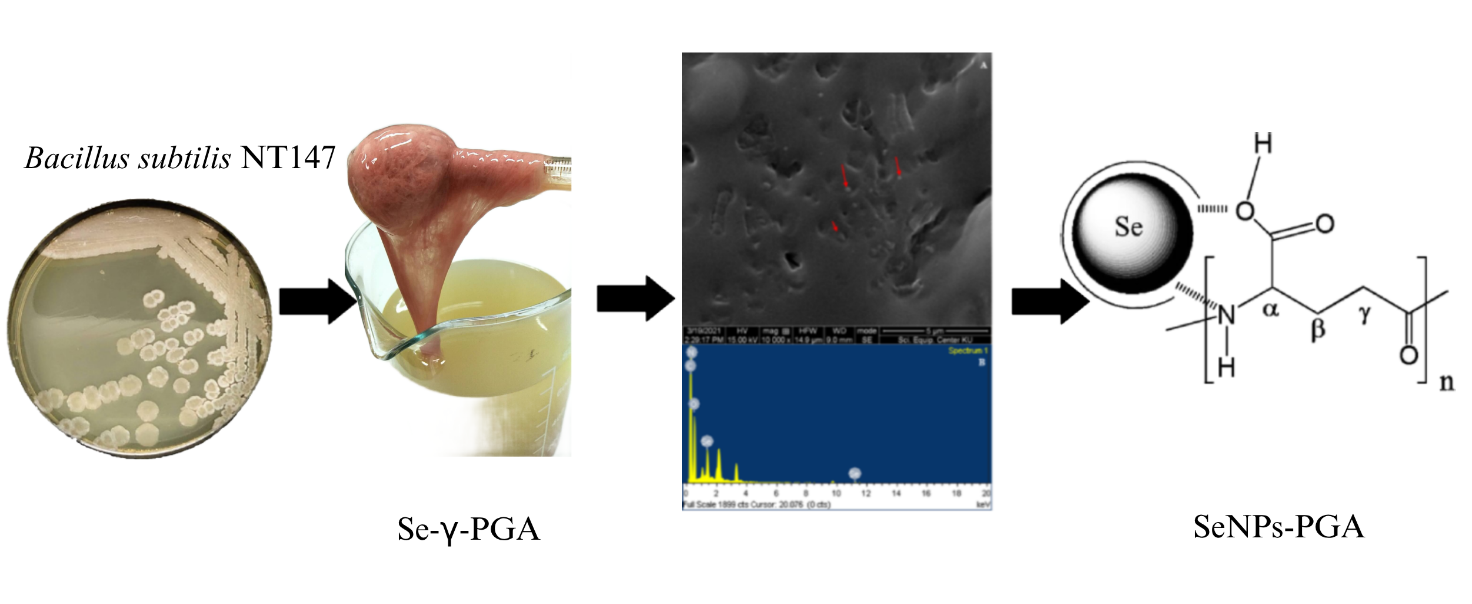
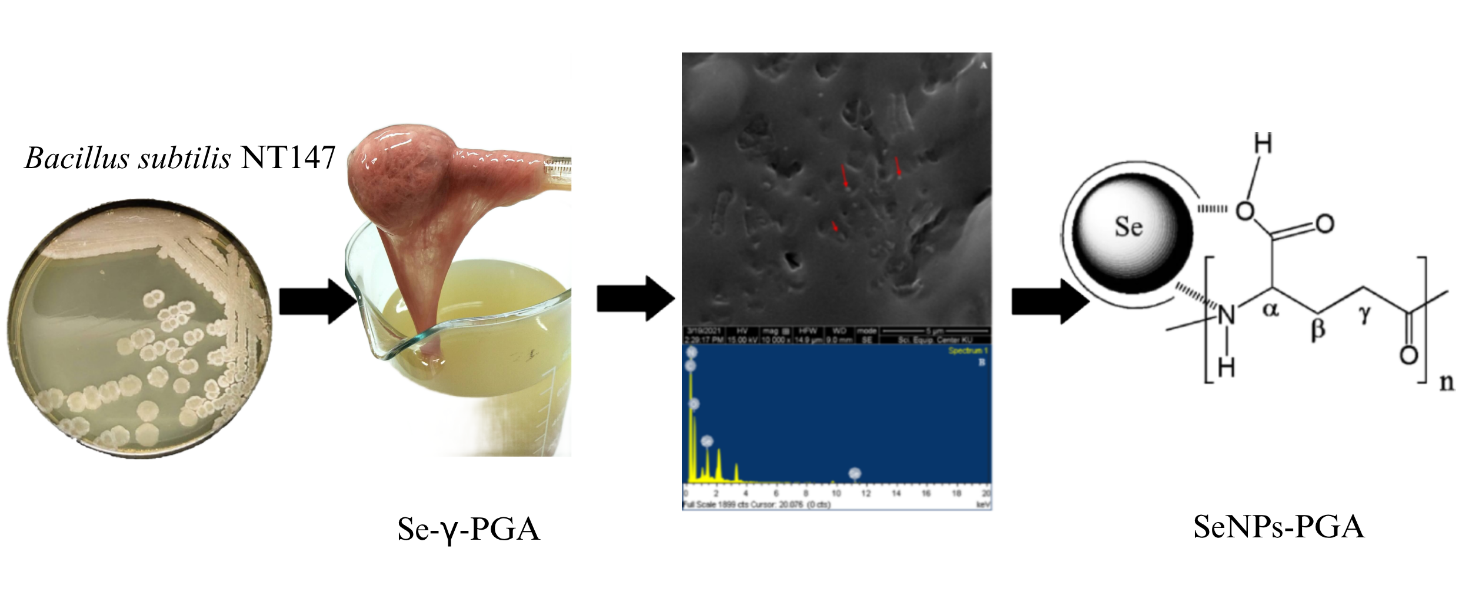
Biogenic synthesized selenium nanoparticles (SeNPs) have garnered significant interest in both biomedical and agricultural fields. Encapsulation of SeNPs by natural biopolymers can increase the stability and biocompatibility of the nanoparticles. In this work, synthesis of SeNPs by Bacillus subtilis NT147, g-polyglutamic acid (g-PGA) producing strain and production of Se-enriched g-PGA (Se-PGA) were carried out. B. subtilis NT147 was cultured in Luria Bertani broth supplemented with 0.5 mM Na2SeO3 at 37 ± 2 °C with shaking at 150 rpm. From ICP analysis, the selenium amount in the bacterial cells was highest at 18 h (11.3 mg/g cell DW). The TEM image confirmed that SeNPs were spherical shape and produced mainly in the bacterial cells. Particle size analysis using a laser scattering particle size distribution analyzer indicated that small particle sizes 226 and 259 nm were observed at 6 and 12 h, respectively. Poor dispersion and aggregation of SeNPs were observed after 12 h, resulting in larger particles. Production of g-PGA significantly decreased when Na2SeO3 was presented in the culture media. Therefore, B. subtilis NT147 was cultured in a sucrose yeast extract medium containing 5 % sucrose at 37 ± 2 °C with shaking at 150 rpm for 36 h to maximized g-PGA yield. Then 2.5 mM Na2SeO3 was added into the culture medium and continued shaking for 4 h. Cells were removed and Se-PGA was precipitated. SEM image showed a spherical shape of SeNPs dispersed in g-PGA and the EDS confirmed the presence of Se, C, N and O in the Se-PGA composite suggesting that SeNPs were mainly came out after cell lysis. FTIR spectra of Se-PGA showed peak, indicating the presence of carbonyl and hydroxyl groups, suggesting proteins and amino acids. The Se-PGA at a concentration of 2.0 g/L exhibited 17.96 % of inhibition against Colletotrichum sp.
HIGHLIGHTS
Synthesis of selenium nanoparticles (SeNPs) by Bacillus subtilis NT147, a g-polyglutamic acid (g-PGA) producing strain was investigated. Se-enriched g-PGA (Se-PGA) production and physiochemical characterization were carried out. Se-PGA exhibited fungal inhibition activity.
GRAPHICAL ABSTRACT
Downloads
References
J Sarkar, D Mridha, MA Davoodbasha, J Banerjee, S Chanda, K Ray, T Roychowdhury, K Acharya and J Sarkar. A state‑of‑the‑art systemic review on selenium nanoparticles: Mechanisms and factors influencing biogenesis and its potential applications. Biological Trace Element Research 2023; 201(10), 5000-5036.
X Nie, X Yang, J He, P Liu, H Shi, T Wang and D Zhang. Bioconversion of inorganic selenium to less toxic selenium forms by microbes: A review. Frontiers in Bioengineering and Biotechnology 2023; 11, 1167123.
Y Zhu, B Ren, H Li, Z Lin, G Bañuelos, L Li, G Zhao and Y Guo. Biosynthesis of selenium nanoparticles and effects of selenite, selenate, and selenomethionine on cell growth and morphology in Rahnella aquatilis HX2. Applied Microbiology and Biotechnology 2018; 102(14), 6191-6205.
R Sowmya, SKR Namasivayam and SK Shree. A critical review on nano‑selenium based materials: Synthesis, biomedicine applications and biocompatibility assessment. Journal of Inorganic and Organometallic Polymers and Materials 2024; 34, 3037-3055.
DM Cruz, G Mi and TJ Webster. Synthesis and characterization of biogenic selenium nanoparticles with antimicrobial properties made by Staphylococcus aureus, methicillin-resistant Staphylococcus aureus (MRSA), Escherichia coli, and Pseudomonas aeruginosa. Journal of Biomedical Materials Research Part A 2018; 106(5), 1400-1412.
JJO Garza‑García, JA Hernández‑Díaz, JM León‑Morales, G Velázquez‑Juárez, A Zamudio‑Ojeda, J Arratia‑Quijada, OK Reyes‑Maldonado, JC López‑Velázquez1 and S García‑Morales. Selenium nanoparticles based on Amphipterygium glaucum extract with antibacterial, antioxidant, and plant biostimulant properties. Journal of Nanobiotechnology 2023; 21(1), 252.
M Pescuma, F Aparicio, RD Zysler, E Lima, C Zapata, JA Marfetán, ML Vélez and OF Ordoñez. Biogenic selenium nanoparticles with antifungal activity against the wood-rotting fungus Oligoporus pelliculosus. Biotechnology Reports 2023; 37, e00787.
G Murugesan, K Nagaraj, D Sunmathi and K Subramani. Methods involved in the synthesis of selenium nanoparticles and their different applications - a review. European Journal of Biomedical and Pharmaceutical sciences 2019; 6(4), 189-194.
AE Abdelhamid, EH Ahmed, HM Awad and MMH Ayoub. Synthesis and cytotoxic activities of selenium nanoparticles incorporated nano-chitosan. Polymer Bulletin 2024; 81(2), 1421-1437.
T Ramachandran, D Manoharan, S Natesan, SK Rajaram, P Karuppiah, MR Shaik, M Khan and B Shaik. Synthesis and structural characterization of selenium nanoparticles - Bacillus sp. MKUST-01 exopolysaccharide (SeNPs-EPS) conjugate for biomedical applications. Biomedicines 2023; 11(9), 2520.
P Concórdio-Reis, AC Macedo, M Cardeira, X Moppert, J Guézennec, C Sevrin, C Grandfils, AT Serra and F Freitas. Selenium bio-nanocomposite based on Alteromonas macleodii Mo169 exopolysaccharide: Synthesis, characterization, and in vitro antioxidant activity. Bioengineering 2023; 10(2), 193.
E Khaledizade, F Tafvizi and P Jafari. Anti-breast cancer activity of biosynthesized selenium nanoparticles using Bacillus coagulans supernatant. Journal of Trace Elements in Medicine and Biology 2024; 82, 127357.
J Song, J Zhou, X Li, P Li, G Tian, C Zhang and D Zhou. Nano-selenium stablilized by Konjac Glucommannan and its biological activity in vitro. LWT 2022; 161, 113289.
KE Yunusov, AA Sarymsakov, JZO Jalilov and AA Аtakhanov. Physicochemical properties and antimicrobial activity of nanocomposite films based on carboxymethylcellulose and silver nanoparticles. Polymers for Advanced Technologies 2022; 32(4), 1822-1830.
W Fuangchoonuch, K Chompoonuch, K Amprayn, O Chunhachart, S Prateepchinda, S Benjautthaya, W Laosripaiboon, S Jarussophon and N Jaratsophon. Characterization, selenium accumulation and their antioxidant activity with different forms of coated selenium nanoparticles in sunflower sprout. Chemistry for catalyzing sustainability and prosperity. In: Proceedings of the Pure and Applied Chemistry International Conference, Nonthaburi, Thailand. 2020, p. 127-132.
EO Mikhailova. Selenium nanoparticles: Green synthesis and biomedical application. Molecules 2023; 28(24), 8125.
S Zheng, J Su, L Wang, R Yao, D Wang, Y Deng, R Wang, G Wang and C Rensing. Selenite reduction by the obligate aerobic bacterium Comamonas testosteroni S44 isolated from a metal-contaminated soil. BMC Microbiology 2014; 14(1), 204.
Y Yang, J Jing, S Fan, Z Chen and Y Qu. Unraveling the molecular mechanisms of selenite reduction: Transcriptomic analysis of Bacillus reveals the key role of sulfur assimilation. Biotechnology Letters 2023; 45(11), 1513-1520.
D Wang, C Rensing and S Zheng. Microbial reduction and resistance to selenium: Mechanisms, applications and prospects. Journal of Hazardous Materials 2022; 421, 126684.
A Kumar, B Prasad, J Manjhi and KS Prasad. Antioxidant activity of selenium nanoparticles biosynthesized using a cell-free extract of Geobacillus. Toxicological and Environmental Chemistry 2020; 102(10), 556-567.
Y Duan, M Li, S Zhang, Y Wang, J Deng, Q Wang, T Yi, X Dong, S Cheng, Y He, C Gao and Z Wang. Highly efficient biotransformation and production of selenium nanoparticles and polysaccharides using potential probiotic Bacillus subtilis T5. Metabolites 2022; 12(12), 1204.
S Ye, J Zhang, Z Liu, Y Zhang, J Li and YO Li. Biosynthesis of selenium rich exopolysaccharide (Se-EPS) by Pseudomonas PT-8 and characterization of its antioxidant activities. Carbohydrate Polymers 2016; 142, 230-239.
SN Borah, L Goswami, S Sen, D Sachan, H Sarma, M Montes, JR Peralta-Videa, K Pakshirajan and M Narayan. Selenite bioreduction and biosynthesis of selenium nanoparticles by Bacillus paramycoides SP3 isolated from coal mine overburden leachate. Environmental Pollution 2021; 285, 117519.
S Bharathi, S Kumaran, G Suresh, M Ramesh, V Thangamani, SR Pugazhvendan and K Sathiyamurthy. Extracellular synthesis of nanoselenium from fresh water bacteria Bacillus sp., and its validation of antibacterial and cytotoxic potential. Biocatalysis and Agricultural Biotechnology 2020; 27, 101655.
P Liu, H Long, H Cheng, M Liang, Z Liu, Z Han, Z Guo, H Shi, M Sun and S He. Highly-efficient synthesis of biogenic selenium nanoparticles by Bacillus paramycoides and their antibacterial and antioxidant activities. Frontiers in Bioengineering and Biotechnology 2023; 11, 1227619.
AH Hashem, AM Abdelaziz, AA Askar, HM Fouda, AMA Khalil, KA Abd-Elsalam and MM Khaleil. Bacillus megaterium-mediated synthesis of selenium nanoparticles and their antifungal activity against Rhizoctonia solani in Faba Bean plants. Journal of Fungi 2021; 7(3), 195.
X Yong, W Raza, G Yu, W Ran, Q Shen and X Yang. Optimization of the production of poly-γ-glutamic acid by Bacillus amyloliquefaciens C1 in solid-state fermentation using dairy manure compost and monosodium glutamate production residues as basic substrates. Bioresource Technology 2011; 102(16), 7548-7554.
AD Cesaro, SBD Silva, VZD Silva and MAZ Ayub. Physico-chemical and rheological characterization of poly-gamma-glutamic acid produced by a new strain of Bacillus subtilis. European Polymer Journal 2014; 57, 91-98.
K Elbanna, FS Alsulami, LA Neyaz and HH Abulreesh. Poly (γ) glutamic acid: A unique microbial biopolymer with diverse commercial applicability. Frontiers in Microbiology 2024; 15, 1348411.
G Wang, Q Liu, Y Wang, J Li, Y Chen, Q Wen, D Zheng, W Kang and H Quan. The application and functional progress of γ-poly-glutamic acid in food: A mini-review. Current Pharmaceutical Design 2020; 26(41), 5347-5352.
SB Park, MH Sung, H Uyama and DK Han. Poly (glutamic acid): Production, composites, and medical applications of the next-generation biopolymer. Progress in Polymer Science 2021; 113, 101341.
N Ngearnpat, O Chunhachart, N Kotabin and K Issakul. Comparative assessment of gamma-polyglutamic acid and Bacillus subtilis cells as biostimulants to improve rice growth and soil quality. Journal of Ecological Engineering 2023; 24(12), 46-59.
Z Xu, P Lei, X Feng, S Li and H Xu. Analysis of the metabolic pathways affected by poly-γ-glutamicacid in Arabidopsis thaliana based on genechip microarray. Journal of Agricultural and Food Chemistry 2016; 64(32), 6257-6266.
H Ma, P Li, N Xiao and T Xia. Poly‑γ‑glutamic acid promoted maize root development by affecting auxin signaling pathway and the abundance and diversity of rhizosphere microbial community. BMC Plant Biology 2022; 22(1), 521.
H El-Ramady, N Abdalla, HS Taha, T Alshaal, A El-Henawy, SE-DA Faizy, MS Shams, SM Youssef, T Shalaby, Y Bayoumi, N Elhawat, S Shehata, A Sztrik, J Prokisch, M Fári, É Domokos-Szabolcsy, EA Pilon-Smits, D Selmar, S Haneklaus and E Schnug. Selenium and nano-selenium in plant nutrition. Environmental Chemistry Letters 2016; 14, 123-147.
AA Nagdalian, AV Blinov, SA Siddiqui, AA Gvozdenko, AB Golik, DG Maglakelidze, IV Rzhepakovsky, MY Kukharuk, SI Piskov, MB Rebezov and MA Shah. Effect of selenium nanoparticles on biological and morphofunctional parameters of barley seeds (Hordéum vulgáre L.). Scientifc Reports 2023; 13(1), 6453.
W Li, Y Wang, J Li, X Guo, Q Song and J Xu. Selenite improves growth by modulating phytohormone pathways and reprogramming primary and secondary metabolism in tomato plants. Plant Physiology and Biochemistry 2024; 214, 108930.
A Ullah, X Yin, F Wang, B Xu, ZA Mirani, B Xu, MWH Chan, A Ali, M Usman, N Ali and M Naveed. Biosynthesis of selenium nanoparticles (via Bacillus subtilis BSN313), and their isolation, characterization, and bioactivities. Molecules 2021; 26(18), 5559.
SM Joshi, SD Britto, S Jogaiah and SI Ito. Mycogenic selenium nanoparticles as potential new generation broad spectrum antifungal molecules. Biomolecules 2019; 9(9), 419.
OEA Al-Hagar, D Abol-Fotouh, ES Abdelkhalek, MMA Elsoud and NM Sidkey. Bacillus niabensis OAB2: Outstanding bio-factory of selenium nanoparticles. Materials Chemistry and Physics 2021; 273, 125147.
FG Martínez, G Moreno-Martin, M Pescuma, Y Madrid-Albarrán and F Mozzi. Biotransformation of selenium by lactic acid bacteria: Formation of seleno-nanoparticles and seleno-amino acids. Frontiers in Bioengineering and Biotechnology 2020; 8, 506.
D Wang, X Xia, S Wu, S Zheng and G Wang. The essentialness of glutathione reductase GorA for biosynthesis of Se (0)-nanoparticles and GSH for CdSe quantum dot formation in Pseudomonas stutzeri TS44. Journal of Hazardous Materials 2019; 366, 301-310.
M Ashengroph and SR Hosseini. A newly isolated Bacillus amyloliquefaciens SRB04 for the synthesis of selenium nanoparticles with potential antibacterial properties. International Microbiology 2021; 24(1), 103-114.
Z Wang, N Li, X Zhou, S Wei, Y Zhu, M Li, J Gong, Y He, X Dong, C Gao and S Cheng. Optimization of fermentation parameters to improve the biosynthesis of selenium nanoparticles by Bacillus licheniformis F1 and its comprehensive application. BMC Microbiology 2024; 24(1), 271.
E Sans-Serramitjana, C Gallardo-Benavente, F Melo, JM Pérez-Donoso, C Rumpel, PJ Barra, P Durán and MDLL Mora. A comparative study of the synthesis and characterization of biogenic selenium nanoparticles by 2 contrasting endophytic selenobacteria. Microorganisms 2023; 11(6), 1600.
B Hosnedlova, M Kepinska, S Skalickova, C Fernandez, B Ruttkay-Nedecky, Q Peng, M Baron, M Melcova,R Opatrilova, J Zidkova, G Bjørklund, J Sochor and R Kizek. Nano-selenium and its nanomedicine applications: A critical review. International Journal of Nanomedicine 2018; 13, 2107-2128.
DA Al-Quwaie. The influence of bacterial selenium nanoparticles biosynthesized by Bacillus subtilus DA20 on blood constituents, growth performance, carcass traits, and gut microbiota of broiler chickens. Poultry Science 2023; 102(9), 102848.
NT Quach, THN Vu, TTA Nguyen, H Ha, PH Ho, S Chu-Ky, L Nguyen, HV Nguyen, TTT Thanh, NA Nguyen, HH Chu and QT Phi. Structural and genetic insights into a poly-γ-glutamic acid with in vitro antioxidant activity of Bacillus velezensis VCN56. World Journal of Microbiology and Biotechnology 2022; 38(10), 173.
MAR Siddique, MA Khan, SAI Bokhari, M Ismail, K Ahmad, HA Haseeb, MM Kayani, S Khan, N Zahid and SB Khan. Ascorbic acid-mediated selenium nanoparticles as potential antihyperuricemic, antioxidant, anticoagulant, and thrombolytic agents. Green Processing and Synthesis 2024; 13(1), 20230158.
N Shahabadi, S Zendehcheshm and F Khademi. Selenium nanoparticles: Synthesis, in-vitro cytotoxicity, antioxidant activity and interaction studies with ct-DNA and HSA, HHb and Cyt c serum proteins. Biotechnology Reports 2021; 30, e00615.
M Safaei, HR Mozaffari, H Moradpoor, MM Imani, R Sharifi and A Golshah. Optimization of green synthesis of selenium nanoparticles and evaluation of their antifungal activity against oral Candida albicans infection. Advances in Materials Science and Engineering 2022; 2022(1), 1376998.
AA Kamnev, PV Mamchenkova, YA Dyatlova and AV Tugarova. FTIR spectroscopic studies of selenite reduction by cells of the rhizobacterium Azospirillum brasilense Sp7 and the formation of selenium nanoparticles. Journal of Molecular Structure 2017; 1140, 106-112.
F Wang, M Du, L Kai, S Du, W Hu, Y Wang and Y Cheng. Exopolymer-functionalized nanoselenium from Bacillus subtilis SR41: Characterization, monosaccharide analysis and free radical scavenging ability. Polymers 2022; 14(17), 3523.
GH Ho, TI Ho, KH Hsieh, YC Su, PY Lin, J Yang, KH Yang and SC Yang. γ -Polyglutamic acid produced by Bacillus subtilis (natto): Structural characteristics, chemical properties and biological functionalities. Journal of the Chinese Chemical Society 2006; 53(6), 1363-1384.
P Srithi, N Jarussophon, M Srithaworn and O Chunhachart. In situ modification of bacterial cellulose by γ-polyglutamic acid: A comprehensive characterization. Journal of Food Health and Bioenvironmental Science 2024; 17(2), 56-63.
G Arunşah, A Gűl and EE Hameş-Tuna. Evaluation of a novel antibacterial wound dressing based on bacterial cellulose containing ɣ-PGA/chitosan complex. In: Proceedings of the HEZARFEN International Congress of Science, Mathematics and Engineering, Izmir, Turkey. 2019, p. 114-125.
C Dou, Zheng Li, J Gong, Q Li, C Qiao and J Zhang. Bio-based poly (γ-glutamic acid) hydrogels reinforced with bacterial cellulose nanofibers exhibiting superior mechanical properties and cytocompatibility. International Journal of Biological Macromolecules 2021; 170(15), 354-365.
MT El-Saadony, AM Saad, AA Najjar, SO Alzahrani, FM Alkhatib, ME Shafi, E Selem, ESM Desoky, SEE Fouda, AM El-Tahan and MAA Hassan. The use of biological selenium nanoparticles to suppress Triticum aestivum L. crown and root rot diseases induced by Fusarium species and improve yield under drought and heat stress. Saudi Journal of Biological Sciences 2021; 28(8), 4461-4471.
B Nowruzi, BS Jalil and JS Metcalf. Antifungal screening of selenium nanoparticles biosynthesized by microcystin-producing Desmonostoc alborizicum. BMC Biotechnology 2023; 23(1), 41.
AI Perfileva and KV Krutovsky. Nanotechnology in plant health. CRC Press, Boca Raton, 2024.
DA Serov, VV Khabatova, V Vodeneev, R Li and SV Gudkov. A review of the antibacterial, fungicidal and antiviral properties of selenium nanoparticles. Materials 2023; 16(15), 5363.
M Shahbaz, A Akram, NI Raja, T Mukhtar, A Mehak, N Fatima, M Ajmal, K Ali, N Mustafa and F Abasi. Antifungal activity of green synthesized selenium nanoparticles and their effect on physiological, biochemical, and antioxidant defense system of mango under mango malformation disease. Plos One 2023; 18(2), e0274679.
SH Nile, D Thombre, A Shelar, K Gosavi, J Sangshetti, W Zhang, E Sieniawska, R Patil and G Kai. Antifungal properties of biogenic selenium nanoparticles functionalized with nystatin for the inhibition of Candida albicans biofilm formation. Molecules 2023; 28, 1836.
Downloads
Published
How to Cite
Issue
Section
License
Copyright (c) 2024 Walailak University

This work is licensed under a Creative Commons Attribution-NonCommercial-NoDerivatives 4.0 International License.





