
Unravelling the Bifunctional Potential of Phylloplane Yeasts from Rose Flowers: Zinc Solubilization and Biocontrol of Fungal Phytopathogens
Keywords:
Phyllosphere, Biocontrol, Zinc solubilization, Calcareous soil, Phytopathogenic fungi, Phylloplane Yeast, Phyllosphere, Biocontrol, Zinc solubilization, Calcareous soil, Phytopathogenic fungi, Phylloplane yeastAbstract
Plants cultivated on calcareous soils frequently show symptoms of zinc deficiency, which can increase their susceptibility to fungal phytopathogen infections and adversely impact plant growth and productivity. One potential approach to mitigate these issues is the application of zinc-solubilizing microbes with antagonistic activity against fungal phytopathogens. Therefore, the objective of this study was to isolate and screen yeasts from rose flowers for their ability to solubilize zinc and suppress fungal phytopathogens. Ninety-two phylloplane yeasts were screened for zinc-solubilizing efficiency using modified Pikovskaya’s agar individually supplemented with 0.1% ZnO, ZnCO₃, and ZnS. Among these isolates, we selected 5 zinc-solubilizing yeasts that exhibited high zinc-solubilizing efficiency (ZSE), ranging from 3.73 to 5.38 and from 3.80 to 5.12 on media supplemented with 0.1% ZnO and ZnCO₃, respectively. These strains were identified as Kurtzmaniella quercitrusa and Hanseniaspora opuntiae based on the D1/D2 domain of LSU rDNA sequence analysis. Their growth, zinc solubilization at alkaline pH, acid production, and traits for promoting plant growth were investigated. Kurtzmaniella quercitrusa KPR1006 grew well in alkaline conditions and had the highest amount of soluble zinc at 73.64 mg/L at pH 7.0, followed by 53.04 mg/L at pH 8.0 and 29.75 mg/L at pH 9.0. The analysis of acids produced by K. quercitrusa KPR1006 indicated that citric acid, succinic acid, malic acid, and acetic acid were present in the culture filtrate. The cell-free supernatant from Hanseniaspora opuntiae KPR2060 significantly inhibited the hyphal growth of Sclerotium sp. and Phytophthora sp. M01 by 54.35 ± 1.54% and 81.65 ± 1.93%, respectively, and it also suppressed the germination of sclerotia and conidia. While K. quercitrusa KPR1006 inhibited the hyphal growth of Sclerotium sp. and Phytophthora sp. M01 by 29.88% and 76.94%, respectively. These phylloplane yeasts have demonstrated significant potential in simultaneously enhancing zinc solubilization and functioning as yeast-based bio-fungicides.
HIGHLIGHTS
Phylloplane yeasts with remarkably high zinc solubilization efficiency and the ability to inhibit plant pathogenic fungi were isolated from rose flowers. The acid profile produced by alkalotolerant phylloplane yeast, Kurtzmaniella quercitrusa KPR1006, for zinc solubilization was demonstrated.
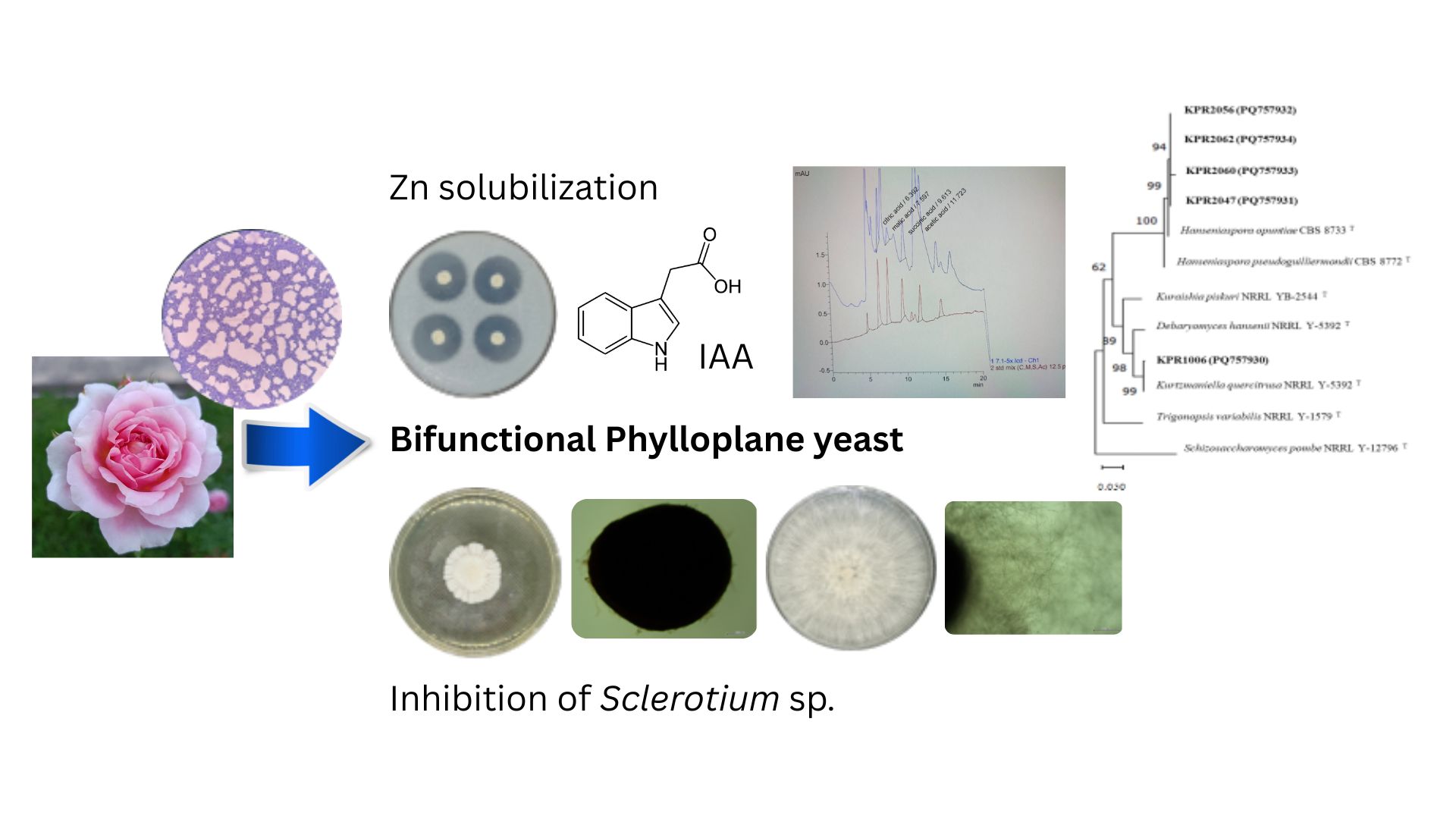
GRAPHICAL ABSTRACT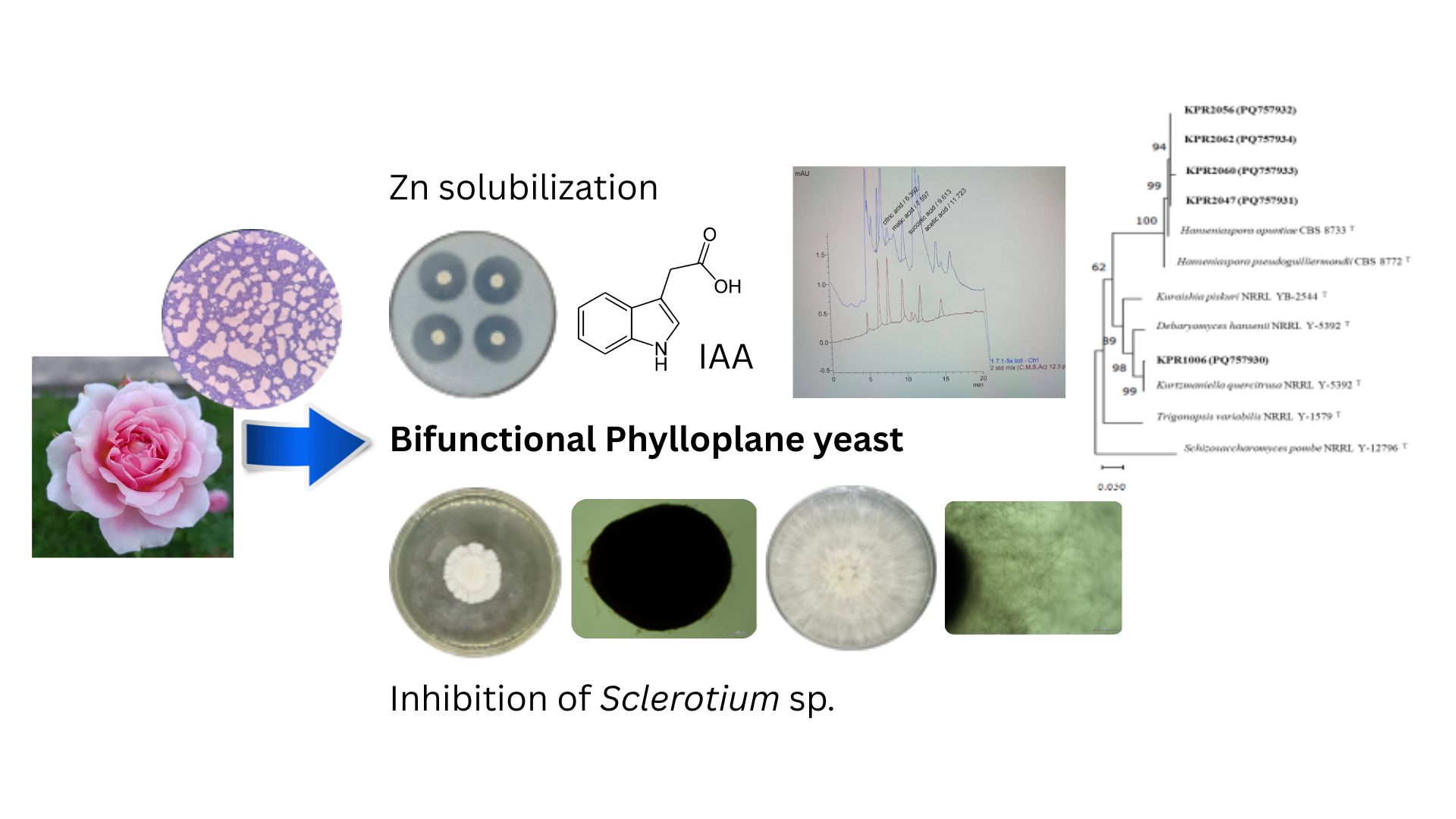
Downloads
References
C Cabot, S Martos, M Llugany, B Gallego, R Tolrà and C Poschenrieder. A role for zinc in plant defense against pathogens and herbivores. Frontiers in Plant Science 2019; 10, 1171.
M Umair Hassan, M Aamer, M Umer Chattha, T Haiying, B Shahzad, L Barbanti, M Nawaz, A Rasheed, A Afzal, Y Liu and H Guoqin. The critical role of zinc in plants facing the drought stress. Agriculture 2020; 10(9), 369-389.
T Tsonev and FJC Lidon. Zinc in plants - an overview. Emirates Journal of Food and Agriculture 2012; 24(4), 322-333.
N Takrattanasaran, J Chanchareonsook, S Thongpae and E Sarobol. Evaluation of mehlich 3 and ammonium bicarbonate-DTPA extractants for prediction of available zinc in calcareous soils in central Thailand. Kasetsart Journal 2010; 44, 824-829.
N Chittamart, J Inkam, D Ketrot and T Darunsontaya. Geochemical fractionation and adsorption characteristics of zinc in Thai major calcareous soils. Communication in Soil Science and Plant Analysis 2016; 47(20), 2348-2363.
EM Mattiello, HA Ruiz, JC Neves, MC Ventrella and WL Araujo. Zinc deficiency affects physiological and anatomical characteristics in maize leaves. Journal Plant Physiology 2015; 183, 138-143.
N Takrattanasaran, J Chanchareonsook, PG Johnson, S Thongpae and E Sarobol. Amelioration of zinc deficiency of corn in calcareous soils of Thailand: zinc sources and application methods. Journal of Plant Nutrition 2013; 36(8), 1275-1286.
A Sharma, B Patni, D Shankhdhar and SC Shankhdhar. Zinc - an indispensable micronutrient. Physiology Molecular Biological Plants 2013; 19(1), 11-20.
Land Development Department, Available at: https://www.ldd.go.th, accessed July 2025.
S Hussain, MA Maqsood and Rahmatullah. Increasing grain zinc and yield of wheat for the developing world: A review. Emirates Journal of Food and Agriculture 2010; 22(5), 326-339.
AQ Zhao, XH Tian, YL Chen and S Li. Application of ZnSO4 or Zn-EDTA fertilizer to a calcareous soil: Zn diffusion in soil and its uptake by wheat plants. Journal of Science Food and Agriculture 2015; 96(5), 1484-1491.
SS Dhaliwal, V Sharma, AK Shukla, J Kaur, V Verma, M Kaur, P Singh, A Gaber and A Hossain. Zinc-based mineral (ZnSO4·7H2O) and chelated (Zn-EDTA) fertilizers improve the productivity, quality and efficiency indices of field pea (Pisum sativum L.) through biofortification. Journal of Trace Elements and Minerals 2022; 2, 10033.
CL Doolette, TL Read, C Li, KG Scheckel, E Donner, PM Kopittke, JK Schjoerring and E Lombi. Foliar application of zinc sulphate and zinc EDTA to wheat leaves: Differences in mobility, distribution, and speciation. Journal of Experimental Botany 2018; 69(18), 4469-4481.
M Hamzah Saleem, K Usman, M Rizwan, H Al Jabri and M Alsafran. Functions and strategies for enhancing zinc availability in plants for sustainable agriculture. Frontiers of Plant Science 2022; 13, 1033092.
K Yuce and B Tileklioglu. Effect of plant hormones on the cambial activity of Cerasus vulgaris miller under stress conditions with Zn. Journal of Plant Protection Research 2019; 59(3), 304-323.
I Cakmak. Tansley review No. 111: Possible roles of zinc in protecting plant cells from damage by reactive oxygen species. The New Phytologist 2000; 146, 185-205.
N Natasha, M Shahid, I Bibi, J Iqbal, S Khalid, B Murtaza, HF Bakhat, ABU Farooq, M Amjad, HM Hammad, NK Niazi and M Arshad. Zinc in soil-plant-human system: A data-analysis review. Science of The Total Environment 2022; 808, 152024.
G Feigl, N Lehotai, A Molnár, A Ӧrdӧg, M Rodríguez-Ruiz, JM Palma, FJ Corpas, L Erdei and Z Kolbert. Zinc induces distinct changes in the metabolism of reactive oxygen and nitrogen species (ROS and RNS) in the roots of two Brassica species with different sensitivity to zinc stress. Annals of Botany 2015; 116(4), 613-625.
BG Forde and PJ Lea. Glutamate in plants: Metabolism, regulation, and signaling. Journal of Experimental Botany 2007; 58(9), 2339-2358.
GK Patra, GK Acharya, J Panigrahi, AK Mukherjee and GR Rout. The soil-borne fungal pathogen Athelia rolfsii: Past, present, and future concern in legumes. Folia Microbiologica 2023; 68(5), 677-690.
F Sun, S Sun, Y Yang, B Zhou, C Duan, W Shan and Z Zhu. A novel disease of mung bean, phytophthora stem rot caused by a new forma specialis of Phytophthora vignae. Plant Disease 2021; 105(8), 2160-2168.
AG McCoy, AM Byrne, JL Jacobs, G Anderson, JE Kurle, DEP Telenko and MI Chilvers. Oomicide treated soybean seeds reduce early season stand loss to Phytophthora sojae. Crop Protection 2022; 157, 105984.
P Paparu, A Acur, F Kato, C Acam, J Nakibuule, A Nkuboye, S Musoke and C Mukankusi. Morphological and pathogenic characterization of Sclerotium rolfsii, the causal agent of southern blight disease on common bean in Uganda. Plant Disease 2020; 104(8), 2130-2137.
MF Ahmad, FA Ahmad, AA Alsayegh, M Zeyaullah, AM AlShahrani, K Muzammil, AA Saati, S Wahab, EY Elbendary, N Kambal, MH Abdelrahman and S Hussain. Pesticides impact on human health and the environment with their mechanisms of action and possible countermeasures. Heliyon 2024; 10(7), e29128.
MC Fisher, NJ Hawkins, D Sanglard and SJ Gurr. Worldwide emergence of resistance to antifungal drugs challenges human health and food security. Science 2018; 360(6390), 739-742.
SF Syed Ab Rahman, E Singh, CMJ Pieterse and PM Schenk. Emerging microbial biocontrol strategies for plant pathogens. Plant Science 2018; 267, 102-111.
A Ansabayeva, M Makhambetov, NY Rebouh, M Abdelkader, HS Saudy, KM Hassan, MA Nasser, MAA Ali and M Ebrahim. Plant growth-promoting microbes for resilient farming systems: Mitigating environmental stressors and boosting crop productivity - a review. Horticulturae 2025; 11(3), 260-290.
S Soponputtaporn, M Srithaworn, Y Promnuan, P Srirat and O Chunhachart. Indole-3-acetic acid producing yeasts in the phyllosphere of legumes: Benefits for chili growth. Trends in Sciences 2024; 21(3), 7335-7360.
J Garcia and J Kao-Kniffin. Microbial group dynamics in plant rhizospheres and their implications on nutrient cycling. Frontiers in Microbiology 2018; 9, 1516-1523.
M Srithaworn, J Jaroenthanyakorn, J Tangjitjaroenkun, C Suriyachadkun and O Chunhachart. Zinc solubilizing bacteria and their potential as bioinoculant for growth promotion of green soybean (Glycine max L. Merr.). PeerJ 2023; 11, e15128.
VK Upadhayay, AV Singh, A Khan and A Sharma. Contemplating the role of zinc-solubilizing bacteria in crop biofortification: An approach for sustainable bioeconomy. Frontiers in Agronomy 2022; 4, 903321.
R Yasmin, S Hussain, MH Rasool, MH Siddique and S Muzammil. Isolation, characterization of Zn solubilizing bacterium (Pseudomonas protegens RY2) and its contribution in growth of chickpea (Cicer arietinum L.) as deciphered by improved growth parameters and Zn content. Dose Response 2021; 19(3), 15593258211036791.
K Bhatt and DK Maheshwari. Zinc solubilizing bacteria (Bacillus megaterium) with multifarious plant growth promoting activities alleviates growth in Capsicum annuum L. 3 Biotech 2020; 10(2), 36-46.
P Kushwaha, R Srivastava, K Pandiyan, A Singh, H Chakdar, PL Kashyap, AK Bhardwaj, K Murugan, N Karthikeyan, SY Bagul, AK Srivastava and AK Saxena. Enhancement in plant growth and zinc biofortification of chickpea (Cicer arietinum L.) by Bacillus altitudinis. Journal of Soil Science and Plant Nutrition 2021; 21(2), 922-935.
VK Upadhayay, S Gangola, G Taj, K Gaurav, A Rani, S Kumar, S Garg, G Gupta, H Ali, S Siddiqui, SAM Alamri, A Mittal, SA Alrumman and M Pandey. Zinc-solubilizing bacterial consortia: A promising approach for zinc biofortification of crops. Frontiers in Microbiology 2025; 16, 1575514.
S Krithika and D Balachandar. Expression of zinc transporter genes in rice as influenced by zinc-solubilizing Enterobacter cloacae strain ZSB14. Frontiers in Plant Science 2016; 7, 446.
M Ali, I Ahmed, H Tariq, S Abbas, MH Zia, A Mumtaz and M Sharif. Growth improvement of wheat (Triticum aestivum) and zinc biofortification using potent zinc-solubilizing bacteria. Frontiers in Plant Science 2023; 14, 1140454.
RC Yadav, SK Sharma, A Varma, UB Singh, A Kumar, I Bhupenchandra, JP Rai, PK Sharma and HV Singh. Zinc-solubilizing Bacillus spp. in conjunction with chemical fertilizers enhance growth, yield, nutrient content, and zinc biofortification in wheat crop. Frontiers in Microbiology 2023; 14, 1210938.
R Khande, SK Sharma, A Ramesh and MP Sharma. Zinc solubilizing Bacillus strains that modulate growth, yield and zinc biofortification of soybean and wheat. Rhizosphere 2017; 4, 126-138.
G Sethi, KK Behera, R Sayyed, V Adarsh, BS Sipra, L Singh, AA Alamro and M Behera. Enhancing soil health and crop productivity: the role of zinc-solubilizing bacteria in sustainable agriculture. Plant Growth Regulations 2025; 105, 601-617.
KA Nimsi, K Manjusha, K Kathiresan and H Arya. Plant growth-promoting yeasts (PGPY), the latest entrant for use in sustainable agriculture: A review. Journal of Applied Microbiology 2023; 134, 1-11.
M Rebolleda-Gómez, NJ Forrester, AL Russell, N Wei, AM Fetters, JD Stephens and TL Ashman. Gazing into the anthosphere: considering how microbes influence floral evolution. New Phytologist 2019; 224(3), 1012-1020.
S Baudino, P Sun, JC Caissard, B Nairaud, S Moja, JL Magnard, A Bony, F Jullien, RC Schuurink, P Vergne, A Dubois, O Raymond, M Bendahmane, L Hibrand-Saint Oyant, J Jeauffre, J Clotault, T Thouroude, F Foucher and B Blerot. Rose floral scent. Acta Horticulturae 2019; 1232, 69-80.
O Rop, J Mlcek, T Jurikova, J Neugebauerova and J Vabkova. Edible flowers-a new promising source of mineral elements in human nutrition. Molecules 2012; 17, 6672-6683.
T Hisatomi and K Toyomura. Isolation, identification, and characterization of wild budding yeasts from rose flowers in Fukuyama city, Hiroshima, Japan, and their application in bread and wine production. Mycoscience 2021; 62, 382-389.
SF Fu, PF Sun, HY Lu, JY Wei, HS Xiao, WT Fang, BY Cheng and JY Chou. Plant growth-promoting traits of yeasts isolated from the phyllosphere and rhizosphere of Drosera spatulata Lab. Fungal Biology 2016; 120, 433-448.
Tripti, V Kumar and Anshumali. Phosphate solubilizing activity of some bacterial strains isolated from chemical pesticide exposed agriculture soil. International Journal of Engineering Research and Development 2012; 3(9), 1-6.
B Schwyn and JB Neilands. Universal chemical assay for the detection and determination of siderophores. Analytical Biochemistry 1987; 160, 47-56.
S Öztekin and F Karbancioglu-Guler. Biological control of green mould on mandarin fruit through the combined use of antagonistic yeasts. Biological Control 2023; 180, 105186.
M Dissanayake. Inhibitory Effect of selected medicinal plant extracts on phytopathogenic fungus Fusarium oxysporum. Annual Research and Review in Biology 2014; 4(1), 133-142.
CM Cabañas, A Hernández, A Martínez, P Tejero, M Vázquez-Hernández, A Martín and S Ruiz-Moyano. Control of Penicillium glabrum by indigenous antagonistic yeast from vineyards. Foods 2020; 9(12), 1864.
DAS Gebily, GAM Ghanem, MM Ragab, AM Ali, NE-dK Soliman and TH Abd El-Moity. Characterization and potential antifungal activities of three Streptomyces spp. as biocontrol agents against Sclerotinia sclerotiorum (Lib.) de bary infecting green bean. Egyptian Journal of Biological Pest Control 2021; 31(1), 1-15.
CMS Kumar, S D’Silva, R Praveena, A Kaprakkaden, LR Athira Krishnan, M Balaji Rajkumar, V Srinivasan and R Dinesh. Zinc solubilization and organic acid production by the entomopathogenic fungus, Metarhizium pingshaense sheds light on its key ecological role in the environment. Science of The Total Environment 2024; 923, 171348.
T Agrawal and AS Kotasthane. Chitinolytic assay of indigenous Trichoderma isolates collected from different geographical locations of Chhattisgarh in Central India. SpringerPlus 2012; 1(a73), 1-10.
A Fernandez-San Millan, L Larraya, I Farran, M Ancin and J Veramendi. Successful biocontrol of major postharvest and soil-borne plant pathogenic fungi by antagonistic yeasts. Biological Control 2021; 160, 104683
CP Kurtzman and CJ Robnett. Identification and phylogeny of ascomycetous yeasts from analysis of nuclear large subunit (26S) ribosomal DNA partial sequences. Antonie van Leewenhoek 1998; 73, 331-371.
SF Altschul, TL Madden, AA Schäffer, J Zhang, Z Zhang, W Miller and DJ Lipman. Gapped BLAST and PSI-BLAST: a new generation of protein database search programs. Nucleic Acids Research 1997; 25(17), 3389-3402.
S Kumar, G Stecher, M Li, C Knyaz and K Tamura. MEGA X: Molecular evolutionary genetics analysis across computing platforms. Molecular Biology and Evolution 2018; 35(6), 1547-1549.
CC Rering, AB Rudolph and JJ Beck. Pollen and yeast change nectar aroma and nutritional content alone and together, but honey bee foraging reflects only the avoidance of yeast. Environmental Microbiology 2021; 23(8), 4141-4150.
C Suriyachadkun, O Chunhachart, M Srithaworn, R Tangchitcharoenkhul and J Tangjitjareonkun. Zinc-solubilizing Streptomyces spp. as bioinoculants for promoting the growth of soybean (Glycine max (L.) Merrill). Journal of Microbiology and Biotechnology 2022; 32(11), 1435-1446.
VS Saravanan, SR Subramoniam and SA Raj. Assessing in vitro solubilization potential of different zinc solubilizing bacterial (ZSB) isolates. Brazilian Journal of Microbiology 2004; 35(1-2), 121-125.
HF Rehman, A Ashraf, S Muzammil, MH Siddique and T Ali. Assessment of zinc solubilization potential of zinc-resistant Pseudomonas oleovorans strain ZSB13 isolated from contaminated soil. Brazilain Journal of Biology 2021; 83, e240015.
S S Shaikh and M S Saraf. Optimization of growth conditions for zinc-solubilizing plant growth-associated bacteria and fungi. Journal of Advanced Research in Biotechnology 2017; 2(1), 1-9.
MZ Mumtaz, KM Barry, AL Baker, DS Nichols, M Ahmad, ZA Zahir and ML Britz. Production of lactic and acetic acids by Bacillus sp. ZM20 and Bacillus cereus following exposure to zinc oxide: A possible mechanism for Zn solubilization. Rhizosphere 2019; 12, 100170.
A Serra-Cardona, D Canadell and J Arino. Coordinate responses to alkaline pH stress in budding yeast. Microbial Cell 2015; 2 (6), 182-196.
J Arino. Integrative responses to high pH stress in S. cerevisiae. OMICS 2010; 14(5), 517-523
ZP Guo and L Olsson. Physiological responses to acid stress by Saccharomyces cerevisiae when applying high initial cell density. FEMS Yeast Research 2016; 16(7), 1-11.
K Zhang, W Wang and Q Yang. Transcriptome analysis reveals the regulation of Aureobasidium pullulans under different pH stress. International Journal of Molecular Sciences 2023; 24(22), 16103.
PA Lund, D De Biase, O Liran, O Scheler, NP Mira, Z Cetecioglu, EN Fernandez, S Bover-Cid, R Hall, M Sauer and C O’Byrne. Understanding how microorganisms respond to acid pH is central to their control and successful exploitation. Frontiers in Microbiology 2020; 11, 556140.
VY Sekova, LI Kovalyov, MA Kovalyova, NN Gessler, MA Danilova, EP Isakova and YI Deryabina. Proteomics readjustment of the Yarrowia lipolytica yeast in response to increased temperature and alkaline stress. Microorganisms 2021; 9(12), 2619.
X Zhang, Y Yao, S Dhanasekaran, J Li, GL Ngolong Ngea, X Gu, B Li, L Zhao and H Zhang. Controlling black spot of postharvest broccoli by Meyerozyma guilliermondii and its regulation on ROS metabolism of broccoli. Biological Control 2022; 170, 104938.
J Li, T Yang, F Yuan, X Lv and Y Zhou. Inhibitory effect and potential antagonistic mechanism of isolated epiphytic yeasts against Botrytis cinerea and Alternaria alternata in postharvest blueberry fruits. Foods 2024; 13(9), 1334.
A Fernandez-San Millan, I Farran, L Larraya, M Ancin, LM Arregui and J Veramendi. Plant growth-promoting traits of yeasts isolated from Spanish vineyards: benefits for seedling development. Microbiological Research 2020; 237, 126480.
G Zara, M Budroni, I Mannazzu, F Fancello and S Zara. Yeast biofilm in food realms: Occurrence and control. World Journal of Microbiology and Biotechnology 2020; 36(9), 134-144.
S Muccilli and C Restuccia. Bioprotective role of yeasts. Microorganisms 2015; 3(4), 588-611.
G Muthukrishanan, J Munisamy, SK Gopalasubramaniam, KS Subramanian, R Dharmaraj, DJ Nath, P Dutta and AK Devarajan. Impact of foliar application of phyllosphere yeast strains combined with soil fertilizer application on rice growth and yield. Environmental Microbiome 2024; 19(1), 102.
Published
How to Cite
Issue
Section
License
Copyright (c) 2025 Walailak University

This work is licensed under a Creative Commons Attribution-NonCommercial-NoDerivatives 4.0 International License.





