
Bioactive Compound from Endophytic Fungus Trichoderma sp. Isolated from Cashew (Anacardium occidentale) Leaves
DOI:
https://doi.org/10.48048/tis.2025.9336Keywords:
Bioactive compound, Endophytic fungi, Trichoderma sp., Anacardium occidentaleAbstract
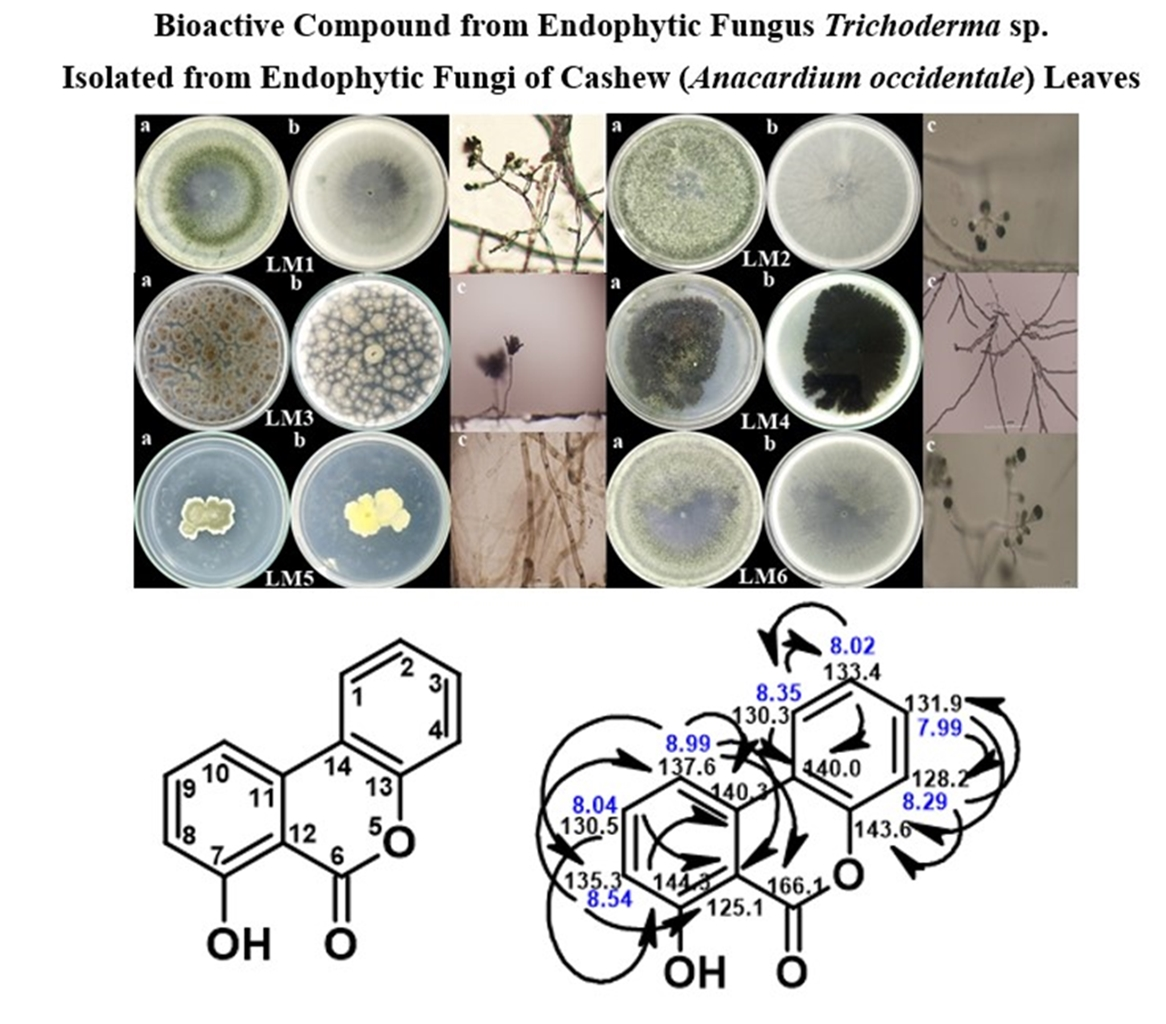
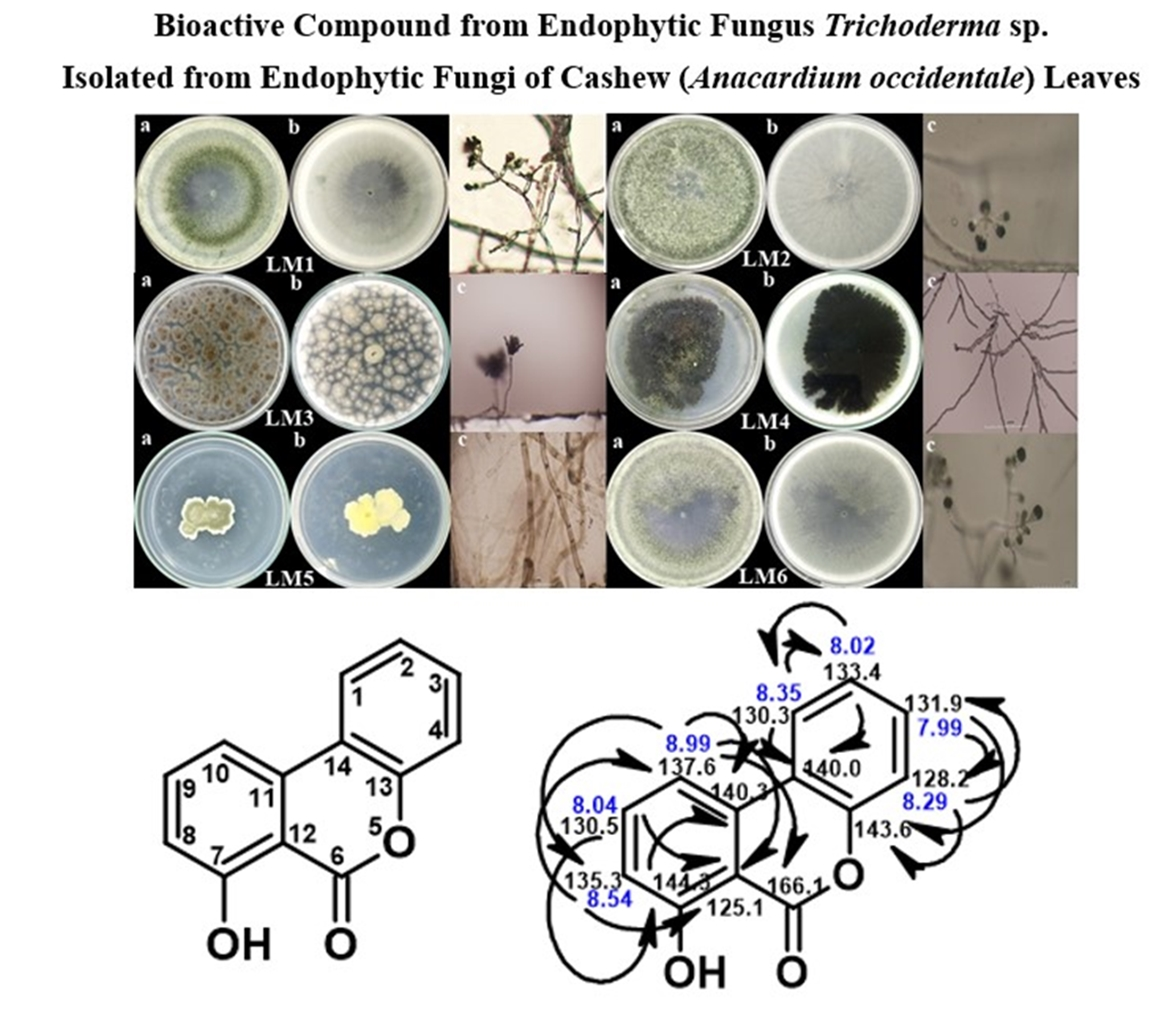
Anacardium occidentale, commonly referred to as cashew, serves an important function in agriculture and healthcare sectors. The leaves of A. occidentale are valued as a vegetable and have applications in traditional medicinal practices. This study analyzed the antioxidant and antibacterial properties, along with bioactive compounds synthesized by endophytic fungi that exist in a symbiotic relationship within the leaf tissues of A. occidentale. The endophytic fungi were isolated from A. occidentale leaves using PDA (Potato Dextrose Agar) media and identified morphologically. Each pure isolate was cultured in Potato Dextrose Broth (PDB) medium for a duration of 4 weeks at ambient temperature under stable conditions. Following this incubation phase, the liquid culture was separated from the biomass and subjected to extraction with ethyl acetate, which was then evaporated to yield a concentrated extract. Each of these concentrated extracts was assessed for antioxidant properties using the DPPH (2,2-diphenyl-1-picrylhydrazyl) assay and for antibacterial properties using the disk diffusion technique. Active extracts were further separated using chromatography techniques to isolate pure compounds, which were subsequently characterized by 1D and 2D NMR spectroscopy. This study identified 6 endophytic fungi (LM1 - LM6), comprising 3 Trichoderma sp. (LM1, LM2 and LM6), 1 Aspergillus sp. (LM3), 1 Nigrospora sp. (LM4) and 1 Penicillium sp. (LM5) based on morphological analysis. The antioxidant and antibacterial assays revealed that LM2 and LM4 demonstrated potent antioxidant effects and significant antibacterial efficacy against all bacterial strains tested. The LM2 isolate was selected for further bioactive compound isolation due to its higher extract yield. Chromatographic separation resulted in a pure yellow solid compound identified as a phenolic derivative, which showed weak antioxidant activity but demonstrated potent antibacterial effects against Bacillus subtilis and Salmonella typhi. Therefore, the endophytic fungus Trichoderma sp. (LM2) shows potential for development in the form of an extract or as a pure compound with structural modifications.
HIGHLIGHTS
- We found endophytic fungi isolated from leaves of Anacardium occidentale.
- Trichoderma sp. (LM1), selected endophytic fungus, has the best antibacterial and antioxidant properties.
- The pure compound that was successfully isolated from the Trichoderma sp. is 7-hydroxy-6H-benzo[c]chromen-6-one
GRAPHICAL ABSTRACT
Downloads
References
FP de Abreu, M Dornier, AP Dionisio, M Carail, C Caris-Veyrat and C Dhuique-Mayer. Cashew apple (Anacardium occidentale L.) extract from by-product of juice processing: A focus on carotenoids. Food Chemistry 2013; 138(1), 25-31.
B Salehi, M Gültekin-Özgüven, C Kırkın, B Özçelik, MFB Morais-Braga, JNP Carneiro, CF Bezerra, TGD Silva, HDM Coutinho, B Amina, L Armstrong, Z Selamoglu, M Sevindik, Z Yousaf, J Sharifi-Rad, AM Muddathir, HP Devkota, M Martorell, AK Jugran and N Martins. Anacardium plants: Chemical, nutritional composition and biotechnological applications. Biomolecules 2019; 9(9), 465.
S Encarnação, CD Mello-Sampayo, NAG Graca, L Catarino, IBMD Silva, BS Lima and OMD Silva. Total phenolic content, antioxidant activity and pre-clinical safety evaluation of an Anacardium occidentale stem bark Portuguese hypoglycemic traditional herbal preparation. Industrial Crops and Products 2016; 82, 171-178.
B Salehi, M Gültekin-Özgüven, C Kirkin, B Özçelik, MFB Morais-Braga, JNP Carneiro, CF Bezerra, TGD Silva, HDM Coutinho, B Amina, L Armstrong, Z Selamoglu, M Sevindik, Z Yousaf, J Sharifi-Rad, AM Muddathir, HP Devkota, M Martorell, AK Jugran, WC Cho and N Martins. Antioxidant, antimicrobial, and anticancer effects of Anacardium plants: An ethnopharmacological perspective. Frontiers Endocrinology 2020; 11, 295.
RG Amaral, LRMD Andrade, LN Andrade, KC Loureiro, EB Souto and P Severino. Cashew gum: A review of Brazilian patents and pharmaceutical applications with a special focus on nanoparticles. Micromachines 2022; 13(7), 1137.
MD Silveira Vasconcelos, NF Gomes-Rochette, MLMD Oliveira, DCS Nunes-Pinheiro, AR Tomé, FYMD Sousa, FGM Pinheiro, CFH Moura, MRA Miranda, EF Mota and DFD Melo. Anti-inflammatory and wound healing potential of cashew apple juice (Anacardium occidentale L.) in mice. Experimental Biology and Medicine 2015; 240(12), 1648-1655.
R Siracusa. Anacardium occidentale L. Cashew nuts in a mouse model of colitis. Nutrients 2020; 12(3), 834.
YG Akyereko, GB Yeboah, FD Wireko‐Manu, F Alemawor, FC Mills‐Robertson and W Odoom. Nutritional value and health benefits of cashew apple. JSFA Reports 2023; 3(3), 110-118.
YS Jaiswal, PA Tatke, SY Gabhe and AB Vaidya. Antidiabetic activity of extracts of Anacardium occidentale Linn. leaves on n-streptozotocin diabetic rats. Journal of Traditional and Complementary Medicine 2017; 7(4), 421-427.
C Gutiérrez-Paz, MC Rodríguez-Moreno, MS Hernández-Gómez and JP Fernández-Trujillo. The Cashew Pseudofruit (Anacardium occidentale): Composition, processing effects on bioactive compounds and potential benefits for human health. Foods 2024; 13(15), 2357.
YY Chen, N Li, X Guo, H Huang, P Garcia‐Oliveira, J Sun, J Zhang, MA Prieto, Z Guo and C Liu. The nutritional and bio-active constituents, functional activities, and industrial applications of cashew (Anacardium occidentale): A review. Food Frontiers 2023; 4(4), 1606-1621.
KC Sika, H Adoukonou-Sagbadja, LE Ahoton, I Adebo, FA Adigoun, A Saidou, SO Kotchoni, A Ahanchede and L Baba-Moussa. Indigenous knowledge and traditional management of cashew (Anacardium occidentale L.) genetic resources in Benin. Journal of Experimental Biology and Agricultural Science 2013; 1(5), 375-382.
AA Mustapha. Ethnobotanical field survey of medicinal plants used by traditional medicine practitioners to manage HIV/AIDS opportunistic infections and their prophylaxis in Keffi Metropolis, Nigeria. Asian Journal of Plant Science Research 2014; 4(1), 7-14.
J Wen, SK Okyere, S Wang, J Wang, L Xie, Y Ran and Y Hu. Endophytic fungi: An effective alternative source of plant-derived bioactive compounds for pharmacological studies. Journal of Fungi 2022; 8(2), 205.
P Jha, T Kaur, I Chhabra, A Panja, S Paul, V Kumar and T Malik. Endophytic fungi: Hidden treasure chest of antimicrobial metabolites interrelationship of endophytes and metabolites. Frontiers in Microbiology 2023; 14, 1227830.
G Caruso, MT Abdelhamid, A Kalisz and A Sekara. Linking endophytic fungi to medicinal plants therapeutic activity. A case study on Asteraceae. Agriculture 2020; 10(7), 286.
BS Adeleke and OO Babalola. Pharmacological potential of fungal endophytes associated with medicinal plants: A review. Journal of Fungi 2021; 7(2), 147.
E Elfita, R Oktiansyah, M Mardiyanto, H Widjajanti, A Setiawan and SSA Nasution. Bioactive compounds of endophytic fungi Lasiodiplodia theobromae isolated from the leaves of Sungkai (Peronema canescens). Biointerface Research in Applied Chemistry 2023; 13(6), 59-69.
AN Yadav, S Singh, S Mishra and A Gupta. Recent advancement in white biotechnology through fungi. Springer International Publishing, Cham, Switzerland, 2019.
FP Permatasari, H Widjajanti, PL Hariani and R Oktiansyah. Antioxidant activity of endophytic fungi isolated from cashew (Anacardium occidentale) leaves. Tropical Journal and Natural Product Research 2023; 7(12), 5486.
R Oktiansyah, Elfita, H Widjajanti, S Salni and A Setiawan. Antibacterial and antioxidant activity of endophytic fungi extracts isolated from the petiole of sungkai plant (Peronema canescens). Biodiversitas Journal of Biological Diversity 2023; 24(12), 6516-6526.
T Watanabe. Pictorial atlas of soil and seed fungi. CRC Press, Boca Raton, 2010.
TJ Walsh, RT Hayden and DH Larone. Larone’s medically important fungi: A guide to identification. ASM Press, Washington DC, 2018.
JI Pitt and AD Hocking. Fungi and food spoilage. Springer, New York, 2009.
R Oktiansyah, E Elfita, H Widjajanti, PL Hariani, N Hidayati, A Setiawan and S Salni. Secondary metabolites of endophytic fungi isolated from the stem bark of Sungkai (Peronema canescens Jack.). Journal of Research in Pharmacy 2024; 28(1), 89-109.
P Molyneux. The use of the stable free radical diphenylpicryl-hydrazyl (DPPH) for estimating antioxidant activity. Songklanakarin Journal of Science and Technology 2003; 50(6), 211-219.
S Abbas, T Shanbhag and A Kothare. Applications of bromelain from pineapple waste towards acne. Saudi Journal of Biological Science 2021; 28(1), 1001-1009.
R Oktiansyah, H Widjajanti, A Setiawan and Elfita. Antioxidant and antibacterial activity of endophytic fungi isolated from fruit of Sungkai (Peronema canescens). Science and Technology Indonesia 2024; 9(1), 17-27.
J Poveda and D Eugui. Combined use of Trichoderma and beneficial bacteria (mainly Bacillus and Pseudomonas): Development of microbial synergistic bio-inoculants in sustainable agriculture. Biological Control 2022; 176, 105100.
P Guzmán-Guzmán, A Kumar, SDL Santos-Villalobos, FI Parra-Cota, MDC Orozco-Mosqueda, AE Fadiji, S Hyder, OO Babalola and G Santoyo. Trichoderma species: Our best fungal allies in the biocontrol of plant diseases - a review. Plants 2023; 12(3), 432.
D Periasamy, S Mani and R Ambikapathi. White rot fungi and their enzymes for the treatment of industrial dye effluents. In: A Nath, YS Singh, S Mishra and A Gupta (Eds.). Fungal biology recent advancement. Springer, Cham, Switzerland, 2019.
K Stuper-Szablewska, T Szablewski, A Przybylska-Balcerek, L Szwajkowska-Michałek, M Krzyżaniak, D Świerk, R Cegielska-Radziejewska and Z Krejpcio. Antimicrobial activities evaluation and phytochemical screening of some selected plant materials used in traditional medicine. Molecules 2023; 28(1), 244.
IMM Silva, RM Silva, VB Paula and LM Estevinho. Biological activities of endophytic fungi isolated from Annona muricata Linnaeus: A systematic review. Brazilian Journal of Biology 2022; 84, e259525.
R Oktiansyah, B Juliandi, KA Widayati and V Juniantito. Neuronal cell death and mouse (Mus musculus) behaviour induced by bee venom. Tropical Life Science Research 2018; 29(2), 1-11.
R Salwan, N Rialch and V Sharma. Bioactive volatile metabolites of Trichoderma: An overview. In: H Singh, C Keswani, M Reddy, E Sansinenea and C García-Estrada (Eds.). Secondary metabolites of plant growth promoting rhizomicroorganisms. Springer, Singapore, 2020.
TE Schierling, W Vogt, RT Voegele and A El-Hasan. Efficacy of Trichoderma spp. and Kosakonia sp. both independently and combined with fungicides against botrytis cinerea on strawberries. Antibiotics 2024; 13(9), 912.
A Verma, P Gupta, N Rai, RK Tiwari, A Kumar, P Salvi, SC Kamble, SK Singh and V Gautam. Assessment of biological activities of fungal endophytes derived bioactive compounds isolated from Amoora rohituka. Journal of Fungi 2022; 8(3), 285.
A Puri, P Mohite, S Maitra, V Subramaniyan, V Kumarasamy, DE Uti, AA Sayed, FM El-Demerdash, M Algahtani, AF El-kott, AA Shati, M Albaik, MM Abdel-Daim and IJ Atangwho. From nature to nanotechnology: The interplay of traditional medicine, green chemistry, and biogenic metallic phytonanoparticles in modern healthcare innovation and sustainability. Biomedical Pharmacotherapy 2024; 170, 116083.
RS Lodi, C Peng, X Dong, P Deng and L Peng. Trichoderma hamatum and its benefits. Journals of Fungi 2023; 9(10), 994.
X Yao, H Guo, K Zhang, M Zhao, J Ruan and J Chen. Trichoderma and its role in biological control of plant fungal and nematode disease. Frontiers in Microbiology 2023; 14, 1160551.
R Tyśkiewicz, A Nowak, E Ozimek and J Jaroszuk-ściseł. Trichoderma: The current status of its application in agriculture for the biocontrol of fungal phytopathogens and stimulation of plant growth. International Journal of Molecular Sciences 2022; 23(4), 2329.
D Natsiopoulos, E Topalidou, S Mantzoukas and PA Eliopoulos. Endophytic Trichoderma: Potential and prospects for plant health management. Pathogens 2024; 13(7), 548.
NA Zin and NA Badaluddin. Biological functions of Trichoderma spp. for agriculture applications. Annuals of Agricultural Sciences 2020; 65(2), 168-178.
L Kredics, R Büchner, D Balázs, H Allaga, O Kedves, G Racić, A Varga, VD Nagy, C Vágvölgyi and G Sipos. Recent advances in the use of Trichoderma-containing multicomponent microbial inoculants for pathogen control and plant growth promotion. World Journal of Microbiology and Biotechnology 2024; 40, 162.
S Jurić, K Sopko Stracenski, Ż Król-Kilińska, I Žutić, SF Uher, E Đermić, S Topolovec-Pintarić and M Vinceković. The enhancement of plant secondary metabolites content in Lactuca sativa L. by encapsulated bioactive agents. Scientific Reports 2020; 10, 3737.
VD Kancheva, MA Dettori, D Fabbri, P Alov, SE Angelova, AK Slavova-Kazakova, P Carta, VA Menshov, OI Yablonskaya, AV Trofimov, I Tsakovska and L Saso. Natural chain-breaking antioxidants and their synthetic analogs as modulators of oxidative stress. Antioxidants 2021; 10(4), 624.
A Kurek-Górecka, A Rzepecka-Stojko, M Górecki, J Stojko, M Sosada and G Swierczek-Zieba. Structure and antioxidant activity of polyphenols derived from propolis. Molecules 2014; 19(1), 78-101.
D Bešlo, N Golubić, V Rastija, D Agić, M Karnaš, D Šubarić and B Lučić. Antioxidant activity, metabolism, and bioavailability of polyphenols in the diet of animals. Antioxidants 2023; 12(6), 1141.
M Miklasińska-Majdanik, M Kępa, RD Wojtyczka, D Idzik and TJ Wąsik. Phenolic compounds diminish antibiotic resistance of Staphylococcus aureus clinical strains. International Journal of Environmental Research and Public Health 2018; 15(10), 2321.
P Sinlapapanya, P Sumpavapol, N Nirmal, B Zhang, H Hong and S Benjakul. Ethanolic Cashew leaf extract: Antimicrobial activity, mode of action, and retardation of spoilage bacteria in refrigerated Nile tilapia slices. Foods 2022; 11(21), 3461.
S Suriyaprom, P Mosoni, S Leroy, T Kaewkod, M Desvaux and Y Tragoolpua. Antioxidants of fruit extracts as antimicrobial agents against pathogenic bacteria. Antioxidants 2022; 11(3), 602.
A Bouyahya, I Chamkhi, A Balahbib, M Rebezov, MA Shariati, P Wilairatana, MS Mubarak, T Benali and NM El-Omari. Anti-Quorum-Sensing actions, and clinical trials of medicinal plant bioactive compounds against bacteria: A comprehensive review. Molecules 2022, 27, 1484.
A Lobiuc, NE Pavăl, II Mangalagiu, R Gheorghiță, GC Teliban, D Amăriucăi-Mantu and V Stoleru. Future antimicrobials: Natural and functionalized phenolics. Molecules 2023; 28(3), 1114.
Downloads
Published
How to Cite
Issue
Section
License
Copyright (c) 2024 Walailak University

This work is licensed under a Creative Commons Attribution-NonCommercial-NoDerivatives 4.0 International License.





