
Standardisation of Vitexin and Isovitexin in Ficus deltoidea var. Kunstleri (FDK) Extract and Anti-Hyperlipidaemic Properties of FDK Hydrogel in High Cholesterol Diet-Induced Early and Established Atherosclerosis Rabbits
DOI:
https://doi.org/10.48048/tis.2025.9114Keywords:
Anti-hyperlipidaemic, Hydrogel, Ficus deltoidea var kunstleri, Standardised extract, AtherosclerosisAbstract
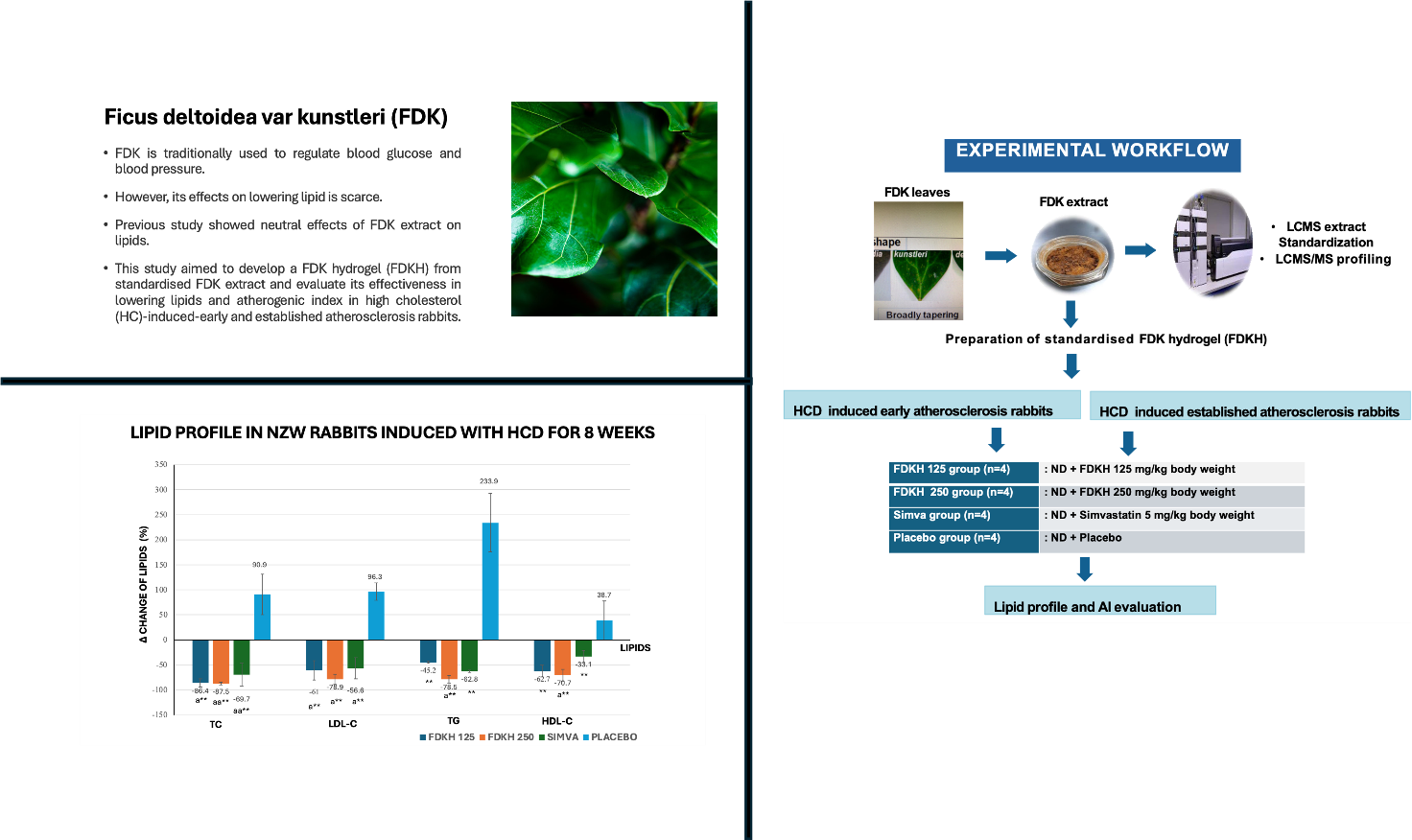
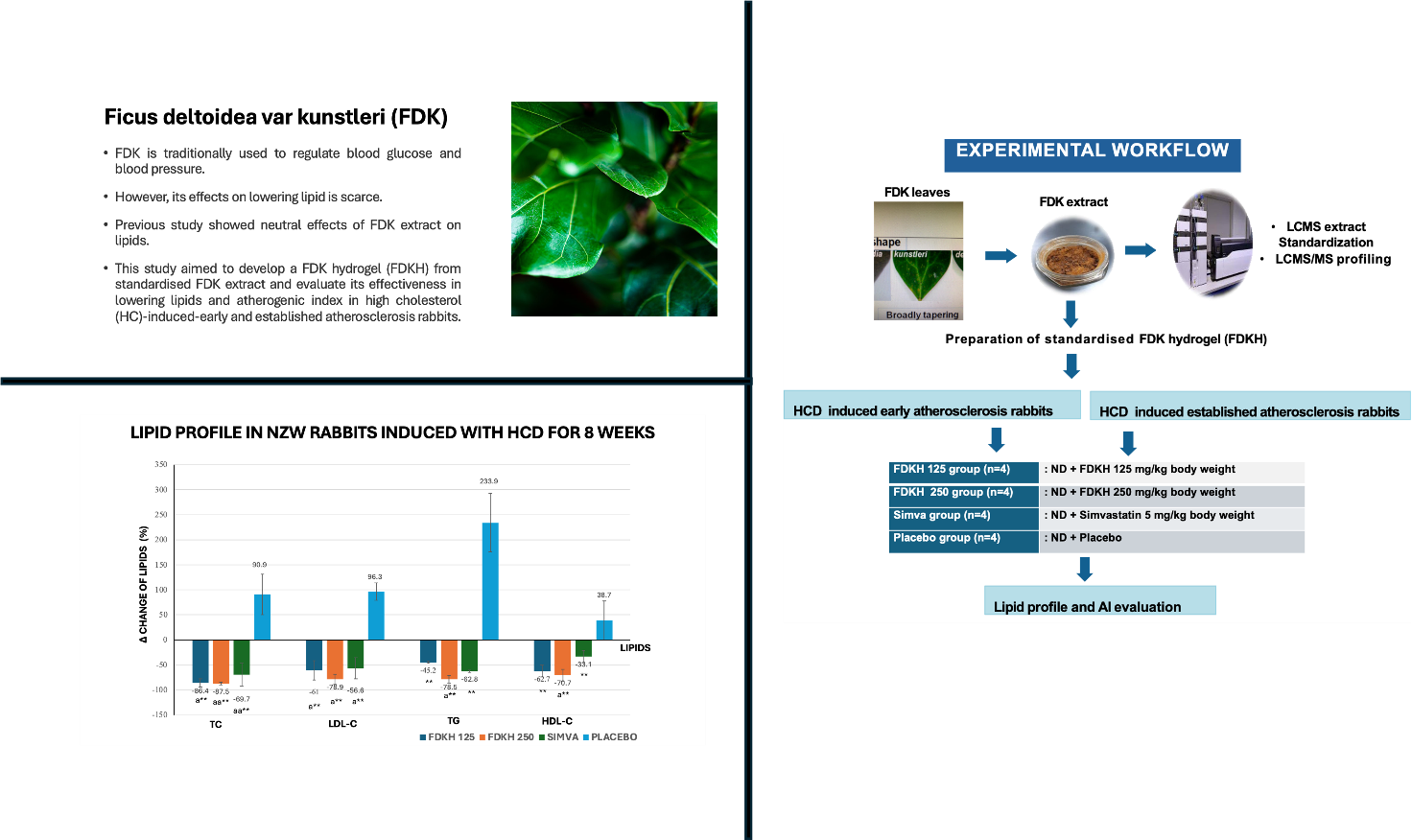
Hyperlipidaemia is a major risk factor for cardiovascular disease (CVD) due to its role in forming atherosclerotic plaques. Finding natural products with anti-hyperlipidaemic properties is important for preventing atherosclerosis. Ficus deltoidea var kunstleri extract (FDK) is traditionally used to regulate blood glucose and blood pressure, however its effect on lowering lipid is scarce. Previous study showed neutral effects of FDK extract on lipids. Hydrogel delivery is commonly used to enhance absorption of active compounds therefore enhancing their therapeutic effect. This study aimed to develop a FDK hydrogel from standardised FDK extract and evaluate its effectiveness in lowering lipids and atherogenic index (AI) in high cholesterol (HC)-induced-early and established atherosclerosis rabbits. Standardised FDK extract against vitexin and isovitexin was produced according to a standard guideline using Liquid chromatography-tandem mass spectrometry (LCMS/MS) method prior to the preparation of FDK hydrogel (FDKH). Forty-rabbits were fed with 1 % high cholesterol diet for 4 and 8 weeks to induce early and established atherosclerosis, respectively. Each group was subdivided into 4 intervention arms: 1) FDKH 125 mg/kg; 2) FDKH 250 mg/kg; 3) Simvastatin 5 mg/kg; and 5) placebo for 8 weeks. Lipid profile and atherogenic index (AI) were measured at the baseline (B0), post-HC diet and post-treatment in both early and established atherosclerosis rabbits. Quantitative analysis of FDK using LC-MS/QQQ reveals the presence of 3.5 ± 0.04 mg/g of vitexin and 3.1 ± 0.8 mg/g isovitexin, respectively. In the early atherosclerotic group, at week 12, all treatment groups showed significant reductions in total cholesterol (TC), low-density lipoprotein cholesterol (LDL-C), and triglycerides (TG) compared to week 4. The reductions varied by treatment type. FDKH 250 mg/kg resulted in the highest reductions in TC and LDL-C, followed by FDKH 125 mg/kg and simvastatin, which is still higher than placebo. Interestingly, simvastatin led to the greatest reduction in TG, followed by FDKH 125 mg/kg and FDKH 250 mg/kg. In the established atherosclerotic group, FDKH 250 mg/kg again demonstrated the highest reductions in TC, LDL-C and TG levels, confirming its efficacy in more advanced stages of atherosclerosis. Both FDKH dosages significantly improved AI compared to the placebo, with FDKH 250 mg/kg showing the lowest AI value. These findings suggest that FDKH, particularly at the 250 mg/kg dosage, is highly effective in reducing lipid levels and improving AI, indicating its potential as a potent alternative to traditional treatments like simvastatin. Further clinical trials are warranted to confirm these results and explore the long-term effects and safety of FDKH in humans. In conclusion, FDKH have significant potential to mitigate serum lipid and atherogenesis in both early and established atherosclerosis rabbits. This advancement represents a promising adjunct treatment option, offering a natural and effective solution for hyperlipidaemia.
HIGHLIGHTS
- Ficus deltoidea var kunstleri (FDK) extract was successfully standardised using a validated LC-MS/QQQ method against 2 major bioactive components, vitexin and isovitexin.
- Treatment with FDK hydrogel (FDKH) led to a significant reduction of TC, LDL and TG and atherogenic index in high cholesterol-induced-early and established atherosclerosis rabbits.
- FDKH have significant potential to mitigate serum lipid and atherogenesis in both early and established atherosclerosis rabbits.
- This study suggests a promising adjunct treatment option of FDKH, offering a natural and effective solution for hyperlipidaemia.
GRAPHICAL ABSTRACT
Downloads
References
D Zhao. Epidemiological features of cardiovascular disease in Asia. Journals of the American College of Cardiology 2021; 1(1), 1-13.
N Thangiah, TT Su, K Chinna, MY Jalaludin, MNA Mohamed and HA Majid. Longitudinal assessment between lifestyle-related risk factors and a composite cardiovascular disease (CVD) risk index among adolescents in Malaysia. Scientific Reports 2021; 11(1), 19135.
U Ahmad, RS Ahmad, MS Arshad, Z Mushtaq, SM Hussain and A Hameed. Antihyperlipidemic efficacy of aqueous extract of Stevia rebaudiana Bertoni in albino rats. Lipids in Health and Disease 2018; 17(1), 175.
WH El-Tantawy and A Temraz. Natural products for controlling hyperlipidemia: Review. Archieves of Physiology and Biochemistry 2019; 125(2), 128-135.
X Zhang, C Wu, H Wu, L Sheng, Y Su, X Zhang, H Luan, G Sun, X Sun, Y Tian, Y Ji, P Guo and X Xu. Anti-hyperlipidemic effects and potential mechanisms of action of the caffeoylquinic acid-rich Pandanus tectorius fruit extract in hamsters fed a high fat-diet. PLoS One 2013; 8(4), e61922.
HA Fathi, A Allam, M Elsabahy, G Fetih and M El-Badry. Nanostructured lipid carriers for improved oral delivery and prolonged antihyperlipidemic effect of simvastatin. Colloids and Surface B Biointerfaces 2018; 162, 236-245.
RF Abdel-Rahman, SM Ezzat, HA Ogaly, RM Abd-Elsalam, AF Hessin, MI Fekry, DF Mansour and SO Mohamed. Ficus deltoidea extract down-regulates protein tyrosine phosphatase 1B expression in a rat model of type 2 diabetes mellitus: A new insight into its antidiabetic mechanism. Journal of Nutritional Sciences 2020; 9, e2.
CP Ham, F Uzar, PS Abdul-Rahman, N Abdullah and N Aminudin. Alterations of cholesterol lowering-related proteins in the serum of hypercholesterolemic-induced rats treated with Ficus deltoidea. Sains Malaysiana 2020; 49(5), 1055-1066.
A Mohd Ariff, NA Abu Bakar, S Abd Muid, E Omar, NH Ismail, AM Ali, NA Mohd Kasim and H Mohd Nawawi. Ficus deltoidea suppresses endothelial activation, inflammation, monocytes adhesion and oxidative stress via NF-κB and eNOS pathways in stimulated human coronary artery endothelial cells. BMC Complementary Medicine and Therapies 2020; 20(1), 56.
A Pandey, S Tripathi and CA Pandey. Concept of standardization, extraction and pre phytochemical screening strategies for herbal drug. Journal of Pharmacognosy and Phytochemistry 2014; 115(25), 115-119.
W Thongphichai, T Uttarawichien, P Chanvorachote, S Pitiporn, T Charoen-ame, P Kwankhao, P Towiwat and S Sukrong. Standardization of the ethanolic extract of Crinum latifolium leaves by 2 bioactive markers with antiproliferative activity against TGF-β-promoted prostate stromal cells (WPMY-1). BMC Complementary Medicine and Therapies 2022; 22(1), 139.
IL Abdulai, SK Kwofie, WS Gbewonyo, D Boison JB Puplampu and MB Adinortey. Multitargeted effects of vitexin and isovitexin on diabetes mellitus and its complications. Science World Journal 2021; 2021, 6641128.
R Kesavan, S Chandel, S Upadhyay, R Bendre, R Ganugula, UR Potunuru, H Giri, G Sahu, PU Kumar, GB Reddy, G Joksic, AK Bera and M Dixit. Gentiana lutea exerts anti-atherosclerotic effects by preventing endothelial inflammation and smooth muscle cell migration. Nutrition Metabolism and Cardiovascular Diseases 2016; 26(4), 293-301.
Z Sun, B Yan, WY Yu, X Yao, X Ma, G Sheng and Q Ma. Vitexin attenuates acute doxorubicin cardiotoxicity in rats via the suppression of oxidative stress, inflammation and apoptosis and the activation of FOXO3a. Experimental and Therapeutic Medicine 2016; 12(3), 1879-1884.
A Mohd Ariff, E Omar, S Muid, NA Mohd Kasim, NH Ismail and H Nawawi. Ficus deltoidea var. kunstleri extract administration in hypercholesterolaemic, atherosclerotic rabbits: Effects on organ function, morphology, and atherosclerosis development. Malaysian Applied Biology 2023; 52(1), 73-85.
S Potrč, LF Zemljič, M Sterniša, SS Možina and O Ploh. Development of biodegradable whey-based laminate functionalised by chitosan-natural extract formulations. International Journal of Molecular Sciences 2020; 21(10), 3668.
Z Shariatinia. Carboxymethyl chitosan: Properties and biomedical applications. International Journal of Biological Macromolecules 2018; 120, 1406-1419.
HS Mohammad Noor, NH Ismail, N Kasim, R Mohd Zohdi and AM Ali. Hypoglycemic and glucose tolerance activity of standardized extracts Ficus deltoidea varieties in normal rats. Journal of Medicinal Plants Studies 2016; 4(5), 275-279.
T Abdul Rahman, NF Hassim, N Zulkafli, S Muid, NK Kornain and H Nawawi. Atheroprotective effects of pure tocotrienol supplementation in the treatment of rabbits with experimentally induced early and established atherosclerosis. Food and Nutrition Research 2016; 60(1), 31525.
T Kazemi, M Hajihosseini, M Moossavi, M Hemmati and M Ziaee. Cardiovascular risk factors and atherogenic indices in an Iranian population: Birjand East of Iran. Clinical Medicine Insights: Cardiology 2018; 12, 1-6.
N Kasim, A Afzan, N Manshoor and NH Ismail. Quantification of vitexin and isovitexin in 7 varieties of Ficus deltoidea in Peninsular Malaysia. Malaysian Journal of Chemistry 2023; 25(1), 47-45.
A Suneetha and S Donepudi. HPLC method development and validation for the estimation of axitinibe in rabbit plasma. Brazilian Journal of Pharmaceutical Sciences 2017; 53(03), e00012.
ST Prajapati, PK Patel, VB Chauhan, CN Patel and M Patel. Development and validation of the liquid chromatography-tandem mass spectrometry method for quantitative estimation of candesartan from human plasma. Pharmaceuticals Method 2011; 2(2), 130-134.
SP Li, CF Qiao, YW Chen, J Zhao, XM Cui, QW Zhang, XM Liu and DJ Hu. A novel strategy with standardized reference extract qualification and single compound quantitative evaluation for quality control of Panax notoginseng used as a functional food. Journal of Chromatography A 2013; 1313, 302-307.
JM Betz, PN Brown and C Mark. Accuracy, precision, and reliability of chemical measurements in natural products research. Fitoterapia 2011; 82(1), 44-52.
N Sanli, G Fonrodona, J Barbosa, GA Özkan and JL Beltran. Modelling retention in liquid chromatography of polyphenolic acids: Prediction of solvent composition and pH of the mobile phase. Analytica Chimica Acta 2005; 537(1-2), 53-61.
IW Wainer. Chromatography: Liquid. Chromatographia 2000; 52(11-12), 691-695.
J Ma, H Yang, MJ Basile and EJ Kennelly. Analysis of polyphenolic antioxidants from the fruits of 3 Pouteria species by selected ion monitoring liquid chromatography-mass spectrometry. Journal of Agricultural and Food Chemistry 2004; 52(19), 5873-5878.
CB Yeoh, FKA Bustamam, N Sulaiman, NSK Khairuddin, MG Tay and MH Saw. Development of analytical method for determination of thiosultap-disodium residue in palm oil matrix. Journal of Oil Palm Research 2019; 31(4), 634-640.
E Ola. Determination of ng/mL Levetiracetam using ultra-high-performance liquid chromatography - photodiode absorbance. Journal Chromatographic Science 2012; 50(3), 253-258.
M Rafieian-Kopaei, M Setorki, M Doudi, A Baradaran and H Nasri. Atherosclerosis: Process, indicators, risk factors and new hopes. International Journal of Preventive Medicine 2014; 5(8), 927-946.
H Ram, R Jatwa and A Purohit. Antiatherosclerotic and cardioprotective potential of acacia senegal seeds in diet-induced atherosclerosis in rabbits. Biochemistry Research International 2014; 2014(1), 436848.
H Lu, Y Xu, H Zhao and X Xu. A novel rabbit model of atherosclerotic vulnerable plaque established by cryofluid-induced endothelial injury. Scientific Reports 2024; 14(1), 9447.
M Chen, C Fang, J Guo, L Pang, Y Zhou, Y Hong, L Yang, J Zhang, T Zhang, B Zhou and G Hu. Predictive value of atherogenic index of plasma and atherogenic index of plasma combined with low-density lipoprotein cholesterol for the risk of acute myocardial infarction. Frontiers in Cardiovascular Medicine 2023; 10, 1117362.
A Bakshi, J Bavikar and S Asegaonkar. Comparative study of calculated lipid indices viz atherogenic index of plasma, atherogenic coefficient and lipid accumulation product over conventional lipid profile parameters as better predictors of atherosclerosis in obesity: A cross sectional study. International Journal of Clinical Biochemistry Research 2019; 6(1), 2-6
C Parsons, P Agasthi, F Mookadam and R Arsanjani. Reversal of coronary atherosclerosis: Role of lifestyle and medical management. Trends in Cardiovascular Medicine 2018; 28(8), 524-531.
A Ahmadi, T Jamialahmadi and A Sahebkar. Polyphenols and atherosclerosis: A critical review of clinical effects on LDL oxidation. Pharmacological Research 2022; 184, 106414.
DS Kalman, HI Schwartz, S Feldman and DR Krieger. Efficacy and safety of Elaeis guineensis and Ficus deltoidea leaf extracts in adults with pre-diabetes. Nutrition Journal 2013; 12(1), 36.
K Zhang, W Song, D Li and X Jin. Apigenin in the regulation of cholesterol metabolism and protection of blood vessels. Experimental and Therapeutic Medicine 2017; 13(5), 1719-1724.
Y Jiang, Q Gong, Y Gong, C Zhuo, J Huang and Q Tang. Vitexin attenuates non-alcoholic fatty liver disease lipid accumulation in high fat-diet fed mice by activating autophagy and reducing endoplasmic reticulum stress in liver. Biological and Pharmaceutical Bulletin 2022; 45(3), 260-267.
DN Olennikov and NI Kashchenko. Acylated flavonoids from Cucumis sativus inhibit the activity of human pancreatic lipase. Applied Biochemistry and Microbiology 2023; 59, 530-538.
MD Abdulrahman. Crude extract of Ficus deltoidea Jack (FD) as a natural biological therapy. Exploration of Targeted Anti-Tumor Therapy 2023; 4(1), 57-88.
OA Tokede, TA Onabanjo, A Yansane, JM Gaziano and L Djoussé. Soya products and serum lipids: A meta-analysis of randomised controlled trials. British Journal of Nutrition 2015; 114(6), 831-843.
C Desfrançois, R Auzély and I Texier. Lipid nanoparticles and their hydrogel composites for drug delivery: A review. Pharmaceuticals 2018; 11(4), 118.
DKS Nishadani, TMSU Gunathilake and YC Ching. Carboxymethyl cellulose hydrogel for pH-responsive drug release of curcumin. Iranian Polymer Journal 2024; 33, 1449-1467.
S Sudirman, CS Lai and YL Yan. Histological evidence of chitosan-encapsulated curcumin suppresses heart and kidney damages on streptozotocin-induced type-1 diabetes in mice model. Scientific Reports 2019; 9, 15233.
M Stachowiak, DT Mlynarczyk and J Dlugaszewska. Wondrous yellow molecule: Are hydrogels a successful strategy to overcome the limitations of curcumin? Molecules 2024; 29(8), 1757.
IN Abd Rahim, MK Noor Alicezah, E Omar, S Abd Muid and H Nawawi. Evaluation on the effectiveness of high cholesterol diet feeding in inducing early and established atherosclerotic lesions in New Zealand white rabbits. Frontier of Biosciences 2023; 28(4), 70.
F Simon, A Larena-Avellaneda and S Wipper. Experimental atherosclerosis research on large and small animal models in vascular surgery. Journal of Vascular Research 2022; 59(4), 221-228.
Published
How to Cite
Issue
Section
License
Copyright (c) 2025 Walailak University

This work is licensed under a Creative Commons Attribution-NonCommercial-NoDerivatives 4.0 International License.





