
Antimalarial Potential of Ostruthin Isolated from Luvunga sarmentosa Root and Stem: In Vitro and In Silico Studies
DOI:
https://doi.org/10.48048/tis.2025.9010Keywords:
Antimalarial, LDH Assay, Coumarin, Luvunga sarmentosa, Molecular docking, PfDHODH, PfLDH, Antimalarial, LDH assay, Coumarin, Luvunga sarmentosa, Molecular docking, PfDHODH, PfLDHAbstract
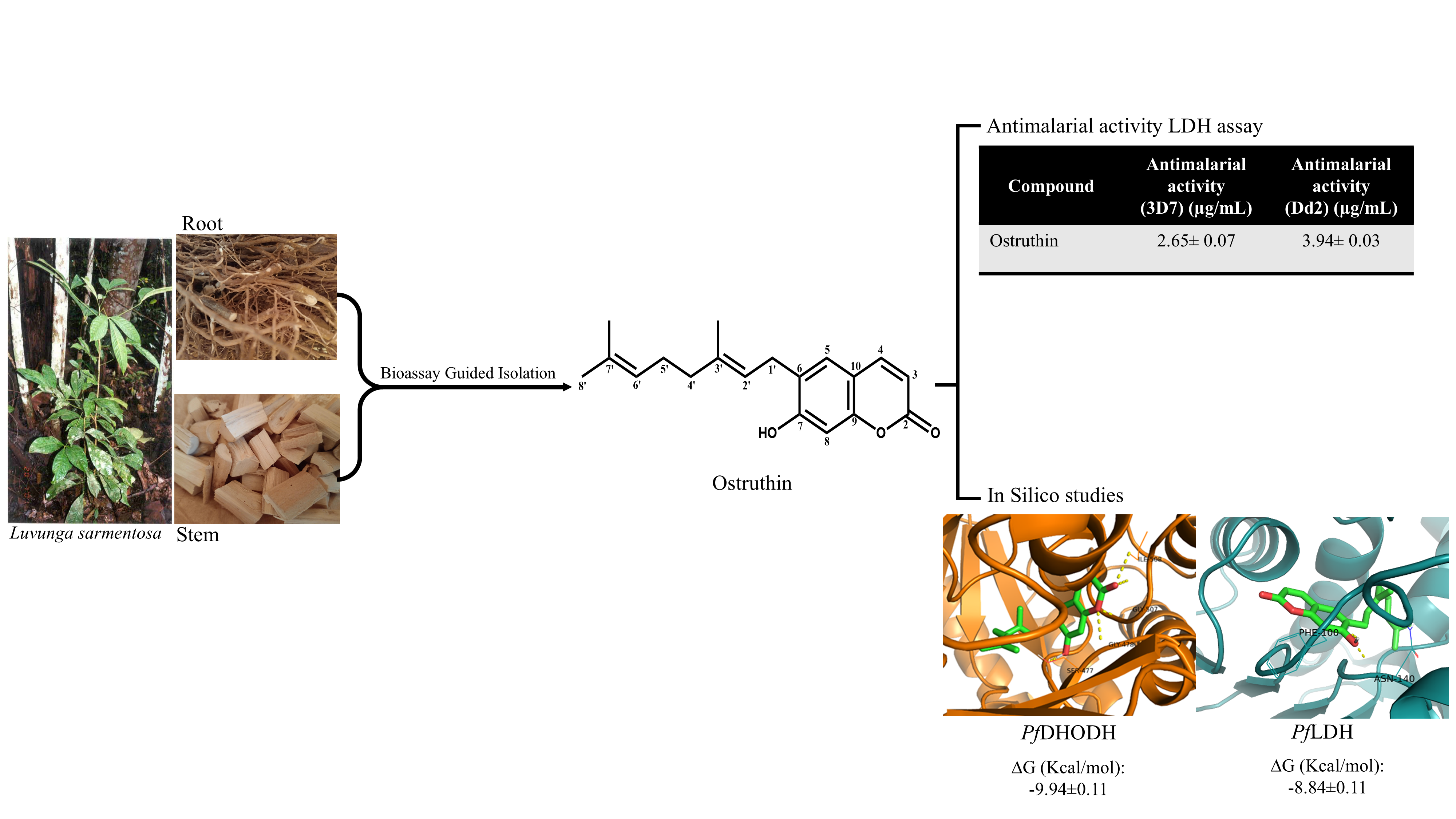
The high morbidity and mortality due to malaria infection worldwide led to the demand for new antimalarial drug development, one of which is utilizing herbal medicines as a new alternative to malaria treatment. This study aims to isolate and identify antimalarial compounds from Luvunga sarmentosa root and stem by bioassay-guided isolation approach. Luvunga sarmentosa root and stem were extracted, fractionated and purified to obtain an antimalarial compound. Compound identification was conducted based on 1H, 13C and 2D NMR. The LDH assay was used to test the antimalarial activity against Plasmodium falciparum. A molecular docking study was performed on PfDHODH (PD-ID: 1TV5) and PfLDH (PD-ID: 1LDG) using Autodock tools. The bioassay-guided isolation obtained a coumarin compound identified as ostruthin (6-geranyl-7-hydroxycoumarin) as antimalarial isolated from L. sarmentosa root and stem extract. Ostruthin exhibited antimalarial activity with an IC50 value of 2.65 ± 0.07 µg/mL against P. falciparum. The molecular docking results showed that ostruthin was predicted as a potential PfDHODH and PfLDH inhibitor based on their binding affinity which are −9.94 ± 0.11 and −8.84 ± 0.11 kcal/mol, respectively, and their interaction with receptor’s amino acids. Ostruthin isolated from the root and stem of L. sarmentosa is active as an antimalarial, and further research, such as in vivo studies and clinical trials, is needed to develop this compound as a drug.
HIGHLIGHTS
- Luvunga sarmentosa is a traditional medicine used by the Dayak tribe to treat aphrodisiacs and fever
- Isolation of active compound from Luvunga sarmentosa root and stem was conducted by bioassay-guided isolation approach
- The antimalarial studies suggest that dichloromethane extracts of Luvunga sarmentosa root and leaves have a more potent antimalarial than hexane and methanol extract
- Ostruthin (6-geranyl-7-hydroxycoumarin) was successfully isolated from the roots and stems of Luvunga sarmentosa
- Ostruthin inhibited P. falciparum in vitro and potentially inhibited PfDHODH and PfLDH based on in silico studies
GRAPHICAL ABSTRACT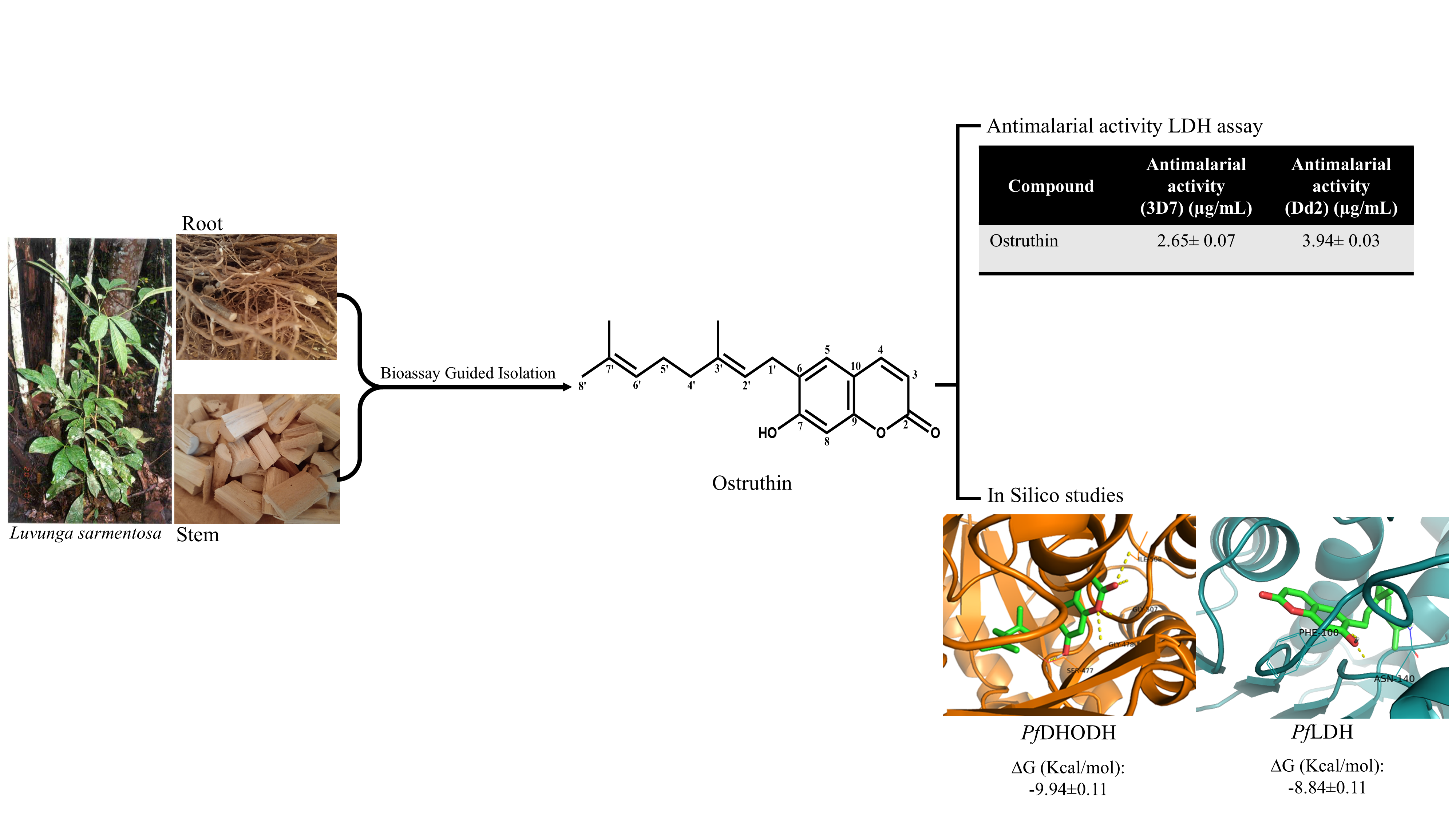
Downloads
References
World Health Organization. World malaria report 2023, Available at: https://www.who.int/teams/ global-malaria-programme/reports/world-malaria -report-2023, accessed June 2024.
Ministry of Health RI. Annual malaria report 2022. Vol. XI. Directorate General for Disease Prevention and Control, Ministry of Health RI, Jakarta, Indonesia, 2023, p. 135-139.
N Mishra, RS Bharti, P Mallick, OP Singh, B Srivastava, R Rana, S Phookan, HP Gupta, P Ringwald and N Valecha. Emerging polymorphisms in falciparum Kelch 13 gene in Northeastern region of India. Malaria Journal 2016; 15, 583.
D Tungmunnithum, A Thongboonyou, A Pholboon and A Yangsabai. Flavonoids and other phenolic compounds from medicinal plants for pharmaceutical and medical aspects: An overview. Medicines 2018; 5(3), 93.
K Karunamoorthi and E Tsehaye. Ethnomedicinal knowledge, belief and self-reported practice of local inhabitants on traditional antimalarial plants and phytotherapy. Journal of Ethnopharmacology 2012; 141(1), p. 143-150.
P Sirinut, A Petchkongkeaw, J Romsaiyud, S Prateeptongkum and P Thongyoo. Phytochemical constituents from the root of Luvunga scandens and biological activity evaluation. Natural Product Communications 2017; 12(9), 1483-1484.
W Ahmad, H Ilmi, L Tumewu, DK Sari, AF Hafid and A Widyawaruyanti. Luvunga scandens (Roxb) as the promising source of antimalarial drugs against Plasmodium falciparum 3D7. Journal of Research in Pharmacy 2024; 28(3), 891-898.
S Syarpin, S Permatasari and D Pujianto. Analysis of phytochemical constituents and antioxidant activity from the fractions of Luvunga sarmentosa root extract using LCMS/MS. Biodiversitas 2023; 24(2), 733-740.
AF Hafid, H Ilmi, U Islamiati, HK Nisa, L Tumewu, M Adianti, TS Wahyuni, S Suciati and A Widyawaruyanti. The combination of Luvunga sarmentosa (BI.) and Eurycoma longifolia Jackhydro-alcoholic extract as a source of antioxidant and analgesic agent. Journal of Research in Pharmacy 2023; 27(2), 642-651.
A Hafizi, A Rahmadi, D Diana, U Progaram and S Kehutanan. Etnobotani tanaman obat oleh masyarakat dayak meratus di Kecamatan Halong Kabupaten Balangan Provinsi Kalimantan selatan (in Indonesian). Jurnal Sylva Scienteae 2022; 5(1), 8-13.
N Wathan, R Rina, N Rahmah, H Aulia and N Pujianti. Etnobotani tumbuhan obat oleh etnis dayak meratus di desa gunung riut kabupaten balangan kalimantan selatan (in Indonesian). Pharma Xplore: Jurnal Sains dan Ilmu Farmasi 2023; 8(1), 35-48.
MA Rashid, AI Gray, PG Waterman and JA Armstrong. Novel C-geranyl 7-hydroxycoumarins from the aerial parts of Eriostemon tomentellus. Zeitschrift für Naturforschung B 1992; 47(2), 284-287.
C Lambros and JP Vanderberg. Synchronization of Plasmodium falciparum erythrocytic stages in culture. The Journal of parasitology 1979; 65(3), 418-420.
X Wang, Y Miyazaki, DK Inaoka, ED Hartuti, YI Watanabe, T Shiba, S Harada, H Saimoto, JN Burrows, FJG Benito, T Nozaki and K Kita. Identification of Plasmodium falciparum mitochondrial malate: Quinone oxidoreductase inhibitors from the pathogen box. Genes 2019; 10, 471.
LK Basco, S Mitaku, AL Skaltsounis, N Ravelomanantsoa, F Tillequin, M Koch and J Le Bras. In vitro activities of furoquinoline and acridone alkaloids against Plasmodium falciparum. 1994; 38(5), 1169-1171.
MF Dolabela. In vitro antiplasmodial activity of extract and constituents from Esenbeckia febrifuga, a plant traditionally used to treat malaria in the Brazilian Amazon. Phytomedicine 2008; 15(5), 367-372.
R Batista, AJS Júnior and AB De Oliveira. Plant-derived antimalarial agents: New leads and efficient phytomedicines. Part II. Non-alkaloidal natural products. Molecules 2009; 14(8), 3037-3072.
YT Liu, Y Ju and XM Qin. Studies on the compatibility mechanism and material basis of Danggui Buxue Decoction against anemia mice using metabonomics and network pharmacology. Journal of Pharmacy and Pharmacology 2021; 73(6), 767-777.
P Banerjee, AO Eckert, AK Schrey and R Preissner. ProTox-II: A webserver for the prediction of toxicity of chemicals. Nucleic Acids Research 2018; 46(W1), W257-W263.
K Kang, WDC Schenkeveld, G Weber and SM Kraemer. Stability of coumarins and determination of the net iron oxidation state of iron-coumarin complexes: Implications for examining plant iron acquisition mechanisms. ACS Earth and Space Chemistry 2023; 7(12), 2339-2352.
HM Becker. Carbonic anhydrase IX and acid transport in cancer. British Journal of Cancer 2022; 122(2), 157-167.
S Giovannuzzi, V De Luca, A Nocentini, C Capasso and CT Supuran. Coumarins inhibit η-class carbonic anhydrase from Plasmodium falciparum. Journal of Enzyme Inhibition and Medicinal Chemistry 2022; 37(1), 680-685.
M Jakubowski, E Szahidewicz-Krupska and A Doroszko. The human carbonic anhydrase II in platelets: An underestimated field of its activity. BioMed Research International 2018; 2018(1), 4548353.
N Irfan, P Vaithyanathan, H Anandaram, SM Zaidh, SP Varshini and A Puratchikody. Active and allosteric site binding MM-QM studies of Methylidene tetracyclo derivative in PCSK9 protein intended to make a safe antilipidemic agent. Journal of Biomolecular Structure and Dynamics 2023; 42(13), 9-14.
RK Goel, D Singh, A Lagunin and V Poroikov. PASS-assisted exploration of new therapeutic potential of natural products. Medicinal Chemistry Research 2011; 20(9), 1509-1514.
P Ravula, HB Vamaraju, M Paturi, NSC Jn and S Kolli. Design, synthesis, in silico toxicity prediction, molecular docking, and evaluation of novel pyrazole derivatives as potential antiproliferative agents. EXCLI Journal 2016; 15, 187-202.
PTV Nguyen, GLT Nguyen, OT Đinh, CQ Duong, LH Nguyen and TN Truong. In search of suitable protein targets for anti-malarial and anti-dengue drug discovery. Journal of Molecular Structure 2022; 1256, 132520.
E Hempelmann. Hemozoin biocrystallization in Plasmodium falciparum and the antimalarial activity of crystallization inhibitors. Parasitology Research 2007; 100(4), 671-676.
AP Gorka, A De Dios and PD Roepe. Quinoline drug-heme interactions and implications for antimalarial cytostatic versus cytocidal activities. Journal of Medicinal Chemistry 2013; 56(13), 5231-5246.
Downloads
Published
How to Cite
Issue
Section
License
Copyright (c) 2024 Walailak University

This work is licensed under a Creative Commons Attribution-NonCommercial-NoDerivatives 4.0 International License.





