
Antimalarial and Cytotoxic Activities of Cratoxylum sumatranum (Jack) Bl. Twigs Dichloromethane Extract and Its Phytochemical Profiling by LC-MS/MS
DOI:
https://doi.org/10.48048/tis.2025.10576Keywords:
Cratoxylum sumatranum, Antimalarial, Cytotoxic, Phytochemical profileAbstract
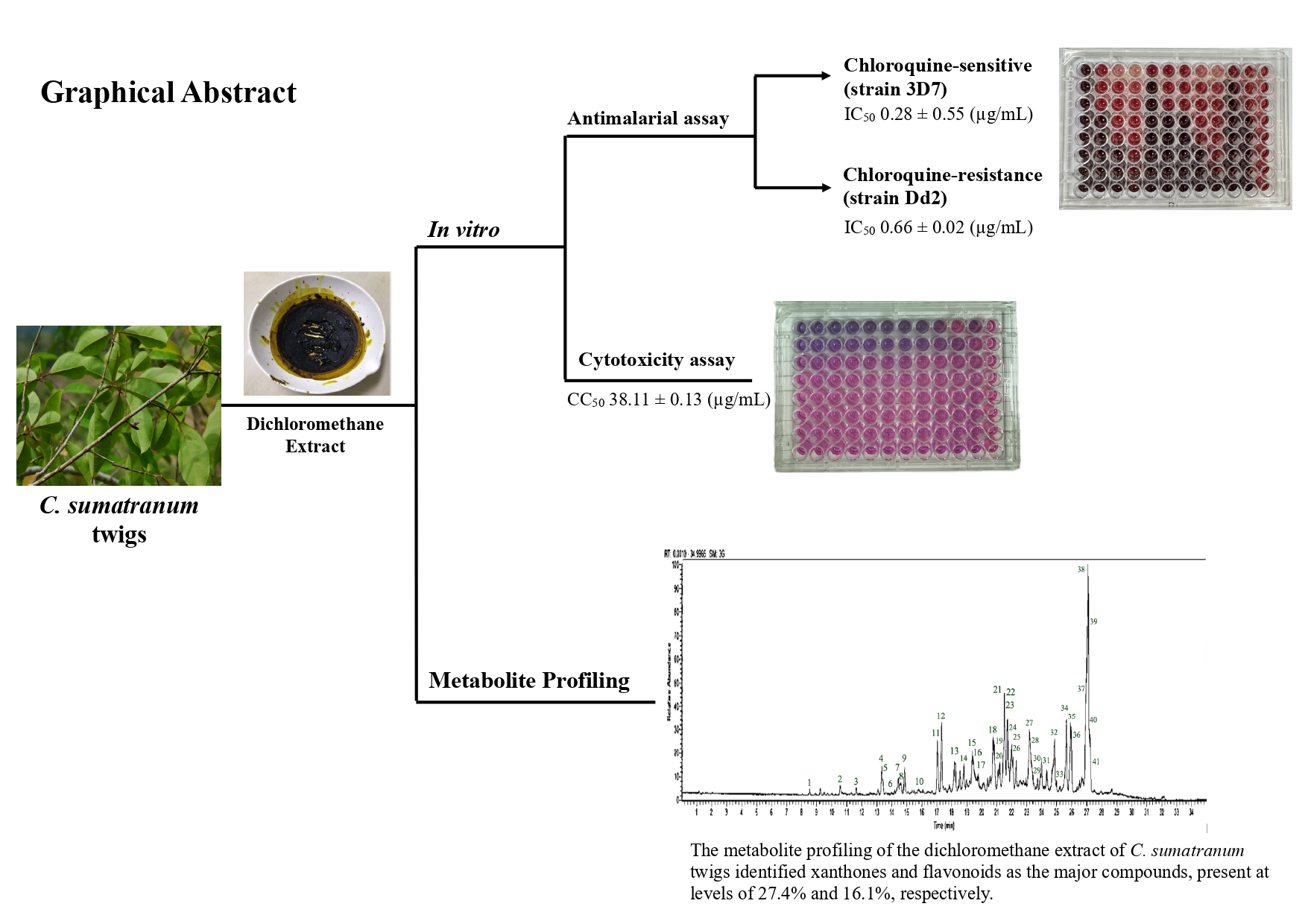
The genus Cratoxylum has been traditionally used to treat malaria. Several active antimalarial compounds were isolated from C. mangiayi, C. cochinchinense, and C. glaucum. Further exploration of another species within this genus, aparticularly C. sumatranum, is warranted based on a chemotaxonomic approach. This research aims to evaluate the in vitro inhibitory activity of C. sumatranum twig extract against Plasmodium falciparum strains 3D7 and Dd2, assess its cytotoxicity, and analyze metabolites responsible for antimalarial activity. The antimalarial activity was evaluated against P. falciparum strains 3D7 (chloroquine-sensitive) and Dd2 (chloroquine-resistant) using the lactate dehydrogenase (LDH) assay, and cytotoxicity was assessed on BHK-21 cells using the Resazurin assay. In addition, metabolite profiling of the twig extract was performed using LC-MS/MS to identify potential bioactive compounds. The results demonstrated that the dichloromethane extract exhibited high antimalarial activity against P. falciparum strains 3D7 and Dd2 with IC₅₀ values of 0.28 ± 0.55 and 0.66 ± 0.02 µg/mL, respectively, and was considered non-toxic with a CC50 value of 38.11 ± 0.13 μg/mL. The phytochemical profiling by LC-MS/MS revealed that the extract contains compounds including xanthones, flavonoids, anthraquinones, terpenoids, coumarins, chalcones, phenylpropanoids, lignans, and amino acids with potential antimalarial properties. These findings highlight C. sumatranum as a promising candidate for developing new antimalarial agents.
HIGHLIGHTS
- Cratoxylum sumatranum is a traditional medicine to treat fever, stomach ailments, dysentery, burns, and infections
- The dichloromethane extract of sumatranum exhibited high antimalarial activity against P. falciparum strains sensitif (3D7) and resistance (Dd2) and low cytotoxicity against BHK-21 cells
- Dereplication analysis using LC-MS/MS is a rapid and efficient method for identifying compounds in extract
- LC-MS/MS profiling of dichloromethane extract of sumatranum twigs revealed a rich array of metabolites, such as xanthones and flavonoids
- Several xanthones are known to exhibit antimalarial activity by interfering with hemoglobin degradation within the food vacuoles of the parasite
GRAPHICAL ABSTRACT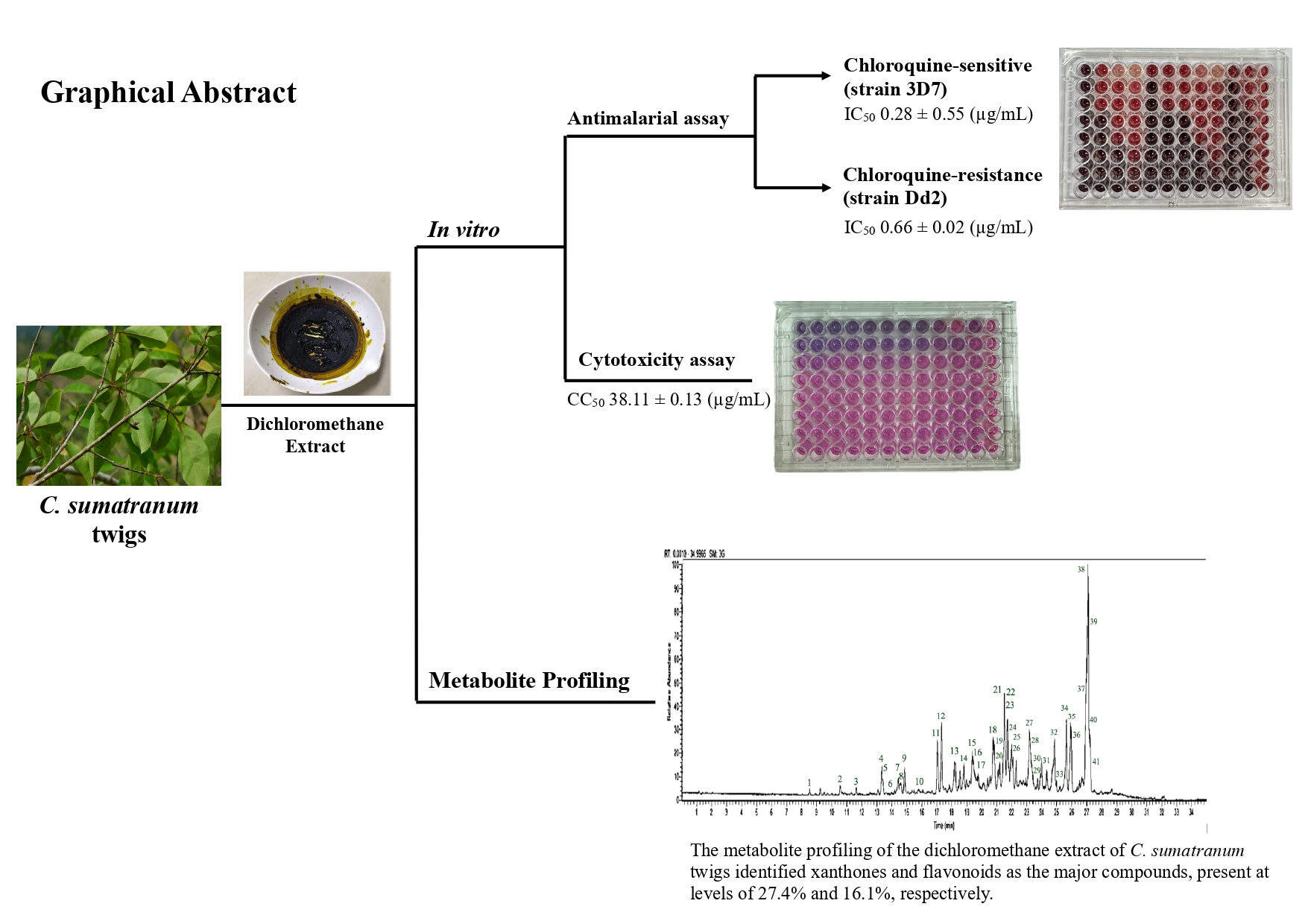
Downloads
References
World Health Organization. World malaria report 2021. World Health Organization, Geneva, Switzerland, 2021.
P Li. Annual report 2022. AIMS Energy 2023; 11(1), 135-139.
N Mishra, RS Bharti, P Mallick, OP Singh, B Srivastava, R Rana, S Phookan, HP Gupta, P Ringwald and N Valecha. Emerging polymorphisms in falciparum Kelch 13 gene in Northeastern region of India. Malaria Journal 2016; 15(1), 4-9.
CY Bok, J Low, E Kat, D Augundhooa, H Ariffin, YB Mok, KQ Lim, S Le Chew, S Salvamani, KE Loh, CF Loke, B Gunasekaran and SA Tan. Comprehensive review of Cratoxylum genus: Ethnomedical uses, phytochemistry, and pharmacological properties. Pertanika Tropical Agricultural Science 2023; 46(1), 213-241.
S Laphookhieo, W Maneerat and S Koysomboon. Antimalarial and cytotoxic phenolic compounds from Cratoxylum maingayi and Cratoxylum cochinchinense. Molecules 2009; 14(4), 1389-1395.
S Suryanto, L Tumewu, H Ilmi, AF Hafid, S Suciati and A Widyawaruyanti. Antimalarial activity of Cratoxyarborenone E, a prenylated xanthone, isolated from the leaves of Cratoxylum glaucum Korth. Pharmacia 2024; 71(1), 1-7.
MLG Dapar. Cratoxylum sumatranum (Jack) Blume Hypericaceae. In: FM Franco (Ed.). Ethnobotany of the mountain regions of Southeast Asia. Springer, Cham, Switzerlands, 2021, p. 333-337.
A Arnida, ER Sahi and S Sutomo. Aktivitas antiplasmodium in vitro dan identifikasi golongan senyawa dari ekstrak etanol batang manuran (Coptosapelta tomentosa Valeton ex K.Heyne) asal kalimantan Selatan (in Indonesian). Jurnal Ilmiah Ibnu Sina 2017; 2(2), 270-278.
C Tantapakul, W Maneerat, T Sripisut, T Ritthiwigrom, RJ Andersen, P Cheng, S Cheenpracha, A Raksat and S Laphookhieo. New benzophenones and xanthones from Cratoxylum sumatranum ssp. neriifolium and their antibacterial and antioxidant activities. Journal of Agricultural and Food Chemistry 2916; 64(46), 8755-8762.
F Wicaksana, FY Wardana, H Ilmi, L Tumewu, T Widiandani, AF Hafid and A Widyawaruyanti. Antimalarial activity of caged xanthone isolated compounds from Cratoxylum sumatranum stem bark: In vitro and in silico approaches. Journal of Advanced Pharmaceutical Technology & Research 2024; 15(4), 352-358.
L Tumewu, FY Wardana, H Ilmi, AA Permanasari, AF Hafid and A Widyawaruyanti. Cratoxylum sumatranum stem bark exhibited antimalarial activity by Lactate Dehydrogenase (LDH) assay. Journal of Basic and Clinical Physiology and Pharmacology 2021; 32(4), 817-822.
MF Dolabela, SG Oliveira, JM Nascimento, JM Peres, H Wagner, MM Póvoa and AB de Oliveira. In vitro antiplasmodial activity of extract and constituents from Esenbeckia febrifuga, a plant traditionally used to treat malaria in the Brazilian Amazon. Phytomedicine 2008; 15(5), 367-372.
HA Abd Karim, NE Rasol, NH Ismail, C Wiart and CP Osman. Metabolites annotation of dichloromethane extract of Kibatalia maingayi woods using orbitrap high-resolution mass spectrometry. Malaysian Journal of Chemistry 2022; 24(4), 161-172.
S Laphookhieo, JK Syers, R Kiattansakul and K Chantrapromma. Cytotoxic and antimalarial xanthones. Chemical and Pharmaceutical Bulletin 2006; 54, 745-747.
DK Sari, G Jeelani, H Ilmi, L Tumewu, R Wahyuni, A Widyawaruyanti, T Nozaki and AF Hafid. Therapeutic potential of Indonesian plant extracts in combating malaria and protozoan neglected tropical disease. BMC Complementary Medicine and Therapies 2024; 24(1), 416.
P García-Huertas, A Pabón, C Arias and S Blair. Evaluation of cytotoxic effect and genetic damage of standardized extracts of Solanum nudum with antiplasmodial activity. Biomédica 2013; 33(1), 78-87.
G Indrayanto, GS Putra and F Suhud. Validation of in-vitro bioassay methods: Application in herbal drug research. Profiles of Drug Substances Excipients and Related Methodology 2021; 46, 273-307.
B Kwansa-Bentum, K Agyeman, J Larbi-Akor, C Anyigba and R Appiah-Opong. In vitro assessment of antiplasmodial activity and cytotoxicity of Polyalthia longifolia leaf extracts on Plasmodium falciparum strain NF54. Malaria Research and Treatment 2019; 2019(1), 6976298.
M Zakiah, RA Syarif, M Mustofa, J Jumina, N Fatmasari and EN Sholikhah. In vitro antiplasmodial, heme polymerization, and cytotoxicity of hydroxyxanthone derivatives. Journal of Tropical Medicine 2021; 2021(1), 8866681.
Y Melaku, M Solomon, R Eswaramoorthy, U Beifuss, V Ondrus and Y Mekonnen. Synthesis, antiplasmodial activity and in silico molecular docking study of pinocembrin and its analogs. BMC Chemistry 2022; 16(1), 36.
GAG de Souza, NC da Silva, J de Souza, KRM de Oliveira, AL da Fonseca, LC Baratto, ECP de Oliveira, F de Pilla Varotti and WP Moraes. In vitro and in vivo antimalarial potential of oleoresin obtained from Copaifera reticulata Ducke (Fabaceae) in the Brazilian Amazon rainforest. Phytomedicine 2017; 24, 111-118.
A Widyawaruyanti and NC Zaini. Mekanisme dan aktivitas antimalaria dari senyawa flavonoid yang diisolasi dari cempedak (Artocarpus Champeden) (in Indonesian). Jurnal Bina Praja 2011; 13(2), 67-77.
AR Bilia, P Melillo de Malgalhaes, MC Bergonzi and FF Vincieri. Simultaneous analysis of artemisinin and flavonoids of several extracts of Artemisia annua L. obtained from a commercial sample and a selected cultivar. Phytomedicine 2006; 13(7), 487-493.
JB Lekana-Douki, JB Bongui, SLO Liabagui, SEZ Edou, R Zatra, U Bisvigou and P Druilhe. In vitro antiplasmodial activity and cytotoxicity of 9 plants traditionally used in Gabon. Journal of Ethnopharmacology 2011; 133(3), 1103-1108.
CW Wright. Traditional antimalarials and the development of novel antimalarial drugs. Journal of Ethnopharmacology 2005; 100(1-2), 67-71.
K Kaur, M Jain, T Kaur and R Jain. Antimalarials from nature. Bioorganic & Medicinal Chemistry 2009; 17(9), 3229-3256.
B Gilbert and L Alves. Synergy in plant medicines. Current Medicinal Chemistry 2005; 10(1), 13-20.
R Verpoorte, YH Choi and HK Kim. Ethnopharmacology and systems biology: A perfect holistic match. Journal of Ethnopharmacology 2005; 100(1-2), 53-56.
AL Harvey. Natural products in drug discovery. Drug Discovery Today 2008; 13(19-20), 894-901.
Published
How to Cite
Issue
Section
License
Copyright (c) 2025 Walailak University

This work is licensed under a Creative Commons Attribution-NonCommercial-NoDerivatives 4.0 International License.





