
Changing in Spatial and Temporal Accumulation of Microplastics in the Water Column at Urban Ko Yo Community in Songkhla Lagoon, Thailand
DOI:
https://doi.org/10.48048/tis.2025.8953Keywords:
Anthropogenic, Coastal pollution, FTIR analysis, Global Issues, Microplastics, Water quality, Urban communityAbstract
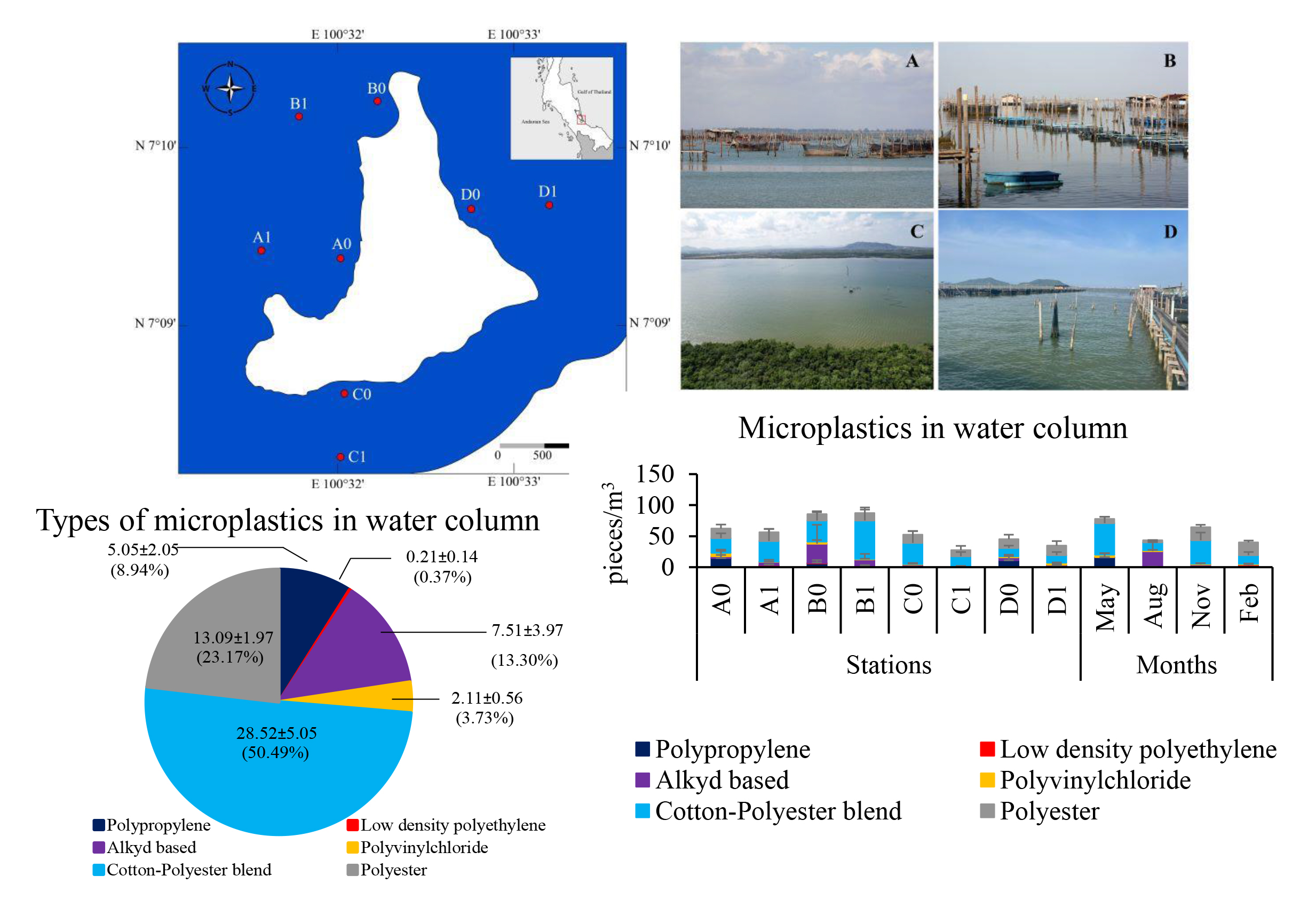
Ko Yo, situated at the mouth of Songkhla Lagoon, is an urban ecosystem renowned as one of the active areas of Songkhla Province. Numerous anthropogenic activities occur in this area, including homestay tourism, aquaculture, fishing, and the operation of restaurants, all of which generate significant environmental waste. Microplastics represent a widespread pollutant and have been widely recognized as a critical environmental concern. However, they have received little attention among the general public. Therefore, this study investigated the type and quantity of microplastic accumulation in the water bodies surrounding Ko Yo, Songkhla Province. Water sampling stations were established along the coastline and 1 km into the subtidal area, and sampling was conducted for a year. Microplastics in the water samples were recorded and categorized using a modified size and color sorting protocol. Samples were analyzed via Fourier-transform infrared spectroscopy to identify microplastic polymers. The results revealed the accumulation of 6 types of microplastics around Ko Yo: Cotton polyester blend, polyester, alkyd, polypropylene, polyvinylchloride, and low-density polyethylene. These polymers most frequently occurred during the summer and the northeastern monsoon season. Cotton polyester blend, a synthetic fiber commonly used in clothing, furniture, ropes, nets, and cages, was found in the highest quantities across all months and stations. This update on microplastic contamination in natural environments near household areas could lead the idea of the microplastic status around Ko Yo and provide vital insights into the environmental and health implications of microplastics.
HIGHLIGHTS
Ko Yo is an urban ecosystem and high anthropogenic activities of Songkhla Province. This research concerned on the microplastic pollution along Ko Yo. Water sampling stations were established along the coastline and 1 km into the subtidal area, and sampling was conducted for a year. Six types of microplastics found in water around Ko Yo: Cotton polyester blend, polyester, alkyd, polypropylene, polyvinylchloride, and low-density polyethylene. These polymers most frequently occurred during the summer and the northeastern monsoon season. Cotton polyester blend, a synthetic fiber commonly used in clothing, furniture, ropes, nets, and cages, was found in the highest quantities across all months and stations.
GRAPHICAL ABSTRACT
Downloads
References
Plastic Europe - the Facts 2020: An analysis of European plastic production, Demand and Waste Data, Available at: http://www.plasticseurope.org, accessed May 2021.
M Eriksen, LCM Lebreton, HS Carson, M Thiel, CJ Moore, JC Borerro, F Galgani, PG Ryan and J Reisser. Plastic pollution in the world’s oceans: More than 5 trillion plastic pieces weighing over 250,000 tons afloat at sea. PLoS One 2014; 9(12), e111913.
RC Thompson, Y Olsen, RP Mitchell, A Davis, SJ Rowland, AWG John, D McGonigle and AE Russell. Lost at sea: Where is all the plastic? Science 2004; 304(5672), 838.
DKA Barnes, F Galgani, RC Thompson and M Barlaz. Accumulation and fragmentation of plastic debris in global environments. Philosophical Transactions of the Royal Society B: Biological Sciences 2009; 364(1526), 1985-1998.
A Van, CM Rochman, EM Flores, KL Hill, E Vargas, SA Vargas and E Hoh. Persistent organic pollutants in plastic marine debris found on beaches in San Diego, California. Chemosphere 2012; 86(3), 258-263.
CCV Colen, B Vanhove, A Diem and T Moens. Does microplastic ingestion by zooplankton affect predator-prey interactions? An experimental study on larviphagy. Environmental Pollution 2020; 256, 113479.
M Cole, P Lindeque, E Fileman, C Halsband, R Goodhead, J Moger and TS Galloway. Microplastic ingestion by zooplankton. Environmental Science & Technology 2013; 47(12), 6646-6655.
L Gallitelli, C Battisti, L Pietrelli and M Scalici. Anthropogenic particles in coypu (Myocastor coypus; Mammalia, Rodentia)’ faeces: First evidence and considerations about their use as track for detecting microplastic pollution. Environmental Science and Pollution Research International 2022; 29(36), 55293-55301.
P Jitkaew, S Pradit, P Noppradit, K Sengloyluan, M Yucharoen, S Suwanno, V Tanrattanakul, K Sornplang, T Nitiratsuwan and M Geindre. Accumulation of microplastics in stomach, intestine, and tissue of two shrimp species (Metapenaeus moyebi and Macrobrachium rosenbergii) at the Khlong U-Taphao, southern Thailand. International Journal of Agricultural Technology 2023; 19(1), 83-89.
P Jitkaew, S Pradit, P Noppradit, K Sengloyluan, M Yucharoen, S Suwanno, V Tanrattanakul, K Sornplang and T Nitiratsuwan. Occurrence of microplastics in freshwater gastropods from a tropical river U-Taphao, southern Thailand. PeerJ 2023; 11, e14861.
K Tee-Hor, T Nitiratsuwan and S Pradit. Identification of anthropogenic debris in the stomach and intestines of giant freshwater prawns from the Trang River in southern Thailand. PeerJ 2023; 11, e16082.
KK Soe, S Maae, Z Jaafar, P Chuaduangpui, S Jantarat and S Hajisamae. Plastic ingestion by three species of Scylla (Brachyura) from the coastal areas of Thailand. Marine Pollution Bulletin 2024; 198, 115914.
MN Issac and B Kandasubramanian. Effect of microplastics in water and aquatic systems. Environmental Science and Pollution Research International 2021; 28(16), 19544-19562.
AI Osman, M Hosny, AS Eltaweil, S Omar, AM Elgarahy, M Farghali, PS Yap, YS Wu, S Nagandran, K Batumalaie, SCB Gopinath, OD John, M Sekar, T Saikia, P Karunanithi, MHM Hatta and KA Akinyede. Microplastic sources, formation, toxicity and remediation: A review. Environmental Chemistry Letters 2023; 21, 2129-2169.
S Pradit, P Noppradit, P Jitkaew, K Sengloyluan, M Yucharoen, P Suwanno, V Tanrattanakul, K Sornplang and T Nitiratsuwan. Microplastic accumulation in catfish and its effects on fish eggs from Songkhla Lagoon, Thailand. Journal of Marine Science and Engineering 2023; 11(4), 723.
CB Crawford and B Quinn. Plastic production, waste and legislation. In: CB Crawford and B Quinn (Eds.). Microplastic pollutants. Elsevier Science, Amsterdam, Netherlands, 2017, p. 39-56.
WL Kovach. MVSP - A MultiVariate statistical package, MVSP version 3.22, Kovach Computing Services, Pentraeth, Wales, Available at: http://www.kovcomp.co.uk/downl2.html, accessed May 2024.
DV Rosato, DV Rosato and MV Rosato. Plastic product material and process selection handbook. Elsevier, Amsterdam, Netherlands, 2004.
MA Browne, P Crump, SJ Niven, E Teuten, A Tonkin, T Galloway and R Thompson. Accumulations of microplastic on shorelines worldwide: Sources and sinks. Environmental Science & Technology 2011; 45(21), 9175-9179.
D Eerkes-Medrano, RC Thompson and DC Aldridge. Microplastics in freshwater systems: A review of the emerging threats, identification of knowledge gaps and prioritisation of research needs. Water Research 2015; 75, 63-82.
F Cardia and A Lovatelli. Aquaculture operations in floating HDPE cages: A field handbook. Food and Agriculture Organization of the United Nations, Rome, Italy, 2015.
MA Browne, T Galloway and R Thompson. Microplastic - an emerging contaminant of potential concern? Integrated Environmental Assessment and Management 2007; 3(4), 559-561.
LM Rios, C Moore and PR Jones. Persistent organic pollutants carried by synthetic polymers in the ocean environment. Marine Pollution Bulletin 2007; 54(8), 1230-1237.
CJ Moore. Synthetic polymers in the marine environment: A rapidly increasing, long-term threat. Environmental Research 2008; 108(2), 131-139.
AL Andrady. Microplastics in the marine environment. Marine Pollution Bulletin 2011; 62(8), 1596-1605.
M Claessens, LV Cauwenberghe, MB Vandegehuchte and CR Janssen. New techniques for the detection of microplastics in sediments and field collected organisms. Marine Pollution Bulletin 2013; 70(1-2), 227-233.
DA Cooper and PL Corcoran. Effects of mechanical and chemical processes on the degradation of plastic beach debris on the island of Kauai, Hawaii. Marine Pollution Bulletin 2020; 60(5), 650-654.
SD Hick. Understanding tides. National Oceanic and Atmospheric Administration National Ocean Service, Silver Spring, Maryland, 2006.
D Habib, DC Locke and LJ Cannone. Synthetic fibers as indicators of municipal sewage sludge, sludge products, and sewage treatment plant effluents. Water, Air & Soil Pollution 1998; 103, 1-8.
C Zarfl, D Fleet, E Fries, F Galgani, G Gerdts, G Hanke and M Matthies. Microplastics in oceans. Marine Pollution Bulletin 2011; 62(8), 1589-1591.
PK Cheung, PL Hung and L Fok. River microplastic contamination and dynamics upon a rainfall event in Hong Kong, China. Environmental Processes 2019; 6, 253-264.
V Hidalgo-Ruz, L Gutow, RC Thompson and M Thiel. Microplastics in the marine environment: A review of the methods used for identification and quantification. Environmental Science & Technology 2012; 46(6), 3060-3075.
B Henry, K Laitala and IG Klepp. Microfibres from apparel and home textiles: Prospects for including microplastics in environmental sustainability assessment. The Science of the Total Environment 2019; 652, 483-494.
M Kooi, J Reisser, B Slat, FF Ferrari, MS Schmid, S Cunsolo, R Brambini, K Noble, LA Sirks, TEW Linders, RI Schoeneich-Argent and AA Koelmans. The effect of particle properties on the depth profile of buoyant plastics in the ocean. Scientific Reports 2016; 6, 33882.
LC Woodall, A Sanchez-Vidal, M Canals, GLJ Paterson, R Coppock, V Sleight, A Calafat, AD Rogers, BE Narayanaswamy and RC Thompson. The deep sea is a major sink for microplastic debris. Royal Society Open Science 2014; 1(4), 140317.
P Li, X Wang, M Su, X Zou, L Duan and H Zhang. Characteristics of plastic pollution in the environment: A review. Bulletin of Environmental Contamination Toxicology 2021; 107(4), 577-584.
Downloads
Published
How to Cite
Issue
Section
License
Copyright (c) 2024 Walailak University

This work is licensed under a Creative Commons Attribution-NonCommercial-NoDerivatives 4.0 International License.





